Presented by :
Elaf Ibrahim
Afrah hamroon
Norah Abdurrahman
Badria saad
Reem eid
Supervised by :
Dr.abdullah alatawi

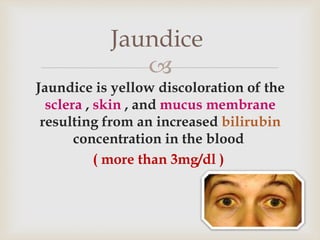
Jaundice is yellow discoloration of the
sclera , skin , and mucus membrane
resulting from an increased bilirubin
concentration in the blood
( more than 3mg/dl )
Jaundice


`

Causes of jaundice
Category
Pre-hepatic:
Hepatic:
Post-Hepatic:
Definition
increased bilirubin load for the liver cell
( haemolytic jaundice )
defects in conjugation
( hepatocellular, neonatal jaundice)
Disturbance of excretion.
( Obstructive jaundice )

Types of jaundice
Hemolytic jaundice
Hepatocellular jaundice
Obstructive jaundice
Neonatal jaundice

The increased breakdown of red cells
leads to an increase in production of
bilirubin.
Etiology
Haemolytic
jaundice
IntraerythrocyteExtraerythricyte
Hemolytic anemia
1- spherocytosis
2- G6PD- deficiency
3- Thalasemia
4- Vit-B12 & Folate
deficiency
Malaria
Autoimmune
Physical trauma ( burn ,
prosthetic heart valve )
Drugs : ( dapsone )
Clinical Feature :
Mild Jaundice * why ????
Pallor * Why ??
Splenomegaly
LFT :
increased plasma unconjugated bilirubin ( less than 6mg/dl )
Liver enzyme & Albumen are normal
Urine :
no bilirubinurea * why ??
Increase urinary urobilinogen
Serum :
Low RBCs _ High Reticulocyte _ Low Haptoglobulin
Haemolytic
jaundice

Liver cell damage leads to an increase in production of
bilirubin
Etiology :
Hepatitis ( Viral _ Autoimmune _ Alcoholic )
Cirrhosis due to any cause
Recurrent idiopathic cholestasis
Pregnancy
Drugs : contraceptive _ anabolic steroids
Leptospirosis
Physiological Neonatal jaundice
Hepatocellular
jaundice

Liver cell damage can cause increased levels of
unconjugated bilirubin in blood due to decreased
conjugation.
The bilirubin that is conjugated is not efficiently
secreted into the bile, but instead diffuses (“leaks”)
into the blood.
So , in hepatocellular jaundice all conjugated &
unconjugated bilirubin will be increased
Hepatocellular
jaundice
Clinical feature :
Jaundice
Fever * why ?
Hepatomegaly
Splenomegaly
Dark urine & normal stool
LFT :
High ALT & AST
Serum :
Conjugated & unconjugated hyperbilrubinemia
Viral markers
prolonged PT * Chronic liver disease *
Decrease Albumin* Chronic liver disease *
Urine :
bilirubinurea
Hepatocellular
jaundice

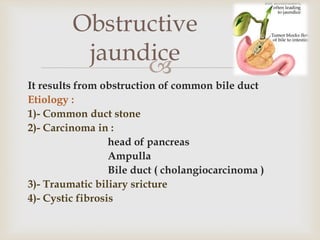
It results from obstruction of common bile duct
Etiology :
1)- Common duct stone
2)- Carcinoma in :
head of pancreas
Ampulla
Bile duct ( cholangiocarcinoma )
3)- Traumatic biliary sricture
4)- Cystic fibrosis
Obstructive
jaundice

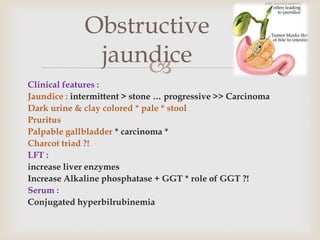
Clinical features :
Jaundice : intermittent > stone … progressive >> Carcinoma
Dark urine & clay colored * pale * stool
Pruritus
Palpable gallbladder * carcinoma *
Charcot triad ?!
LFT :
increase liver enzymes

Increase Alkaline phosphatase + GGT * role of GGT ?!
Serum :
Conjugated hyperbilrubinemia
Obstructive
jaundice

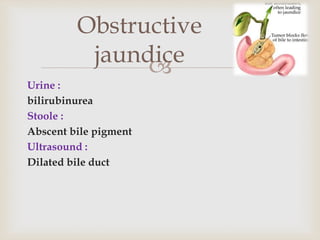
Urine :
bilirubinurea
Stoole :
Abscent bile pigment
Ultrasound :
Dilated bile duct
Obstructive
jaundice

Late Features :
In prologed obstructive jaundice secondary
malabsorbtion develop due to deficiency of bile salt
Presenting with :
Weight loss
Vit K deficiency ( Bleeding )
Vit D deficiency ( bone pain )
Steatorrhoea
Obstructive
jaundice





ConjugatedUnconjugated
Dubin-Johnson syndromeGilberts syndrome
Due to Partial deficiency of
glucorunyle transeferase
Rotor syndromeCrigel-najjar syndrome
Type1 : Abscent glucorunyle
transeferase
Type2 : Partial deficiency of
glucorunyle transeferase
Congenital
hyperbilrubinemia
■ Country of origin. The incidence of hepatitis B virus
(HBV) infection is increased in many parts of the world.
■ Duration of illness. A history of jaundice with prolonged
weight loss in an older patient suggests malignancy. A
short history, particularly with a prodromal illness of
malaise, suggests a hepatitis.
■ Recent outbreak of jaundice. An outbreak in the
community suggests hepatitis A virus (HAV).
■ Recent consumption of shellfish. This suggests HAV
infection.
■ Intravenous drug use, or recent injections or tattoos.
These all increase the chance of HBV and hepatitis C
virus (HCV) infection.
Differential diagnosis of
jaundice

■ Blood transfusion or infusion of pooled blood
products Increased risk of HBV and HCV.
■ Alcohol consumption. A history of drinking habits
should be taken
■ Drugs taken
Differential diagnosis of
jaundice

Hepatomegaly.
A smooth tender liver is seen in hepatitis,
but a Knobbly irregular liver suggests metastases.
Shrinking Liver suggests chronic liver disease
Splenomegaly.
This indicates portal hypertension in patients when
signs of chronic liver disease are present
( clubbing _ palmar erythema _ spider nevi _ascites _
Gynecomastia _ pitting edema )
Differential diagnosis of
jaundice


-History
-Physical exam
-Labs (LFTs)–ALT, AST,
bilirubin, ALK-P,
albumin, PT
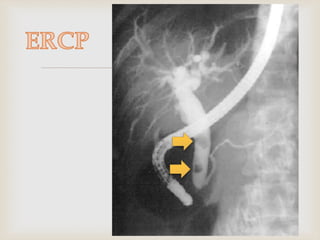
-imaging: US, ERCP, CT
Evaluation of jaundice



Newborn infants, particularly
if premature, often accumulate bilirubin,
because the activity of hepatic bilirubin glucuronyl-
transferase is low at birth (it reaches adult levels in
about 4 weeks).
Elevated bilirubin, in excess of the binding capacity
of albumin, can diffuse into the basal ganglia and
cause toxic encephalopathy (kernicterus).
Neonatal jaundice


Treatment:
Newborns with significantly elevated bilirubin levels are
treated with blue fluorescent light.
This light converts bilirubin
to more polar and, so,
water - soluble isomers.
These photoisomers can be
excreted into the bile without
conjugation with glucuronic acid
Neonatal jaundice

An 80-year-old African American female with a past medical history
(PMH) of osteoarthritis (OA) is admitted to the hospital with a chief
complaint (CC) of jaundice for 2 months. The patient did not notice
the jaundice or felt any differently but her physician was worried
and she was admitted to a different hospital 2 months ago. The liver
ultrasound (U/S) showed gallstones and she had a laparoscopic
cholecystectomy 2 months ago. After surgery, the jaundice
decreased slightly but then returned.
The reason for her admission to the hospital is the persistent
jaundice. She has no other complaints but itching for 2-3 days.
No abdominal pain, no nausea, vomiting, diarrhea or constipation
(N/V/D/C). She also noticed that her urine has been tea-colored for
the last month. She lost 30 lbs for 1 year despite her good appetite.
Past medical history (PMH):
Osteoarthritis (OA), esophagogastroduodenoscopy (EGD) and
colonoscopy 4 months ago were both reported as normal.
Past surgical history (PSH):
Cholecystectomy 2 months ago, appendectomy and explorative
laparotomy for intestinal obstruction years ago.
Medications:
Celebrex (celecoxib), Arthrotec (diclofenac and misoprostol),
aspirin (ASA).
Family medical history (FMH):
Hypertension (HTN).
Social history (SH):
She quit drinking and smoking 40 years ago.
Physical examination:
Vital signs:
TMP: 36.5
P:86
RR:16
BP:155/66 mmHg.
Normal body weight.
visible skin and scleral icterus.
No stigmata of chronic liver disease.
Abdomen: Soft, not distended, 4 "keyhole" scars from the
laparoscopic cholecystectomy, old laparotomy scar.
The CT of the abdomen showed
nondilated bile ducts and nothing
more in terms of helping us to sort
out the reason for the jaundice.


‫ Jaundice

  • 1.
    Presented by : ElafIbrahim Afrah hamroon Norah Abdurrahman Badria saad Reem eid Supervised by : Dr.abdullah alatawi
  • 2.
     Jaundice is yellowdiscoloration of the sclera , skin , and mucus membrane resulting from an increased bilirubin concentration in the blood ( more than 3mg/dl ) Jaundice
  • 3.
  • 4.
  • 5.
     Causes of jaundice Category Pre-hepatic: Hepatic: Post-Hepatic: Definition increasedbilirubin load for the liver cell ( haemolytic jaundice ) defects in conjugation ( hepatocellular, neonatal jaundice) Disturbance of excretion. ( Obstructive jaundice )
  • 6.
     Types of jaundice Hemolyticjaundice Hepatocellular jaundice Obstructive jaundice Neonatal jaundice
  • 7.
     The increased breakdownof red cells leads to an increase in production of bilirubin. Etiology Haemolytic jaundice IntraerythrocyteExtraerythricyte Hemolytic anemia 1- spherocytosis 2- G6PD- deficiency 3- Thalasemia 4- Vit-B12 & Folate deficiency Malaria Autoimmune Physical trauma ( burn , prosthetic heart valve ) Drugs : ( dapsone )
  • 8.
    Clinical Feature : MildJaundice * why ???? Pallor * Why ?? Splenomegaly LFT : increased plasma unconjugated bilirubin ( less than 6mg/dl ) Liver enzyme & Albumen are normal Urine : no bilirubinurea * why ?? Increase urinary urobilinogen Serum : Low RBCs _ High Reticulocyte _ Low Haptoglobulin Haemolytic jaundice
  • 9.
     Liver cell damageleads to an increase in production of bilirubin Etiology : Hepatitis ( Viral _ Autoimmune _ Alcoholic ) Cirrhosis due to any cause Recurrent idiopathic cholestasis Pregnancy Drugs : contraceptive _ anabolic steroids Leptospirosis Physiological Neonatal jaundice Hepatocellular jaundice
  • 10.
     Liver cell damagecan cause increased levels of unconjugated bilirubin in blood due to decreased conjugation. The bilirubin that is conjugated is not efficiently secreted into the bile, but instead diffuses (“leaks”) into the blood. So , in hepatocellular jaundice all conjugated & unconjugated bilirubin will be increased Hepatocellular jaundice
  • 11.
    Clinical feature : Jaundice Fever* why ? Hepatomegaly Splenomegaly Dark urine & normal stool LFT : High ALT & AST Serum : Conjugated & unconjugated hyperbilrubinemia Viral markers prolonged PT * Chronic liver disease * Decrease Albumin* Chronic liver disease * Urine : bilirubinurea Hepatocellular jaundice
  • 12.
     It results fromobstruction of common bile duct Etiology : 1)- Common duct stone 2)- Carcinoma in : head of pancreas Ampulla Bile duct ( cholangiocarcinoma ) 3)- Traumatic biliary sricture 4)- Cystic fibrosis Obstructive jaundice
  • 13.
     Clinical features : Jaundice: intermittent > stone … progressive >> Carcinoma Dark urine & clay colored * pale * stool Pruritus Palpable gallbladder * carcinoma * Charcot triad ?! LFT : increase liver enzymes Increase Alkaline phosphatase + GGT * role of GGT ?! Serum : Conjugated hyperbilrubinemia Obstructive jaundice
  • 14.
     Urine : bilirubinurea Stoole : Abscentbile pigment Ultrasound : Dilated bile duct Obstructive jaundice
  • 15.
     Late Features : Inprologed obstructive jaundice secondary malabsorbtion develop due to deficiency of bile salt Presenting with : Weight loss Vit K deficiency ( Bleeding ) Vit D deficiency ( bone pain ) Steatorrhoea Obstructive jaundice
  • 16.
  • 17.
  • 18.
  • 19.
  • 20.
     ConjugatedUnconjugated Dubin-Johnson syndromeGilberts syndrome Dueto Partial deficiency of glucorunyle transeferase Rotor syndromeCrigel-najjar syndrome Type1 : Abscent glucorunyle transeferase Type2 : Partial deficiency of glucorunyle transeferase Congenital hyperbilrubinemia
  • 21.
    ■ Country oforigin. The incidence of hepatitis B virus (HBV) infection is increased in many parts of the world. ■ Duration of illness. A history of jaundice with prolonged weight loss in an older patient suggests malignancy. A short history, particularly with a prodromal illness of malaise, suggests a hepatitis. ■ Recent outbreak of jaundice. An outbreak in the community suggests hepatitis A virus (HAV). ■ Recent consumption of shellfish. This suggests HAV infection. ■ Intravenous drug use, or recent injections or tattoos. These all increase the chance of HBV and hepatitis C virus (HCV) infection. Differential diagnosis of jaundice
  • 22.
     ■ Blood transfusionor infusion of pooled blood products Increased risk of HBV and HCV. ■ Alcohol consumption. A history of drinking habits should be taken ■ Drugs taken Differential diagnosis of jaundice
  • 23.
     Hepatomegaly. A smooth tenderliver is seen in hepatitis, but a Knobbly irregular liver suggests metastases. Shrinking Liver suggests chronic liver disease Splenomegaly. This indicates portal hypertension in patients when signs of chronic liver disease are present ( clubbing _ palmar erythema _ spider nevi _ascites _ Gynecomastia _ pitting edema ) Differential diagnosis of jaundice
  • 24.
  • 25.
     -History -Physical exam -Labs (LFTs)–ALT,AST, bilirubin, ALK-P, albumin, PT -imaging: US, ERCP, CT Evaluation of jaundice
  • 26.
  • 27.
  • 28.
     Newborn infants, particularly ifpremature, often accumulate bilirubin, because the activity of hepatic bilirubin glucuronyl- transferase is low at birth (it reaches adult levels in about 4 weeks). Elevated bilirubin, in excess of the binding capacity of albumin, can diffuse into the basal ganglia and cause toxic encephalopathy (kernicterus). Neonatal jaundice
  • 29.
  • 30.
     Treatment: Newborns with significantlyelevated bilirubin levels are treated with blue fluorescent light. This light converts bilirubin to more polar and, so, water - soluble isomers. These photoisomers can be excreted into the bile without conjugation with glucuronic acid Neonatal jaundice
  • 31.
  • 32.
    An 80-year-old AfricanAmerican female with a past medical history (PMH) of osteoarthritis (OA) is admitted to the hospital with a chief complaint (CC) of jaundice for 2 months. The patient did not notice the jaundice or felt any differently but her physician was worried and she was admitted to a different hospital 2 months ago. The liver ultrasound (U/S) showed gallstones and she had a laparoscopic cholecystectomy 2 months ago. After surgery, the jaundice decreased slightly but then returned. The reason for her admission to the hospital is the persistent jaundice. She has no other complaints but itching for 2-3 days. No abdominal pain, no nausea, vomiting, diarrhea or constipation (N/V/D/C). She also noticed that her urine has been tea-colored for the last month. She lost 30 lbs for 1 year despite her good appetite.
  • 33.
    Past medical history(PMH): Osteoarthritis (OA), esophagogastroduodenoscopy (EGD) and colonoscopy 4 months ago were both reported as normal. Past surgical history (PSH): Cholecystectomy 2 months ago, appendectomy and explorative laparotomy for intestinal obstruction years ago. Medications: Celebrex (celecoxib), Arthrotec (diclofenac and misoprostol), aspirin (ASA). Family medical history (FMH): Hypertension (HTN). Social history (SH): She quit drinking and smoking 40 years ago.
  • 34.
    Physical examination: Vital signs: TMP:36.5 P:86 RR:16 BP:155/66 mmHg. Normal body weight. visible skin and scleral icterus. No stigmata of chronic liver disease. Abdomen: Soft, not distended, 4 "keyhole" scars from the laparoscopic cholecystectomy, old laparotomy scar.
  • 36.
    The CT ofthe abdomen showed nondilated bile ducts and nothing more in terms of helping us to sort out the reason for the jaundice.
  • 37.

Editor's Notes

  • #23 Dapsone : AB for leprosy