Liver Function Tests (LFT)
Review: Liver
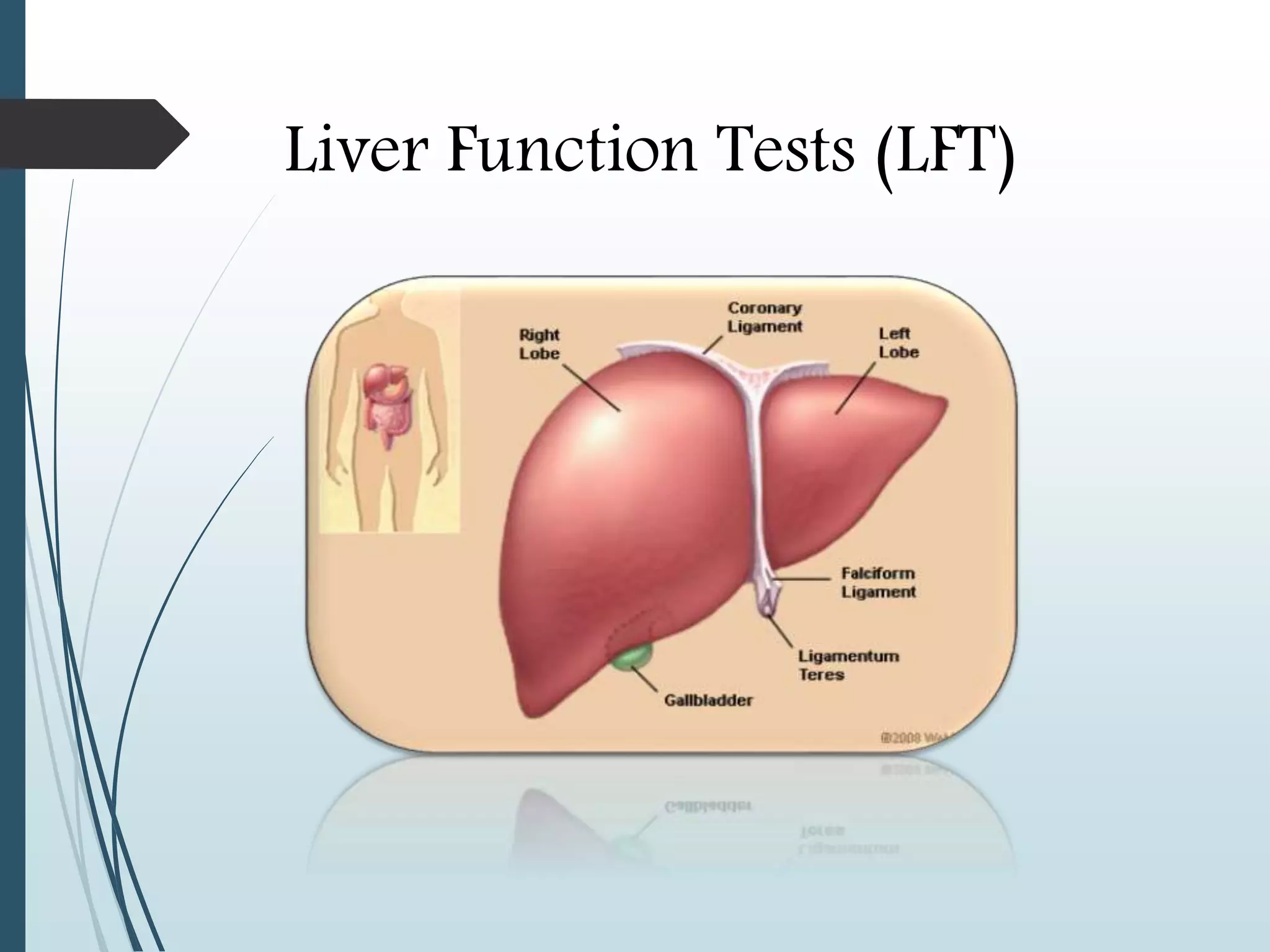
The liver is the largest organ in the body.
It is located below the diaphragm in the right upper
quadrant of the abdominal cavity and extended
approximately from the right 5th rib to the lower
border of the rib cage.
The working cells of the liver are known as
hepatocytes.
 Liver regeneration can occur after surgical removal of a
portion of the liver or after injuries that destroy parts of the
liver.
 Functionally Complex Organ that place a critical
biochemical role in- Metabolism – Digestion –
Detoxification and Elimination of substance from body.
 Based on functional capabilities of organs specific
biochemical investigation have been developed to assess
their functions.
FUNCTIONS OF LIVER
Metabolic function:
 Liver actively participates in carbohydrate, lipid
protein, mineral & vitamin metabolisms.
Excretory function:
 Bile pigments, bile salts & cholesterol are
excreted in bile into intestine.
Hematological function:
 Liver participates in formation of blood
(particularly in embryo)
 Liver is also produces clotting factors like factor V,
VII.
 Fibrinogen involved in blood coagulation is also
synthesized in liver.
 It synthesize plasma proteins & destruction of
erythrocytes.
Storage function:
 Glycogen, vitamins A, D & B12 & trace
element iron are stored in liver.
Protective function & detoxification:
 Ammonia is detoxified to urea.
 kupffer cells of liver perform phagocytosis to
eliminate foreign compounds.
 Liver is responsible for the metabolism of
xenobiotics.
! Why is LFT (liver function test) done?
 Detect presence of liver disease
 To Detect the disease whether mild or Severe
 Distinguish among different types of liver diseases.
 Follow the response of treatment
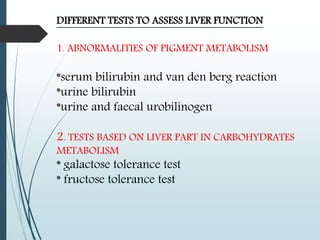
DIFFERENT TESTS TO ASSESS LIVER FUNCTION
1. ABNORMALITIES OF PIGMENT METABOLISM
*serum bilirubin and van den berg reaction
*urine bilirubin
*urine and faecal urobilinogen
2. TESTS BASED ON LIVER PART IN CARBOHYDRATES
METABOLISM
* galactose tolerance test
* fructose tolerance test
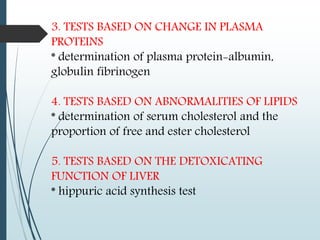
3. TESTS BASED ON CHANGE IN PLASMA
PROTEINS
* determination of plasma protein-albumin,
globulin fibrinogen
4. TESTS BASED ON ABNORMALITIES OF LIPIDS
* determination of serum cholesterol and the
proportion of free and ester cholesterol
5. TESTS BASED ON THE DETOXICATING
FUNCTION OF LIVER
* hippuric acid synthesis test
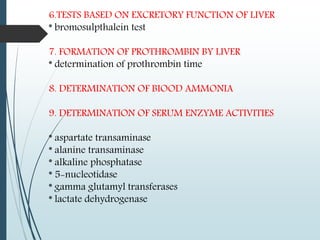
6.TESTS BASED ON EXCRETORY FUNCTION OF LIVER
* bromosulpthalein test
7. FORMATION OF PROTHROMBIN BY LIVER
* determination of prothrombin time
8. DETERMINATION OF BIOOD AMMONIA
9. DETERMINATION OF SERUM ENZYME ACTIVITIES
* aspartate transaminase
* alanine transaminase
* alkaline phosphatase
* 5-nucleotidase
* gamma glutamyl transferases
* lactate dehydrogenase
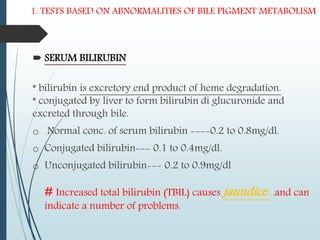
1. TESTS BASED ON ABNORMALITIES OF BILE PIGMENT METABOLISM
 SERUM BILIRUBIN
* bilirubin is excretory end product of heme degradation.
* conjugated by liver to form bilirubin di glucuronide and
excreted through bile.
o Normal conc. of serum bilirubin ----0.2 to 0.8mg/dl.
o Conjugated bilirubin--- 0.1 to 0.4mg/dl.
o Unconjugated bilirubin--- 0.2 to 0.9mg/dl
# Increased total bilirubin (TBIL) causes jaundice , and can
indicate a number of problems.
Van den Bergh Test for Bilirubin
 It is a specific test for for identificaion of increased serum bilirubin
levels.
 Normal serum gives a negative van den Bergh reaction.
 Mechanism of the reaction:
Van den Bergh reagent is a mixture of equal volumes of sulfanilic
acid (in dilute HCI)& sodium nitrite.
 Principle:
Diazotised sulfanilic acid reacts with bilirubin to form a purple
coloured azobilirubin.
 Direct and indirect reactions:
Unconjugated Bilirubin is insoluble in water while the conjugated
bilirubin is soluble.
 Van den Bergh reagent reacts with conjugated bilirubin & gives a
purple colour immediately (normally within 30 seconds).
• This is DIRECT POSITIVE van den Bergh reaction.
 Addition of methanol (or alcohol) dissolves the unconjugated
bilirubin & gives the van den Bergh reaction (normally within 30
minutes) positive.
• This is INDIRECT POSITIVE.
 lf the serum contains both unconjugated and conjugated
bilirubin in high concentration, the purple colour is produced
immediately (direct positive) which is further intensified by the
addition of alcohol (indirect positive).
• This type of reaction is known as BIPHASIC.
JAUNDICE
 Yellowish discoloration of the skin , eyes , and mucous membrane due to
increased bilirubin level.
# Jaundice is visible when serum bilirubin exceeds 2.4 mg/dl.
There are 3 TYPES of jaundice:-
1.PREHEPATIC/HAEMOLYTIC
2.HEPATIC/HEPATOCELLULAR
3.POST HEPATIC/OBSTRUCTIVE
*HAEMOLYTIC JAUNDICE—increases in unconjugated bilirubin—van der
Bergh test is indirect reaction
*HEPATOCELLULAR JAUNDICE —increases either or both --- Van der Bergh
testis direct reaction
*OBSTRUCTIVE JAUNDICE—increases in conjugated bilirubin—Van der
Bergh test is direct reaction
Van den Bergh reaction & jaundice
It is useful in understanding the nature of jaundice.
This is due to jaundice is characterized by increased
serum concentration of unconjugated bilirubin
(hemolytic), conjugated bilirubin (obstructive) or both
of them (hepatic).
Indirect positive - Haemolytic jaundice
Direct positive - Obstructive jaundice
Biphasic - Hepatic jaundice
Urinary Bilirubin
# Normally bilirubin is absent in urine.
Unconjugated bilirubin is insoluble in water and always absent in urine
Conjugated bilirubin being water soluble is excreted in urine in
obstructive jaundice. This can be detected by Fouchet’s test
Urinary urobilinogen:
# Normally trace amounts is present in urine.
In obstructive jaundice no urobilinogen is present in urine because bilirubin
cannot enter intestine.
Note: Presence of bilirubin in urine and absence of urobilinogen in urine is seen
in obstructive jaundice.
In hemolytic jaundice increased production of bilirubin causes increased
formation of urobilinogen which appears in urine.
Note: Increased urobilinogen in urine and absence of bilirubin in urine is seen
in hemolytic jaundice.
Fecal urobilinogen
# Normally urobilinogen in faeces is excreted is 50-250mg/day.
 In Hemolytic jaundice faecal urobilinogen is increased which
is dark colored.
 In Obstructive jaundice faecal urobilinogen is decreased or
absent; as there is obstruction in flow of bile and the color of
the feces is pale or clay-colored.
 A complete absent of faecal urobilinogen shows malignant
obstruction.
 A decrease may also occur in extreme cases of diseases affecting
hepatic parenchyma.
2. TESTS BASED ON LIVER PART IN CARBOHYDRATE
METABOLISM
 GALACTOSE TOLERANCE TEST
Galactose is monosaccharide exclusively metabolized by the liver.
* The liver function can be assessed by measuring the utilization of
galactose
* The normal liver is able to convert galactose into glucose ;but this
function is impaired in intrahepatic disease and the amount of blood
galactose and galactose in urine is excessive.
Method:
• subject is given galactose intravenously about 300mg/kg body
weight.
• blood is withdrawn at 10mins intervals for 2hrs,galactose is
estimated.
Interpretations:
• normally, half life of galactose is about 10-15mins.
• this is markedly increased in hepatocellular damage (cirrhosis,
3. TESTS BASED ON CHANGES IN PLASMA PROTEIN
 DETERMINATION OF TOTAL PLASMA PROTEIN ALBUMIN,GLOBULIN
& A:G RATIO
• Liver is the site of albumin synthesis and also possibly of some α and β
globulin.
• Albumin has a half-life of 20-25 days. It is a good marker to assess chronic
liver damage.
• Albumin is also decreased in malnutrition.
• In advanced parenchymal liver disease and in cirrhosis liver albumin is
grossly decreased and globulin are often increases .So that A:G ratio is
reversed.
• Total plasma protein conc.--- 6.0 to 8.0g/dl
• Albumin level --- 3.5 to 5.3 g/dl
• Globulin level --- 2.5 to 3.5 g/dl
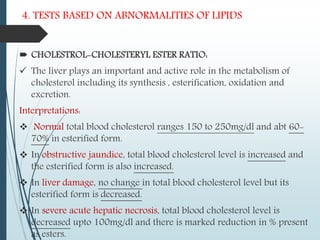
4. TESTS BASED ON ABNORMALITIES OF LIPIDS
 CHOLESTROL-CHOLESTERYL ESTER RATIO:
 The liver plays an important and active role in the metabolism of
cholesterol including its synthesis , esterification, oxidation and
excretion.
Interpretations:
 Normal total blood cholesterol ranges 150 to 250mg/dl and abt 60-
70% in esterified form.
 In obstructive jaundice, total blood cholesterol level is increased and
the esterified form is also increased.
 In liver damage, no change in total blood cholesterol level but its
esterified form is decreased.
 In severe acute hepatic necrosis, total blood cholesterol level is
decreased upto 100mg/dl and there is marked reduction in % present
as esters.
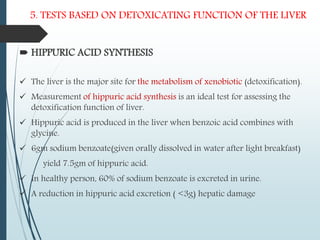
5. TESTS BASED ON DETOXICATING FUNCTION OF THE LIVER
 HIPPURIC ACID SYNTHESIS
 The liver is the major site for the metabolism of xenobiotic (detoxification).
 Measurement of hippuric acid synthesis is an ideal test for assessing the
detoxification function of liver.
 Hippuric acid is produced in the liver when benzoic acid combines with
glycine.
 6gm sodium benzoate(given orally dissolved in water after light breakfast)
yield 7.5gm of hippuric acid.
 In healthy person, 60% of sodium benzoate is excreted in urine.
 A reduction in hippuric acid excretion ( <3g) hepatic damage
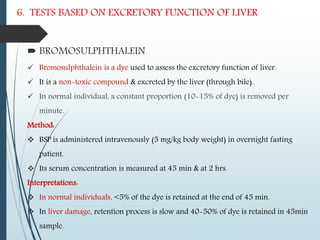
6. TESTS BASED ON EXCRETORY FUNCTION OF LIVER
 BROMOSULPHTHALEIN
 Bromosulphthalein is a dye used to assess the excretory function of liver.
 It is a non-toxic compound & excreted by the liver (through bile).
 In normal individual, a constant proportion (10-15% of dye) is removed per
minute.
Method:
 BSP is administered intravenously (5 mg/kg body weight) in overnight fasting
patient.
 Its serum concentration is measured at 45 min & at 2 hrs.
Interpretations:
 In normal individuals, <5% of the dye is retained at the end of 45 min.
 In liver damage, retention process is slow and 40-50% of dye is retained in 45min
sample.
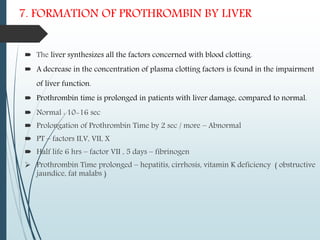
7. FORMATION OF PROTHROMBIN BY LIVER
 The liver synthesizes all the factors concerned with blood clotting.
 A decrease in the concentration of plasma clotting factors is found in the impairment
of liver function.
 Prothrombin time is prolonged in patients with liver damage, compared to normal.
 Normal : 10-16 sec
 Prolongation of Prothrombin Time by 2 sec / more – Abnormal
 PT – factors II,V, VII, X
 Half life 6 hrs – factor VII , 5 days – fibrinogen
 Prothrombin Time prolonged – hepatitis, cirrhosis, vitamin K deficiency ( obstructive
jaundice, fat malabs )
8. DETERMINATION OF BIOOD AMMONIA
 The major source of ammonia(NH3) in blood is bacteria of
gastrointestinal tract(GIT).
 Ammonia is later converted to urea by the liver then it is
excreted by kidneys.
 This test used for detecting hepatic encephalopathy.
 Normally, blood ammonia varies from 40-75μg/ 100ml of
blood.
 Increased in ammonia in blood is found in cases of cirrhosis of
liver .
 In liver damage, blood ammonia levels may be >200μg/100ml
.
7. SERUM ENZYMES – REFLECT DAMAGE TO HEPATOCYTES
A large number of enzyme estimations are available
which are used to ascertain liver function.
They are be divided into two groups:
A). Enzymes indicating hepatocellular damage.
B). Enzymes indicating cholestasis (obstruction).
In liver cells injury , damage to the membrane of cells &
organelles allows intracellular enzymes to leak into the
blood
A) Enzymes indicating hepatocellular
damage
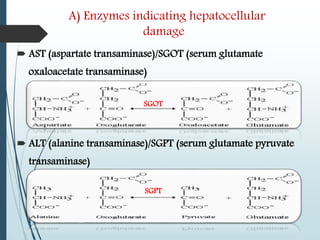
 AST (aspartate transaminase)/SGOT (serum glutamate
oxaloacetate transaminase)
 ALT (alanine transaminase)/SGPT (serum glutamate pyruvate
transaminase)
SGOT
SGPT
Aspartate transaminase (AST/SGOT)
Normal range: 10-45 U/L.
AST is found in both cytoplasm & mitochondria
AST/GOT also reflects damage to the hepatic cells
& is less specific for liver disease.
It is a cardiac marker.
AST help diagnose various heart, muscle or brain
disorders, such as a myocardial infarct (heart
attack).
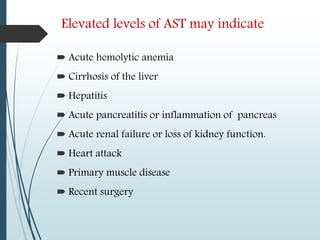
Elevated levels of AST may indicate
 Acute hemolytic anemia
 Cirrhosis of the liver
 Hepatitis
 Acute pancreatitis or inflammation of pancreas
 Acute renal failure or loss of kidney function.
 Heart attack
 Primary muscle disease
 Recent surgery
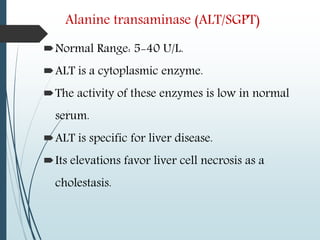
Alanine transaminase (ALT/SGPT)
Normal Range: 5-40 U/L.
ALT is a cytoplasmic enzyme.
The activity of these enzymes is low in normal
serum.
ALT is specific for liver disease.
Its elevations favor liver cell necrosis as a
cholestasis.
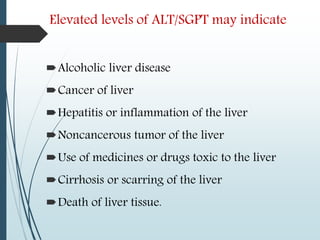
Elevated levels of ALT/SGPT may indicate
Alcoholic liver disease
Cancer of liver
Hepatitis or inflammation of the liver
Noncancerous tumor of the liver
Use of medicines or drugs toxic to the liver
Cirrhosis or scarring of the liver
Death of liver tissue.
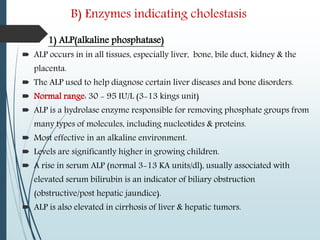
B) Enzymes indicating cholestasis
1) ALP(alkaline phosphatase)
 ALP occurs in in all tissues, especially liver, bone, bile duct, kidney & the
placenta.
 The ALP used to help diagnose certain liver diseases and bone disorders.
 Normal range: 30 - 95 IU/L (3-13 kings unit)
 ALP is a hydrolase enzyme responsible for removing phosphate groups from
many types of molecules, including nucleotides & proteins.
 Most effective in an alkaline environment.
 Levels are significantly higher in growing children.
 A rise in serum ALP (normal 3-13 KA units/dl), usually associated with
elevated serum bilirubin is an indicator of biliary obstruction
(obstructive/post hepatic jaundice).
 ALP is also elevated in cirrhosis of liver & hepatic tumors.
2) γ - Glutamyl transpeptidase (GGT)
 Normal range: 10-15 U/L
 This is a microsomal enzyme widely distributed in body tissues,
including liver.
 Measurement of γ - glutamyl transpeptidase (GGT) activity provides
a sensitive index to asses liver abnormality.
 Serum GGT is highly elevated in biliary obstruction & alcoholism.
 GGT elevation parallels than of ALP.
 Increased level of GGT are observed in chronic alcoholism ,pancreatic
disease ,MI ,renal failure ,diabetes mellitus.
 Several drugs (e.g. phenytoin) induce (liver synthesis) & increase this
enzyme in circulation.
3). 5'-Nucleotidase
Normal range: 2-15 U/L
The serum activity of 5'-nucleotidase is elevated
in hepatobiliary disease & this parallels ALP.
It is highest in post-hepatic obstructive jaundice.
The 5'-nucleotidase is normal in patients with
bone disease where as serum ALP increased .
Thank you

Liver function test

  • 1.
  • 2.
    Review: Liver The liveris the largest organ in the body. It is located below the diaphragm in the right upper quadrant of the abdominal cavity and extended approximately from the right 5th rib to the lower border of the rib cage. The working cells of the liver are known as hepatocytes.
  • 3.
     Liver regenerationcan occur after surgical removal of a portion of the liver or after injuries that destroy parts of the liver.  Functionally Complex Organ that place a critical biochemical role in- Metabolism – Digestion – Detoxification and Elimination of substance from body.  Based on functional capabilities of organs specific biochemical investigation have been developed to assess their functions.
  • 4.
    FUNCTIONS OF LIVER Metabolicfunction:  Liver actively participates in carbohydrate, lipid protein, mineral & vitamin metabolisms. Excretory function:  Bile pigments, bile salts & cholesterol are excreted in bile into intestine.
  • 5.
    Hematological function:  Liverparticipates in formation of blood (particularly in embryo)  Liver is also produces clotting factors like factor V, VII.  Fibrinogen involved in blood coagulation is also synthesized in liver.  It synthesize plasma proteins & destruction of erythrocytes.
  • 6.
    Storage function:  Glycogen,vitamins A, D & B12 & trace element iron are stored in liver. Protective function & detoxification:  Ammonia is detoxified to urea.  kupffer cells of liver perform phagocytosis to eliminate foreign compounds.  Liver is responsible for the metabolism of xenobiotics.
  • 7.
    ! Why isLFT (liver function test) done?  Detect presence of liver disease  To Detect the disease whether mild or Severe  Distinguish among different types of liver diseases.  Follow the response of treatment
  • 8.
    DIFFERENT TESTS TOASSESS LIVER FUNCTION 1. ABNORMALITIES OF PIGMENT METABOLISM *serum bilirubin and van den berg reaction *urine bilirubin *urine and faecal urobilinogen 2. TESTS BASED ON LIVER PART IN CARBOHYDRATES METABOLISM * galactose tolerance test * fructose tolerance test
  • 9.
    3. TESTS BASEDON CHANGE IN PLASMA PROTEINS * determination of plasma protein-albumin, globulin fibrinogen 4. TESTS BASED ON ABNORMALITIES OF LIPIDS * determination of serum cholesterol and the proportion of free and ester cholesterol 5. TESTS BASED ON THE DETOXICATING FUNCTION OF LIVER * hippuric acid synthesis test
  • 10.
    6.TESTS BASED ONEXCRETORY FUNCTION OF LIVER * bromosulpthalein test 7. FORMATION OF PROTHROMBIN BY LIVER * determination of prothrombin time 8. DETERMINATION OF BIOOD AMMONIA 9. DETERMINATION OF SERUM ENZYME ACTIVITIES * aspartate transaminase * alanine transaminase * alkaline phosphatase * 5-nucleotidase * gamma glutamyl transferases * lactate dehydrogenase
  • 11.
    1. TESTS BASEDON ABNORMALITIES OF BILE PIGMENT METABOLISM  SERUM BILIRUBIN * bilirubin is excretory end product of heme degradation. * conjugated by liver to form bilirubin di glucuronide and excreted through bile. o Normal conc. of serum bilirubin ----0.2 to 0.8mg/dl. o Conjugated bilirubin--- 0.1 to 0.4mg/dl. o Unconjugated bilirubin--- 0.2 to 0.9mg/dl # Increased total bilirubin (TBIL) causes jaundice , and can indicate a number of problems.
  • 12.
    Van den BerghTest for Bilirubin  It is a specific test for for identificaion of increased serum bilirubin levels.  Normal serum gives a negative van den Bergh reaction.  Mechanism of the reaction: Van den Bergh reagent is a mixture of equal volumes of sulfanilic acid (in dilute HCI)& sodium nitrite.  Principle: Diazotised sulfanilic acid reacts with bilirubin to form a purple coloured azobilirubin.  Direct and indirect reactions: Unconjugated Bilirubin is insoluble in water while the conjugated bilirubin is soluble.
  • 13.
     Van denBergh reagent reacts with conjugated bilirubin & gives a purple colour immediately (normally within 30 seconds). • This is DIRECT POSITIVE van den Bergh reaction.  Addition of methanol (or alcohol) dissolves the unconjugated bilirubin & gives the van den Bergh reaction (normally within 30 minutes) positive. • This is INDIRECT POSITIVE.  lf the serum contains both unconjugated and conjugated bilirubin in high concentration, the purple colour is produced immediately (direct positive) which is further intensified by the addition of alcohol (indirect positive). • This type of reaction is known as BIPHASIC.
  • 14.
    JAUNDICE  Yellowish discolorationof the skin , eyes , and mucous membrane due to increased bilirubin level. # Jaundice is visible when serum bilirubin exceeds 2.4 mg/dl. There are 3 TYPES of jaundice:- 1.PREHEPATIC/HAEMOLYTIC 2.HEPATIC/HEPATOCELLULAR 3.POST HEPATIC/OBSTRUCTIVE *HAEMOLYTIC JAUNDICE—increases in unconjugated bilirubin—van der Bergh test is indirect reaction *HEPATOCELLULAR JAUNDICE —increases either or both --- Van der Bergh testis direct reaction *OBSTRUCTIVE JAUNDICE—increases in conjugated bilirubin—Van der Bergh test is direct reaction
  • 15.
    Van den Berghreaction & jaundice It is useful in understanding the nature of jaundice. This is due to jaundice is characterized by increased serum concentration of unconjugated bilirubin (hemolytic), conjugated bilirubin (obstructive) or both of them (hepatic). Indirect positive - Haemolytic jaundice Direct positive - Obstructive jaundice Biphasic - Hepatic jaundice
  • 16.
    Urinary Bilirubin # Normallybilirubin is absent in urine. Unconjugated bilirubin is insoluble in water and always absent in urine Conjugated bilirubin being water soluble is excreted in urine in obstructive jaundice. This can be detected by Fouchet’s test Urinary urobilinogen: # Normally trace amounts is present in urine. In obstructive jaundice no urobilinogen is present in urine because bilirubin cannot enter intestine. Note: Presence of bilirubin in urine and absence of urobilinogen in urine is seen in obstructive jaundice. In hemolytic jaundice increased production of bilirubin causes increased formation of urobilinogen which appears in urine. Note: Increased urobilinogen in urine and absence of bilirubin in urine is seen in hemolytic jaundice.
  • 17.
    Fecal urobilinogen # Normallyurobilinogen in faeces is excreted is 50-250mg/day.  In Hemolytic jaundice faecal urobilinogen is increased which is dark colored.  In Obstructive jaundice faecal urobilinogen is decreased or absent; as there is obstruction in flow of bile and the color of the feces is pale or clay-colored.  A complete absent of faecal urobilinogen shows malignant obstruction.  A decrease may also occur in extreme cases of diseases affecting hepatic parenchyma.
  • 18.
    2. TESTS BASEDON LIVER PART IN CARBOHYDRATE METABOLISM  GALACTOSE TOLERANCE TEST Galactose is monosaccharide exclusively metabolized by the liver. * The liver function can be assessed by measuring the utilization of galactose * The normal liver is able to convert galactose into glucose ;but this function is impaired in intrahepatic disease and the amount of blood galactose and galactose in urine is excessive. Method: • subject is given galactose intravenously about 300mg/kg body weight. • blood is withdrawn at 10mins intervals for 2hrs,galactose is estimated. Interpretations: • normally, half life of galactose is about 10-15mins. • this is markedly increased in hepatocellular damage (cirrhosis,
  • 19.
    3. TESTS BASEDON CHANGES IN PLASMA PROTEIN  DETERMINATION OF TOTAL PLASMA PROTEIN ALBUMIN,GLOBULIN & A:G RATIO • Liver is the site of albumin synthesis and also possibly of some α and β globulin. • Albumin has a half-life of 20-25 days. It is a good marker to assess chronic liver damage. • Albumin is also decreased in malnutrition. • In advanced parenchymal liver disease and in cirrhosis liver albumin is grossly decreased and globulin are often increases .So that A:G ratio is reversed. • Total plasma protein conc.--- 6.0 to 8.0g/dl • Albumin level --- 3.5 to 5.3 g/dl • Globulin level --- 2.5 to 3.5 g/dl
  • 20.
    4. TESTS BASEDON ABNORMALITIES OF LIPIDS  CHOLESTROL-CHOLESTERYL ESTER RATIO:  The liver plays an important and active role in the metabolism of cholesterol including its synthesis , esterification, oxidation and excretion. Interpretations:  Normal total blood cholesterol ranges 150 to 250mg/dl and abt 60- 70% in esterified form.  In obstructive jaundice, total blood cholesterol level is increased and the esterified form is also increased.  In liver damage, no change in total blood cholesterol level but its esterified form is decreased.  In severe acute hepatic necrosis, total blood cholesterol level is decreased upto 100mg/dl and there is marked reduction in % present as esters.
  • 21.
    5. TESTS BASEDON DETOXICATING FUNCTION OF THE LIVER  HIPPURIC ACID SYNTHESIS  The liver is the major site for the metabolism of xenobiotic (detoxification).  Measurement of hippuric acid synthesis is an ideal test for assessing the detoxification function of liver.  Hippuric acid is produced in the liver when benzoic acid combines with glycine.  6gm sodium benzoate(given orally dissolved in water after light breakfast) yield 7.5gm of hippuric acid.  In healthy person, 60% of sodium benzoate is excreted in urine.  A reduction in hippuric acid excretion ( <3g) hepatic damage
  • 22.
    6. TESTS BASEDON EXCRETORY FUNCTION OF LIVER  BROMOSULPHTHALEIN  Bromosulphthalein is a dye used to assess the excretory function of liver.  It is a non-toxic compound & excreted by the liver (through bile).  In normal individual, a constant proportion (10-15% of dye) is removed per minute. Method:  BSP is administered intravenously (5 mg/kg body weight) in overnight fasting patient.  Its serum concentration is measured at 45 min & at 2 hrs. Interpretations:  In normal individuals, <5% of the dye is retained at the end of 45 min.  In liver damage, retention process is slow and 40-50% of dye is retained in 45min sample.
  • 23.
    7. FORMATION OFPROTHROMBIN BY LIVER  The liver synthesizes all the factors concerned with blood clotting.  A decrease in the concentration of plasma clotting factors is found in the impairment of liver function.  Prothrombin time is prolonged in patients with liver damage, compared to normal.  Normal : 10-16 sec  Prolongation of Prothrombin Time by 2 sec / more – Abnormal  PT – factors II,V, VII, X  Half life 6 hrs – factor VII , 5 days – fibrinogen  Prothrombin Time prolonged – hepatitis, cirrhosis, vitamin K deficiency ( obstructive jaundice, fat malabs )
  • 24.
    8. DETERMINATION OFBIOOD AMMONIA  The major source of ammonia(NH3) in blood is bacteria of gastrointestinal tract(GIT).  Ammonia is later converted to urea by the liver then it is excreted by kidneys.  This test used for detecting hepatic encephalopathy.  Normally, blood ammonia varies from 40-75μg/ 100ml of blood.  Increased in ammonia in blood is found in cases of cirrhosis of liver .  In liver damage, blood ammonia levels may be >200μg/100ml .
  • 25.
    7. SERUM ENZYMES– REFLECT DAMAGE TO HEPATOCYTES A large number of enzyme estimations are available which are used to ascertain liver function. They are be divided into two groups: A). Enzymes indicating hepatocellular damage. B). Enzymes indicating cholestasis (obstruction). In liver cells injury , damage to the membrane of cells & organelles allows intracellular enzymes to leak into the blood
  • 26.
    A) Enzymes indicatinghepatocellular damage  AST (aspartate transaminase)/SGOT (serum glutamate oxaloacetate transaminase)  ALT (alanine transaminase)/SGPT (serum glutamate pyruvate transaminase) SGOT SGPT
  • 27.
    Aspartate transaminase (AST/SGOT) Normalrange: 10-45 U/L. AST is found in both cytoplasm & mitochondria AST/GOT also reflects damage to the hepatic cells & is less specific for liver disease. It is a cardiac marker. AST help diagnose various heart, muscle or brain disorders, such as a myocardial infarct (heart attack).
  • 28.
    Elevated levels ofAST may indicate  Acute hemolytic anemia  Cirrhosis of the liver  Hepatitis  Acute pancreatitis or inflammation of pancreas  Acute renal failure or loss of kidney function.  Heart attack  Primary muscle disease  Recent surgery
  • 29.
    Alanine transaminase (ALT/SGPT) NormalRange: 5-40 U/L. ALT is a cytoplasmic enzyme. The activity of these enzymes is low in normal serum. ALT is specific for liver disease. Its elevations favor liver cell necrosis as a cholestasis.
  • 30.
    Elevated levels ofALT/SGPT may indicate Alcoholic liver disease Cancer of liver Hepatitis or inflammation of the liver Noncancerous tumor of the liver Use of medicines or drugs toxic to the liver Cirrhosis or scarring of the liver Death of liver tissue.
  • 31.
    B) Enzymes indicatingcholestasis 1) ALP(alkaline phosphatase)  ALP occurs in in all tissues, especially liver, bone, bile duct, kidney & the placenta.  The ALP used to help diagnose certain liver diseases and bone disorders.  Normal range: 30 - 95 IU/L (3-13 kings unit)  ALP is a hydrolase enzyme responsible for removing phosphate groups from many types of molecules, including nucleotides & proteins.  Most effective in an alkaline environment.  Levels are significantly higher in growing children.  A rise in serum ALP (normal 3-13 KA units/dl), usually associated with elevated serum bilirubin is an indicator of biliary obstruction (obstructive/post hepatic jaundice).  ALP is also elevated in cirrhosis of liver & hepatic tumors.
  • 32.
    2) γ -Glutamyl transpeptidase (GGT)  Normal range: 10-15 U/L  This is a microsomal enzyme widely distributed in body tissues, including liver.  Measurement of γ - glutamyl transpeptidase (GGT) activity provides a sensitive index to asses liver abnormality.  Serum GGT is highly elevated in biliary obstruction & alcoholism.  GGT elevation parallels than of ALP.  Increased level of GGT are observed in chronic alcoholism ,pancreatic disease ,MI ,renal failure ,diabetes mellitus.  Several drugs (e.g. phenytoin) induce (liver synthesis) & increase this enzyme in circulation.
  • 33.
    3). 5'-Nucleotidase Normal range:2-15 U/L The serum activity of 5'-nucleotidase is elevated in hepatobiliary disease & this parallels ALP. It is highest in post-hepatic obstructive jaundice. The 5'-nucleotidase is normal in patients with bone disease where as serum ALP increased .
  • 34.