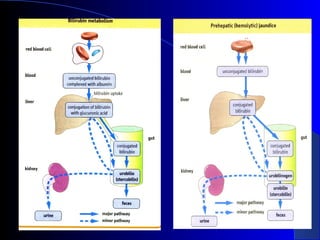
Laboratory Investigations in a case
of Jaundice
Tapeshwar Yadav
(Lecturer)
BMLT, DNHE,
M.Sc. Medical Biochemistry
BILE PIGMENTS
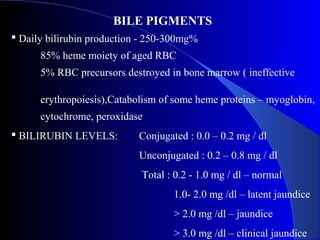
 Daily bilirubin production - 250-300mg%
85% heme moiety of aged RBC
5% RBC precursors destroyed in bone marrow ( ineffective
erythropoiesis),Catabolism of some heme proteins – myoglobin,
cytochrome, peroxidase
 BILIRUBIN LEVELS: Conjugated : 0.0 – 0.2 mg / dl
Unconjugated : 0.2 – 0.8 mg / dl
Total : 0.2 - 1.0 mg / dl – normal
1.0- 2.0 mg /dl – latent jaundice
> 2.0 mg /dl – jaundice
> 3.0 mg /dl – clinical jaundice
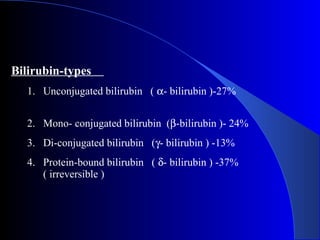
Bilirubin-types
1. Unconjugated bilirubin ( α- bilirubin )-27%
2. Mono- conjugated bilirubin (β-bilirubin )- 24%
3. Di-conjugated bilirubin (γ- bilirubin ) -13%
4. Protein-bound bilirubin ( δ- bilirubin ) -37%
( irreversible )
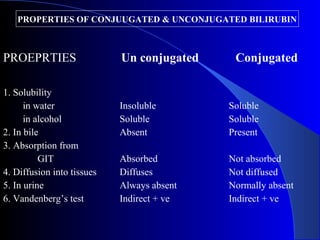
PROEPRTIES Un conjugated Conjugated
1. Solubility
in water
in alcohol
2. In bile
3. Absorption from
GIT
4. Diffusion into tissues
5. In urine
6. Vandenberg’s test
Insoluble
Soluble
Absent
Absorbed
Diffuses
Always absent
Indirect + ve
Soluble
Soluble
Present
Not absorbed
Not diffused
Normally absent
Indirect + ve
PROPERTIES OF CONJUUGATED & UNCONJUGATED BILIRUBIN
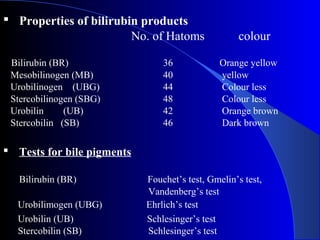
 Properties of bilirubin products
No. of Hatoms colour
Bilirubin (BR) 36 Orange yellow
Mesobilinogen (MB) 40 yellow
Urobilinogen (UBG) 44 Colour less
Stercobilinogen (SBG) 48 Colour less
Urobilin (UB) 42 Orange brown
Stercobilin (SB) 46 Dark brown
 Tests for bile pigments
Bilirubin (BR) Fouchet’s test, Gmelin’s test,
Vandenberg’s test
Urobilimogen (UBG) Ehrlich’s test
Urobilin (UB) Schlesinger’s test
Stercobilin (SB) Schlesinger’s test
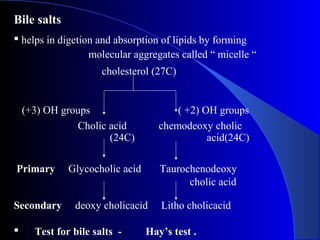
Bile salts
 helps in digetion and absorption of lipids by forming
molecular aggregates called “ micelle “
cholesterol (27C)
(+3) OH groups ( +2) OH groups
Cholic acid chemodeoxy cholic
(24C) acid(24C)
Primary Glycocholic acid Taurochenodeoxy
cholic acid
Secondary deoxy cholicacid Litho cholicacid
 Test for bile salts - Hay’s test .
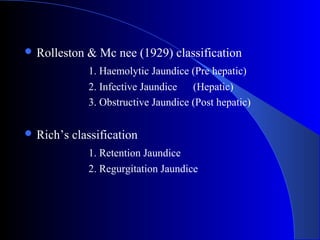
 Rolleston & Mc nee (1929) classification
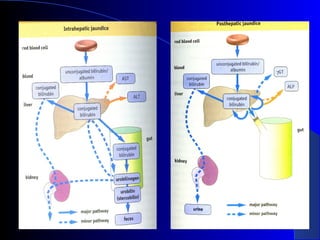
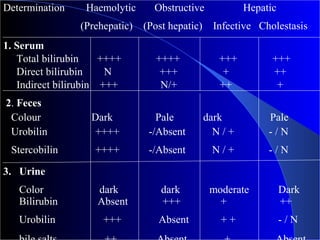
1. Haemolytic Jaundice (Pre hepatic)
2. Infective Jaundice (Hepatic)
3. Obstructive Jaundice (Post hepatic)
 Rich’s classification
1. Retention Jaundice
2. Regurgitation Jaundice
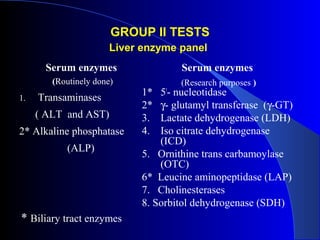
Determination Haemolytic Obstructive Hepatic
(Prehepatic) (Post hepatic) Infective Cholestasis
1. Serum
Total bilirubin ++++ ++++ +++ +++
Direct bilirubin N +++ + ++
Indirect bilirubin +++ N/+ ++ +
2. Feces
Colour Dark Pale dark Pale
Urobilin ++++ -/Absent N / + - / N
Stercobilin ++++ -/Absent N / + - / N
3. Urine
Color dark dark moderate Dark
Bilirubin Absent +++ + ++
Urobilin +++ Absent + + - / N
GROUP II TESTS
Liver enzyme panel
Serum enzymes
(Routinely done)
1. Transaminases
( ALT and AST)
2* Alkaline phosphatase
(ALP)
Serum enzymes
(Research purposes )
1* 5!
- nucleotidase
2* γ- glutamyl transferase (γ-GT)
3. Lactate dehydrogenase (LDH)
4. Iso citrate dehydrogenase
(ICD)
5. Ornithine trans carbamoylase
(OTC)
6* Leucine aminopeptidase (LAP)
7. Cholinesterases
8. Sorbitol dehydrogenase (SDH)
* Biliary tract enzymes
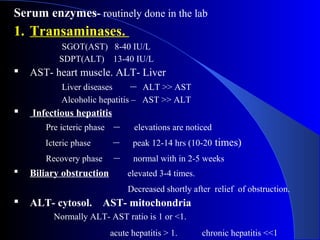
Serum enzymes- routinely done in the lab
1. Transaminases.
SGOT(AST) 8-40 IU/L
SDPT(ALT) 13-40 IU/L
 AST- heart muscle. ALT- Liver
Liver diseases – ALT >> AST
Alcoholic hepatitis – AST >> ALT
 Infectious hepatitis
Pre icteric phase – elevations are noticed
Icteric phase – peak 12-14 hrs (10-20 times)
Recovery phase – normal with in 2-5 weeks
 Biliary obstruction elevated 3-4 times.
Decreased shortly after relief of obstruction.
 ALT- cytosol. AST- mitochondria
Normally ALT- AST ratio is 1 or <1.
acute hepatitis > 1. chronic hepatitis <<1
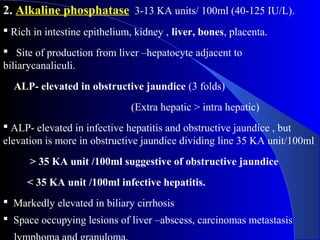
2. Alkaline phosphatase 3-13 KA units/ 100ml (40-125 IU/L).
 Rich in intestine epithelium, kidney , liver, bones, placenta.
 Site of production from liver –hepatocyte adjacent to
biliarycanaliculi.
ALP- elevated in obstructive jaundice (3 folds)
(Extra hepatic > intra hepatic)
 ALP- elevated in infective hepatitis and obstructive jaundice , but
elevation is more in obstructive jaundice dividing line 35 KA unit/100ml
> 35 KA unit /100ml suggestive of obstructive jaundice
< 35 KA unit /100ml infective hepatitis.
 Markedly elevated in biliary cirrhosis
 Space occupying lesions of liver –abscess, carcinomas metastasis
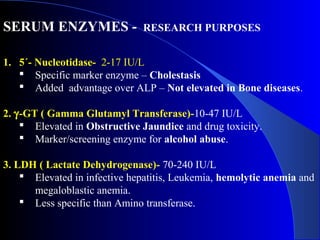
SERUM ENZYMES - RESEARCH PURPOSES
1. 5´- Nucleotidase- 2-17 IU/L
 Specific marker enzyme – Cholestasis
 Added advantage over ALP – Not elevated in Bone diseases.
2. γ-GT ( Gamma Glutamyl Transferase)-10-47 IU/L
 Elevated in Obstructive Jaundice and drug toxicity.
 Marker/screening enzyme for alcohol abuse.
3. LDH ( Lactate Dehydrogenase)- 70-240 IU/L
 Elevated in infective hepatitis, Leukemia, hemolytic anemia and
megaloblastic anemia.
 Less specific than Amino transferase.
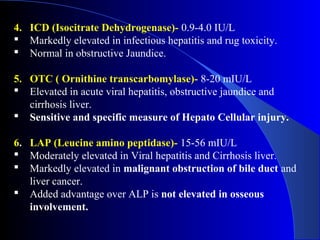
4. ICD (Isocitrate Dehydrogenase)- 0.9-4.0 IU/L
 Markedly elevated in infectious hepatitis and rug toxicity.
 Normal in obstructive Jaundice.
5. OTC ( Ornithine transcarbomylase)- 8-20 mIU/L
 Elevated in acute viral hepatitis, obstructive jaundice and
cirrhosis liver.
 Sensitive and specific measure of Hepato Cellular injury.
6. LAP (Leucine amino peptidase)- 15-56 mIU/L
 Moderately elevated in Viral hepatitis and Cirrhosis liver.
 Markedly elevated in malignant obstruction of bile duct and
liver cancer.
 Added advantage over ALP is not elevated in osseous
involvement.
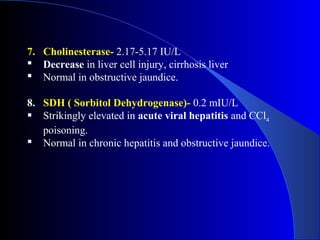
7. Cholinesterase- 2.17-5.17 IU/L
 Decrease in liver cell injury, cirrhosis liver
 Normal in obstructive jaundice.
8. SDH ( Sorbitol Dehydrogenase)- 0.2 mIU/L
 Strikingly elevated in acute viral hepatitis and CCl4
poisoning.
 Normal in chronic hepatitis and obstructive jaundice.
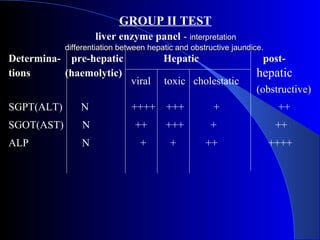
Determina- pre-hepatic Hepatic post-
tions (haemolytic)
SGPT(ALT) N ++++ +++ + ++
SGOT(AST) N ++ +++ + ++
ALP N + + ++ ++++
viral toxic cholestatic
hepatic
(obstructive)
GROUP II TEST
liver enzyme panel - interpretationinterpretation
differentiation between hepatic and obstructive jaundice.differentiation between hepatic and obstructive jaundice.
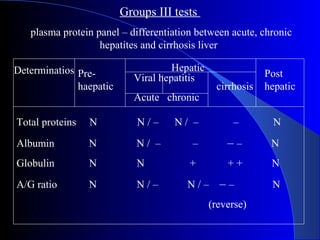
Groups III tests
plasma protein panel – differentiation between acute, chronic
hepatites and cirrhosis liver
Determinatios Pre-
haepatic
Hepatic
Viral hepatitis
Acute chronic
cirrhosis
Post
hepatic
Total proteins N N / – N / – – N
Albumin N N / – – – – N
Globulin N N + + + N
A/G ratio N N / – N / – – – N
(reverse)
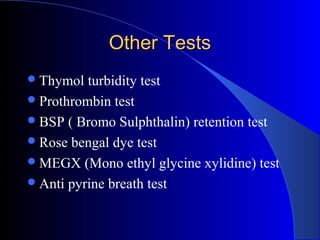
Other TestsOther Tests
Thymol turbidity test
Prothrombin test
BSP ( Bromo Sulphthalin) retention test
Rose bengal dye test
MEGX (Mono ethyl glycine xylidine) test
Anti pyrine breath test
How do you investigate a case ofHow do you investigate a case of
JaundiceJaundice
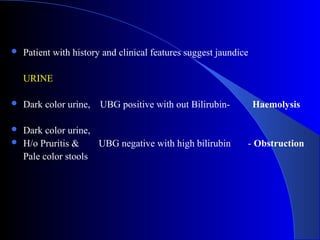
 Patient with history and clinical features suggest jaundice
URINE
 Dark color urine, UBG positive with out Bilirubin- Haemolysis
 Dark color urine,
 H/o Pruritis & UBG negative with high bilirubin - Obstruction
Pale color stools
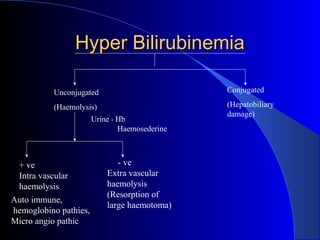
Hyper BilirubinemiaHyper Bilirubinemia
Unconjugated
(Haemolysis)
Conjugated
(Hepatobiliary
damage)
Urine - Hb
Haemosederine
+ ve - ve
Intra vascular
haemolysis
Extra vascular
haemolysis
(Resorption of
large haemotoma)
Auto immune,
hemoglobino pathies,
Micro angio pathic
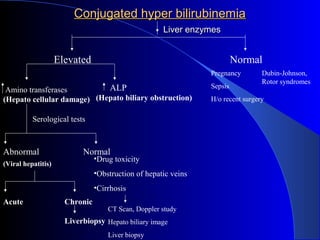
Conjugated hyper bilirubinemiaConjugated hyper bilirubinemia
Liver enzymesLiver enzymes
Elevated Normal
Amino transferases
(Hepato cellular damage) (Hepato biliary obstruction)
ALP
Serological tests
Abnormal Normal
(Viral hepatitis)
Acute Chronic
Liverbiopsy
•Drug toxicity
•Obstruction of hepatic veins
•Cirrhosis
CT Scan, Doppler study
Hepato biliary image
Liver biopsy
Pregnancy
Sepsis
H/o recent surgery
Dubin-Johnson,
Rotor syndromes
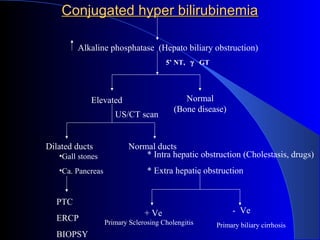
Conjugated hyper bilirubinemiaConjugated hyper bilirubinemia
Alkaline phosphatase (Hepato biliary obstruction)
5’ NT, γ GT
Elevated Normal
(Bone disease)
US/CT scan
Dilated ducts Normal ducts
•Gall stones
•Ca. Pancreas
PTC
ERCP
BIOPSY
* Intra hepatic obstruction (Cholestasis, drugs)
* Extra hepatic obstruction
+ Ve - Ve
Primary Sclerosing Cholengitis Primary biliary cirrhosis
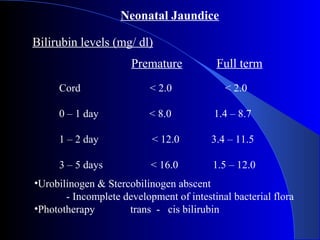
Neonatal Jaundice
Bilirubin levels (mg/ dl)
Premature Full term
Cord < 2.0 < 2.0
0 – 1 day < 8.0 1.4 – 8.7
1 – 2 day < 12.0 3.4 – 11.5
3 – 5 days < 16.0 1.5 – 12.0
•Urobilinogen & Stercobilinogen abscent
- Incomplete development of intestinal bacterial flora
•Phototherapy trans - cis bilirubin
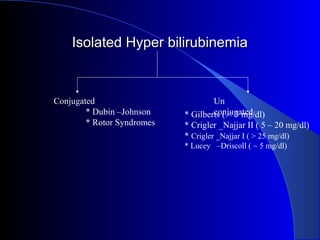
Isolated Hyper bilirubinemiaIsolated Hyper bilirubinemia
Conjugated
* Dubin –Johnson
* Rotor Syndromes
* Gilberts ( < 3 mg/dl)
* Crigler _Najjar II ( 5 – 20 mg/dl)
* Crigler _Najjar I ( > 25 mg/dl)
* Lucey –Driscoll ( ~ 5 mg/dl)
Un
conjugated
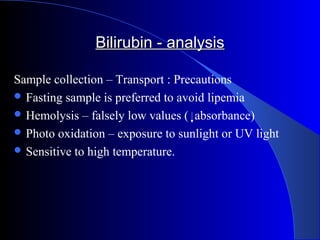
Bilirubin - analysisBilirubin - analysis
Sample collection – Transport : Precautions
 Fasting sample is preferred to avoid lipemia
 Hemolysis – falsely low values ( absorbance)
 Photo oxidation – exposure to sunlight or UV light
 Sensitive to high temperature.
Jaundice - Liver Function Tests

Jaundice - Liver Function Tests

  • 1.
    Laboratory Investigations ina case of Jaundice Tapeshwar Yadav (Lecturer) BMLT, DNHE, M.Sc. Medical Biochemistry
  • 2.
    BILE PIGMENTS  Dailybilirubin production - 250-300mg% 85% heme moiety of aged RBC 5% RBC precursors destroyed in bone marrow ( ineffective erythropoiesis),Catabolism of some heme proteins – myoglobin, cytochrome, peroxidase  BILIRUBIN LEVELS: Conjugated : 0.0 – 0.2 mg / dl Unconjugated : 0.2 – 0.8 mg / dl Total : 0.2 - 1.0 mg / dl – normal 1.0- 2.0 mg /dl – latent jaundice > 2.0 mg /dl – jaundice > 3.0 mg /dl – clinical jaundice
  • 3.
    Bilirubin-types 1. Unconjugated bilirubin( α- bilirubin )-27% 2. Mono- conjugated bilirubin (β-bilirubin )- 24% 3. Di-conjugated bilirubin (γ- bilirubin ) -13% 4. Protein-bound bilirubin ( δ- bilirubin ) -37% ( irreversible )
  • 4.
    PROEPRTIES Un conjugatedConjugated 1. Solubility in water in alcohol 2. In bile 3. Absorption from GIT 4. Diffusion into tissues 5. In urine 6. Vandenberg’s test Insoluble Soluble Absent Absorbed Diffuses Always absent Indirect + ve Soluble Soluble Present Not absorbed Not diffused Normally absent Indirect + ve PROPERTIES OF CONJUUGATED & UNCONJUGATED BILIRUBIN
  • 5.
     Properties ofbilirubin products No. of Hatoms colour Bilirubin (BR) 36 Orange yellow Mesobilinogen (MB) 40 yellow Urobilinogen (UBG) 44 Colour less Stercobilinogen (SBG) 48 Colour less Urobilin (UB) 42 Orange brown Stercobilin (SB) 46 Dark brown  Tests for bile pigments Bilirubin (BR) Fouchet’s test, Gmelin’s test, Vandenberg’s test Urobilimogen (UBG) Ehrlich’s test Urobilin (UB) Schlesinger’s test Stercobilin (SB) Schlesinger’s test
  • 6.
    Bile salts  helpsin digetion and absorption of lipids by forming molecular aggregates called “ micelle “ cholesterol (27C) (+3) OH groups ( +2) OH groups Cholic acid chemodeoxy cholic (24C) acid(24C) Primary Glycocholic acid Taurochenodeoxy cholic acid Secondary deoxy cholicacid Litho cholicacid  Test for bile salts - Hay’s test .
  • 7.
     Rolleston &Mc nee (1929) classification 1. Haemolytic Jaundice (Pre hepatic) 2. Infective Jaundice (Hepatic) 3. Obstructive Jaundice (Post hepatic)  Rich’s classification 1. Retention Jaundice 2. Regurgitation Jaundice
  • 10.
    Determination Haemolytic ObstructiveHepatic (Prehepatic) (Post hepatic) Infective Cholestasis 1. Serum Total bilirubin ++++ ++++ +++ +++ Direct bilirubin N +++ + ++ Indirect bilirubin +++ N/+ ++ + 2. Feces Colour Dark Pale dark Pale Urobilin ++++ -/Absent N / + - / N Stercobilin ++++ -/Absent N / + - / N 3. Urine Color dark dark moderate Dark Bilirubin Absent +++ + ++ Urobilin +++ Absent + + - / N
  • 11.
    GROUP II TESTS Liverenzyme panel Serum enzymes (Routinely done) 1. Transaminases ( ALT and AST) 2* Alkaline phosphatase (ALP) Serum enzymes (Research purposes ) 1* 5! - nucleotidase 2* γ- glutamyl transferase (γ-GT) 3. Lactate dehydrogenase (LDH) 4. Iso citrate dehydrogenase (ICD) 5. Ornithine trans carbamoylase (OTC) 6* Leucine aminopeptidase (LAP) 7. Cholinesterases 8. Sorbitol dehydrogenase (SDH) * Biliary tract enzymes
  • 12.
    Serum enzymes- routinelydone in the lab 1. Transaminases. SGOT(AST) 8-40 IU/L SDPT(ALT) 13-40 IU/L  AST- heart muscle. ALT- Liver Liver diseases – ALT >> AST Alcoholic hepatitis – AST >> ALT  Infectious hepatitis Pre icteric phase – elevations are noticed Icteric phase – peak 12-14 hrs (10-20 times) Recovery phase – normal with in 2-5 weeks  Biliary obstruction elevated 3-4 times. Decreased shortly after relief of obstruction.  ALT- cytosol. AST- mitochondria Normally ALT- AST ratio is 1 or <1. acute hepatitis > 1. chronic hepatitis <<1
  • 13.
    2. Alkaline phosphatase3-13 KA units/ 100ml (40-125 IU/L).  Rich in intestine epithelium, kidney , liver, bones, placenta.  Site of production from liver –hepatocyte adjacent to biliarycanaliculi. ALP- elevated in obstructive jaundice (3 folds) (Extra hepatic > intra hepatic)  ALP- elevated in infective hepatitis and obstructive jaundice , but elevation is more in obstructive jaundice dividing line 35 KA unit/100ml > 35 KA unit /100ml suggestive of obstructive jaundice < 35 KA unit /100ml infective hepatitis.  Markedly elevated in biliary cirrhosis  Space occupying lesions of liver –abscess, carcinomas metastasis
  • 14.
    SERUM ENZYMES -RESEARCH PURPOSES 1. 5´- Nucleotidase- 2-17 IU/L  Specific marker enzyme – Cholestasis  Added advantage over ALP – Not elevated in Bone diseases. 2. γ-GT ( Gamma Glutamyl Transferase)-10-47 IU/L  Elevated in Obstructive Jaundice and drug toxicity.  Marker/screening enzyme for alcohol abuse. 3. LDH ( Lactate Dehydrogenase)- 70-240 IU/L  Elevated in infective hepatitis, Leukemia, hemolytic anemia and megaloblastic anemia.  Less specific than Amino transferase.
  • 15.
    4. ICD (IsocitrateDehydrogenase)- 0.9-4.0 IU/L  Markedly elevated in infectious hepatitis and rug toxicity.  Normal in obstructive Jaundice. 5. OTC ( Ornithine transcarbomylase)- 8-20 mIU/L  Elevated in acute viral hepatitis, obstructive jaundice and cirrhosis liver.  Sensitive and specific measure of Hepato Cellular injury. 6. LAP (Leucine amino peptidase)- 15-56 mIU/L  Moderately elevated in Viral hepatitis and Cirrhosis liver.  Markedly elevated in malignant obstruction of bile duct and liver cancer.  Added advantage over ALP is not elevated in osseous involvement.
  • 16.
    7. Cholinesterase- 2.17-5.17IU/L  Decrease in liver cell injury, cirrhosis liver  Normal in obstructive jaundice. 8. SDH ( Sorbitol Dehydrogenase)- 0.2 mIU/L  Strikingly elevated in acute viral hepatitis and CCl4 poisoning.  Normal in chronic hepatitis and obstructive jaundice.
  • 17.
    Determina- pre-hepatic Hepaticpost- tions (haemolytic) SGPT(ALT) N ++++ +++ + ++ SGOT(AST) N ++ +++ + ++ ALP N + + ++ ++++ viral toxic cholestatic hepatic (obstructive) GROUP II TEST liver enzyme panel - interpretationinterpretation differentiation between hepatic and obstructive jaundice.differentiation between hepatic and obstructive jaundice.
  • 18.
    Groups III tests plasmaprotein panel – differentiation between acute, chronic hepatites and cirrhosis liver Determinatios Pre- haepatic Hepatic Viral hepatitis Acute chronic cirrhosis Post hepatic Total proteins N N / – N / – – N Albumin N N / – – – – N Globulin N N + + + N A/G ratio N N / – N / – – – N (reverse)
  • 19.
    Other TestsOther Tests Thymolturbidity test Prothrombin test BSP ( Bromo Sulphthalin) retention test Rose bengal dye test MEGX (Mono ethyl glycine xylidine) test Anti pyrine breath test
  • 20.
    How do youinvestigate a case ofHow do you investigate a case of JaundiceJaundice
  • 21.
     Patient withhistory and clinical features suggest jaundice URINE  Dark color urine, UBG positive with out Bilirubin- Haemolysis  Dark color urine,  H/o Pruritis & UBG negative with high bilirubin - Obstruction Pale color stools
  • 22.
    Hyper BilirubinemiaHyper Bilirubinemia Unconjugated (Haemolysis) Conjugated (Hepatobiliary damage) Urine- Hb Haemosederine + ve - ve Intra vascular haemolysis Extra vascular haemolysis (Resorption of large haemotoma) Auto immune, hemoglobino pathies, Micro angio pathic
  • 23.
    Conjugated hyper bilirubinemiaConjugatedhyper bilirubinemia Liver enzymesLiver enzymes Elevated Normal Amino transferases (Hepato cellular damage) (Hepato biliary obstruction) ALP Serological tests Abnormal Normal (Viral hepatitis) Acute Chronic Liverbiopsy •Drug toxicity •Obstruction of hepatic veins •Cirrhosis CT Scan, Doppler study Hepato biliary image Liver biopsy Pregnancy Sepsis H/o recent surgery Dubin-Johnson, Rotor syndromes
  • 24.
    Conjugated hyper bilirubinemiaConjugatedhyper bilirubinemia Alkaline phosphatase (Hepato biliary obstruction) 5’ NT, γ GT Elevated Normal (Bone disease) US/CT scan Dilated ducts Normal ducts •Gall stones •Ca. Pancreas PTC ERCP BIOPSY * Intra hepatic obstruction (Cholestasis, drugs) * Extra hepatic obstruction + Ve - Ve Primary Sclerosing Cholengitis Primary biliary cirrhosis
  • 25.
    Neonatal Jaundice Bilirubin levels(mg/ dl) Premature Full term Cord < 2.0 < 2.0 0 – 1 day < 8.0 1.4 – 8.7 1 – 2 day < 12.0 3.4 – 11.5 3 – 5 days < 16.0 1.5 – 12.0 •Urobilinogen & Stercobilinogen abscent - Incomplete development of intestinal bacterial flora •Phototherapy trans - cis bilirubin
  • 26.
    Isolated Hyper bilirubinemiaIsolatedHyper bilirubinemia Conjugated * Dubin –Johnson * Rotor Syndromes * Gilberts ( < 3 mg/dl) * Crigler _Najjar II ( 5 – 20 mg/dl) * Crigler _Najjar I ( > 25 mg/dl) * Lucey –Driscoll ( ~ 5 mg/dl) Un conjugated
  • 27.
    Bilirubin - analysisBilirubin- analysis Sample collection – Transport : Precautions  Fasting sample is preferred to avoid lipemia  Hemolysis – falsely low values ( absorbance)  Photo oxidation – exposure to sunlight or UV light  Sensitive to high temperature.