LIVER FUNCTION
TEST
AAMIR HELA
Review: Liver
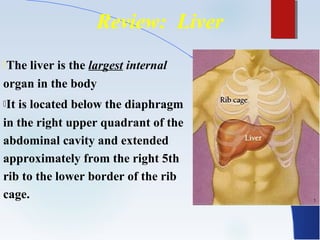
The liver is the largest internal
organ in the body
It is located below the diaphragm
in the right upper quadrant of the
abdominal cavity and extended
approximately from the right 5th
rib to the lower border of the rib
cage.
 .
The working cells of the liver are known
as hepatocytes, which have a unique capacity to
reproduce in response to liver injury.
Liver regeneration can occur after
surgical removal of a portion of the liver or
after injuries that destroy parts of the liver.
Although the liver's ability to react to
damage and repair itself is remarkable,
repetitive insults can produce liver failure and
death.


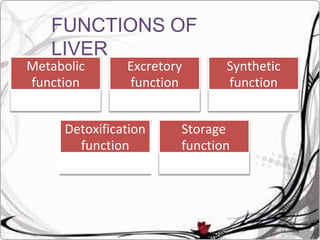
Metabolic
function
Excretory
function
Synthetic
function
Detoxification
function
Storage
function
FUNCTIONS OF
LIVER
Functions of liver
a. Excretory function: bile pigments, bile salts and
cholesterol are excreted in bile into intestine.
b. Metabolic function: liver actively participates in
carbohydrate, lipid, protein, mineral and vitamin
metabolisms.
c. Hematological function: liver is produces
clotting factors like factor V, VII. Fibrinogen
involved in blood coagulation is also synthesized
in liver. It synthesize plasma proteins and
destruction of erythrocytes.
④ Storage functions: glycogen, vitamins A, D and
B12,and trace element iron are stored in liver.
⑤ Protective functions and detoxification:
Ammonia is detoxified to urea. kupffer cells of
liver perform phagocytosis to eliminate foreign
compounds. Liver is responsible for the
metabolism of xenobiotic.
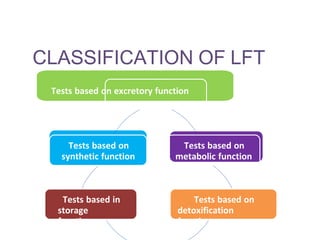
CLASSIFICATION OF LFT
Tests based on excretory function
Tests based on
metabolic function
Tests based on
detoxification
function
Tests based in
storage
function
Tests based on
synthetic function
Liver function tests are performed
usually to:
Detect presence of liver diseases.
Distinguish between different
types of liver disorders.
To know the extent of known liver damage.
Follow the response to treatment.
SHORTCOMINGS OF LFT’S
They can be normal in patients with
serious liver disease.
And abnormal in patients with diseases that
do not affect the liver.
Liver tests rarely suggest a specific
diagnosis; rather, they suggest a general
category of liver disease, such as
hepatocellular or cholestatic.
1.Serum bilirubin
2.Urine bilirubin
3.Urine urobilinogen
4.Urine bile salts
5.Dye excretion tests
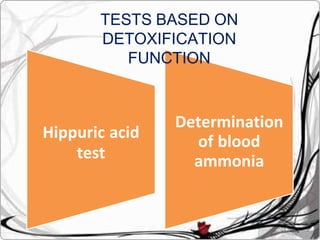
TESTS BASED ON
EXCRETORY FUNCTION
Hippuric acid
test
Determination
of blood
ammonia
TESTS BASED ON
DETOXIFICATION
FUNCTION
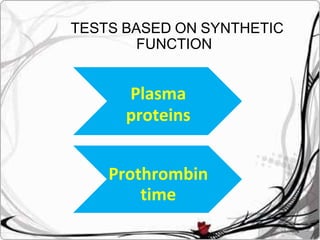
Plasma
proteins
Prothrombin
time
TESTS BASED ON SYNTHETIC
FUNCTION
Tests related to
CARBOHYDRAT
E
metabolism
Tests related
to
LIPID
metabolism
Tests
related
to PROTEIN
metabolism
Galactose tolerance
test
Serum cholesterol Serum proteins
Aminoaciduria
TESTS BASED ON
METABOLIC
FUNCTION
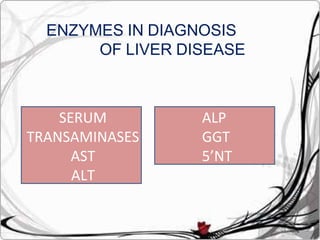
ENZYMES IN DIAGNOSIS
OF LIVER DISEASE
SERUM
TRANSAMINASES
AST
ALT
ALP
GGT
5’NT
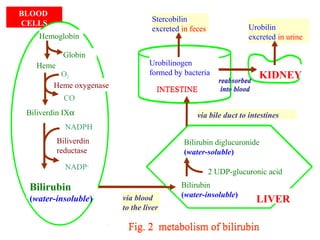
SERUM BILIRUBIN
Total bilirubin (<1mg/dl) is found in blood in 2
fractions
•Conjugated
bilirubin (<0.3mg/dl)
•Soluble in water
so excreted by
kidney
•Unconjugated
bilirubin
•Insoluble in water
so bound to albumin
in blood
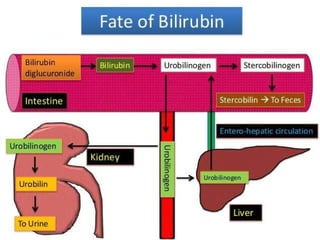
via bile duct to intestines
Stercobilin
excreted in feces
Urobilinogen
formed by bacteria KIDNEY
Urobilin
excreted in urine
BLOOD
CELLS
CO
Biliverdin IXα
Heme oxygenase
O2
Bilirubin
(water-insoluble)
NADP+
NADPH
Biliverdin
reductase
Heme
Globin
Hemoglobin
reabsorbed
into blood
LIVER
Bilirubin diglucuronide
(water-soluble)
2 UDP-glucuronic acid
Bilirubin
(water-insoluble)via blood
to the liver
INTESTINE
Fig. 2 metabolism of bilirubin
via bile duct to intestines
Stercobilin
excreted in feces
Urobilinogen
formed by bacteria KIDNEY
Urobilin
excreted in urine
BLOOD
CELLS
CO
Biliverdin IXα
Heme oxygenase
O2
Bilirubin
(water-insoluble)
NADP+
NADPH
Biliverdin
reductase
Heme
Globin
Hemoglobin
reabsorbed
into blood
LIVER
Bilirubin diglucuronide
(water-soluble)
2 UDP-glucuronic acid
Bilirubin
(water-insoluble)via blood
to the liver
INTESTINE
Fig. 2 metabolism of bilirubin
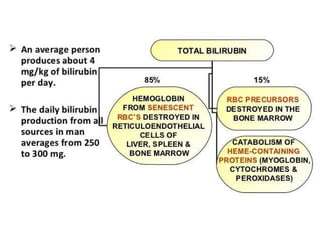
Significance of hyperbilirubinemia
•Daily production of bilirubin <500mg
•But normal liver can conjugate upto 1500mg/day
•So plasma bilirubin concentration is an insensitive
test for liver disease - since it begins to rise
only after significant liver damage has occured
CAUSES OF HYPERBILIRUBINEMIA
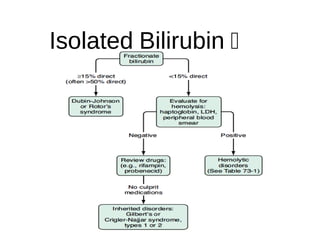
Isolated increase in unconjugated bilirubin is due to –
•Hemolytic disease
•Genetic disorders – crigler najjar and gilbert’s syndrome
•Neonatal jaundice/physiological jaundice
Isolated increase in conjugated bilirubin is due to –
•Genetic disorders – Dubin johnson syndrome and rotor’s
syndrome
Increase in both conjugated and unconjugated bilirubin is
due to –
1. Intrahepatic /liver disorders
Isolated Bilirubin 
DELTA BILIRUBIN / BILIPROTEIN
•When diseases/cholestasis prevents excretion
of conjugated bilirubin into bile
it enters the plasma
Filtered by the kidneys
Excreted in urine
•Some monoconjugated bilrubin can become
covalently bound to albumin
•This protein bound conjugated bilirubin is
known as - biliprotein or delta – bilirubin
•Normally present in very small amount
•Increases in cholestasis
•Half life is longer – 20 days (like albumin)
•Normally half life of conjugated bilirubin is
24 hrs
TESTS FOR SERUM BILIRUBIN
• Spectrophotometric method
• Diazo method
• Peroxidase method
• Diazo- peroxidase method
• HPLC (high performance liquid
chromatography)
• Transcutaneous
bilirubinometer
Van Den Bergh reaction
Serum bilirubin Diazotized sulphanilic
acid (Ehrlich diazo
reagent)
Azobilirubin( red)
Direct bilirubin – reading is taken at
one minute
Add activator /accelerator
2nd
reading at 30 minutes – Total
bilirubin
Measure absorbance at
Van Den Bergh reaction
It is a specific test for identification of
increased serum bilirubin levels.
Normal serum gives a negative van den
Bergh reaction.
Van den Bergh reagent is a mixture of equal
volumes of sulfanilic acid (in dilute
HCI)&sodium nitrite.
Principle:
Diazotised sulfanilic acid reacts with bilirubin
to form a purple coloured azobilirubin.
Direct and indirect reactions:
Bilirubin as such is insoluble in water while
the conjugated bilirubin is soluble.
Van den Bergh reagent reacts with
conjugated bilirubin & gives a purple
colour immediately (normally within 30
seconds. This is direct positive van den
Bergh reaction.
Addition of methanol (or alcohol)
dissolves
the unconjugated bilirubin & gives the
van
den Bergh reaction (normally within 30
minutes) positive.
This is indirect positive.
lf the serum contains both unconjugated and
conjugated bilirubin in high concentration, the
purple colour is produced immediately (direct
positive) which is further intensified
by the addition of alcohol (indirect positive).
This type of reaction is known as biphasic.
Direct positive - Obstructive jaundice
Indirect positive - Haemolytic jaundice
Biphasic - Hepatic jaundice
URINE BILIRUBIN
•Any bilirubin found in urine is conjugated bilirubin
•Presence of bilirubinuria is s/o liver disease
•Can be tested by dipstick test
When dipstick test show presence of urinary
bilirubin – confirmatory test to be done
•Ictotest tablet – based on diazotization reaction –
coupling of solid diazonium salt with bilirubin in an
acidic medium gives a
blue/purple color
•Ictotest can be used to rule out presence of any
interfering substance that give false positive reaction
with dipstick test
•While recovering from jaundice urine bilirubin clears
before serum bilirubin
•Presence of bilirubin in urine impart it dark brown
color
•Also fouchet’s test done – if bilirubin is present a
green color develops
due to formation of biliverdin
URINE UROBILINOGEN
(formed in intestine by bacterial action)
Increase in urine is sensitive indicator of
hepatocellular disease
•It is markedly increased in hemolysis
•In cholestatic jaundice urobilinogen disappears
from urine
•Urine strips are available
•Fresh urine should be used
•Ehrlich’s test – gives pink-red color
BILE SALTS
•Products of cholesterol metabolism
•Facilitate absorption of fat from intestine
•Constitute a substantial amount of bile in bilirubin
excretion and can be used in diagnosing cholestasis
•Primary bile salts – cholate and chenodeoxycholate are
produced in liver
Metabolised by bacteria in intestine
Produces secondary bile salts – lithocholate,
deoxycholate and ursodeoxycholate
•In cirrhosis – reduced ratio of primary to
secondary bile salts
•In cholestasis – as secondary bile salts are not
formed – so increased ratio of primary to
secondary bile salts
•In normal condition – renal excretion of bile salts is
negligible
•In cholestasis – increased renal excretion of bile
salts
•
•For measurement – chromatography (HPLC)
•Hay’s test – bile salts when present lower the
surface tension of urine
•When Sulphur powder is added to the urine,
Sulphur particles sink to the bottom of the tube
•In case of normal urine,
it will float on the surface
DYE EXCRETION TESTS
3 synthetic dyes are commonly employed
to test liver function
•Bromosulphthalein (BSP)
•Indocyanine green
•Rose bengal
Bromosulphthalein excretion test –
5ml/kg weight i.v is given
BSP is taken up by hepatocytes,
conjugated and excreted in bile
•A blood specimen is taken after 45 mins and 2
hrs
•After 45 mins – if >50% dye is retained in blood –
abnormal Liver function is present
•This test is useful in differentiating dubin johnson
from rotor syndrome
•In DJS – At 45 mins – normal blood levels of BSP
•At 2 hrs – higher level of BSP
•In rotor syndrome – at 45 mins – higher levels
•at 2 hrs – lower levels
Hippuric acid
test
Determination
of blood
ammonia
TESTS BASED ON
DETOXIFICATION
FUNCTION
BLOOD AMMONIA
•Produced in body by normal protein
metabolism and by intestinal bacteria
•For detoxification of ammonia
In liver
converted to
urea
Excreted by
kidneys
In striated
muscles
Combines with glutamic
acid
Forms
glutamine
Plasma
proteins
Prothrombin
time
TESTS BASED ON SYNTHETIC
FUNCTION
PROTEIN
•Liver is the sole site for synthesis of most plasma
proteins except immunoglobulins (gamma globulins)
•Serum albumin comprises 60% of all plasma proteins
TESTS FOR PROTEINS INCLUDE-
•Total serum proteins
•Serum albumin
•Sr albumin/globulin ratio
•Serum protein electrophoresis
•Prealbumin
•Procollagen III peptide
•Ceruloplasmin
•Alpha fetoprotein
•Alpha antitrypsin
ALBUMIN
•Synthesized exclusively by liver
•Its half life is 18-20 days
•Due to its slow turn over – not a good indicator
of acute or mild hepatic dysfunction
•In hepatitis - <3g/dl of albumin – possibility of
chronic liver disease
•Non hepatic causes of Hypoalbuminemia -
•Protein losing enteropathy
•Nephrotic syndrome
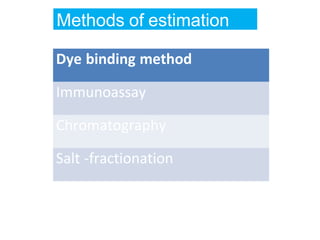
Methods of estimation
Dye binding method
Immunoassay
Chromatography
Salt -fractionation
BROMOCRESYL GREEN METHOD
•Most common
method
•The complex becomes blue in color
•Absorbance at 632 nm is directly proportional
to
the concentration of albumin
GLOBULINS
•Made up of – alpha, beta and gamma globulins
•Gamma globulin is produced by plasma cells
•alpha and beta globulins are synthesized in liver
•In cirrhosis – gamma globulin is increased
•Cirrhotic liver fails to clear bacterial antigens that
normally reach the liver – Abs are formed against such
Ags
– so , increased gamma globulin
•Polyclonal gamma globulin if increases by 100% -
autoimmune hepatitis
•Increased IgM – primary biliary cirrhosis
•Increased IgA – alcoholic liver disease
PREALBUMIN /TRANSTHYRETIN
• Levels fall in liver disease
• Half life – 2 days
• Sensitive indicator of any changes affecting
its synthesis and catabolism
• PAB is a negative acute phase reactant
• Particularly useful in drug-induced
hepatotoxicity
• Normal plasma levels - 0.2-0.4g/L
• Acute phase protein
• Decreased in multiple conditions
–
• Wilson’s disease
• Menkes disease
• Aceruloplasminemia
• Copper deficiency
CERULOPLASMIN
Increased in –
1.Copper toxicity
2.Pregnancy
3.OCPs
COAGULATION FACTORS
•With the exception of F-VIII , all other factors are
synthesized in liver
•Half life ranges from 6hrs for F-VII to 5 days for
fibrinogen
•So their measurement is the single best measure of
hepatic synthetic function
•Tests – Serum prothrombin time
•Marked increase in PT >5secs above the control and not
corrected by Vit K administration – is a poor prognostic
sign in acute viral hepatitis and other acute and
chronic liver disease
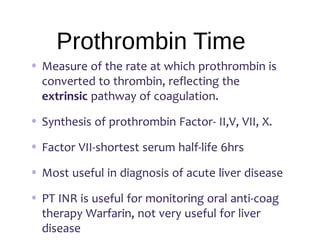
Prothrombin Time
• Measure of the rate at which prothrombin is
converted to thrombin, reflecting the
extrinsic pathway of coagulation.
• Synthesis of prothrombin Factor- II,V, VII, X.
• Factor VII-shortest serum half-life 6hrs
• Most useful in diagnosis of acute liver disease
• PT INR is useful for monitoring oral anti-coag
therapy Warfarin, not very useful for liver
disease
• Causes of prolonged
P.T• hepatic
dysfunction,• congenital deficiency of clotting factors,
• vitamin K deficiency (vitamin K is required for
normal functioning of factors II, VII, IX, and X)
• disseminated intravascular coagulation
(DIC).
• DIC identified by measuring a factor VIII level in
serum.
3. Metabolic capacity:
Tests based on livers part in carbohydrate
metabolism
1. Glucose tolerance test
Not of much value in liver diseases
It is often difficult to separate the part played
by the liver from other factors influencing
glucose metabolism.
2. Galactose tolerance test.
Basis:
Galactose is a monosaccharide, almost exclusively
metabolized by the liver. the normal liver is able to
convert galactose into glucose; but this function is
impaired in intrahepatic disease and the amount of blood
galactose and urine galactose is excessive.
The liver can be assessed by measuring the utilization of
galactose. This is referred to galactose tolerance test.
◆It is used primarily to detect liver cell injury.
◆It can be performed in presence of jaundice.
◆As it measures an intrinsic hepatic function, it
may be used to distinguish obstructive and non
obstructive jaundice.
Tests based on livers part in lipids metabolism
Cholesterol-cholesteryl ester ratio:
The liver plays an active and important role in the
metabolism of cholesterol including its synthesis,
esterification, oxidation and excretion.
Normal total blood cholesterol ranges from 150 ~ 250mg/dl
and approx. 60 to 70% of this is in esterified form.
In parenchymatous liver disease:
there is either no rise or even decrease in total cholesterol
and the ester fraction is always definitely reduced. the degree
of reduction roughly parallels the degree of liver damage.
In severe acute hepatic necrosis:
the total serum cholesterol is usually low and may fall
below 100mg/dl, whilst there is marked reduction in the %
present as esters.
Tests based on livers part in amino acid metabolism
Determination of
BLOOD AMMONIA
Nitrogen part of amino acid is converted to NH3 in the liver
mainly by transamination and deamination and it is converted
to urea in liver only .
Normal range : 15 to 45 mcg/dl
Increases in NH3 can be found in more advanced cases of liver cirrhosis, particular
when there are associated neurological complications.in such cases blood levels
may be over 200 μ g/ml.
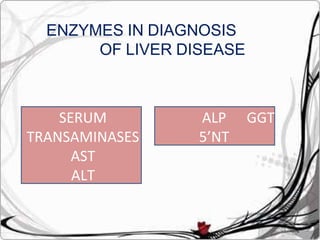
ENZYMES IN DIAGNOSIS
OF LIVER DISEASE
SERUM
TRANSAMINASES
AST
ALT
ALP GGT
5’NT
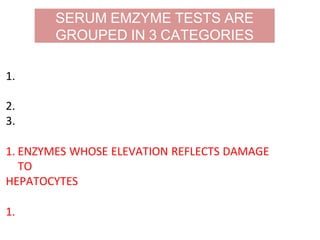
1. Enzymes whose elevation reflects damage to
hepatocytes
2. Enzymes whose elevation reflects cholestasis
3. Enzyme test that do not fit into either pattern
1. ENZYMES WHOSE ELEVATION REFLECTS DAMAGE
TO
HEPATOCYTES
1. AMINOTRANSFERASES (transaminases) – AST and
ALT
SERUM EMZYME TESTS ARE
GROUPED IN 3 CATEGORIES
• AST(SGOT) – found in liver> cardiac muscle > skeletal
muscle> kidneys >brain
• ALT(SGPT) – found primarily in liver
• Normally present in serum in low concentration (0-
40 IU/L)
• When there is damage to liver cell membrane –
increased permeability and so increased serum
concentration
• Liver cell necrosis is not required for release of these
enzymes
•Levels of >1000 IU/L occurs in –
•Acute viral hepatitis
•Toxin and drug induced hepatitis
•Ischaemic liver injury
•In most acute hepatocellular disorders ALT is higher or
equal to AST
• Normal ratio is 0.7 to 1.4
• Useful in Wilson disease, chronic liver disease
and alcoholic liver disease
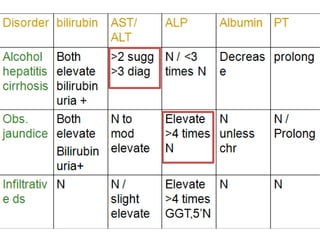
• AST/ALT ratio of > 2:1 is suggestive of and
>3:1
is highly suggestive of ALCOHOLIC liver disease
• AST in Alcoholic live disease is rarely >300
IU/L
AST/ALT RATIO
• ALT is usually normal in alcoholic liver disease ;
can be sometimes low due to an alcohol induced
deficiency of pyridoxal phosphate
• AST/ALT <1 is seen in NASH and viral hepatitis
• Isolated rise of ALT is seen
in
• Chronic HepC infection
• Fatty liver
• Isolated AST elevation
1. Alcohol -related
• Drug -induced liver injury,
• Hemolysis
• Myopathic processes
•Determination of these enzymes are helpful in
distinguishing hepatocellular from cholestatic
jaundice
•Increase in AST and ALT is much more ( >500
IU/L)in hepatocellular jaundice than in cholestatic
jaundice (>200 IU/L)
•Persistence of elevated ALT and AST beyond 6
months in a case of hepatitis indicates development
of chronic hepatitis
3 enzyme activities are important –
•Alkaline phosphatase (ALP)
•5’ nucleotidase ;5’NT
•Gamma glutamyl transferase (GGT)
ALP – found in liver , bone , placenta and small
intestine Physiological increase in ALP is seen in –
1.>60 yrs
2.Pregnancy
ENZYMES WHOSE
ELEVATION REFLECTS
CHOLESTASIS
3. Blood groups O and B – after fatty meal influx
of intestinal ALP into blood
4. In children and adolescent during rapid bone
growth
ALP >4 times the Normal is seen in –
3. Cholestatic liver disease
4. Infiltrative liver disease such as cancer and
amyloidosis
3. Paget’s disease of bone.
•If an isolated increase in ALP is seen , identification
of the source of elevated isoenzyme is helpful-
•Fractionation of ALP by electrophoresis
•Different isoenzymes have diiferent susceptibility
to inactivation by heat
•If increased heat stable fraction is found – MC
from placenta
•Most sensitive to heat inactivation is – bone ALP
3. Measure serum levels of GGT and 5’NT – they are
elevated in only liver disease
• Serum GGT is increased in –
1.Alcoholism- Is a helpful clue in suspected cases
of alcoholism ( even in absence of alcoholic liver
disease)
2.Cholestasis
• GGT and 5’NT is especially used to assess the
nature of ALP
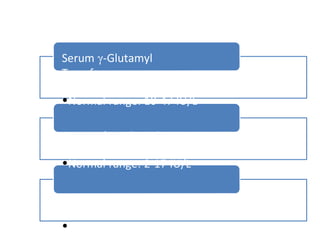
Serum γ-Glutamyl
Transferase
•Normal range: 10-47 IU/L
Serum 5’-Nucleotidase
•Normal range: 2-17 IU/L
Serum alkaline phosphatase
•Normal range: 39-117 IU/L
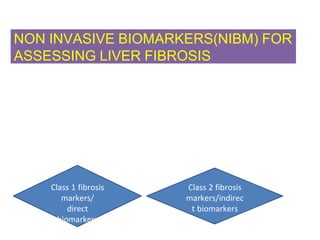
NON INVASIVE BIOMARKERS(NIBM) FOR
ASSESSING LIVER FIBROSIS
•For assessing live fibrosis – liver biopsy is a
preferred method
•Utilization of NIBM for liver histology can
reduce but not replace the requirement for liver
biopsy
•Classification of NIBMs
Class 1 fibrosis
markers/
direct
biomarkers
Class 2 fibrosis
markers/indirec
t biomarkers
DIRECT BIOMARKERS
–•These are parts of liver matrix produced
by
stellate cells during fibrosis process
•These include
Procollagen type 1 and 2
Type IV collagen
Hyaluronic acid
Laminin
MMP-1 (collagenases)
MMP-2 (gelatinase A)
MMP-9 (gelatinase B)
TIMPs (tissue inhibitor of matrix metalloproteinase)
INDIRECT MARKERS
–•These are molecules released into blood due to liver
inflammation
•These include
•Serum ALT
•Serum AST/ALT ratio (AAR) - >1 predictive of
cirrhosis
3. BARD score – AAR + BMI + diabetes
4. AST/platelet ratio (APRI)
5. PGA index – a marker to differentiate
alcoholic liver disease from cirrhosis
Includes – GTT + prothrombin index +
apolipoprotein A
5. Fibrotest and fibrosure
6. Fibro index
7. FIB – 4 score
8. Fibro Q test
9. Steato test
For assessing fibrosis in HIV/HBV
coinfected
patients –
1.Fibrometer
2.Hepascore
1.synthetic function : albumin, clotting
time
2.cholestasis : bilirubin, ALP, GGT
3.hepatocyte injury : AST, ALT
Renal function
tests
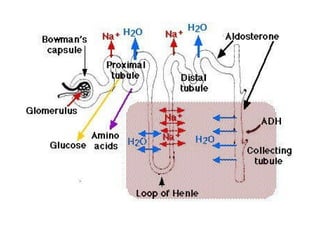
The functional unit of kidney - NEPHRON
Functions of Kidney
• Formation of Urine as the waste product
• Excretion of Urea, Creatinine and Uric acid
• Regulation of water, electrolytes & acid-base
balance
• Production of hormones – Erythropoietin,
renin & calcitriol
Assessment of Renal Function
Is done for
•Assessment of the extent of renal damage
•Monitoring the progression of renal disease
•Monitoring & adjusting the dose of renal toxic
drugs
RFT is devised to give information regarding following parameters
• Renal blood flow
• Glomerular Filtration Rate
• Urine output
Renal tubular function
Renal Glomeruli
Function
RFT .
1. Urine analysis
- Physical examination
- Chemical examination
- Microscopic examination
2. Assessment of Glomerular function
- Renal Clearance tests
1.Blood analaysis of Urea &
Creatinine
2.Proteinuria
3.Hematuria
RFT
3. Tests to measure renal plasma flow
1.Para amino Hippurate test
• Tests for assessment of tubular function
3.Urine concentration test
4.Urine dilution test
- Specific proteinuria or tubular
proteinuria
3.aminoaciduria
4.Phenosulfonphthalein test (PSP)
1. Renal Biopsy
1.to confirm the diagnosis & renal
diseases
.
RFT - Tests for Glomerular Function
Renal Clearance Tests
To assess the rate of glomerular
filtration & renal blood flow.
“The renal clearance of a on substance is defined
as the volume of plasma from which the
substance is completely cleared by the kidneys
per minute.”
This
- plasma conc. Of the substance & it’s
excretary rateDepend
On
-
GFR-
Renal plasma flow
Renal Clearance Tests
• The GFR (Normal = 120 ml/minute )
• Usually equal to clearance of that substance and is
calculated by the following equation
C = U x V
P
where,
C = clearance of the substance (ml/mt)
U = Conc.of substance in urine (mg/L)
P = Conc.of substance in plasma(mg/L)
V = Vol.of the urine passed per minute
CRITERIA FOR IDEAL GFR MARKER
-freely filtered by glomerulus
-should not be reabsorbed or secreted
-should not be metabolized in the kidney
-should not be toxic
-should not be affected by dietary intake
• The substances which are used for Clearance tests
include :
Endogenous -
-
-
Creatinine
Urea
InulinExogenous
Creatinine Clearance Test
• Based on the rate of excretion by the kidneys of
metabolocally produced creatinine
• Creatinine freely filtered in the glomerulus
• Not reabsorbed by the tubules
(a small amount of creatinine is produced by the
tubules)
Creatinine Clearance Test
• Creatinine clearance is determined by
- collecting urine over 24hrs. Period
- a sample of blood is drawn during the
urine collection period.
Creatinine Clearance = U x V
P
U = Urinary creatinine(mg/L) P = Plasma creatinine
(mg/L)
V = Volume of urine per minute
Creatinine Clearance Test
• Creatinine Clearance Normal range 90-120 ml/mt
• ↓ Creat. Clearance is very sensitive indicator of
decreased GFR
• ↓ GFR may be caused by
Acute or Chronic damage to glomerulus or any of its
components
• ↓ Blood flow to glomerulus may also produce
decreased creat.clearance
Urea Clearance Test
• The sensitivity of urea clearance is much less than
the creatinine clearance because—
-plasma conc. Of urea is affected by number of
factors
e.g : dietary protein
fluid intake
infection
surgery, etc…
- Approximately 40 % of filtered urea is normally
reabsorbed by the tubules.
• Normal value of Urea clearance : 75 ml/mt.
Inulin Clearance Test
• Method of choice when accurate determination of
GFR is required.
• Inulin is polysacharide of Fructose.
• freely filtered by glomerulus
• not reabsorbed
• not secreted or metabolically altered by the renal
tubule.
• Normal value : 120 ml/mt.
Disadvantages : need for its IV adminstration
technically difficulty of analysis
Blood analysis of Urea & Creatinine
• Impairment of renal function results in elevation
of Blood Urea ( normal : 20 – 40 mg/dl )
Creatinine ( normal : 0.5 – 1.5 mg/dl )
• Plasma urea is less reliable than creatinine
because it is affected by dietary protein & liver
function
• So, Creatinine is more sensitive Renal Function
Test.
• Uremia :
• Pre renal uremia :
- Dehydration
- diarrhea,
- Severe vomiting
- Diabetic coma.
- severe burns
- intestinal obstruction ,
- Fever and severe infections
• Renal uremia :
- Acute glomerulonephritis
- Nephrosis
- Malignant hypertension
- Chronic pyelonephritis
• Post –renal uremia :
- Stones in urinary tract
- Enlarged prostate
- Tumors of bladder
Urine analysis
• Physical examination
• Chemical examination
• Microscopic examination
Physical examination
- Volume
- odor
- Appearance ( color)
- pH
- Sp.Gravity
.
•Volume : 800 – 2,500 ml ( average: 1500 ml /day)
Polyurea ( > 2500 ml/day )
-Diabetes insipidus
-later stages of Chronic glomerulonephritis
Oliguria : ( < 500 ml/ day )
-Fever, diarrhoea
-early stages of glomerulo nephritis
-cardiac failure
,
Anuria : complete cessation of urine
- Acute tubular necrosis
- B/l. Renal stones
- Surgical Shock.
• Appearance & Color :
- Normal urine – transparent
amber color
- Turbity : indicate infection
pale yellow or
Nephrotic syndrome .. fat particles
- Reddish coloration – hematuria
(Renal stones, cancer etc.)
Urine analysis
pH : normally- Acidic with pH 6.0 (range 5.5 – 7.5)
Alkaline – found in UTI
• Odour : Normal – aromatic
• foul smell – indicates bacterial infection.
• Renal threshold
Renal threshold of a substance is the plasma level
above which the compound is excreted in
Urine.
Glucose
Lactate
180 mg/dl
60 mg/dl
.
• Chemical examination :
- Glucose
- Protein
- Blood
– glycosuria
– proteinuria
• —hematuria
• Albuminuria
• Benign proteinuria300 mg/day
300-1000 mg/day
> 1000 mg/day
pathological proteinuria
glomerular proteinuria
Micro-albuminuria : (30-300 mg/day ) Early indication of
Nephropathy in pts. With Diabetes and
hypertension.
• Microscopic examination :
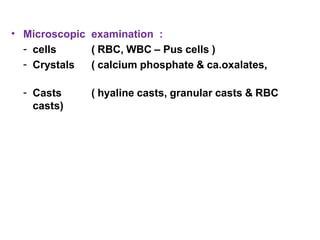
- cells ( RBC, WBC – Pus cells )
- Crystals ( calcium phosphate & ca.oxalates,
amorphos phosphates )
- Casts ( hyaline casts, granular casts & RBC
casts)
Tests for tubular function
1) Specific gravity of urine – Normal 1.015-1.025
•This is an indication of osmolality.
•In case of proteinuria - S.G. elevated.
•Earliest manifestation of renal disease may be
difficulty in concentrating the urine.
•↓ Sp.gr.— excessive water intake, Ch. Nephritis, Diabetes
Insipidus
•↑Sp.gr.— diabetes mellitus, nephrosis, Ch. Renal failure.
•Fixed sp.gr. at 1.010  isosthenuria — earliest manifestation of
renal damage.
Concentration test :
•Bladder is emptied in the morning. Specimen
discarded.
•Second specimen after one hour collected and
specific gravity measured.
•Sp.gr. >1.022  adequate renal function.
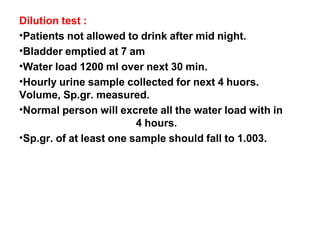
Dilution test :
•Patients not allowed to drink after mid night.
•Bladder emptied at 7 am
•Water load 1200 ml over next 30 min.
•Hourly urine sample collected for next 4 huors.
Volume, Sp.gr. measured.
•Normal person will excrete all the water load with in
4 hours.
•Sp.gr. of at least one sample should fall to 1.003.
Liver and renal functional tests

Liver and renal functional tests

  • 1.
  • 2.
    Review: Liver The liveris the largest internal organ in the body It is located below the diaphragm in the right upper quadrant of the abdominal cavity and extended approximately from the right 5th rib to the lower border of the rib cage.
  • 3.
     . The workingcells of the liver are known as hepatocytes, which have a unique capacity to reproduce in response to liver injury. Liver regeneration can occur after surgical removal of a portion of the liver or after injuries that destroy parts of the liver. Although the liver's ability to react to damage and repair itself is remarkable, repetitive insults can produce liver failure and death.  
  • 4.
  • 5.
    Functions of liver a.Excretory function: bile pigments, bile salts and cholesterol are excreted in bile into intestine. b. Metabolic function: liver actively participates in carbohydrate, lipid, protein, mineral and vitamin metabolisms. c. Hematological function: liver is produces clotting factors like factor V, VII. Fibrinogen involved in blood coagulation is also synthesized in liver. It synthesize plasma proteins and destruction of erythrocytes.
  • 6.
    ④ Storage functions:glycogen, vitamins A, D and B12,and trace element iron are stored in liver. ⑤ Protective functions and detoxification: Ammonia is detoxified to urea. kupffer cells of liver perform phagocytosis to eliminate foreign compounds. Liver is responsible for the metabolism of xenobiotic.
  • 7.
    CLASSIFICATION OF LFT Testsbased on excretory function Tests based on metabolic function Tests based on detoxification function Tests based in storage function Tests based on synthetic function
  • 8.
    Liver function testsare performed usually to: Detect presence of liver diseases. Distinguish between different types of liver disorders. To know the extent of known liver damage. Follow the response to treatment.
  • 9.
    SHORTCOMINGS OF LFT’S Theycan be normal in patients with serious liver disease. And abnormal in patients with diseases that do not affect the liver. Liver tests rarely suggest a specific diagnosis; rather, they suggest a general category of liver disease, such as hepatocellular or cholestatic.
  • 10.
    1.Serum bilirubin 2.Urine bilirubin 3.Urineurobilinogen 4.Urine bile salts 5.Dye excretion tests TESTS BASED ON EXCRETORY FUNCTION
  • 11.
  • 12.
  • 13.
    Tests related to CARBOHYDRAT E metabolism Testsrelated to LIPID metabolism Tests related to PROTEIN metabolism Galactose tolerance test Serum cholesterol Serum proteins Aminoaciduria TESTS BASED ON METABOLIC FUNCTION
  • 14.
    ENZYMES IN DIAGNOSIS OFLIVER DISEASE SERUM TRANSAMINASES AST ALT ALP GGT 5’NT
  • 15.
    SERUM BILIRUBIN Total bilirubin(<1mg/dl) is found in blood in 2 fractions •Conjugated bilirubin (<0.3mg/dl) •Soluble in water so excreted by kidney •Unconjugated bilirubin •Insoluble in water so bound to albumin in blood
  • 16.
    via bile ductto intestines Stercobilin excreted in feces Urobilinogen formed by bacteria KIDNEY Urobilin excreted in urine BLOOD CELLS CO Biliverdin IXα Heme oxygenase O2 Bilirubin (water-insoluble) NADP+ NADPH Biliverdin reductase Heme Globin Hemoglobin reabsorbed into blood LIVER Bilirubin diglucuronide (water-soluble) 2 UDP-glucuronic acid Bilirubin (water-insoluble)via blood to the liver INTESTINE Fig. 2 metabolism of bilirubin via bile duct to intestines Stercobilin excreted in feces Urobilinogen formed by bacteria KIDNEY Urobilin excreted in urine BLOOD CELLS CO Biliverdin IXα Heme oxygenase O2 Bilirubin (water-insoluble) NADP+ NADPH Biliverdin reductase Heme Globin Hemoglobin reabsorbed into blood LIVER Bilirubin diglucuronide (water-soluble) 2 UDP-glucuronic acid Bilirubin (water-insoluble)via blood to the liver INTESTINE Fig. 2 metabolism of bilirubin
  • 19.
    Significance of hyperbilirubinemia •Dailyproduction of bilirubin <500mg •But normal liver can conjugate upto 1500mg/day •So plasma bilirubin concentration is an insensitive test for liver disease - since it begins to rise only after significant liver damage has occured
  • 20.
    CAUSES OF HYPERBILIRUBINEMIA Isolatedincrease in unconjugated bilirubin is due to – •Hemolytic disease •Genetic disorders – crigler najjar and gilbert’s syndrome •Neonatal jaundice/physiological jaundice Isolated increase in conjugated bilirubin is due to – •Genetic disorders – Dubin johnson syndrome and rotor’s syndrome Increase in both conjugated and unconjugated bilirubin is due to – 1. Intrahepatic /liver disorders
  • 21.
  • 22.
    DELTA BILIRUBIN /BILIPROTEIN •When diseases/cholestasis prevents excretion of conjugated bilirubin into bile it enters the plasma Filtered by the kidneys Excreted in urine •Some monoconjugated bilrubin can become covalently bound to albumin
  • 23.
    •This protein boundconjugated bilirubin is known as - biliprotein or delta – bilirubin •Normally present in very small amount •Increases in cholestasis •Half life is longer – 20 days (like albumin) •Normally half life of conjugated bilirubin is 24 hrs
  • 24.
    TESTS FOR SERUMBILIRUBIN • Spectrophotometric method • Diazo method • Peroxidase method • Diazo- peroxidase method • HPLC (high performance liquid chromatography) • Transcutaneous bilirubinometer
  • 25.
    Van Den Berghreaction Serum bilirubin Diazotized sulphanilic acid (Ehrlich diazo reagent) Azobilirubin( red) Direct bilirubin – reading is taken at one minute Add activator /accelerator 2nd reading at 30 minutes – Total bilirubin Measure absorbance at
  • 26.
    Van Den Berghreaction It is a specific test for identification of increased serum bilirubin levels. Normal serum gives a negative van den Bergh reaction. Van den Bergh reagent is a mixture of equal volumes of sulfanilic acid (in dilute HCI)&sodium nitrite.
  • 27.
    Principle: Diazotised sulfanilic acidreacts with bilirubin to form a purple coloured azobilirubin. Direct and indirect reactions: Bilirubin as such is insoluble in water while the conjugated bilirubin is soluble.
  • 28.
    Van den Berghreagent reacts with conjugated bilirubin & gives a purple colour immediately (normally within 30 seconds. This is direct positive van den Bergh reaction. Addition of methanol (or alcohol) dissolves the unconjugated bilirubin & gives the van den Bergh reaction (normally within 30 minutes) positive. This is indirect positive.
  • 29.
    lf the serumcontains both unconjugated and conjugated bilirubin in high concentration, the purple colour is produced immediately (direct positive) which is further intensified by the addition of alcohol (indirect positive). This type of reaction is known as biphasic.
  • 30.
    Direct positive -Obstructive jaundice Indirect positive - Haemolytic jaundice Biphasic - Hepatic jaundice
  • 31.
    URINE BILIRUBIN •Any bilirubinfound in urine is conjugated bilirubin •Presence of bilirubinuria is s/o liver disease •Can be tested by dipstick test When dipstick test show presence of urinary bilirubin – confirmatory test to be done •Ictotest tablet – based on diazotization reaction – coupling of solid diazonium salt with bilirubin in an acidic medium gives a blue/purple color
  • 32.
    •Ictotest can beused to rule out presence of any interfering substance that give false positive reaction with dipstick test •While recovering from jaundice urine bilirubin clears before serum bilirubin •Presence of bilirubin in urine impart it dark brown color •Also fouchet’s test done – if bilirubin is present a green color develops due to formation of biliverdin
  • 33.
    URINE UROBILINOGEN (formed inintestine by bacterial action) Increase in urine is sensitive indicator of hepatocellular disease •It is markedly increased in hemolysis •In cholestatic jaundice urobilinogen disappears from urine •Urine strips are available •Fresh urine should be used •Ehrlich’s test – gives pink-red color
  • 34.
    BILE SALTS •Products ofcholesterol metabolism •Facilitate absorption of fat from intestine •Constitute a substantial amount of bile in bilirubin excretion and can be used in diagnosing cholestasis •Primary bile salts – cholate and chenodeoxycholate are produced in liver Metabolised by bacteria in intestine
  • 35.
    Produces secondary bilesalts – lithocholate, deoxycholate and ursodeoxycholate •In cirrhosis – reduced ratio of primary to secondary bile salts •In cholestasis – as secondary bile salts are not formed – so increased ratio of primary to secondary bile salts
  • 36.
    •In normal condition– renal excretion of bile salts is negligible •In cholestasis – increased renal excretion of bile salts • •For measurement – chromatography (HPLC) •Hay’s test – bile salts when present lower the surface tension of urine •When Sulphur powder is added to the urine, Sulphur particles sink to the bottom of the tube •In case of normal urine, it will float on the surface
  • 37.
    DYE EXCRETION TESTS 3synthetic dyes are commonly employed to test liver function •Bromosulphthalein (BSP) •Indocyanine green •Rose bengal Bromosulphthalein excretion test – 5ml/kg weight i.v is given BSP is taken up by hepatocytes, conjugated and excreted in bile
  • 38.
    •A blood specimenis taken after 45 mins and 2 hrs •After 45 mins – if >50% dye is retained in blood – abnormal Liver function is present •This test is useful in differentiating dubin johnson from rotor syndrome •In DJS – At 45 mins – normal blood levels of BSP •At 2 hrs – higher level of BSP •In rotor syndrome – at 45 mins – higher levels •at 2 hrs – lower levels
  • 39.
  • 40.
    BLOOD AMMONIA •Produced inbody by normal protein metabolism and by intestinal bacteria •For detoxification of ammonia In liver converted to urea Excreted by kidneys In striated muscles Combines with glutamic acid Forms glutamine
  • 41.
  • 42.
    PROTEIN •Liver is thesole site for synthesis of most plasma proteins except immunoglobulins (gamma globulins) •Serum albumin comprises 60% of all plasma proteins TESTS FOR PROTEINS INCLUDE- •Total serum proteins •Serum albumin •Sr albumin/globulin ratio •Serum protein electrophoresis •Prealbumin •Procollagen III peptide •Ceruloplasmin •Alpha fetoprotein •Alpha antitrypsin
  • 43.
    ALBUMIN •Synthesized exclusively byliver •Its half life is 18-20 days •Due to its slow turn over – not a good indicator of acute or mild hepatic dysfunction •In hepatitis - <3g/dl of albumin – possibility of chronic liver disease •Non hepatic causes of Hypoalbuminemia - •Protein losing enteropathy •Nephrotic syndrome
  • 44.
    Methods of estimation Dyebinding method Immunoassay Chromatography Salt -fractionation
  • 45.
    BROMOCRESYL GREEN METHOD •Mostcommon method •The complex becomes blue in color •Absorbance at 632 nm is directly proportional to the concentration of albumin
  • 46.
    GLOBULINS •Made up of– alpha, beta and gamma globulins •Gamma globulin is produced by plasma cells •alpha and beta globulins are synthesized in liver •In cirrhosis – gamma globulin is increased •Cirrhotic liver fails to clear bacterial antigens that normally reach the liver – Abs are formed against such Ags – so , increased gamma globulin •Polyclonal gamma globulin if increases by 100% - autoimmune hepatitis •Increased IgM – primary biliary cirrhosis •Increased IgA – alcoholic liver disease
  • 47.
    PREALBUMIN /TRANSTHYRETIN • Levelsfall in liver disease • Half life – 2 days • Sensitive indicator of any changes affecting its synthesis and catabolism • PAB is a negative acute phase reactant • Particularly useful in drug-induced hepatotoxicity
  • 48.
    • Normal plasmalevels - 0.2-0.4g/L • Acute phase protein • Decreased in multiple conditions – • Wilson’s disease • Menkes disease • Aceruloplasminemia • Copper deficiency CERULOPLASMIN
  • 49.
    Increased in – 1.Coppertoxicity 2.Pregnancy 3.OCPs
  • 50.
    COAGULATION FACTORS •With theexception of F-VIII , all other factors are synthesized in liver •Half life ranges from 6hrs for F-VII to 5 days for fibrinogen •So their measurement is the single best measure of hepatic synthetic function •Tests – Serum prothrombin time •Marked increase in PT >5secs above the control and not corrected by Vit K administration – is a poor prognostic sign in acute viral hepatitis and other acute and chronic liver disease
  • 51.
    Prothrombin Time • Measureof the rate at which prothrombin is converted to thrombin, reflecting the extrinsic pathway of coagulation. • Synthesis of prothrombin Factor- II,V, VII, X. • Factor VII-shortest serum half-life 6hrs • Most useful in diagnosis of acute liver disease • PT INR is useful for monitoring oral anti-coag therapy Warfarin, not very useful for liver disease
  • 52.
    • Causes ofprolonged P.T• hepatic dysfunction,• congenital deficiency of clotting factors, • vitamin K deficiency (vitamin K is required for normal functioning of factors II, VII, IX, and X) • disseminated intravascular coagulation (DIC). • DIC identified by measuring a factor VIII level in serum.
  • 53.
  • 54.
    Tests based onlivers part in carbohydrate metabolism 1. Glucose tolerance test Not of much value in liver diseases It is often difficult to separate the part played by the liver from other factors influencing glucose metabolism.
  • 55.
    2. Galactose tolerancetest. Basis: Galactose is a monosaccharide, almost exclusively metabolized by the liver. the normal liver is able to convert galactose into glucose; but this function is impaired in intrahepatic disease and the amount of blood galactose and urine galactose is excessive. The liver can be assessed by measuring the utilization of galactose. This is referred to galactose tolerance test.
  • 56.
    ◆It is usedprimarily to detect liver cell injury. ◆It can be performed in presence of jaundice. ◆As it measures an intrinsic hepatic function, it may be used to distinguish obstructive and non obstructive jaundice.
  • 57.
    Tests based onlivers part in lipids metabolism Cholesterol-cholesteryl ester ratio: The liver plays an active and important role in the metabolism of cholesterol including its synthesis, esterification, oxidation and excretion. Normal total blood cholesterol ranges from 150 ~ 250mg/dl and approx. 60 to 70% of this is in esterified form.
  • 58.
    In parenchymatous liverdisease: there is either no rise or even decrease in total cholesterol and the ester fraction is always definitely reduced. the degree of reduction roughly parallels the degree of liver damage. In severe acute hepatic necrosis: the total serum cholesterol is usually low and may fall below 100mg/dl, whilst there is marked reduction in the % present as esters.
  • 59.
    Tests based onlivers part in amino acid metabolism Determination of BLOOD AMMONIA Nitrogen part of amino acid is converted to NH3 in the liver mainly by transamination and deamination and it is converted to urea in liver only . Normal range : 15 to 45 mcg/dl Increases in NH3 can be found in more advanced cases of liver cirrhosis, particular when there are associated neurological complications.in such cases blood levels may be over 200 μ g/ml.
  • 60.
    ENZYMES IN DIAGNOSIS OFLIVER DISEASE SERUM TRANSAMINASES AST ALT ALP GGT 5’NT
  • 61.
    1. Enzymes whoseelevation reflects damage to hepatocytes 2. Enzymes whose elevation reflects cholestasis 3. Enzyme test that do not fit into either pattern 1. ENZYMES WHOSE ELEVATION REFLECTS DAMAGE TO HEPATOCYTES 1. AMINOTRANSFERASES (transaminases) – AST and ALT SERUM EMZYME TESTS ARE GROUPED IN 3 CATEGORIES
  • 62.
    • AST(SGOT) –found in liver> cardiac muscle > skeletal muscle> kidneys >brain • ALT(SGPT) – found primarily in liver • Normally present in serum in low concentration (0- 40 IU/L) • When there is damage to liver cell membrane – increased permeability and so increased serum concentration • Liver cell necrosis is not required for release of these enzymes
  • 63.
    •Levels of >1000IU/L occurs in – •Acute viral hepatitis •Toxin and drug induced hepatitis •Ischaemic liver injury •In most acute hepatocellular disorders ALT is higher or equal to AST
  • 64.
    • Normal ratiois 0.7 to 1.4 • Useful in Wilson disease, chronic liver disease and alcoholic liver disease • AST/ALT ratio of > 2:1 is suggestive of and >3:1 is highly suggestive of ALCOHOLIC liver disease • AST in Alcoholic live disease is rarely >300 IU/L AST/ALT RATIO
  • 65.
    • ALT isusually normal in alcoholic liver disease ; can be sometimes low due to an alcohol induced deficiency of pyridoxal phosphate • AST/ALT <1 is seen in NASH and viral hepatitis
  • 66.
    • Isolated riseof ALT is seen in • Chronic HepC infection • Fatty liver • Isolated AST elevation 1. Alcohol -related • Drug -induced liver injury, • Hemolysis • Myopathic processes
  • 67.
    •Determination of theseenzymes are helpful in distinguishing hepatocellular from cholestatic jaundice •Increase in AST and ALT is much more ( >500 IU/L)in hepatocellular jaundice than in cholestatic jaundice (>200 IU/L) •Persistence of elevated ALT and AST beyond 6 months in a case of hepatitis indicates development of chronic hepatitis
  • 68.
    3 enzyme activitiesare important – •Alkaline phosphatase (ALP) •5’ nucleotidase ;5’NT •Gamma glutamyl transferase (GGT) ALP – found in liver , bone , placenta and small intestine Physiological increase in ALP is seen in – 1.>60 yrs 2.Pregnancy ENZYMES WHOSE ELEVATION REFLECTS CHOLESTASIS
  • 69.
    3. Blood groupsO and B – after fatty meal influx of intestinal ALP into blood 4. In children and adolescent during rapid bone growth ALP >4 times the Normal is seen in – 3. Cholestatic liver disease 4. Infiltrative liver disease such as cancer and amyloidosis 3. Paget’s disease of bone.
  • 70.
    •If an isolatedincrease in ALP is seen , identification of the source of elevated isoenzyme is helpful- •Fractionation of ALP by electrophoresis •Different isoenzymes have diiferent susceptibility to inactivation by heat •If increased heat stable fraction is found – MC from placenta •Most sensitive to heat inactivation is – bone ALP 3. Measure serum levels of GGT and 5’NT – they are elevated in only liver disease
  • 71.
    • Serum GGTis increased in – 1.Alcoholism- Is a helpful clue in suspected cases of alcoholism ( even in absence of alcoholic liver disease) 2.Cholestasis • GGT and 5’NT is especially used to assess the nature of ALP
  • 72.
    Serum γ-Glutamyl Transferase •Normal range:10-47 IU/L Serum 5’-Nucleotidase •Normal range: 2-17 IU/L Serum alkaline phosphatase •Normal range: 39-117 IU/L
  • 73.
    NON INVASIVE BIOMARKERS(NIBM)FOR ASSESSING LIVER FIBROSIS •For assessing live fibrosis – liver biopsy is a preferred method •Utilization of NIBM for liver histology can reduce but not replace the requirement for liver biopsy •Classification of NIBMs Class 1 fibrosis markers/ direct biomarkers Class 2 fibrosis markers/indirec t biomarkers
  • 74.
    DIRECT BIOMARKERS –•These areparts of liver matrix produced by stellate cells during fibrosis process •These include Procollagen type 1 and 2 Type IV collagen Hyaluronic acid Laminin MMP-1 (collagenases) MMP-2 (gelatinase A) MMP-9 (gelatinase B) TIMPs (tissue inhibitor of matrix metalloproteinase)
  • 75.
    INDIRECT MARKERS –•These aremolecules released into blood due to liver inflammation •These include •Serum ALT •Serum AST/ALT ratio (AAR) - >1 predictive of cirrhosis 3. BARD score – AAR + BMI + diabetes 4. AST/platelet ratio (APRI)
  • 76.
    5. PGA index– a marker to differentiate alcoholic liver disease from cirrhosis Includes – GTT + prothrombin index + apolipoprotein A 5. Fibrotest and fibrosure 6. Fibro index 7. FIB – 4 score 8. Fibro Q test 9. Steato test
  • 77.
    For assessing fibrosisin HIV/HBV coinfected patients – 1.Fibrometer 2.Hepascore
  • 80.
    1.synthetic function :albumin, clotting time 2.cholestasis : bilirubin, ALP, GGT 3.hepatocyte injury : AST, ALT
  • 81.
  • 82.
    The functional unitof kidney - NEPHRON
  • 84.
    Functions of Kidney •Formation of Urine as the waste product • Excretion of Urea, Creatinine and Uric acid • Regulation of water, electrolytes & acid-base balance • Production of hormones – Erythropoietin, renin & calcitriol
  • 85.
    Assessment of RenalFunction Is done for •Assessment of the extent of renal damage •Monitoring the progression of renal disease •Monitoring & adjusting the dose of renal toxic drugs RFT is devised to give information regarding following parameters • Renal blood flow • Glomerular Filtration Rate • Urine output Renal tubular function Renal Glomeruli Function
  • 86.
    RFT . 1. Urineanalysis - Physical examination - Chemical examination - Microscopic examination 2. Assessment of Glomerular function - Renal Clearance tests 1.Blood analaysis of Urea & Creatinine 2.Proteinuria 3.Hematuria
  • 87.
    RFT 3. Tests tomeasure renal plasma flow 1.Para amino Hippurate test • Tests for assessment of tubular function 3.Urine concentration test 4.Urine dilution test - Specific proteinuria or tubular proteinuria 3.aminoaciduria 4.Phenosulfonphthalein test (PSP) 1. Renal Biopsy 1.to confirm the diagnosis & renal diseases .
  • 88.
    RFT - Testsfor Glomerular Function Renal Clearance Tests To assess the rate of glomerular filtration & renal blood flow. “The renal clearance of a on substance is defined as the volume of plasma from which the substance is completely cleared by the kidneys per minute.” This - plasma conc. Of the substance & it’s excretary rateDepend On - GFR- Renal plasma flow
  • 89.
    Renal Clearance Tests •The GFR (Normal = 120 ml/minute ) • Usually equal to clearance of that substance and is calculated by the following equation C = U x V P where, C = clearance of the substance (ml/mt) U = Conc.of substance in urine (mg/L) P = Conc.of substance in plasma(mg/L) V = Vol.of the urine passed per minute
  • 90.
    CRITERIA FOR IDEALGFR MARKER -freely filtered by glomerulus -should not be reabsorbed or secreted -should not be metabolized in the kidney -should not be toxic -should not be affected by dietary intake
  • 91.
    • The substanceswhich are used for Clearance tests include : Endogenous - - - Creatinine Urea InulinExogenous
  • 92.
    Creatinine Clearance Test •Based on the rate of excretion by the kidneys of metabolocally produced creatinine • Creatinine freely filtered in the glomerulus • Not reabsorbed by the tubules (a small amount of creatinine is produced by the tubules)
  • 93.
    Creatinine Clearance Test •Creatinine clearance is determined by - collecting urine over 24hrs. Period - a sample of blood is drawn during the urine collection period. Creatinine Clearance = U x V P U = Urinary creatinine(mg/L) P = Plasma creatinine (mg/L) V = Volume of urine per minute
  • 94.
    Creatinine Clearance Test •Creatinine Clearance Normal range 90-120 ml/mt • ↓ Creat. Clearance is very sensitive indicator of decreased GFR • ↓ GFR may be caused by Acute or Chronic damage to glomerulus or any of its components • ↓ Blood flow to glomerulus may also produce decreased creat.clearance
  • 95.
    Urea Clearance Test •The sensitivity of urea clearance is much less than the creatinine clearance because— -plasma conc. Of urea is affected by number of factors e.g : dietary protein fluid intake infection surgery, etc… - Approximately 40 % of filtered urea is normally reabsorbed by the tubules. • Normal value of Urea clearance : 75 ml/mt.
  • 96.
    Inulin Clearance Test •Method of choice when accurate determination of GFR is required. • Inulin is polysacharide of Fructose. • freely filtered by glomerulus • not reabsorbed • not secreted or metabolically altered by the renal tubule. • Normal value : 120 ml/mt. Disadvantages : need for its IV adminstration technically difficulty of analysis
  • 97.
    Blood analysis ofUrea & Creatinine • Impairment of renal function results in elevation of Blood Urea ( normal : 20 – 40 mg/dl ) Creatinine ( normal : 0.5 – 1.5 mg/dl ) • Plasma urea is less reliable than creatinine because it is affected by dietary protein & liver function • So, Creatinine is more sensitive Renal Function Test.
  • 98.
    • Uremia : •Pre renal uremia : - Dehydration - diarrhea, - Severe vomiting - Diabetic coma. - severe burns - intestinal obstruction , - Fever and severe infections
  • 99.
    • Renal uremia: - Acute glomerulonephritis - Nephrosis - Malignant hypertension - Chronic pyelonephritis • Post –renal uremia : - Stones in urinary tract - Enlarged prostate - Tumors of bladder
  • 100.
    Urine analysis • Physicalexamination • Chemical examination • Microscopic examination Physical examination - Volume - odor - Appearance ( color) - pH - Sp.Gravity
  • 101.
    . •Volume : 800– 2,500 ml ( average: 1500 ml /day) Polyurea ( > 2500 ml/day ) -Diabetes insipidus -later stages of Chronic glomerulonephritis Oliguria : ( < 500 ml/ day ) -Fever, diarrhoea -early stages of glomerulo nephritis -cardiac failure
  • 102.
    , Anuria : completecessation of urine - Acute tubular necrosis - B/l. Renal stones - Surgical Shock. • Appearance & Color : - Normal urine – transparent amber color - Turbity : indicate infection pale yellow or Nephrotic syndrome .. fat particles - Reddish coloration – hematuria (Renal stones, cancer etc.)
  • 103.
    Urine analysis pH :normally- Acidic with pH 6.0 (range 5.5 – 7.5) Alkaline – found in UTI • Odour : Normal – aromatic • foul smell – indicates bacterial infection.
  • 104.
    • Renal threshold Renalthreshold of a substance is the plasma level above which the compound is excreted in Urine. Glucose Lactate 180 mg/dl 60 mg/dl
  • 105.
    . • Chemical examination: - Glucose - Protein - Blood – glycosuria – proteinuria • —hematuria • Albuminuria • Benign proteinuria300 mg/day 300-1000 mg/day > 1000 mg/day pathological proteinuria glomerular proteinuria Micro-albuminuria : (30-300 mg/day ) Early indication of Nephropathy in pts. With Diabetes and hypertension.
  • 106.
    • Microscopic examination: - cells ( RBC, WBC – Pus cells ) - Crystals ( calcium phosphate & ca.oxalates, amorphos phosphates ) - Casts ( hyaline casts, granular casts & RBC casts)
  • 107.
    Tests for tubularfunction 1) Specific gravity of urine – Normal 1.015-1.025 •This is an indication of osmolality. •In case of proteinuria - S.G. elevated. •Earliest manifestation of renal disease may be difficulty in concentrating the urine. •↓ Sp.gr.— excessive water intake, Ch. Nephritis, Diabetes Insipidus •↑Sp.gr.— diabetes mellitus, nephrosis, Ch. Renal failure. •Fixed sp.gr. at 1.010  isosthenuria — earliest manifestation of renal damage.
  • 108.
    Concentration test : •Bladderis emptied in the morning. Specimen discarded. •Second specimen after one hour collected and specific gravity measured. •Sp.gr. >1.022  adequate renal function.
  • 109.
    Dilution test : •Patientsnot allowed to drink after mid night. •Bladder emptied at 7 am •Water load 1200 ml over next 30 min. •Hourly urine sample collected for next 4 huors. Volume, Sp.gr. measured. •Normal person will excrete all the water load with in 4 hours. •Sp.gr. of at least one sample should fall to 1.003.