06- Securing the Local Area Network 
Ahmed Sultan 
CCNA | CCNA Security | CCNP Security | JNCIA-Junos | CEH 
© 2009 Cisco Learning Institute. 1
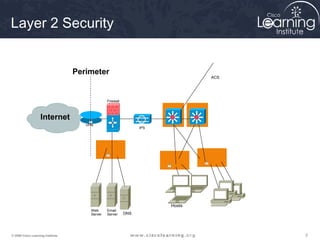
IPS 
Layer 2 Security 
Perimeter 
VPN 
ACS 
Firewall 
Web 
Server 
Email 
Server DNS 
Hosts 
Internet 
© 2009 Cisco Learning Institute. 2
OSI Model 
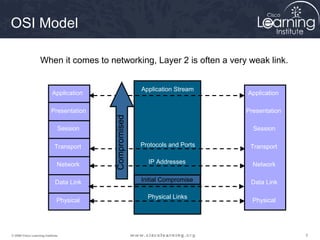
When it comes to networking, Layer 2 is often a very weak link. 
Application Application Stream 
Protocols and Ports 
IP Addresses 
Initial Compromise 
MAC Addresses 
Physical Links 
Presentation 
Session 
Transport 
Network 
Data Link 
Physical 
Compromised 
Application 
Presentation 
Session 
Transport 
Network 
Data Link 
Physical 
© 2009 Cisco Learning Institute. 3
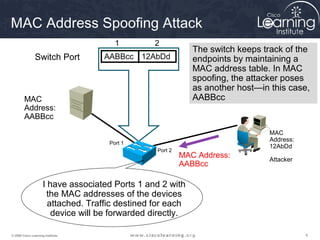
MAC Address Spoofing Attack 
1 2 
Switch Port AABBcc 12AbDd 
MAC 
Address: 
AABBcc 
The switch keeps track of the 
endpoints by maintaining a 
MAC address table. In MAC 
spoofing, the attacker poses 
as another host—in this case, 
AABBcc 
MAC 
Address: 
12AbDd 
MAC Address: 
AABBcc Attacker 
Port 1 
Port 2 
I have associated Ports 1 and 2 with 
the MAC addresses of the devices 
attached. Traffic destined for each 
device will be forwarded directly. 
© 2009 Cisco Learning Institute. 4
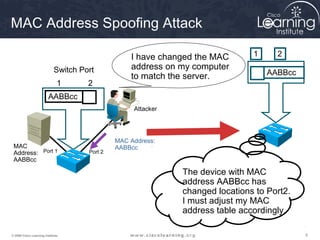
MAC Address Spoofing Attack 
MAC 
Address: 
AABBcc 
Switch Port 
1 2 
AABBcc 
I have changed the MAC 1 2 
address on my computer 
to match the server. 
Attacker 
MAC Address: 
AABBcc 
Port 1 Port 2 
AABBcc 
The device with MAC 
address AABBcc has 
changed locations to Port2. 
I must adjust my MAC 
address table accordingly. 
© 2009 Cisco Learning Institute. 5
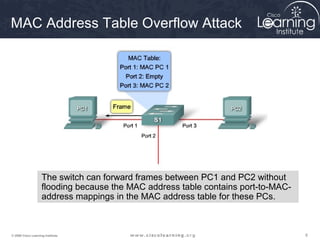
MAC Address Table Overflow Attack 
The switch can forward frames between PC1 and PC2 without 
flooding because the MAC address table contains port-to-MAC-address 
mappings in the MAC address table for these PCs. 
© 2009 Cisco Learning Institute. 6
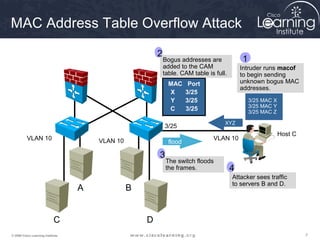
MAC Address Table Overflow Attack 
VLAN 10 VLAN 10 
A B 
C D 
2 1 
Intruder runs macof 
to begin sending 
unknown bogus MAC 
addresses. 
Bogus addresses are 
added to the CAM 
table. CAM table is full. 
MAC Port 
X 3/25 
Y 3/25 
C 3/25 
3/25 
3/25 MAC X 
3/25 MAC Y 
3/25 MAC Z 
XYZ 
flood 
Host C 
VLAN 10 
The switch floods 
the frames. 
4 
Attacker sees traffic 
to servers B and D. 
3 
© 2009 Cisco Learning Institute. 7
LAB 
MAC ADDRESS TABLE 
OVERFLOW ATTACK 
© 2009 Cisco Learning Institute. 8
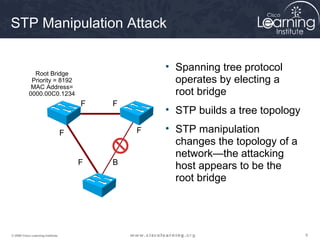
STP Manipulation Attack 
• Spanning tree protocol 
operates by electing a 
root bridge 
• STP builds a tree topology 
• STP manipulation 
changes the topology of a 
network—the attacking 
host appears to be the 
root bridge 
F F 
Root Bridge 
Priority = 8192 
MAC Address= 
0000.00C0.1234 
F F 
F B 
© 2009 Cisco Learning Institute. 9
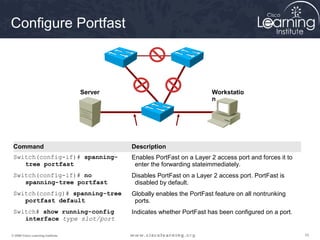
Configure Portfast 
Server Workstatio 
Command Description 
Switch(config-if)# spanning-tree 
portfast 
n 
Enables PortFast on a Layer 2 access port and forces it to 
enter the forwarding stateimmediately. 
Switch(config-if)# no 
spanning-tree portfast 
Disables PortFast on a Layer 2 access port. PortFast is 
disabled by default. 
Switch(config)# spanning-tree 
portfast default 
Globally enables the PortFast feature on all nontrunking 
ports. 
Switch# show running-config 
interface type slot/port 
Indicates whether PortFast has been configured on a port. 
© 2009 Cisco Learning Institute. 10
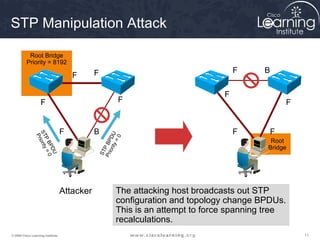
STP Manipulation Attack 
Root Bridge 
Priority = 8192 
F B 
F 
F F 
Root 
Bridge 
F F 
F F 
F B 
STP BPDU 
Priority = 0 
STP BPDU 
Priority = 0 
F 
Attacker The attacking host broadcasts out STP 
configuration and topology change BPDUs. 
This is an attempt to force spanning tree 
recalculations. 
© 2009 Cisco Learning Institute. 11
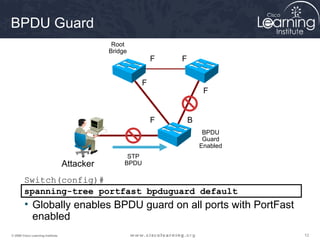
BPDU Guard 
F F 
F 
F 
F B 
Root 
Bridge 
BPDU 
Guard 
Enabled 
Attacker 
STP 
BPDU 
Switch(config)# 
spanning-tree portfast bpduguard default 
• Globally enables BPDU guard on all ports with PortFast 
enabled 
© 2009 Cisco Learning Institute. 12
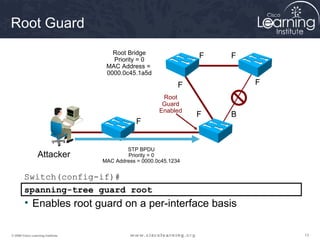
Root Guard 
Root Bridge 
Priority = 0 
MAC Address = 
0000.0c45.1a5d 
F F 
F F 
F B 
F 
STP BPDU 
Priority = 0 
Root 
Guard 
Enabled 
MAC Address = 0000.0c45.1234 
Attacker 
Switch(config-if)# 
spanning-tree guard root 
• Enables root guard on a per-interface basis 
© 2009 Cisco Learning Institute. 13
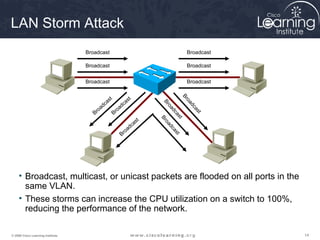
LAN Storm Attack 
Broadcast 
Broadcast 
Broadcast 
Broadcast 
Broadcast 
Broadcast 
Broadcast 
Broadcast 
Broadcast 
Broadcast 
Broadcast 
Broadcast 
• Broadcast, multicast, or unicast packets are flooded on all ports in the 
same VLAN. 
• These storms can increase the CPU utilization on a switch to 100%, 
reducing the performance of the network. 
© 2009 Cisco Learning Institute. 14
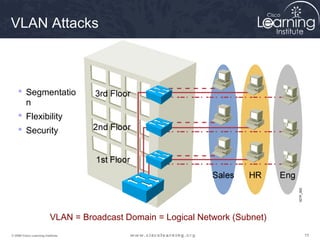
VLAN Attacks 
 Segmentatio 
n 
 Flexibility 
 Security 
VLAN = Broadcast Domain = Logical Network (Subnet) 
© 2009 Cisco Learning Institute. 15
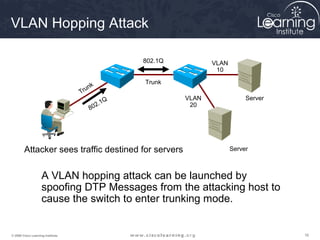
VLAN Hopping Attack 
802.1Q 
Trunk 
802.1Q 
Server 
Trunk 
VLAN 
20 
VLAN 
10 
Attacker sees traffic destined for servers Server 
A VLAN hopping attack can be launched by 
spoofing DTP Messages from the attacking host to 
cause the switch to enter trunking mode. 
© 2009 Cisco Learning Institute. 16
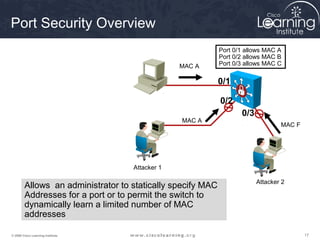
Port Security Overview 
MAC A 
MAC A 
Port 0/1 allows MAC A 
Port 0/2 allows MAC B 
Port 0/3 allows MAC C 
Attacker 1 
MAC F 
Attacker 2 
0/1 
0/2 
0/3 
Allows an administrator to statically specify MAC 
Addresses for a port or to permit the switch to 
dynamically learn a limited number of MAC 
addresses 
© 2009 Cisco Learning Institute. 17
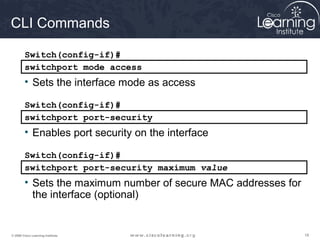
CLI Commands 
Switch(config-if)# 
switchport mode access 
• Sets the interface mode as access 
Switch(config-if)# 
switchport port-security 
• Enables port security on the interface 
Switch(config-if)# 
switchport port-security maximum value 
• Sets the maximum number of secure MAC addresses for 
the interface (optional) 
© 2009 Cisco Learning Institute. 18
LAB 
MAC ADDRESS TABLE 
OVERFLOW ATTACK 
© 2009 Cisco Learning Institute. 19
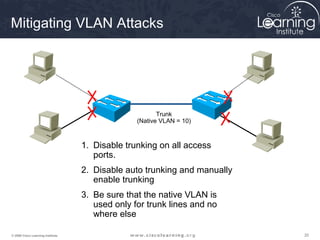
Mitigating VLAN Attacks 
Trunk 
(Native VLAN = 10) 
1. Disable trunking on all access 
ports. 
2. Disable auto trunking and manually 
enable trunking 
3. Be sure that the native VLAN is 
used only for trunk lines and no 
where else 
© 2009 Cisco Learning Institute. 20
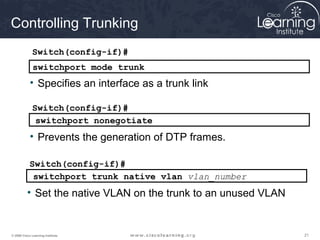
Controlling Trunking 
Switch(config-if)# 
switchport mode trunk 
• Specifies an interface as a trunk link 
. 
Switch(config-if)# 
switchport nonegotiate 
• Prevents the generation of DTP frames. 
Switch(config-if)# 
switchport trunk native vlan vlan_number 
• Set the native VLAN on the trunk to an unused VLAN 
© 2009 Cisco Learning Institute. 21
CCNA Security 07-Securing the local area network

CCNA Security 07-Securing the local area network

  • 1.
    06- Securing theLocal Area Network Ahmed Sultan CCNA | CCNA Security | CCNP Security | JNCIA-Junos | CEH © 2009 Cisco Learning Institute. 1
  • 2.
    IPS Layer 2Security Perimeter VPN ACS Firewall Web Server Email Server DNS Hosts Internet © 2009 Cisco Learning Institute. 2
  • 3.
    OSI Model Whenit comes to networking, Layer 2 is often a very weak link. Application Application Stream Protocols and Ports IP Addresses Initial Compromise MAC Addresses Physical Links Presentation Session Transport Network Data Link Physical Compromised Application Presentation Session Transport Network Data Link Physical © 2009 Cisco Learning Institute. 3
  • 4.
    MAC Address SpoofingAttack 1 2 Switch Port AABBcc 12AbDd MAC Address: AABBcc The switch keeps track of the endpoints by maintaining a MAC address table. In MAC spoofing, the attacker poses as another host—in this case, AABBcc MAC Address: 12AbDd MAC Address: AABBcc Attacker Port 1 Port 2 I have associated Ports 1 and 2 with the MAC addresses of the devices attached. Traffic destined for each device will be forwarded directly. © 2009 Cisco Learning Institute. 4
  • 5.
    MAC Address SpoofingAttack MAC Address: AABBcc Switch Port 1 2 AABBcc I have changed the MAC 1 2 address on my computer to match the server. Attacker MAC Address: AABBcc Port 1 Port 2 AABBcc The device with MAC address AABBcc has changed locations to Port2. I must adjust my MAC address table accordingly. © 2009 Cisco Learning Institute. 5
  • 6.
    MAC Address TableOverflow Attack The switch can forward frames between PC1 and PC2 without flooding because the MAC address table contains port-to-MAC-address mappings in the MAC address table for these PCs. © 2009 Cisco Learning Institute. 6
  • 7.
    MAC Address TableOverflow Attack VLAN 10 VLAN 10 A B C D 2 1 Intruder runs macof to begin sending unknown bogus MAC addresses. Bogus addresses are added to the CAM table. CAM table is full. MAC Port X 3/25 Y 3/25 C 3/25 3/25 3/25 MAC X 3/25 MAC Y 3/25 MAC Z XYZ flood Host C VLAN 10 The switch floods the frames. 4 Attacker sees traffic to servers B and D. 3 © 2009 Cisco Learning Institute. 7
  • 8.
    LAB MAC ADDRESSTABLE OVERFLOW ATTACK © 2009 Cisco Learning Institute. 8
  • 9.
    STP Manipulation Attack • Spanning tree protocol operates by electing a root bridge • STP builds a tree topology • STP manipulation changes the topology of a network—the attacking host appears to be the root bridge F F Root Bridge Priority = 8192 MAC Address= 0000.00C0.1234 F F F B © 2009 Cisco Learning Institute. 9
  • 10.
    Configure Portfast ServerWorkstatio Command Description Switch(config-if)# spanning-tree portfast n Enables PortFast on a Layer 2 access port and forces it to enter the forwarding stateimmediately. Switch(config-if)# no spanning-tree portfast Disables PortFast on a Layer 2 access port. PortFast is disabled by default. Switch(config)# spanning-tree portfast default Globally enables the PortFast feature on all nontrunking ports. Switch# show running-config interface type slot/port Indicates whether PortFast has been configured on a port. © 2009 Cisco Learning Institute. 10
  • 11.
    STP Manipulation Attack Root Bridge Priority = 8192 F B F F F Root Bridge F F F F F B STP BPDU Priority = 0 STP BPDU Priority = 0 F Attacker The attacking host broadcasts out STP configuration and topology change BPDUs. This is an attempt to force spanning tree recalculations. © 2009 Cisco Learning Institute. 11
  • 12.
    BPDU Guard FF F F F B Root Bridge BPDU Guard Enabled Attacker STP BPDU Switch(config)# spanning-tree portfast bpduguard default • Globally enables BPDU guard on all ports with PortFast enabled © 2009 Cisco Learning Institute. 12
  • 13.
    Root Guard RootBridge Priority = 0 MAC Address = 0000.0c45.1a5d F F F F F B F STP BPDU Priority = 0 Root Guard Enabled MAC Address = 0000.0c45.1234 Attacker Switch(config-if)# spanning-tree guard root • Enables root guard on a per-interface basis © 2009 Cisco Learning Institute. 13
  • 14.
    LAN Storm Attack Broadcast Broadcast Broadcast Broadcast Broadcast Broadcast Broadcast Broadcast Broadcast Broadcast Broadcast Broadcast • Broadcast, multicast, or unicast packets are flooded on all ports in the same VLAN. • These storms can increase the CPU utilization on a switch to 100%, reducing the performance of the network. © 2009 Cisco Learning Institute. 14
  • 15.
    VLAN Attacks Segmentatio n  Flexibility  Security VLAN = Broadcast Domain = Logical Network (Subnet) © 2009 Cisco Learning Institute. 15
  • 16.
    VLAN Hopping Attack 802.1Q Trunk 802.1Q Server Trunk VLAN 20 VLAN 10 Attacker sees traffic destined for servers Server A VLAN hopping attack can be launched by spoofing DTP Messages from the attacking host to cause the switch to enter trunking mode. © 2009 Cisco Learning Institute. 16
  • 17.
    Port Security Overview MAC A MAC A Port 0/1 allows MAC A Port 0/2 allows MAC B Port 0/3 allows MAC C Attacker 1 MAC F Attacker 2 0/1 0/2 0/3 Allows an administrator to statically specify MAC Addresses for a port or to permit the switch to dynamically learn a limited number of MAC addresses © 2009 Cisco Learning Institute. 17
  • 18.
    CLI Commands Switch(config-if)# switchport mode access • Sets the interface mode as access Switch(config-if)# switchport port-security • Enables port security on the interface Switch(config-if)# switchport port-security maximum value • Sets the maximum number of secure MAC addresses for the interface (optional) © 2009 Cisco Learning Institute. 18
  • 19.
    LAB MAC ADDRESSTABLE OVERFLOW ATTACK © 2009 Cisco Learning Institute. 19
  • 20.
    Mitigating VLAN Attacks Trunk (Native VLAN = 10) 1. Disable trunking on all access ports. 2. Disable auto trunking and manually enable trunking 3. Be sure that the native VLAN is used only for trunk lines and no where else © 2009 Cisco Learning Institute. 20
  • 21.
    Controlling Trunking Switch(config-if)# switchport mode trunk • Specifies an interface as a trunk link . Switch(config-if)# switchport nonegotiate • Prevents the generation of DTP frames. Switch(config-if)# switchport trunk native vlan vlan_number • Set the native VLAN on the trunk to an unused VLAN © 2009 Cisco Learning Institute. 21