Attack And Defense
Network Security
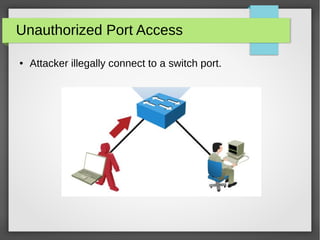
Unauthorized Port Access
● Attacker illegally connect to a switch port.
Mitigate Unauthorized Port Access
● It can be mitigated by configuring Port Security on switch.
● Port-security can set specific MAC address that is allowed
to connect to a port.
Interface fastethernet 0/0 
  switchport port­security
  switchport port­security mac­addr aaa.bbb.ccc
Mitigate Unauthorized Port Access
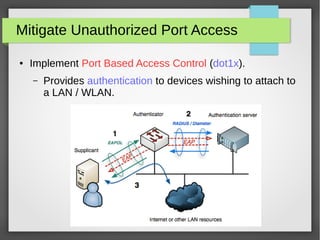
● Implement Port Based Access Control (dot1x).
– Provides authentication to devices wishing to attach to
a LAN / WLAN.
DHCP Spoofing Attack
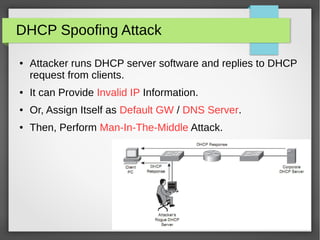
● Attacker runs DHCP server software and replies to DHCP
request from clients.
● It can Provide Invalid IP Information.
● Or, Assign Itself as Default GW / DNS Server.
● Then, Perform Man-In-The-Middle Attack.
Mitigate DHCP Spoofing Attack
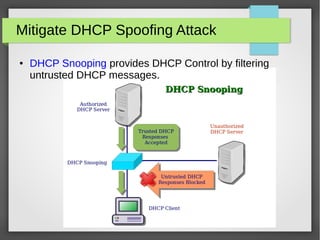
● DHCP Snooping provides DHCP Control by filtering
untrusted DHCP messages.
DHCP Starvation Attack
● Attacker sends a flood of DHCP Request with spoofed
MAC address.
● It can exhaust the address space available on DHCP
Server.
● New legitimate Client can’t connect to network.
● Or, attacker then execute DHCP Spoofing Attack.
– Attacker DHCP Server has no competition responding
to new DHCP Request
Mitigate DHCP Starvation Attack
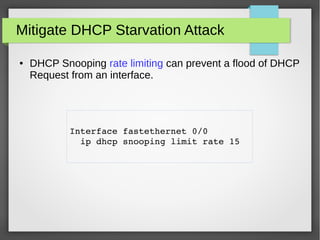
● DHCP Snooping rate limiting can prevent a flood of DHCP
Request from an interface.
Interface fastethernet 0/0 
  ip dhcp snooping limit rate 15
ARP Spoofing Attack
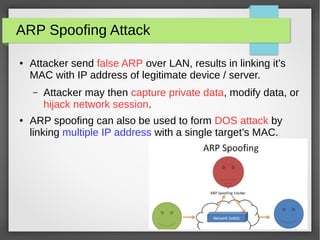
● Attacker send false ARP over LAN, results in linking it’s
MAC with IP address of legitimate device / server.
– Attacker may then capture private data, modify data, or
hijack network session.
● ARP spoofing can also be used to form DOS attack by
linking multiple IP address with a single target’s MAC.
Mitigate ARP Spoofing Attack
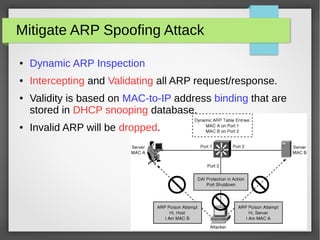
● Dynamic ARP Inspection
● Intercepting and Validating all ARP request/response.
● Validity is based on MAC-to-IP address binding that are
stored in DHCP snooping database.
● Invalid ARP will be dropped.
xx
IP Spoofing Attack
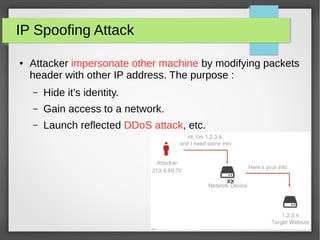
● Attacker impersonate other machine by modifying packets
header with other IP address. The purpose :
– Hide it’s identity.
– Gain access to a network.
– Launch reflected DDoS attack, etc.
Mitigate IP Spoofing Attack
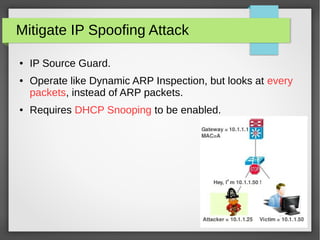
● IP Source Guard.
● Operate like Dynamic ARP Inspection, but looks at every
packets, instead of ARP packets.
● Requires DHCP Snooping to be enabled.
CAM Table Overflows
● CAM tables are limited in size.
● Attacker floods the switch with myriad of fake source MAC
addresses until CAM table is full.
● Switch begins to act like a hub, thus attacker can see all
frames being sent from and to other host.
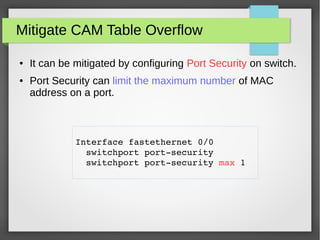
Mitigate CAM Table Overflow
● It can be mitigated by configuring Port Security on switch.
● Port Security can limit the maximum number of MAC
address on a port.
Interface fastethernet 0/0 
  switchport port­security
  switchport port­security max 1
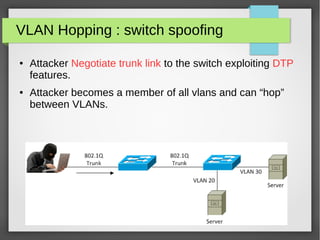
VLAN Hopping : switch spoofing
● Attacker Negotiate trunk link to the switch exploiting DTP
features.
● Attacker becomes a member of all vlans and can “hop”
between VLANs.
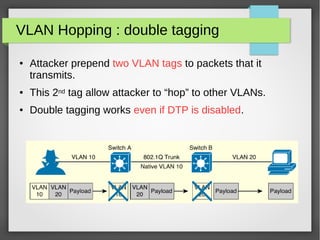
VLAN Hopping : double tagging
● Attacker prepend two VLAN tags to packets that it
transmits.
● This 2nd tag allow attacker to “hop” to other VLANs.
● Double tagging works even if DTP is disabled.
Mitigates VLAN Hopping
● Configure ports connected to user as access ports.
● Disable DTP features.
● Change native VLAN to unused VLAN.
Spanning-Tree Attack
● Attacker negotiate trunk link with the switch.
● Attacker sends superior BPDU thus becomes the root
bridge.
● All traffic passes through the root bridge, thus attacker
have access to all traffic.
Mitigate Spanning Tree Attack
● Enable BPDU Guard
– Immediately disables a port that receives BPDU
● Enable Root Guard
– Prevents inappropriate switch from becoming the root
bridge.
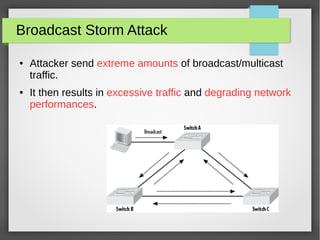
Broadcast Storm Attack
● Attacker send extreme amounts of broadcast/multicast
traffic.
● It then results in excessive traffic and degrading network
performances.
Mitigate Broadcast Storm Attack
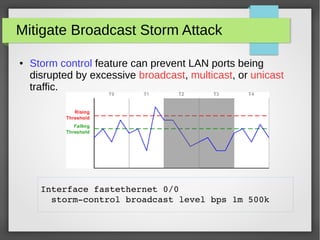
● Storm control feature can prevent LAN ports being
disrupted by excessive broadcast, multicast, or unicast
traffic.
Interface fastethernet 0/0 
  storm­control broadcast level bps 1m 500k
Routing Protocol Attack
● Attacker establish adjacency with official router running
unauthenticated routing protocols.
● It then illegally advertise ip addresses with more trusted
prefix length.
● Thus they can perform :
– Man in the middle attack.
– Phishing.
– Etc.
Routing Protocol Attack
● Implement routing protocol with authentication.
● Use passive-interface on the router wherever necessary.
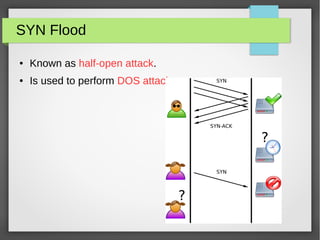
SYN Flood
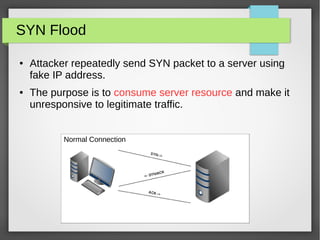
● Attacker repeatedly send SYN packet to a server using
fake IP address.
● The purpose is to consume server resource and make it
unresponsive to legitimate traffic.
Normal Connection
SYN Flood
● Known as half-open attack.
● Is used to perform DOS attack.
Mitigate SYN Flood Attack
● Filtering
● Firewalls
– It can SYN attack by spoofing SYN-ACK to attacker.
● Using IDS / IPS
– i.e : snort (opensource IDS/IPS)
To be continued ...

Network security

  • 1.
  • 2.
    Unauthorized Port Access ●Attacker illegally connect to a switch port.
  • 3.
    Mitigate Unauthorized PortAccess ● It can be mitigated by configuring Port Security on switch. ● Port-security can set specific MAC address that is allowed to connect to a port. Interface fastethernet 0/0    switchport port­security   switchport port­security mac­addr aaa.bbb.ccc
  • 4.
    Mitigate Unauthorized PortAccess ● Implement Port Based Access Control (dot1x). – Provides authentication to devices wishing to attach to a LAN / WLAN.
  • 5.
    DHCP Spoofing Attack ●Attacker runs DHCP server software and replies to DHCP request from clients. ● It can Provide Invalid IP Information. ● Or, Assign Itself as Default GW / DNS Server. ● Then, Perform Man-In-The-Middle Attack.
  • 6.
    Mitigate DHCP SpoofingAttack ● DHCP Snooping provides DHCP Control by filtering untrusted DHCP messages.
  • 7.
    DHCP Starvation Attack ●Attacker sends a flood of DHCP Request with spoofed MAC address. ● It can exhaust the address space available on DHCP Server. ● New legitimate Client can’t connect to network. ● Or, attacker then execute DHCP Spoofing Attack. – Attacker DHCP Server has no competition responding to new DHCP Request
  • 8.
    Mitigate DHCP StarvationAttack ● DHCP Snooping rate limiting can prevent a flood of DHCP Request from an interface. Interface fastethernet 0/0    ip dhcp snooping limit rate 15
  • 9.
    ARP Spoofing Attack ●Attacker send false ARP over LAN, results in linking it’s MAC with IP address of legitimate device / server. – Attacker may then capture private data, modify data, or hijack network session. ● ARP spoofing can also be used to form DOS attack by linking multiple IP address with a single target’s MAC.
  • 10.
    Mitigate ARP SpoofingAttack ● Dynamic ARP Inspection ● Intercepting and Validating all ARP request/response. ● Validity is based on MAC-to-IP address binding that are stored in DHCP snooping database. ● Invalid ARP will be dropped.
  • 11.
    xx IP Spoofing Attack ●Attacker impersonate other machine by modifying packets header with other IP address. The purpose : – Hide it’s identity. – Gain access to a network. – Launch reflected DDoS attack, etc.
  • 12.
    Mitigate IP SpoofingAttack ● IP Source Guard. ● Operate like Dynamic ARP Inspection, but looks at every packets, instead of ARP packets. ● Requires DHCP Snooping to be enabled.
  • 13.
    CAM Table Overflows ●CAM tables are limited in size. ● Attacker floods the switch with myriad of fake source MAC addresses until CAM table is full. ● Switch begins to act like a hub, thus attacker can see all frames being sent from and to other host.
  • 14.
    Mitigate CAM TableOverflow ● It can be mitigated by configuring Port Security on switch. ● Port Security can limit the maximum number of MAC address on a port. Interface fastethernet 0/0    switchport port­security   switchport port­security max 1
  • 15.
    VLAN Hopping :switch spoofing ● Attacker Negotiate trunk link to the switch exploiting DTP features. ● Attacker becomes a member of all vlans and can “hop” between VLANs.
  • 16.
    VLAN Hopping :double tagging ● Attacker prepend two VLAN tags to packets that it transmits. ● This 2nd tag allow attacker to “hop” to other VLANs. ● Double tagging works even if DTP is disabled.
  • 17.
    Mitigates VLAN Hopping ●Configure ports connected to user as access ports. ● Disable DTP features. ● Change native VLAN to unused VLAN.
  • 18.
    Spanning-Tree Attack ● Attackernegotiate trunk link with the switch. ● Attacker sends superior BPDU thus becomes the root bridge. ● All traffic passes through the root bridge, thus attacker have access to all traffic.
  • 19.
    Mitigate Spanning TreeAttack ● Enable BPDU Guard – Immediately disables a port that receives BPDU ● Enable Root Guard – Prevents inappropriate switch from becoming the root bridge.
  • 20.
    Broadcast Storm Attack ●Attacker send extreme amounts of broadcast/multicast traffic. ● It then results in excessive traffic and degrading network performances.
  • 21.
    Mitigate Broadcast StormAttack ● Storm control feature can prevent LAN ports being disrupted by excessive broadcast, multicast, or unicast traffic. Interface fastethernet 0/0    storm­control broadcast level bps 1m 500k
  • 22.
    Routing Protocol Attack ●Attacker establish adjacency with official router running unauthenticated routing protocols. ● It then illegally advertise ip addresses with more trusted prefix length. ● Thus they can perform : – Man in the middle attack. – Phishing. – Etc.
  • 23.
    Routing Protocol Attack ●Implement routing protocol with authentication. ● Use passive-interface on the router wherever necessary.
  • 24.
    SYN Flood ● Attackerrepeatedly send SYN packet to a server using fake IP address. ● The purpose is to consume server resource and make it unresponsive to legitimate traffic. Normal Connection
  • 25.
    SYN Flood ● Knownas half-open attack. ● Is used to perform DOS attack.
  • 26.
    Mitigate SYN FloodAttack ● Filtering ● Firewalls – It can SYN attack by spoofing SYN-ACK to attacker. ● Using IDS / IPS – i.e : snort (opensource IDS/IPS)
  • 27.