ROUTER
What is Router
Types of Router
Advantages
Disadvantages
WHAT IS ROUTER
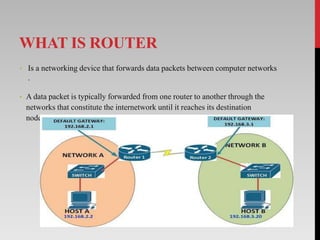
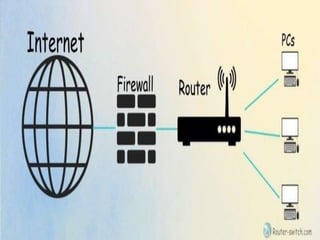
• Is a networking device that forwards data packets between computer networks
.
• A data packet is typically forwarded from one router to another through the
networks that constitute the internetwork until it reaches its destination
node.
TYPE OF ROUTERS
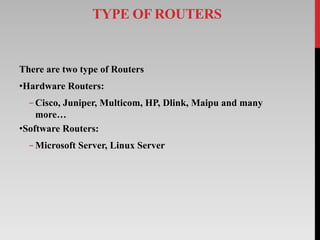
There are two type of Routers
•Hardware Routers:
− Cisco, Juniper, Multicom, HP, Dlink, Maipu and many
more…
•Software Routers:
− Microsoft Server, Linux Server
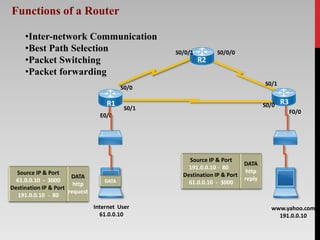
Functions of a Router
•Inter-network Communication
•Best Path Selection
•Packet Switching
•Packet forwarding
R1
E0/0
S0/0
R2
S0/0/0S0/0/1
R3
S0/1
F0/0
S0/1 S0/0
Internet User
61.0.0.10
www.yahoo.com
191.0.0.10
Source IP & Port
61.0.0.10 - 3000
Destination IP & Port
191.0.0.10 - 80
DATA
http
request
DATA
Source IP & Port
191.0.0.10 - 80
Destination IP & Port
61.0.0.10 - 3000
DATA
http
reply
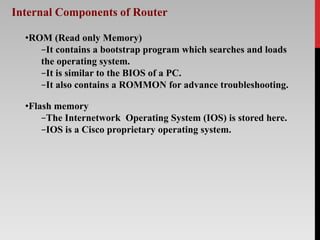
Internal Components of Router
•ROM (Read only Memory)
−It contains a bootstrap program which searches and loads
the operating system.
−It is similar to the BIOS of a PC.
−It also contains a ROMMON for advance troubleshooting.
•Flash memory
−The Internetwork Operating System (IOS) is stored here.
−IOS is a Cisco proprietary operating system.
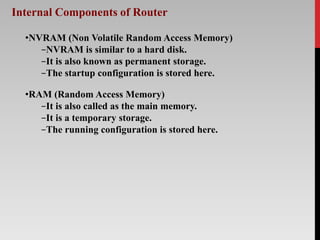
Internal Components of Router
•NVRAM (Non Volatile Random Access Memory)
−NVRAM is similar to a hard disk.
−It is also known as permanent storage.
−The startup configuration is stored here.
•RAM (Random Access Memory)
−It is also called as the main memory.
−It is a temporary storage.
−The running configuration is stored here.
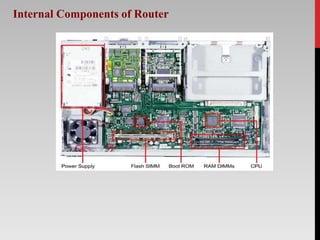
Internal Components of Router
POST
ROM
FLASH
NVRAM
RAM
Power On Self Test – checks the hardware
ROM loads Bootstrap program and searches
for the IOS
IOS from Flash is loaded
The startup configuration is loaded from the
NVRAM
Boot process is completed as everything is
loaded into the RAM
BOOT Sequence
INITIAL CONFIGURATION
Console Connectivity
RJ-45
Connector
Console Port
ComputerRollover
Cable
RJ-45 to DB-9
Converter
Console Connectivity
•Cisco Routers & Switches does not have any default IP address
or Configuration, hence require to use the Console port for
Initial Configuration.
•Require physical connection between the Cisco Router/Switch
and PC via console cable.
•Fixed Router
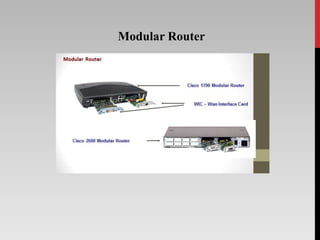
•Modular Router
Types of Hardware Routers
Fixed Router
Modular Router
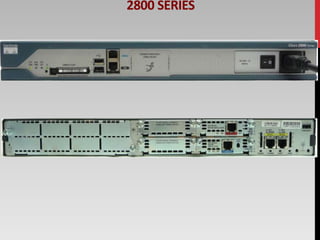
2800 SERIES
TYPES OF ROUTER
Core router
Edge router
Inter Provider Border Router
Wireless router
CORE ROUTER
A core router is a router that forwards packets to computer hosts within a
network (but not between networks).
Model : 800,1900,2600,2800,2900
Cisco 800 Series Routers Cisco 1900
Cisco 2900 Cisco 2800
Cisco 2600
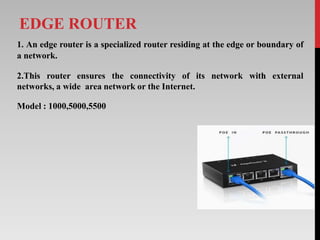
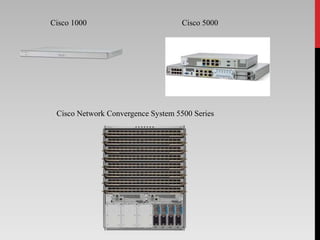
EDGE ROUTER
1. An edge router is a specialized router residing at the edge or boundary of
a network.
2.This router ensures the connectivity of its network with external
networks, a wide area network or the Internet.
Model : 1000,5000,5500
Cisco 1000 Cisco 5000
Cisco Network Convergence System 5500 Series
INTER PROVIDER BORDER ROUTER
Inter-provider Border router is used for Interconnecting ISP. It is a BGP
speaking router that maintains BGP sessions with other BGP speaking
routers in other providers' ASes. It support multi-routing protocols for
secure data processing and high performance.
Model : 6000,9000
Inter Provider Border Router
Router 6000 Series Cisco ASR 9000
BGP ?
Border Gateway Protocol (BGP) is a standardized exterior gateway protocol
designed to exchange routing and reachability information among
autonomous systems (AS) on the Internet.
WIRELESS ROUTER
A wireless router is a device that performs the functions of a router and
also includes the functions of a wireless access point. It is used to provide
access to the Internet or a private computer network.
BGP
1. BGP is the path-vector protocol that provides routing information for
Autonomous systems on the Internet via its AS-Path attribute.
2. Sharing deferent Autonomous only .
3. It is only sharing new processing .
4. It is only sharing incremental processing .
5. ROUTER INFORMATION (Addition , Deletion) .
6. It is Very Slow .
7. It is Running on Application Protocol .
8. TCP Connection , port Number :179 .
9. it is selected only manually include neighbor .
• Autonomous System
– Collection of IP prefixes
– Common routing policy to otherASes
– Registered by an RIR (regional Internet registry)
– Denoted by a name and number
• A Private AS can be usedwhen a single upstream exists
– External routing policy is identical
AS 200
2.2.2.0/24
2.2.3.0/24
Autonomous
System
• Inter-Network – Used for routing
between networks (Autonomous
Systems), or within large networks
• Reachability – BGP defines how oneAS
can reach another, described as a path vector
(AS Path)
• Policy-Based – BGP makes it possible for
an AS to apply policies (e.g. multi-
homing, failover, commercial terms)
• Decentralized – Each AS makes policy
decisions autonomously, using BGP to
coordinate and share routes
KEY BGP CONCEPTS
• Neighboring
routers, within or
between ASes,
establish a TCP
connection on
port 179.
• BGPmessages
include:
– Open
– Update
– Notification
– KeepAlive
BGP THE PROTOCOL
AS 300
3.3.3.4/22
AS 400
4.4.0.0/16
AS 200
2.2.2.0/24
Border Router
AS 100
1.1.1.0/24
Origin
Autonomous
System
Internal
Router
BGP peers exchange
routes, within and
amongASes
HOW A ROUTERWORKS?
INSIDEA ROUTER!
CISCO SYSTEMS, INC
Cisco Systems, Inc. (known as Cisco) is an American
multinational technology conglomerate headquartered
in San José, California, that develops, manufactures,
and sells networking hardware, telecommunications
equipment, and other high- technology services and
products.
TP-LINK
• is a Chinese manufacturer of computer
networking products based in Shenzhen
China .
TP-Link products include wireless routers, ADSL,
range extenders, routers, switches, IP
cameras, power line adapters, print servers,
media converters, wireless adapters and power
banks. TP-Link also manufactured the OnHub
router for Google .
THE BEST WIRELESS
ROUTERS OF 2016 :
TP Link Archer AC3200 WirelessTri-Band GigabitRouter

Router Full Concept pdf

  • 1.
    ROUTER What is Router Typesof Router Advantages Disadvantages
  • 2.
    WHAT IS ROUTER •Is a networking device that forwards data packets between computer networks . • A data packet is typically forwarded from one router to another through the networks that constitute the internetwork until it reaches its destination node.
  • 4.
    TYPE OF ROUTERS Thereare two type of Routers •Hardware Routers: − Cisco, Juniper, Multicom, HP, Dlink, Maipu and many more… •Software Routers: − Microsoft Server, Linux Server
  • 5.
    Functions of aRouter •Inter-network Communication •Best Path Selection •Packet Switching •Packet forwarding R1 E0/0 S0/0 R2 S0/0/0S0/0/1 R3 S0/1 F0/0 S0/1 S0/0 Internet User 61.0.0.10 www.yahoo.com 191.0.0.10 Source IP & Port 61.0.0.10 - 3000 Destination IP & Port 191.0.0.10 - 80 DATA http request DATA Source IP & Port 191.0.0.10 - 80 Destination IP & Port 61.0.0.10 - 3000 DATA http reply
  • 6.
    Internal Components ofRouter •ROM (Read only Memory) −It contains a bootstrap program which searches and loads the operating system. −It is similar to the BIOS of a PC. −It also contains a ROMMON for advance troubleshooting. •Flash memory −The Internetwork Operating System (IOS) is stored here. −IOS is a Cisco proprietary operating system.
  • 7.
    Internal Components ofRouter •NVRAM (Non Volatile Random Access Memory) −NVRAM is similar to a hard disk. −It is also known as permanent storage. −The startup configuration is stored here. •RAM (Random Access Memory) −It is also called as the main memory. −It is a temporary storage. −The running configuration is stored here.
  • 8.
  • 9.
    POST ROM FLASH NVRAM RAM Power On SelfTest – checks the hardware ROM loads Bootstrap program and searches for the IOS IOS from Flash is loaded The startup configuration is loaded from the NVRAM Boot process is completed as everything is loaded into the RAM BOOT Sequence
  • 10.
  • 11.
  • 12.
    Console Connectivity •Cisco Routers& Switches does not have any default IP address or Configuration, hence require to use the Console port for Initial Configuration. •Require physical connection between the Cisco Router/Switch and PC via console cable.
  • 13.
  • 14.
  • 15.
  • 16.
  • 18.
    TYPES OF ROUTER Corerouter Edge router Inter Provider Border Router Wireless router
  • 19.
    CORE ROUTER A corerouter is a router that forwards packets to computer hosts within a network (but not between networks). Model : 800,1900,2600,2800,2900
  • 20.
    Cisco 800 SeriesRouters Cisco 1900 Cisco 2900 Cisco 2800 Cisco 2600
  • 21.
    EDGE ROUTER 1. Anedge router is a specialized router residing at the edge or boundary of a network. 2.This router ensures the connectivity of its network with external networks, a wide area network or the Internet. Model : 1000,5000,5500
  • 22.
    Cisco 1000 Cisco5000 Cisco Network Convergence System 5500 Series
  • 23.
    INTER PROVIDER BORDERROUTER Inter-provider Border router is used for Interconnecting ISP. It is a BGP speaking router that maintains BGP sessions with other BGP speaking routers in other providers' ASes. It support multi-routing protocols for secure data processing and high performance. Model : 6000,9000
  • 24.
  • 25.
    Router 6000 SeriesCisco ASR 9000
  • 26.
    BGP ? Border GatewayProtocol (BGP) is a standardized exterior gateway protocol designed to exchange routing and reachability information among autonomous systems (AS) on the Internet.
  • 27.
    WIRELESS ROUTER A wirelessrouter is a device that performs the functions of a router and also includes the functions of a wireless access point. It is used to provide access to the Internet or a private computer network.
  • 28.
    BGP 1. BGP isthe path-vector protocol that provides routing information for Autonomous systems on the Internet via its AS-Path attribute. 2. Sharing deferent Autonomous only .
  • 29.
    3. It isonly sharing new processing . 4. It is only sharing incremental processing . 5. ROUTER INFORMATION (Addition , Deletion) . 6. It is Very Slow . 7. It is Running on Application Protocol . 8. TCP Connection , port Number :179 . 9. it is selected only manually include neighbor .
  • 30.
    • Autonomous System –Collection of IP prefixes – Common routing policy to otherASes – Registered by an RIR (regional Internet registry) – Denoted by a name and number • A Private AS can be usedwhen a single upstream exists – External routing policy is identical AS 200 2.2.2.0/24 2.2.3.0/24 Autonomous System
  • 31.
    • Inter-Network –Used for routing between networks (Autonomous Systems), or within large networks • Reachability – BGP defines how oneAS can reach another, described as a path vector (AS Path) • Policy-Based – BGP makes it possible for an AS to apply policies (e.g. multi- homing, failover, commercial terms) • Decentralized – Each AS makes policy decisions autonomously, using BGP to coordinate and share routes KEY BGP CONCEPTS
  • 32.
    • Neighboring routers, withinor between ASes, establish a TCP connection on port 179. • BGPmessages include: – Open – Update – Notification – KeepAlive BGP THE PROTOCOL AS 300 3.3.3.4/22 AS 400 4.4.0.0/16 AS 200 2.2.2.0/24 Border Router AS 100 1.1.1.0/24 Origin Autonomous System Internal Router BGP peers exchange routes, within and amongASes
  • 40.
  • 41.
  • 42.
    CISCO SYSTEMS, INC CiscoSystems, Inc. (known as Cisco) is an American multinational technology conglomerate headquartered in San José, California, that develops, manufactures, and sells networking hardware, telecommunications equipment, and other high- technology services and products.
  • 43.
    TP-LINK • is aChinese manufacturer of computer networking products based in Shenzhen China . TP-Link products include wireless routers, ADSL, range extenders, routers, switches, IP cameras, power line adapters, print servers, media converters, wireless adapters and power banks. TP-Link also manufactured the OnHub router for Google .
  • 44.
    THE BEST WIRELESS ROUTERSOF 2016 : TP Link Archer AC3200 WirelessTri-Band GigabitRouter