



Recovery Strategies Chris Ruf Associate Strength & Conditioning Coach
Thanks to our Clinic Sponsors Young Champions http://www.youngchampions.com Power Lift http://www.power-lift.com Xtreme Formulations/Black Star Labs http://www.xtremeformulations.com  http://www.blackstarlabs.com IronMind http://www.ironmind.com
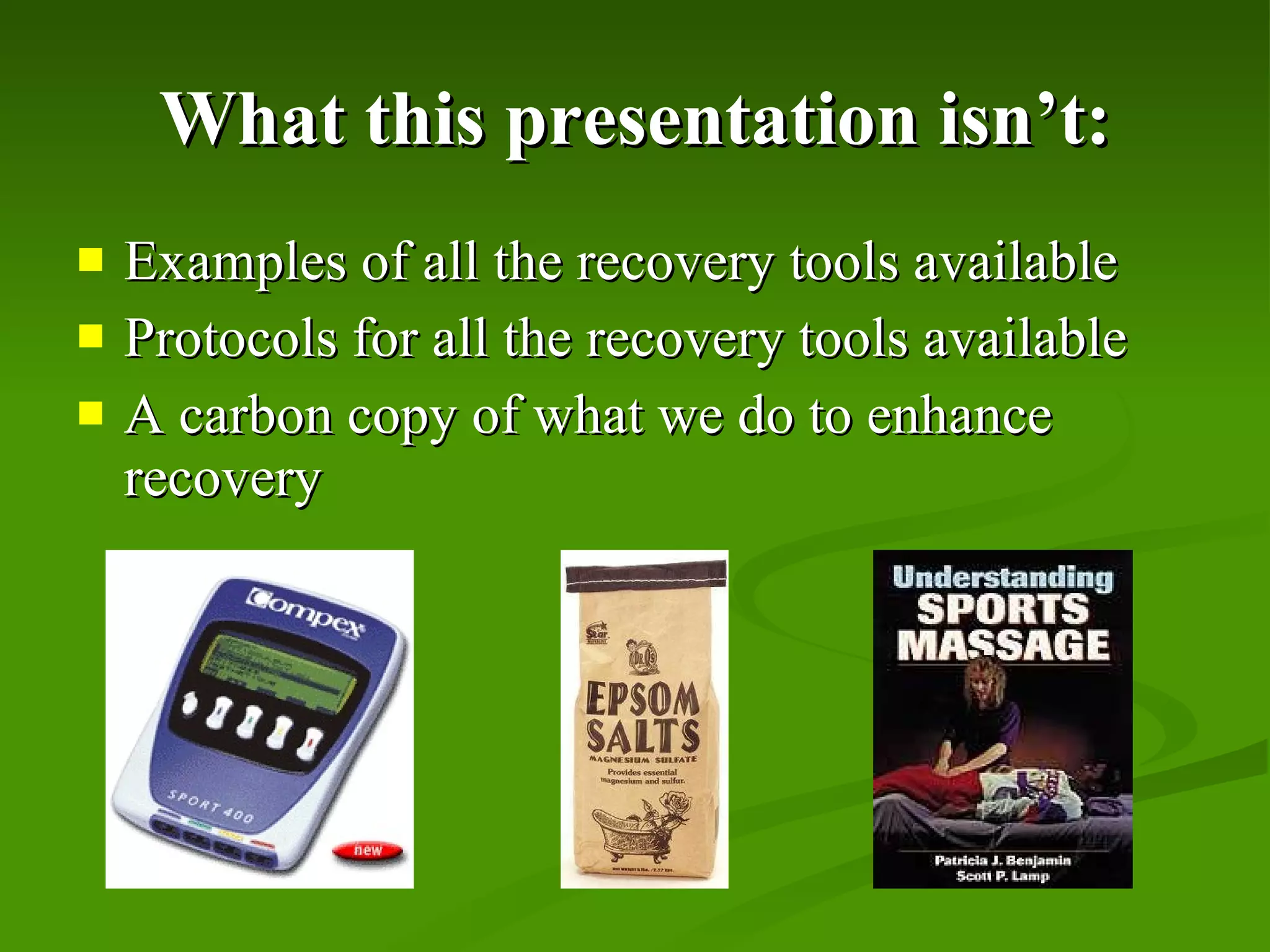
What this presentation isn’t: Examples of all the recovery tools available Protocols for all the recovery tools available A carbon copy of what we do to enhance recovery
What this presentation is: A look at the factors that influence recovery from training A look at ways to manage training stress A brief look at some of the recovery tools that are available
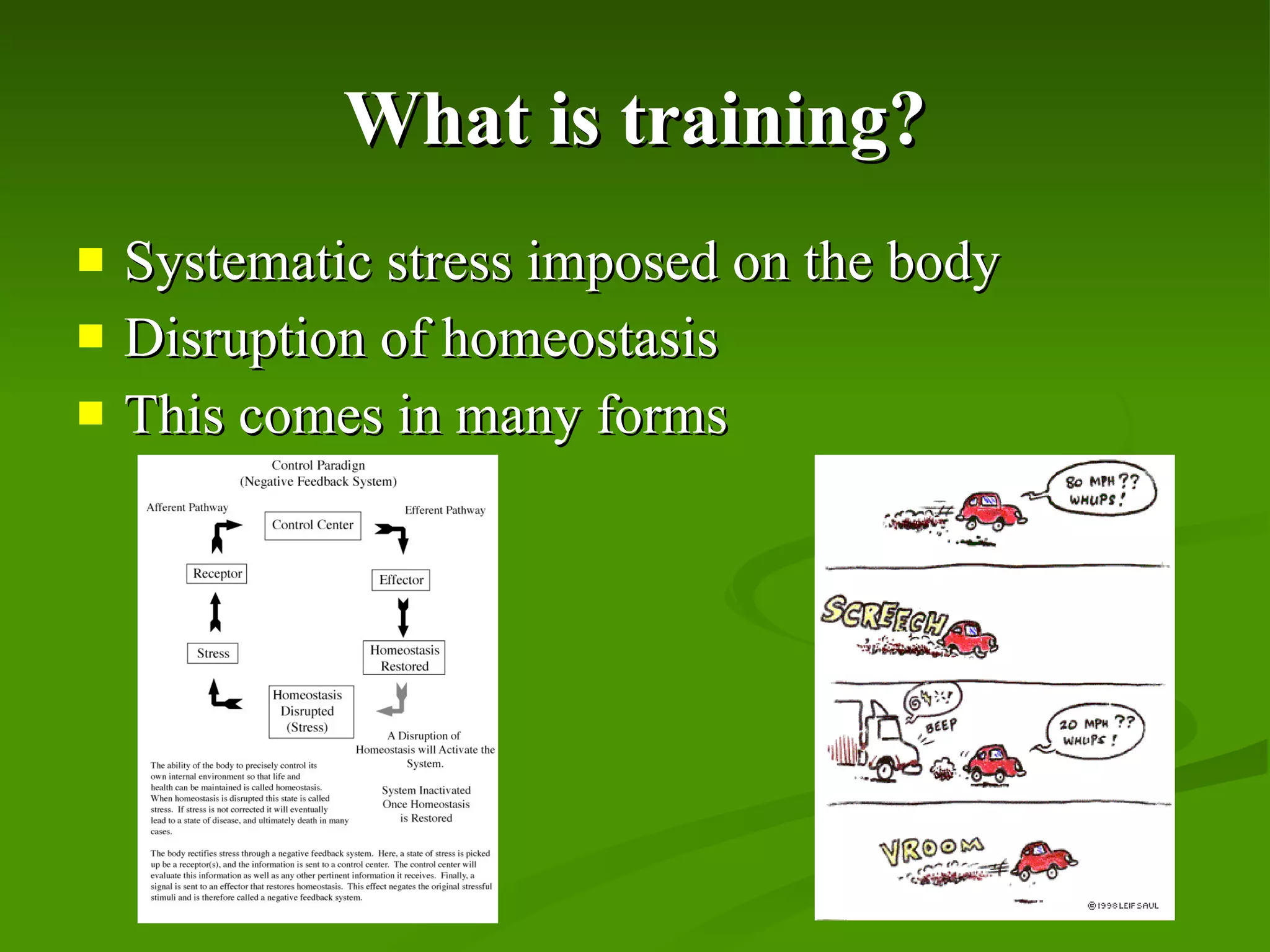
What is training? Systematic stress imposed on the body Disruption of homeostasis This comes in many forms
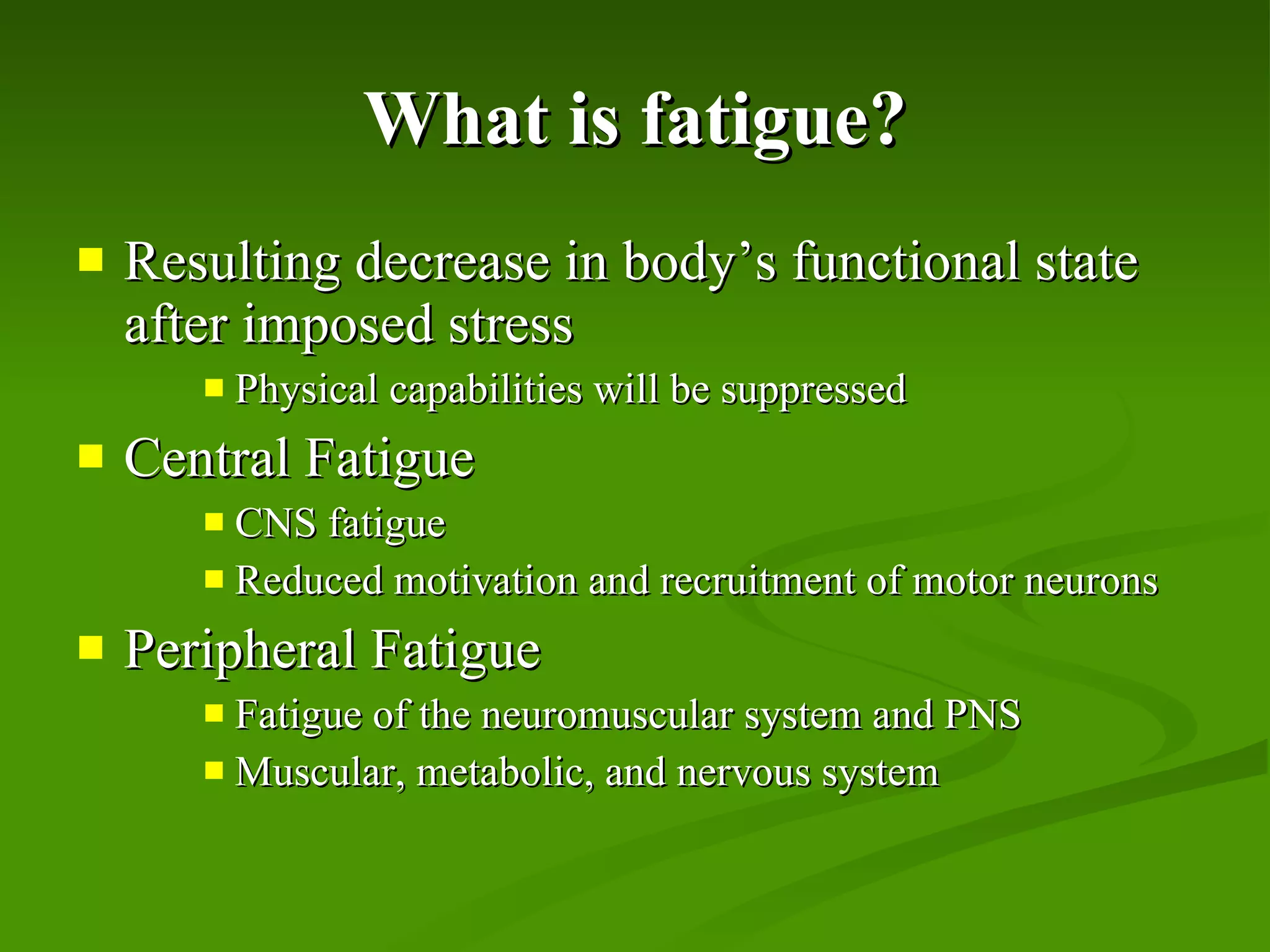
What is fatigue? Resulting decrease in body’s functional state after imposed stress Physical capabilities will be suppressed Central Fatigue CNS fatigue Reduced motivation and recruitment of motor neurons Peripheral Fatigue Fatigue of the neuromuscular system and PNS Muscular, metabolic, and nervous system
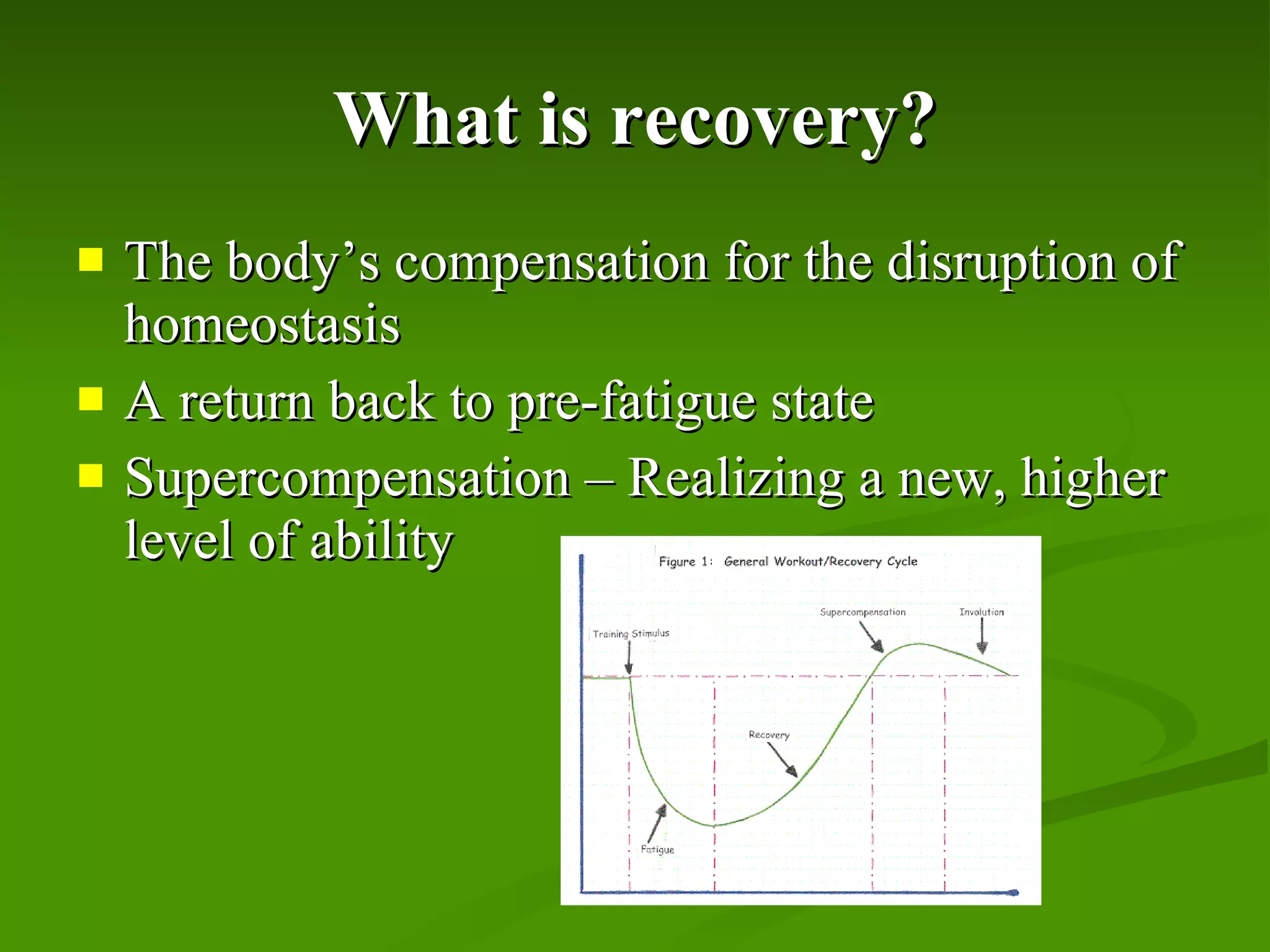
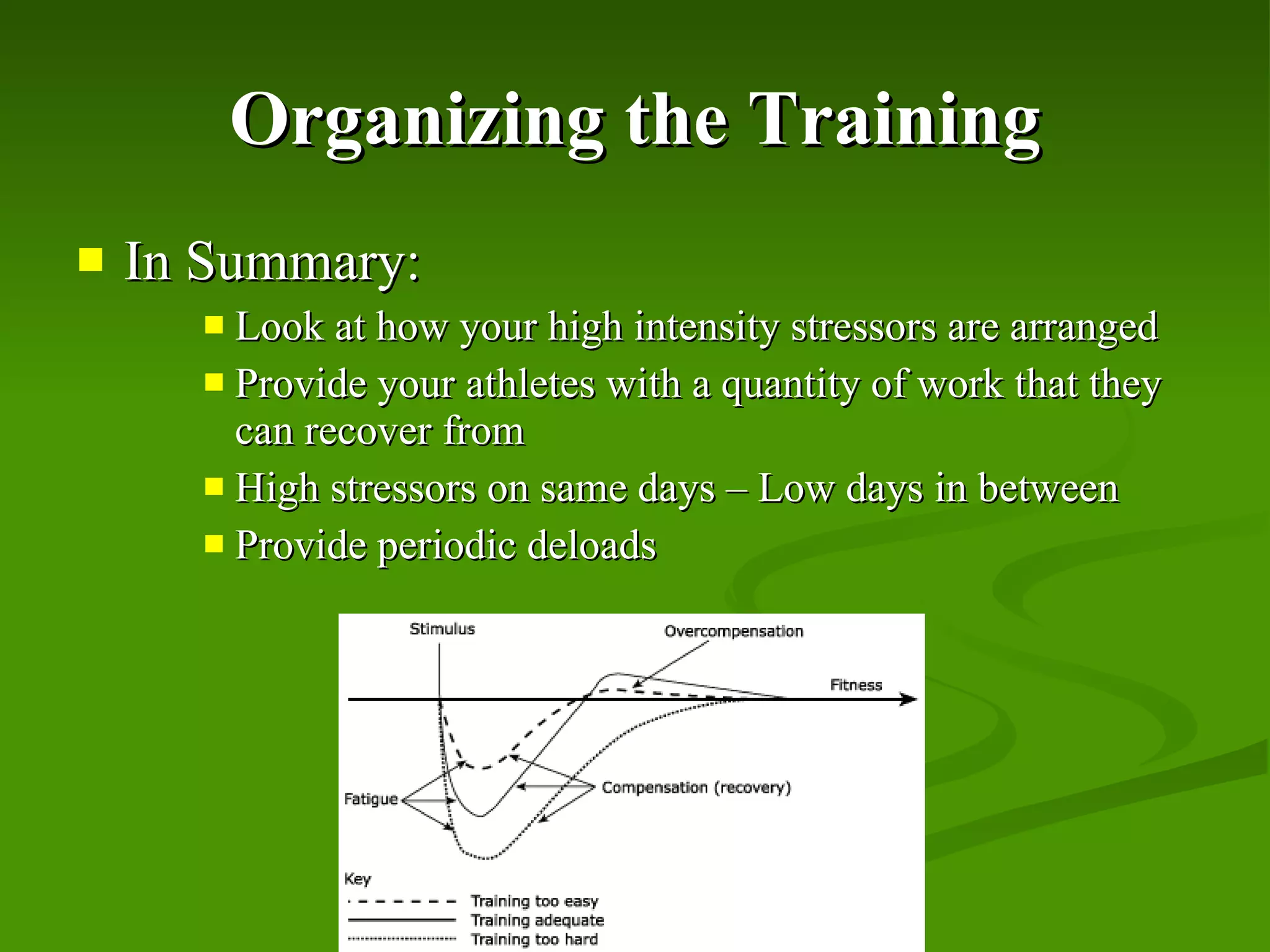
What is recovery? The body’s compensation for the disruption of homeostasis A return back to pre-fatigue state Supercompensation – Realizing a new, higher level of ability
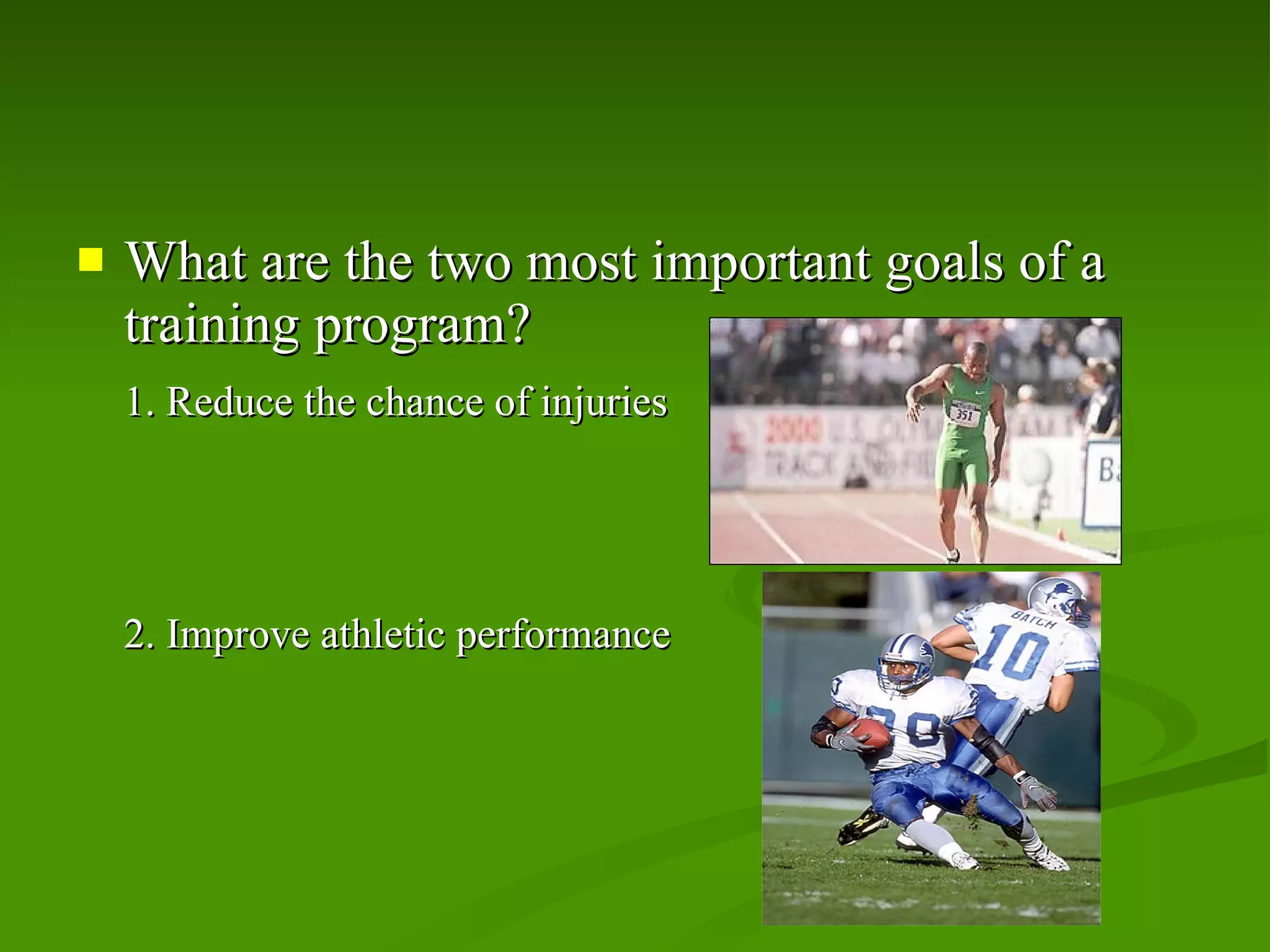
What are the two most important goals of a training program? 1. Reduce the chance of injuries 2. Improve athletic performance
What is the most important and often overlooked aspect of recovering from training?
Setting up your program in a manner that will allow your athletes to recover from the training.
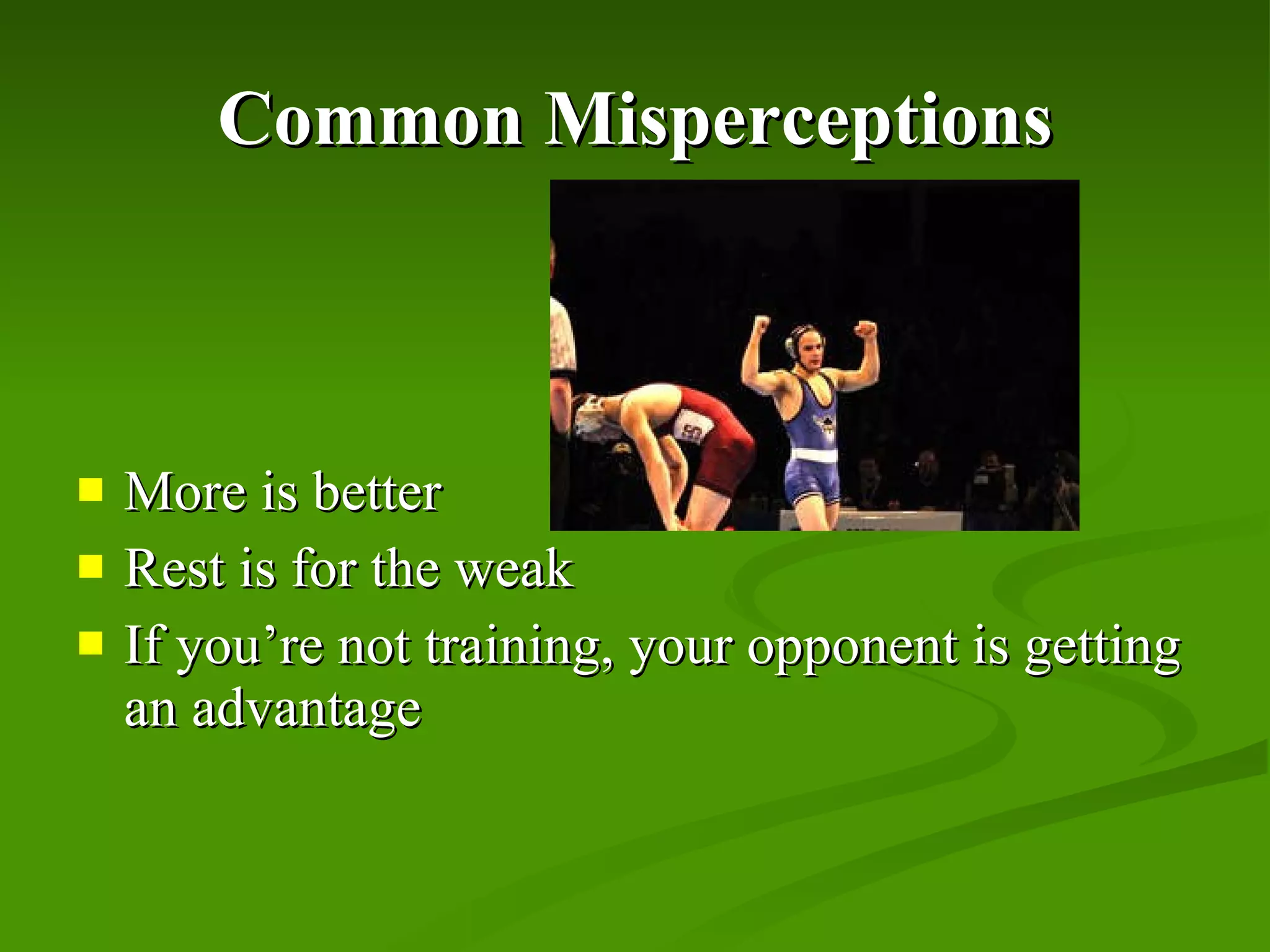
Common Misperceptions More is better Rest is for the weak If you’re not training, your opponent is getting an advantage
Ask yourself: Will the athlete see better results performing a high volume of low to medium quality work? OR Will the athlete see better results performing an  optimal  volume of high quality work?
Different way of thinking Less is more Better to undertrain rather than overtrain Do as much as necessary but as little as possible Train efficiently
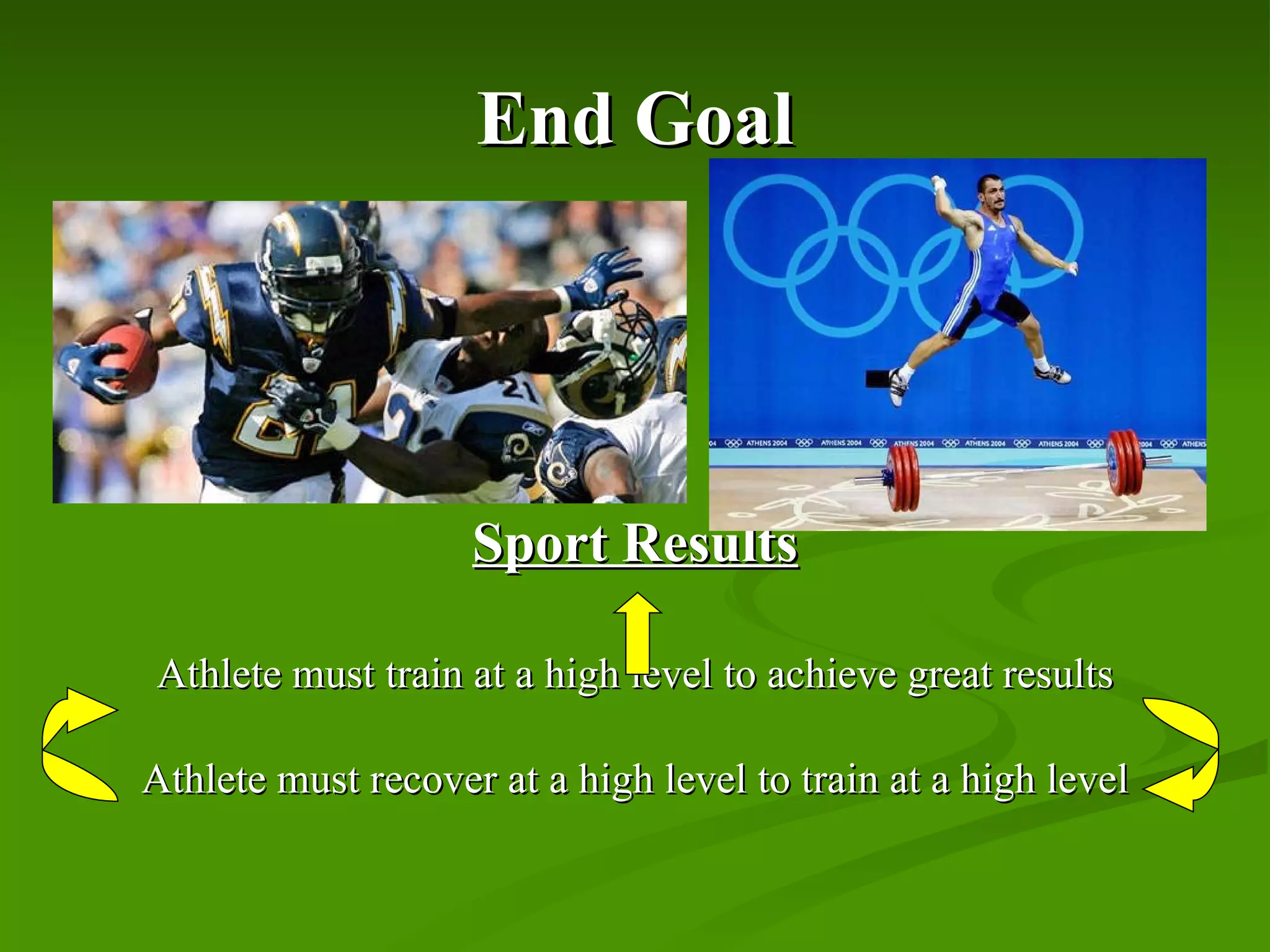
End Goal Sport Results Athlete must train at a high level to achieve great results Athlete must recover at a high level to train at a high level
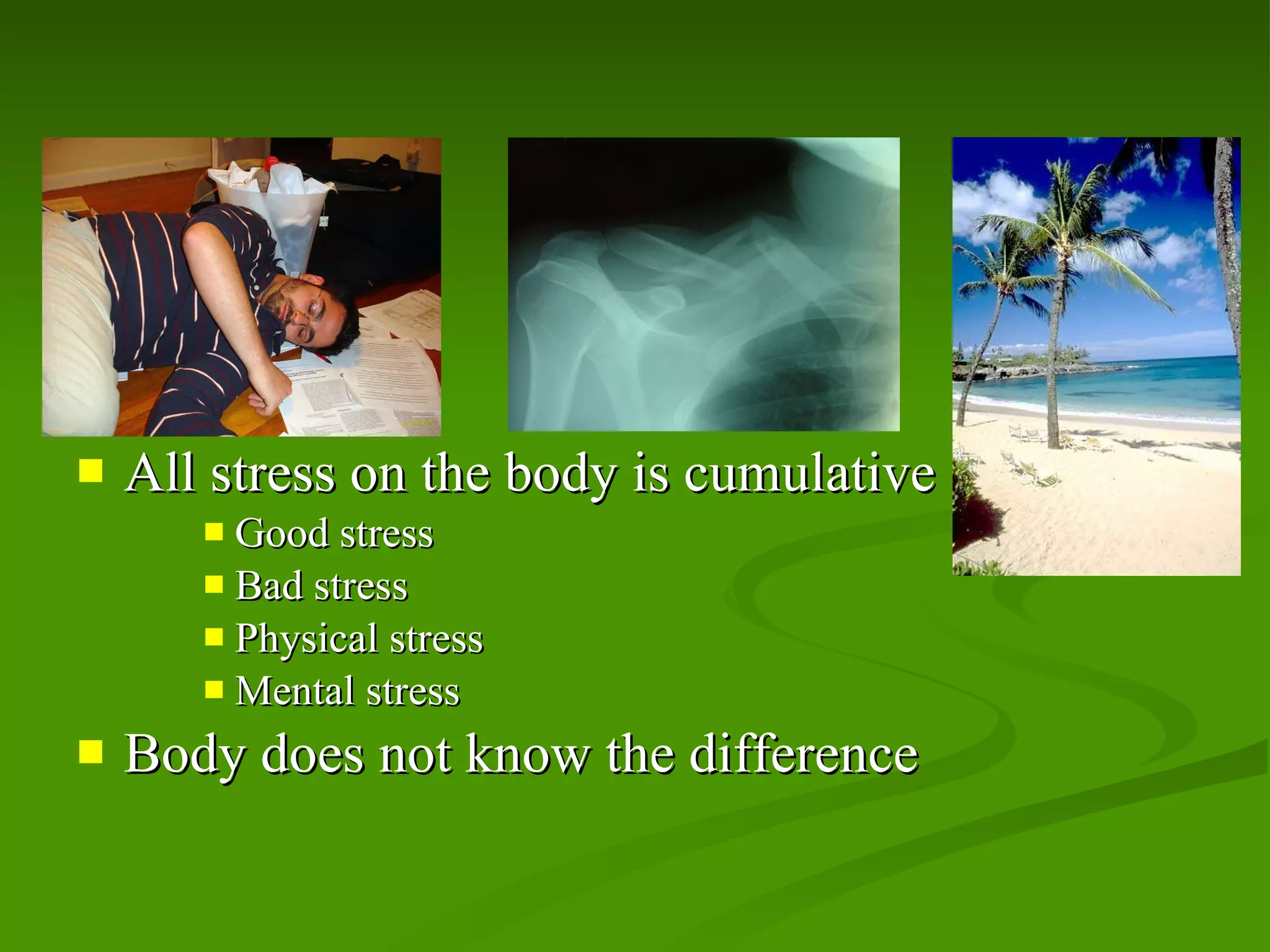
All stress on the body is cumulative Good stress Bad stress Physical stress Mental stress Body does not know the difference
During training, all the different stressors in athlete’s life come into play School Job Sleep Social life Etc. These will all affect athlete’s ability to recover
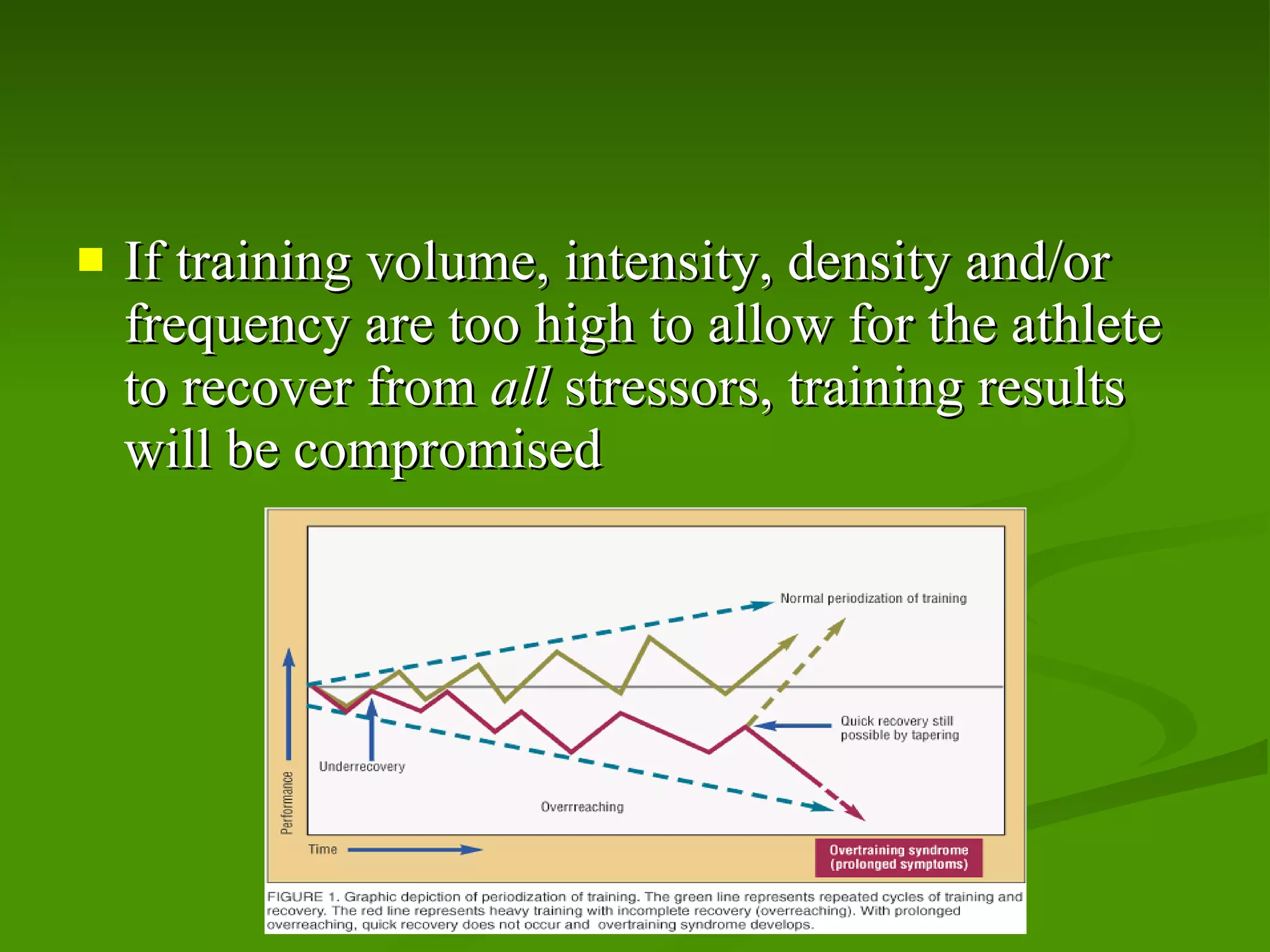
If training volume, intensity, density and/or frequency are too high to allow for the athlete to recover from  all  stressors, training results will be compromised
Do our best to account for the different stressors Reduce training load when necessary and we will get better results in the long run Adjusted training load = higher quality training sessions
Organizing the Training Context is important Preparedness Readiness Goal of training Other stressors Place in daily training, microcycle, mesocycle, and macrocycle/annual plan
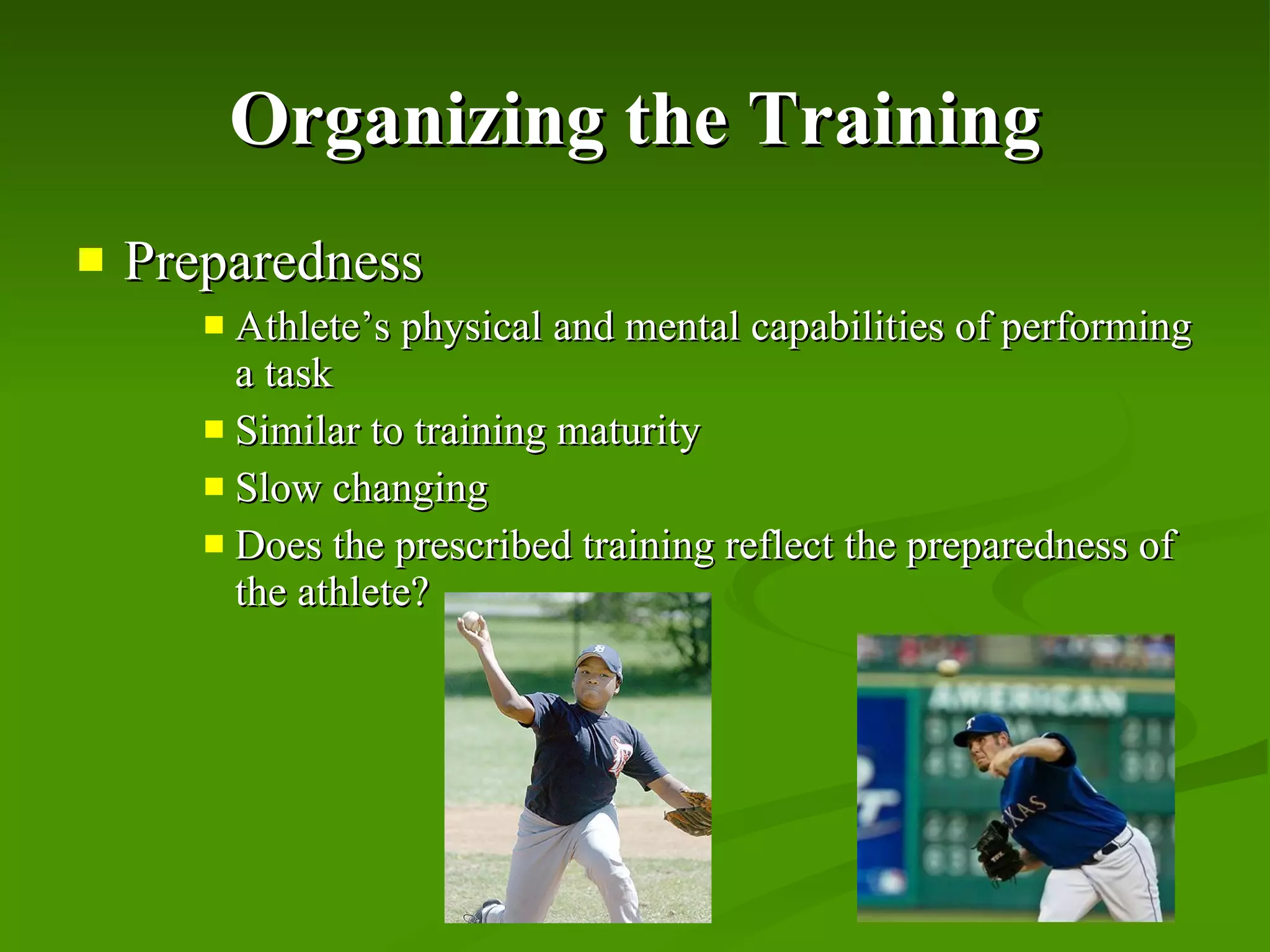
Organizing the Training Preparedness Athlete’s physical and mental capabilities of performing a task Similar to training maturity Slow changing Does the prescribed training reflect the preparedness of the athlete?
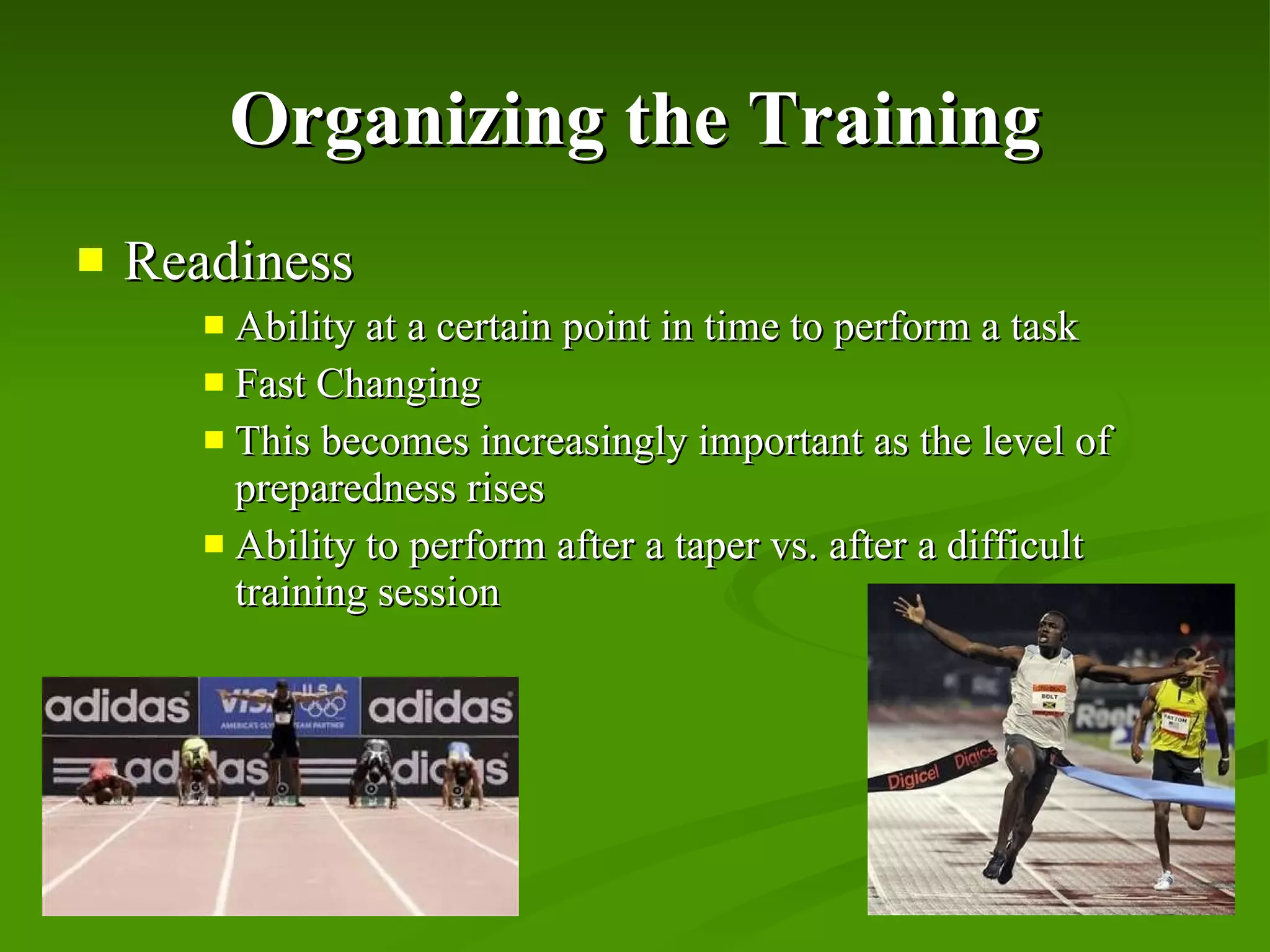
Organizing the Training Readiness Ability at a certain point in time to perform a task Fast Changing This becomes increasingly important as the level of preparedness rises Ability to perform after a taper vs. after a difficult training session
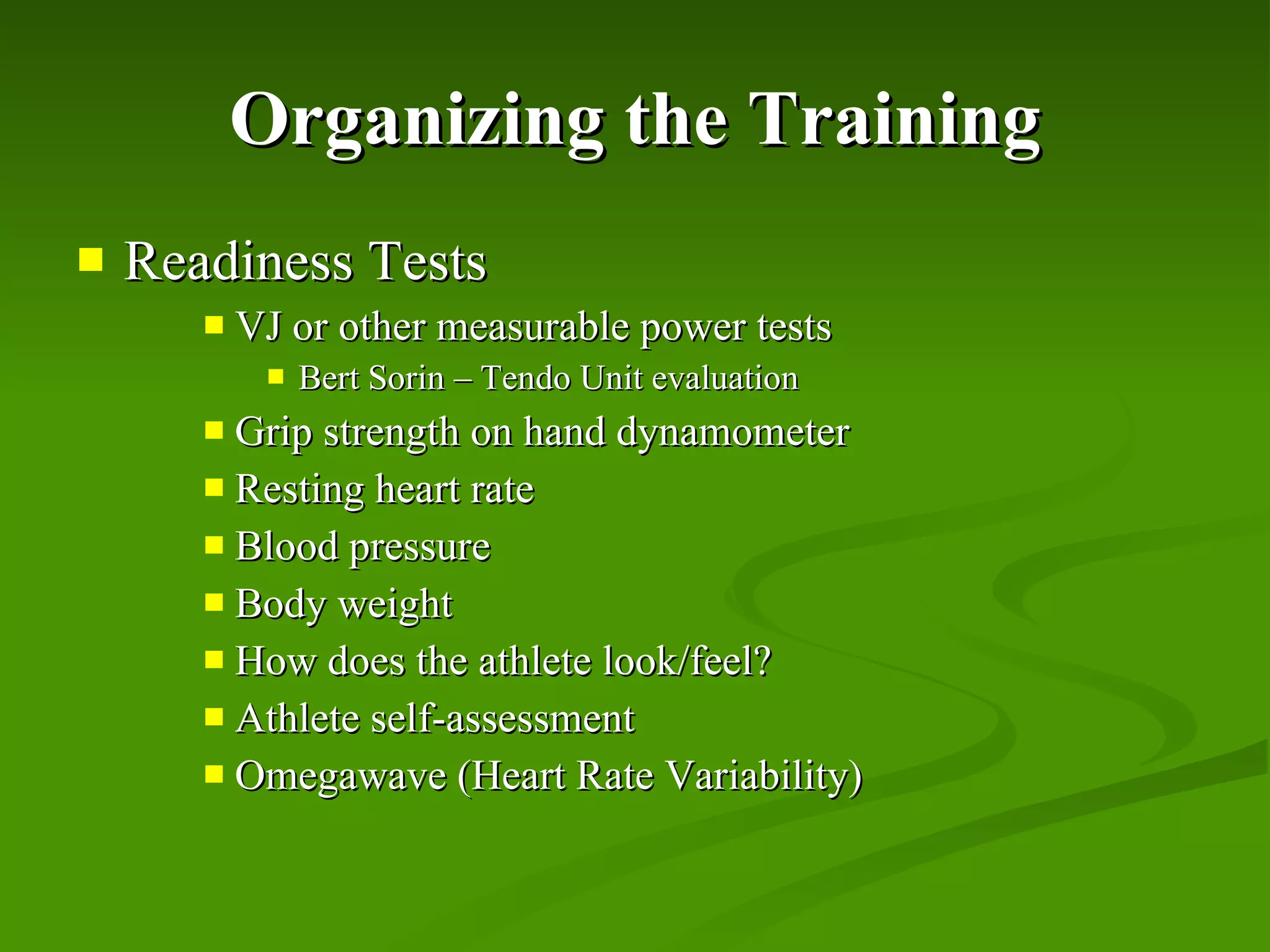
Organizing the Training Readiness Tests VJ or other measurable power tests Bert Sorin – Tendo Unit evaluation Grip strength on hand dynamometer Resting heart rate Blood pressure Body weight How does the athlete look/feel? Athlete self-assessment Omegawave (Heart Rate Variability)
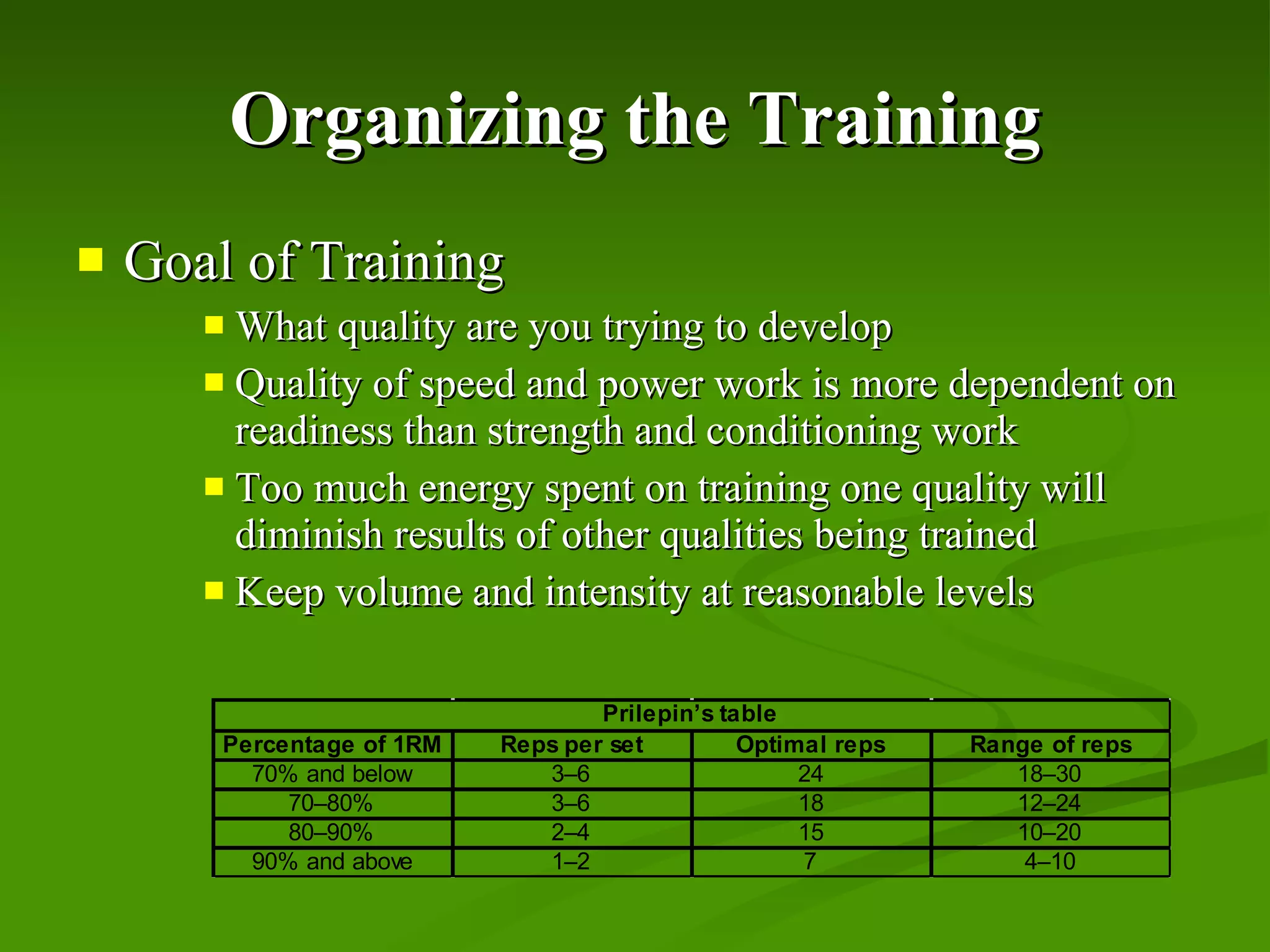
Organizing the Training Goal of Training What quality are you trying to develop Quality of speed and power work is more dependent on readiness than strength and conditioning work Too much energy spent on training one quality will diminish results of other qualities being trained Keep volume and intensity at reasonable levels
Organizing the Training Other Stressors What else needs to be accounted for? Training camp In-Season/Spring Ball Finals & other periods of high academic load
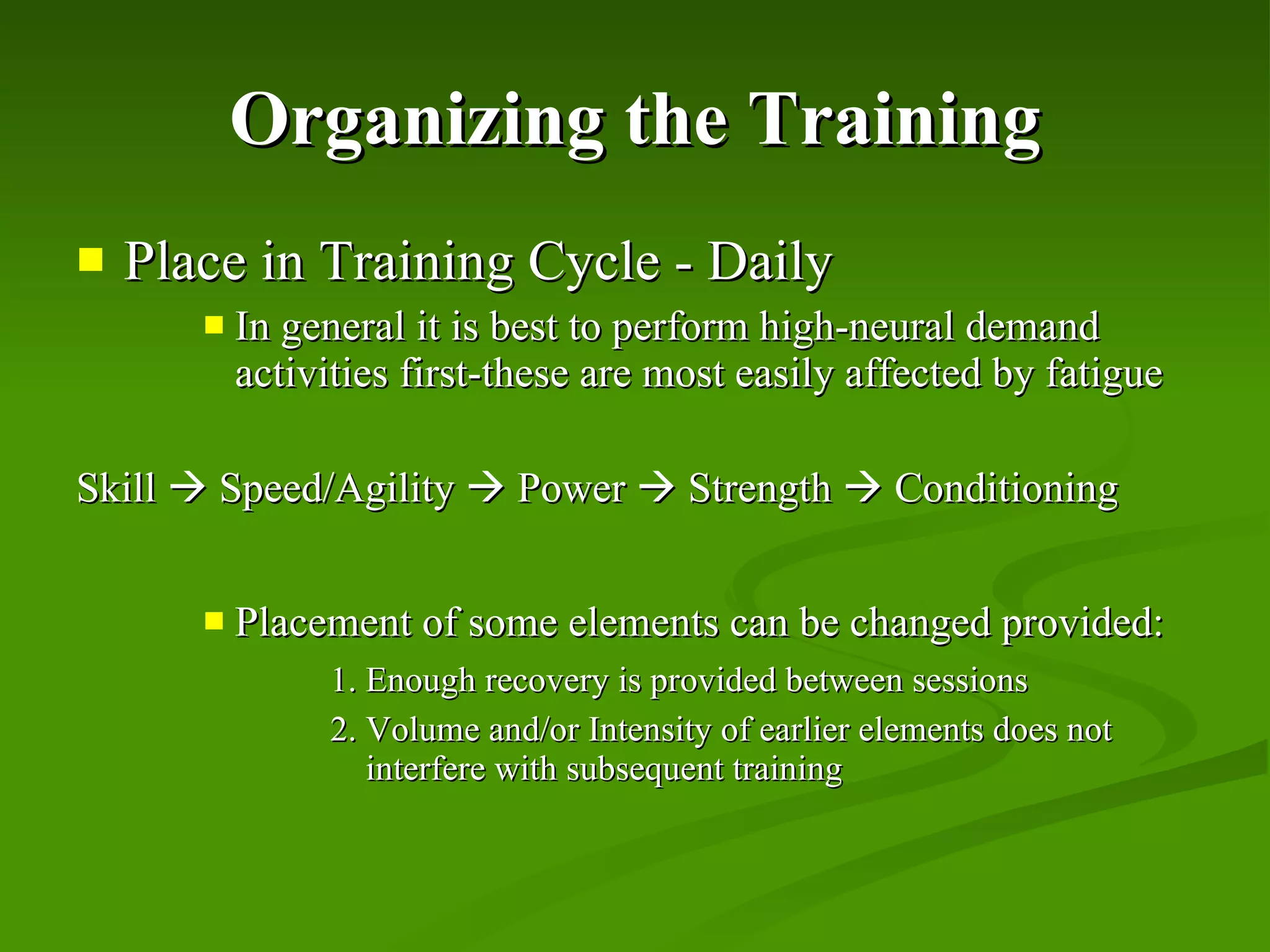
Organizing the Training Place in Training Cycle - Daily In general it is best to perform high-neural demand activities first-these are most easily affected by fatigue Skill    Speed/Agility    Power    Strength    Conditioning Placement of some elements can be changed provided: 1. Enough recovery is provided between sessions 2. Volume and/or Intensity of earlier elements does not    interfere with subsequent training
Organizing the Training Recovery within the training session Keep lifting sessions brief – 45 to 60 min Neural fatigue is longer lasting than metabolic fatigue Provide adequate recovery between sets and exercises Use complete recoveries during Skill/Speed/Agility/Power work to ensure highest quality work is attained Skill work can be low intensity or high intensity
Organizing the Training Place in Training Cycle – Daily The quality of each training session will be determined by what was done in the previous session and what was done to recover from that session Stiffness/soreness is not good for athletes Reduced force output, speed of movement, and ROM Reduced quality of training and movement Increased chance of injury Be mindful of the tissue stress certain movements/loads/speeds place on the athlete
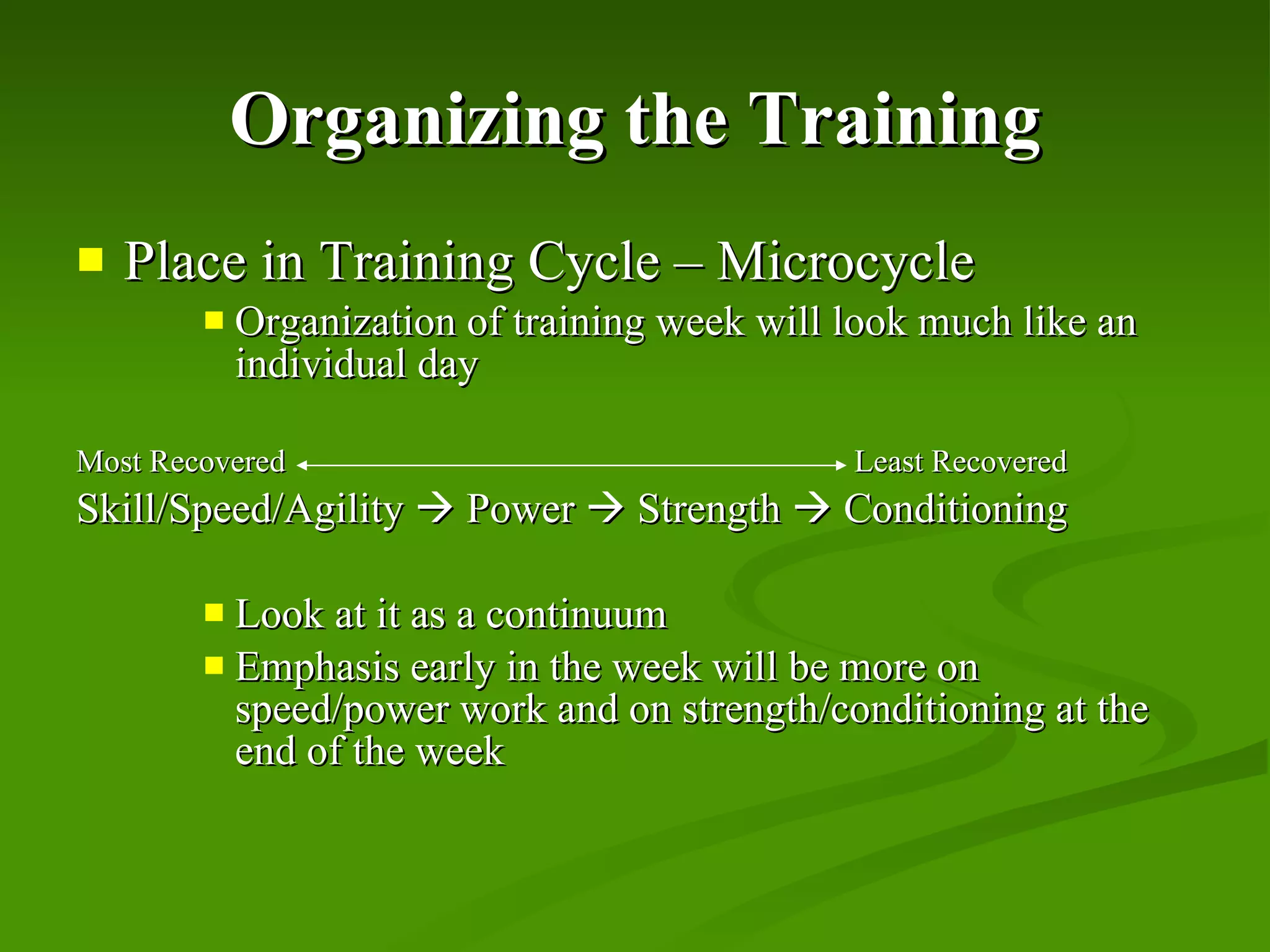
Organizing the Training Place in Training Cycle – Microcycle Organization of training week will look much like an individual day Most Recovered    Least Recovered Skill/Speed/Agility    Power    Strength    Conditioning Look at it as a continuum Emphasis early in the week will be more on speed/power work and on strength/conditioning at the end of the week
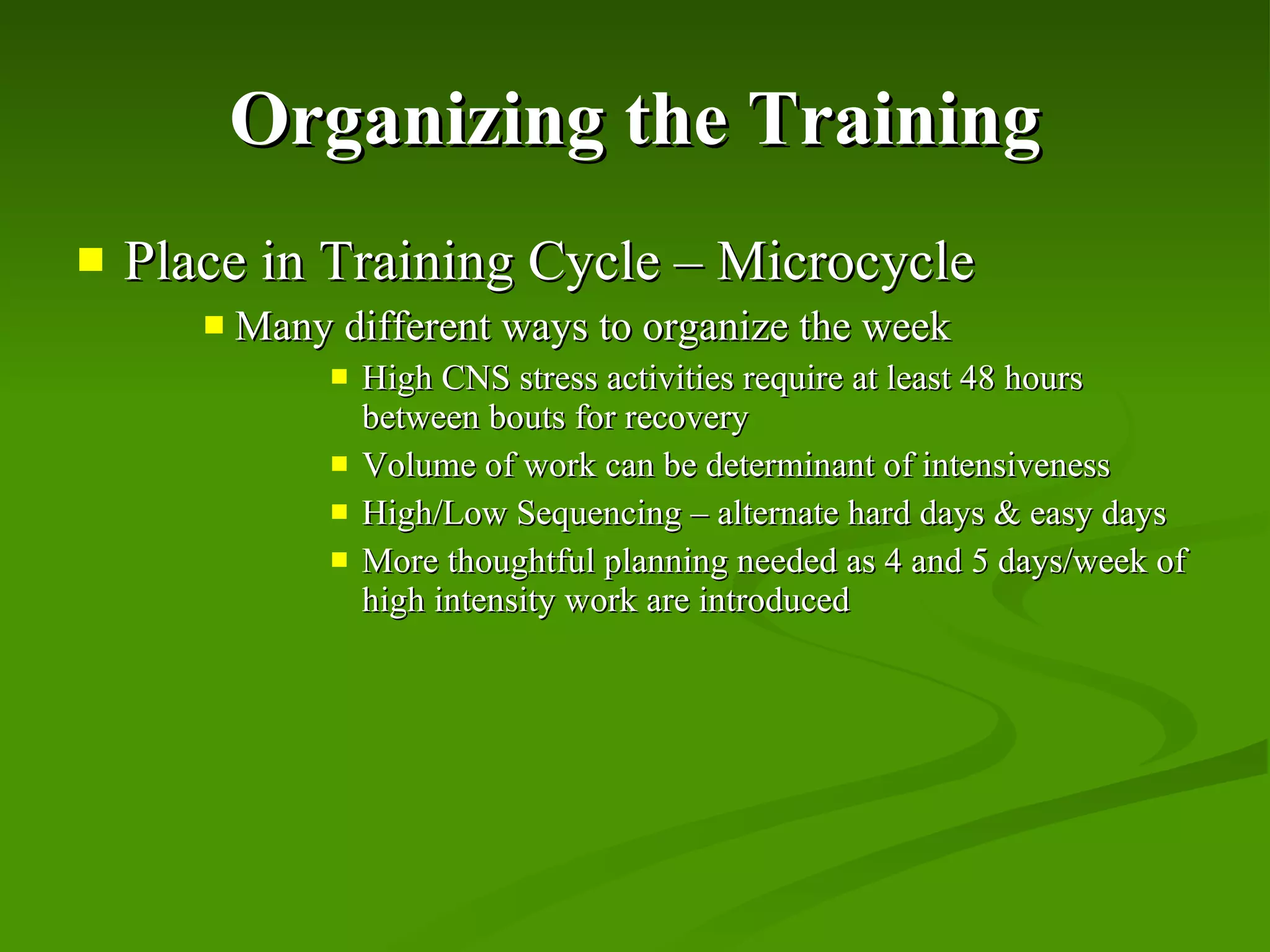
Organizing the Training Place in Training Cycle – Microcycle Many different ways to organize the week High CNS stress activities require at least 48 hours between bouts for recovery Volume of work can be determinant of intensiveness High/Low Sequencing – alternate hard days & easy days More thoughtful planning needed as 4 and 5 days/week of high intensity work are introduced
Organizing the Training Place in Training Cycle – Microcycle Elements of each quality may be present on each day, but in appropriate volumes and sequences High/Low sequencing may not always be possible Arrange training elements in the best way possible under your circumstances
Organizing the Training Place in Training Cycle – Mesocycle Deload every 3 rd  or 4 th  week after intense loading As intensity of training means rises during mesocycle, overall volume of work should decrease High level athlete – focused blocks of training
Organizing the Training Place in Training Cycle – Macrocycle We would consider this our annual plan Different targets of training depending on time of year Off-season – Improve general qualities In-Season/Spring Ball – Improve sport skill/SPP
Organizing the Training In Summary: Look at how your high intensity stressors are arranged Provide your athletes with a quantity of work that they can recover from High stressors on same days – Low days in between Provide periodic deloads
Recovery Tools
Recovery Tools Recovery starts with a proper warm-up Reduce acute & chronic soft-tissue injuries Improve and maintain mobility Increase quality and efficiency of movement Increase elasticity of tissues Serves as a physical and psychological bridge between no intensity and high intensity
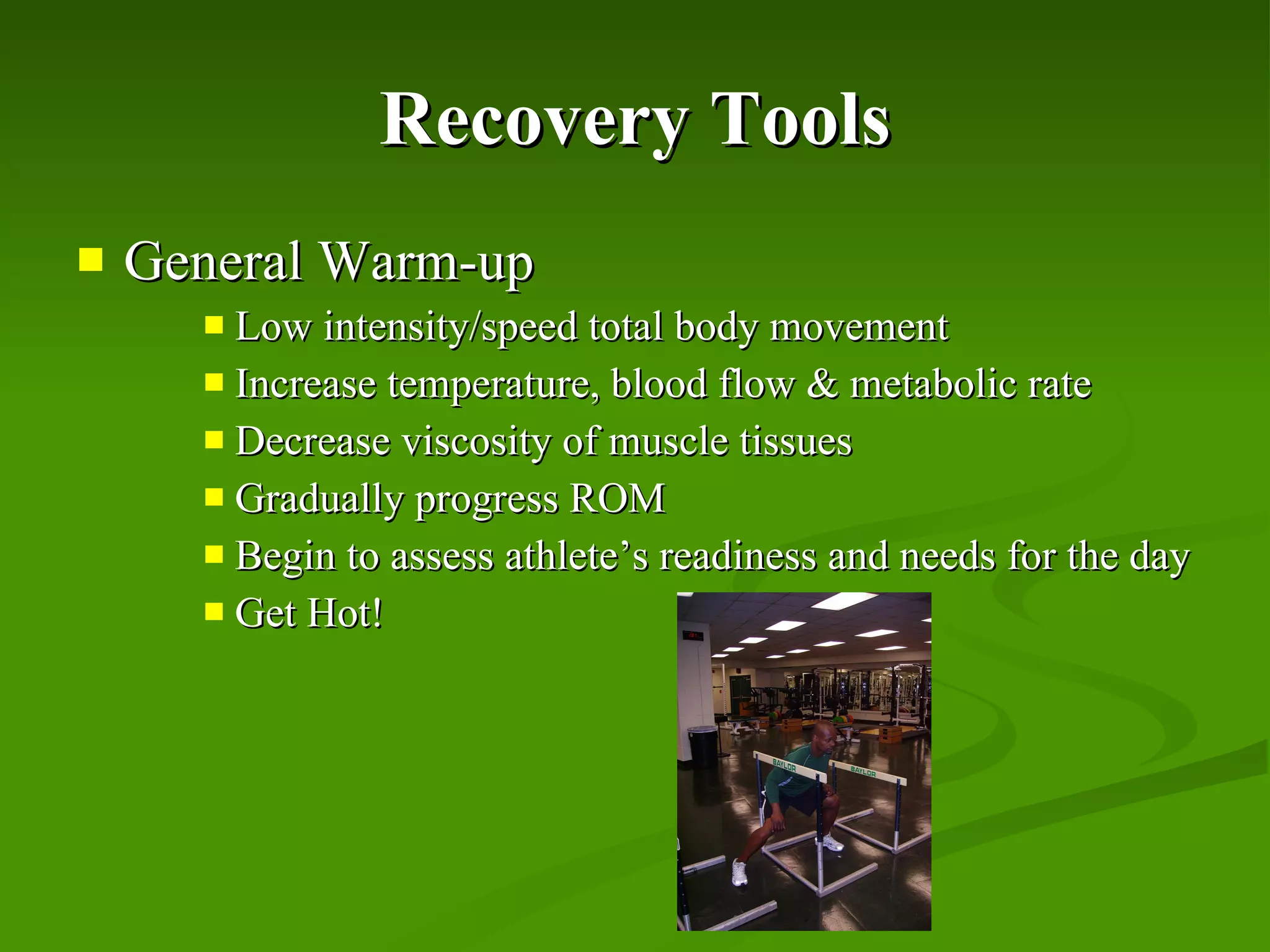
Recovery Tools General Warm-up Low intensity/speed total body movement Increase temperature, blood flow & metabolic rate Decrease viscosity of muscle tissues Gradually progress ROM Begin to assess athlete’s readiness and needs for the day Get Hot!
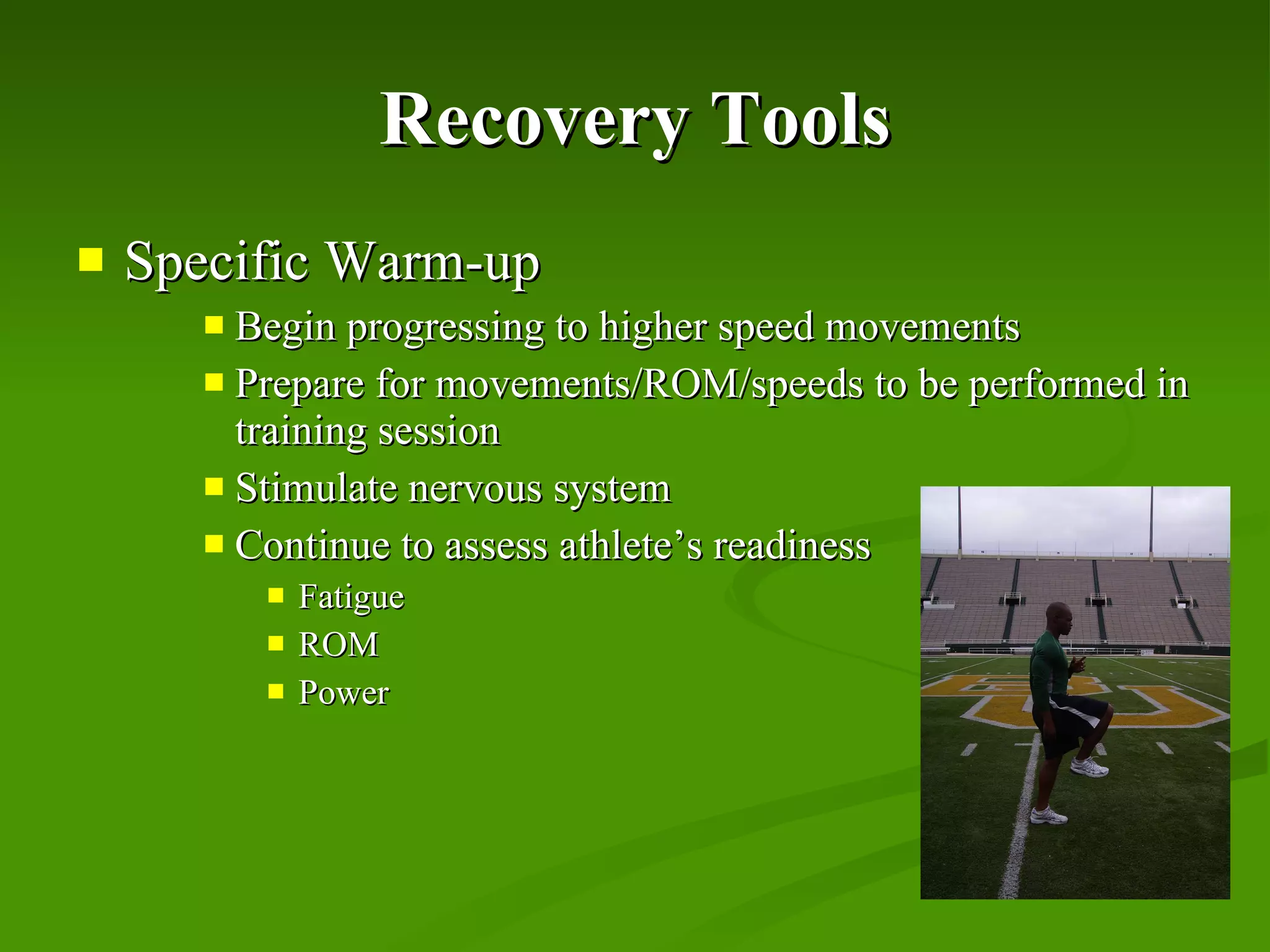
Recovery Tools Specific Warm-up Begin progressing to higher speed movements Prepare for movements/ROM/speeds to be performed in training session Stimulate nervous system Continue to assess athlete’s readiness Fatigue ROM Power
Recovery Tools Sleep Most under-rated recovery tool 7-9 hrs. for adults, 8-10 for children Brief naps are beneficial Large HGH release-growth and repair Dreaming is beneficial for stress reduction
Recovery Tools Improving Sleep Try to establish a routine Allow yourself to wind down prior to bed Cool, comfortable room White noise if necessary Try to avoid caffeine altogether Zinc & Magnesium Aspartate (ZMA) may help some fall asleep
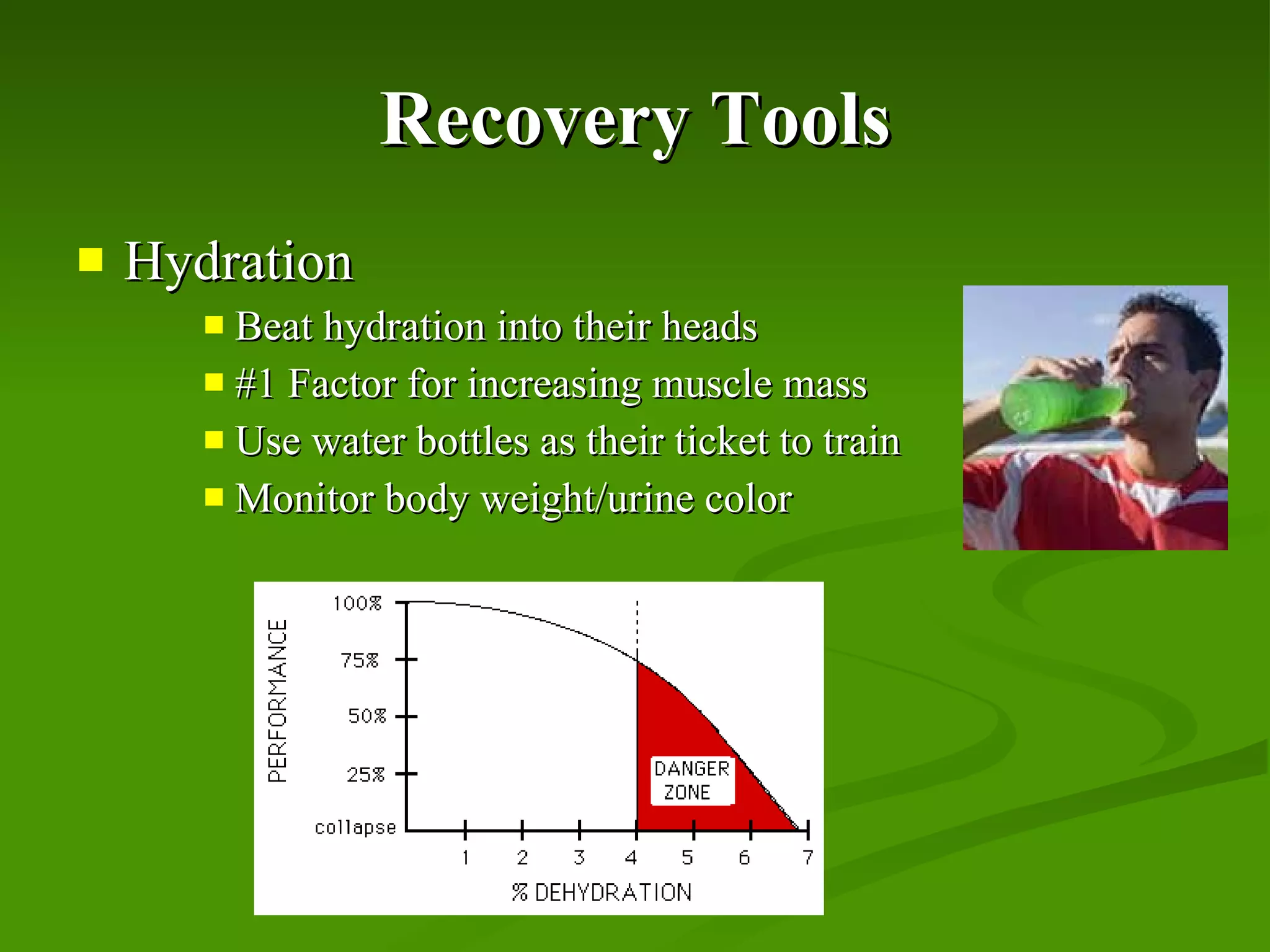
Recovery Tools Hydration Beat hydration into their heads #1 Factor for increasing muscle mass Use water bottles as their ticket to train Monitor body weight/urine color
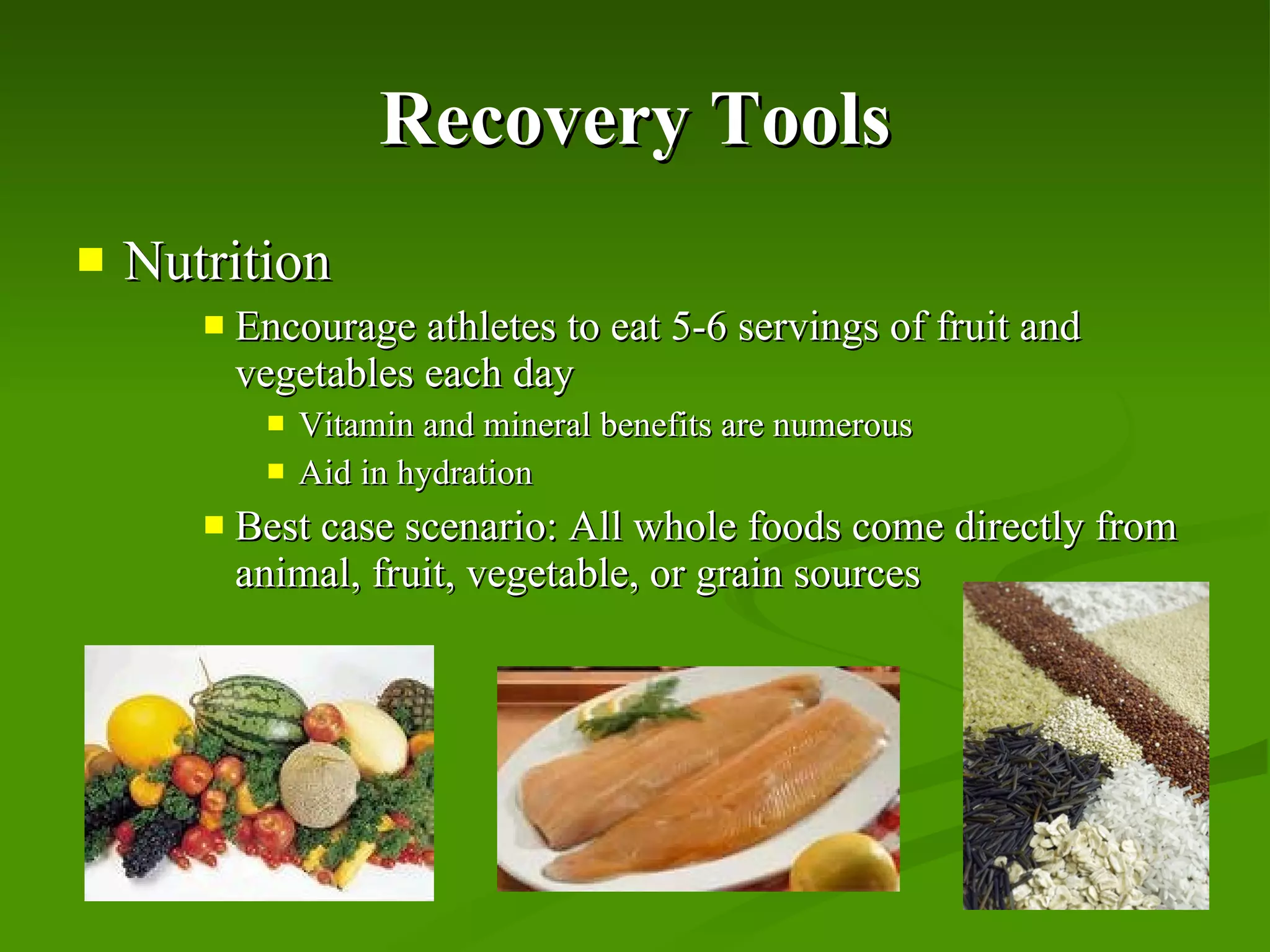
Recovery Tools Nutrition Encourage athletes to eat 5-6 servings of fruit and vegetables each day Vitamin and mineral benefits are numerous Aid in hydration Best case scenario: All whole foods come directly from animal, fruit, vegetable, or grain sources
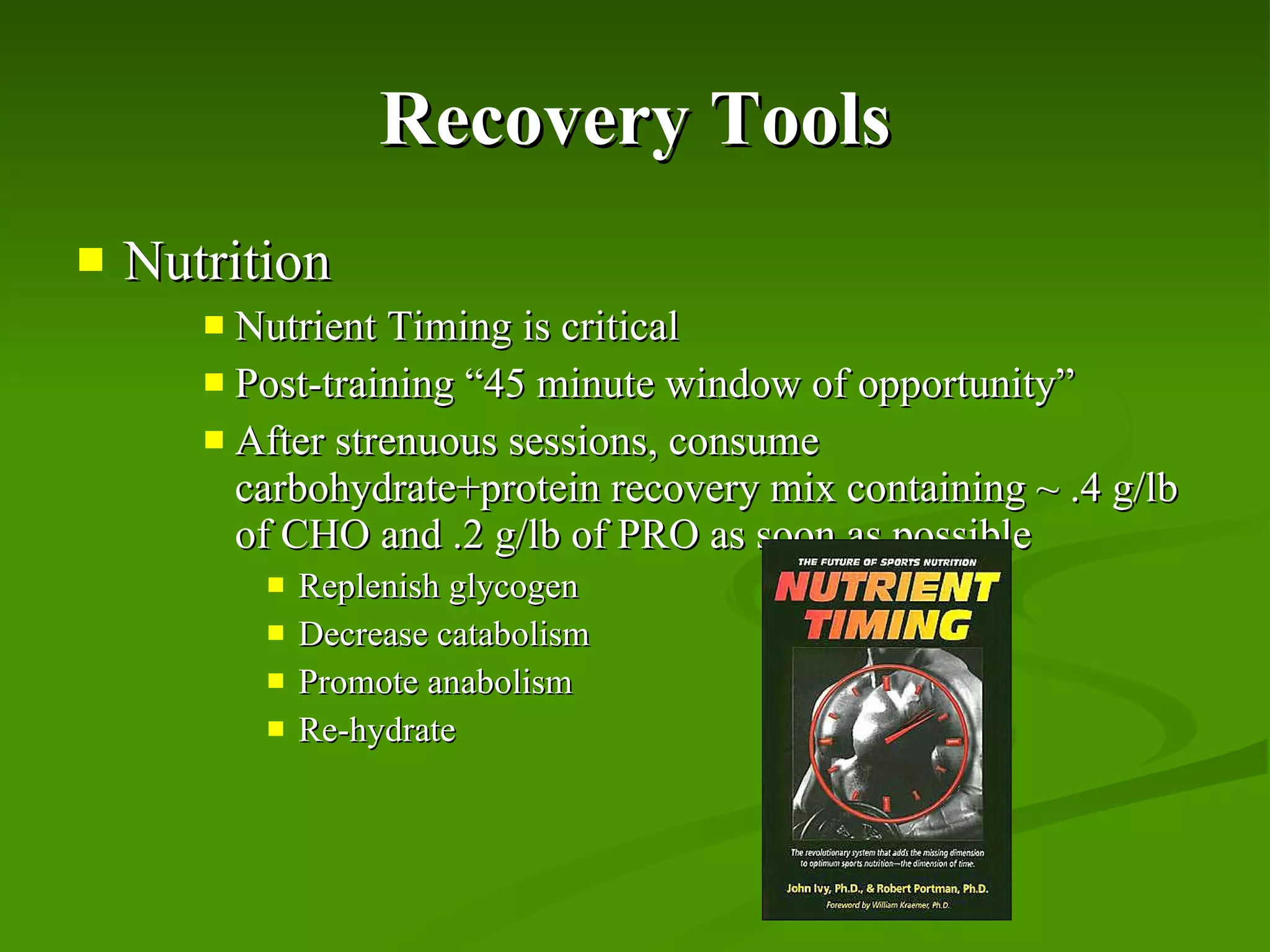
Recovery Tools Nutrition Nutrient Timing is critical  Post-training “45 minute window of opportunity” After strenuous sessions, consume carbohydrate+protein recovery mix containing ~ .4 g/lb of CHO and .2 g/lb of PRO as soon as possible Replenish glycogen Decrease catabolism Promote anabolism Re-hydrate
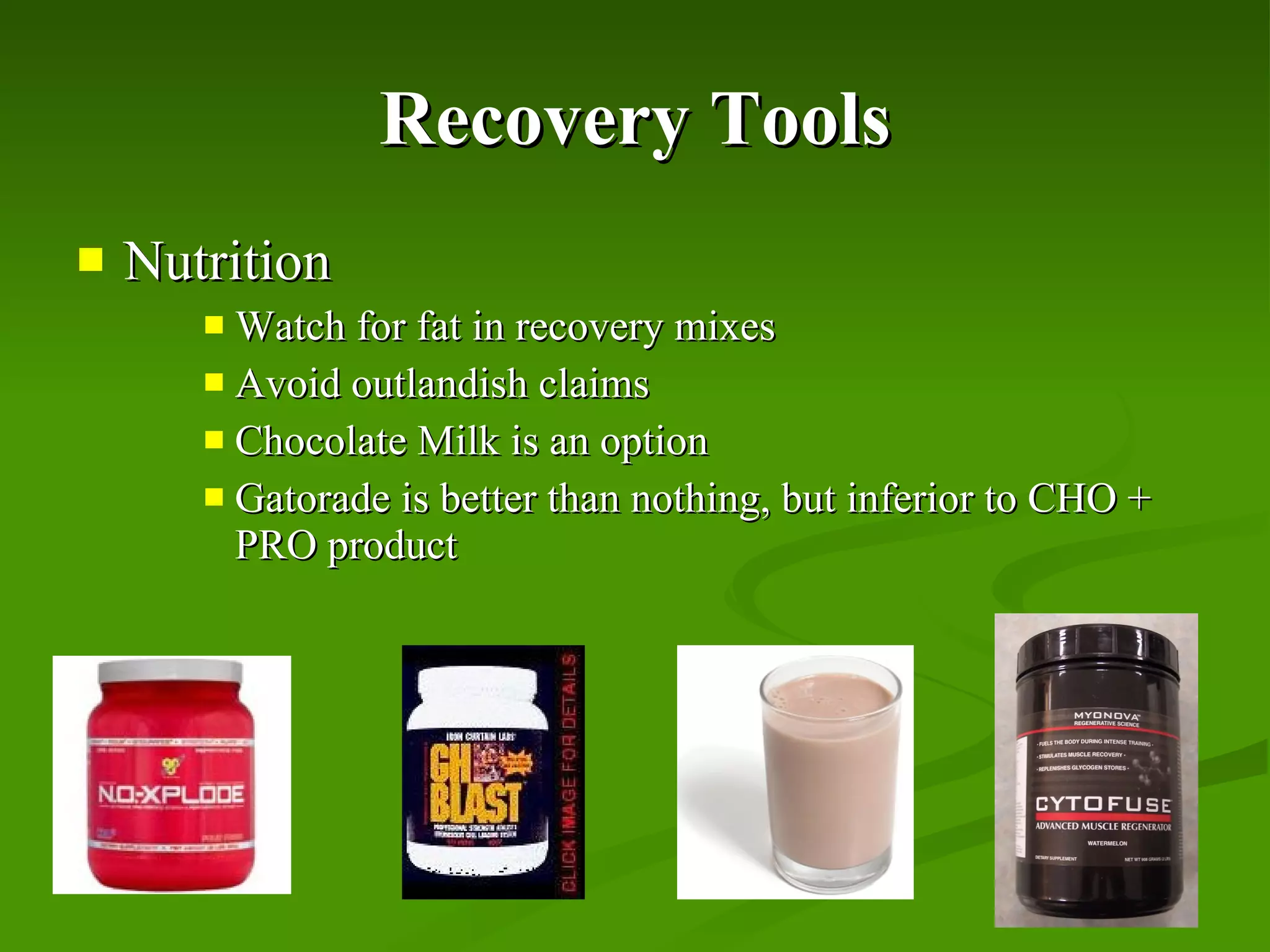
Recovery Tools Nutrition Watch for fat in recovery mixes Avoid outlandish claims  Chocolate Milk is an option Gatorade is better than nothing, but inferior to CHO + PRO product
Recovery Tools Supplementation Stick with the basics Positive Benefits: Creatine Branch Chain Amino Acids Beta Alanine Fish Oils
Recovery Tools Soft Tissue Recovery Want optimal tonus of tissue Proper warm-up and training over time should prevent build-up of knots/adhesions Muscle is most susceptible to pulls directly above and below knots Can apply soft tissue recovery by applying tension (stretching) or pressure (massage)
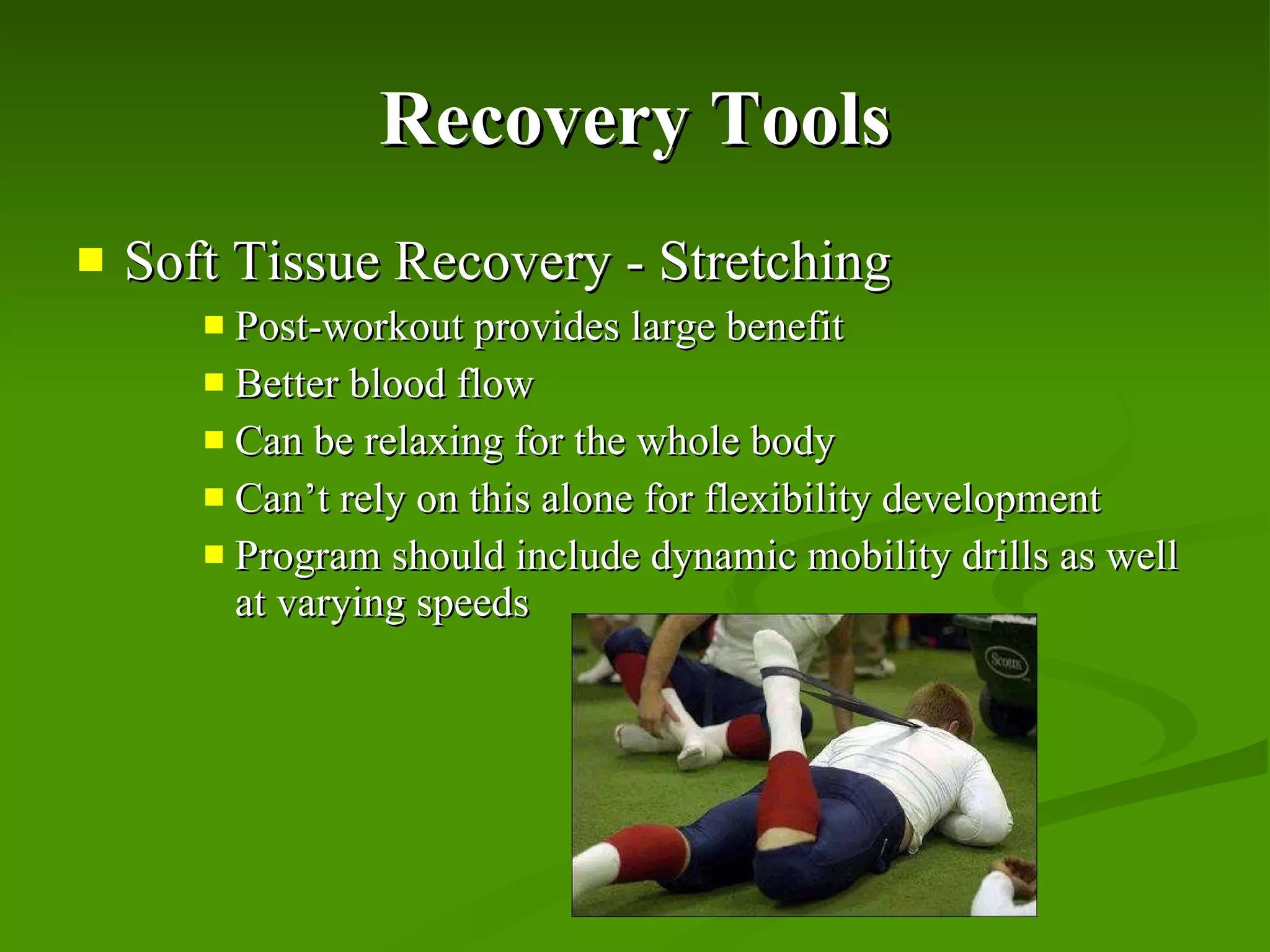
Recovery Tools Soft Tissue Recovery - Stretching Post-workout provides large benefit Better blood flow Can be relaxing for the whole body Can’t rely on this alone for flexibility development Program should include dynamic mobility drills as well at varying speeds
Recovery Tools Soft Tissue Recovery – Stretching Many different types of stretching PNF, AIS, Static, Microstretching, Ballistic, etc. For most purposes, a light static stretch held for 20-30 seconds will work well – Also easiest to coach Be aware of body positioning-don’t cheat the stretch Can use jump-stretch bands, stretch straps, football belts, pieces of inner-tubes, homemade straps
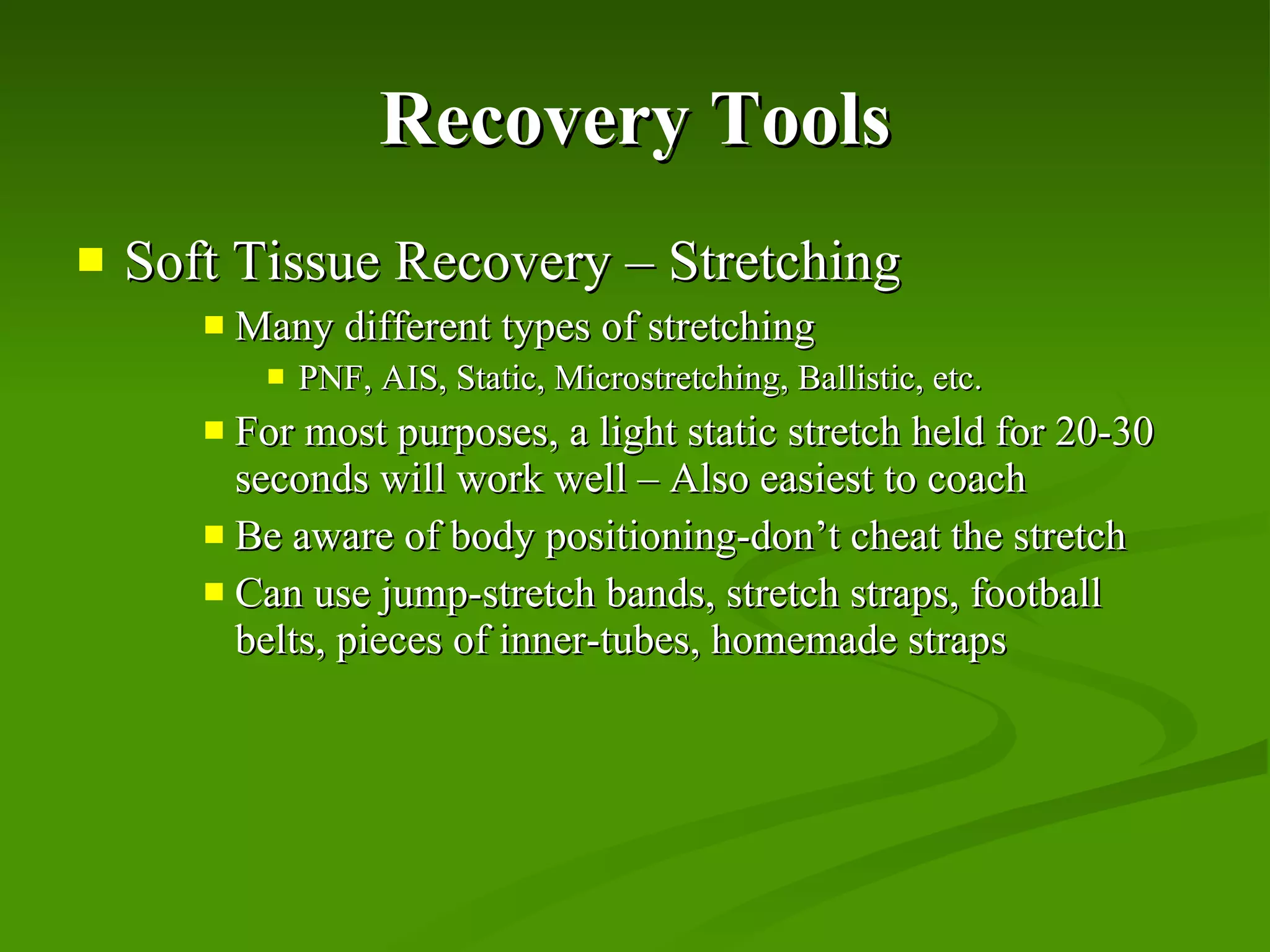
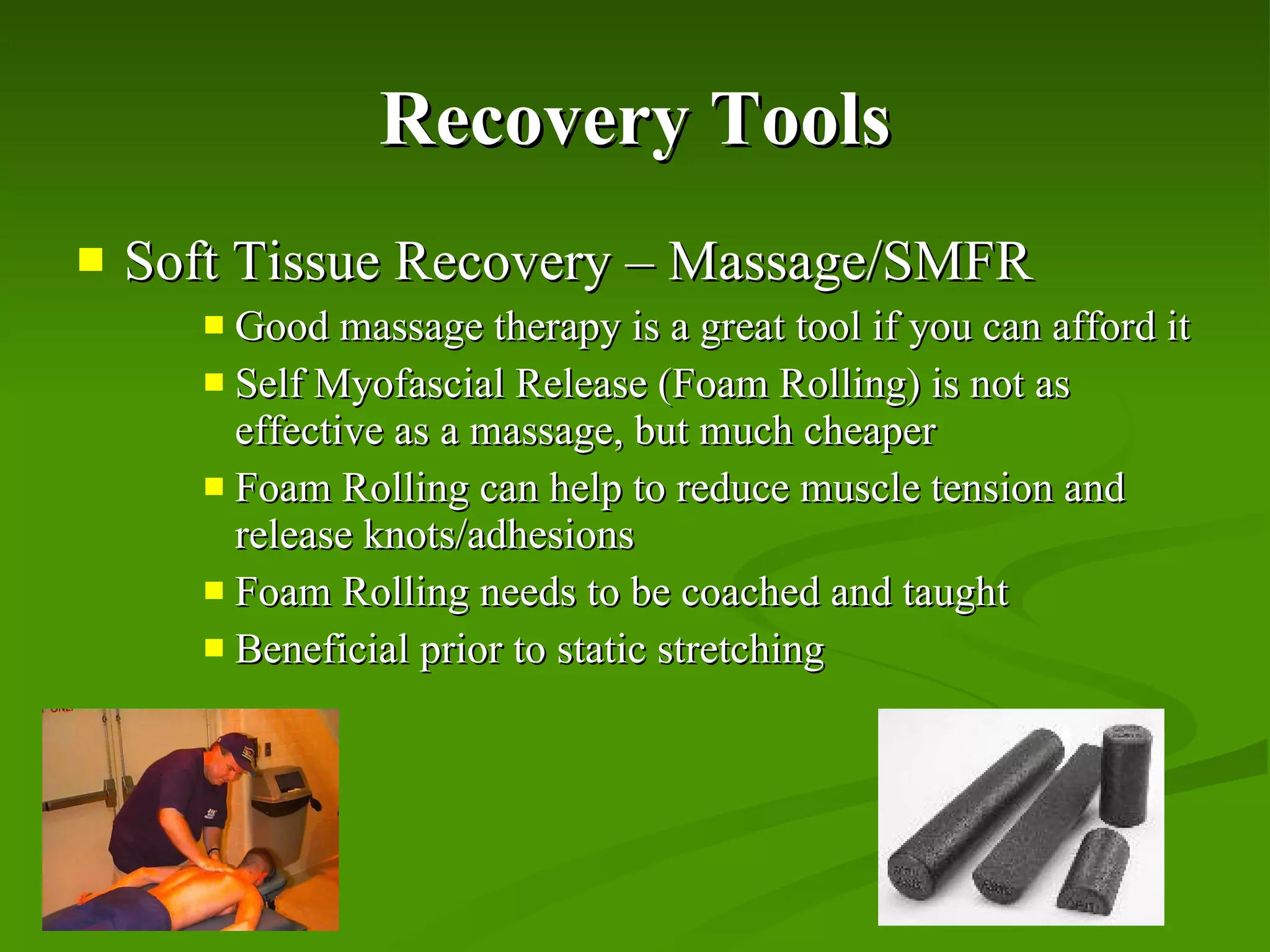
Recovery Tools Soft Tissue Recovery – Massage/SMFR Good massage therapy is a great tool if you can afford it Self Myofascial Release (Foam Rolling) is not as effective as a massage, but much cheaper Foam Rolling can help to reduce muscle tension and release knots/adhesions Foam Rolling needs to be coached and taught Beneficial prior to static stretching
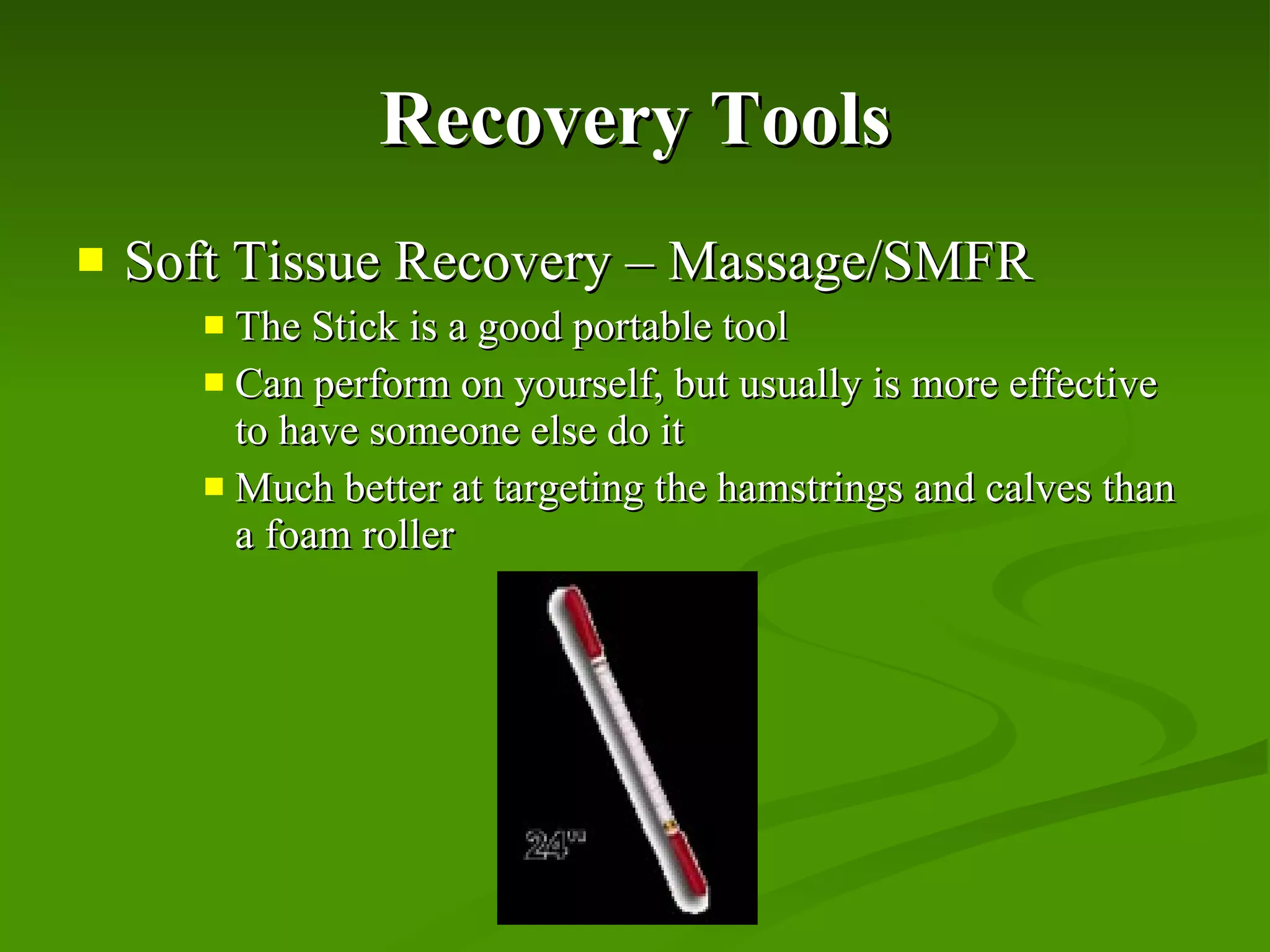
Recovery Tools Soft Tissue Recovery – Massage/SMFR The Stick is a good portable tool Can perform on yourself, but usually is more effective to have someone else do it Much better at targeting the hamstrings and calves than a foam roller
Recovery Tools Hydrotherapy Water is a great recovery tool Low intensity pool workouts between intense sessions can help speed recovery Cold tub immersion post training Immerse for  10-15 minutes Hot/Cold Contrast Baths/Showers Recommended 3:1 ratio of hot:cold ranging from 1:30 – 3 minutes hot and 30 – 60 seconds cold
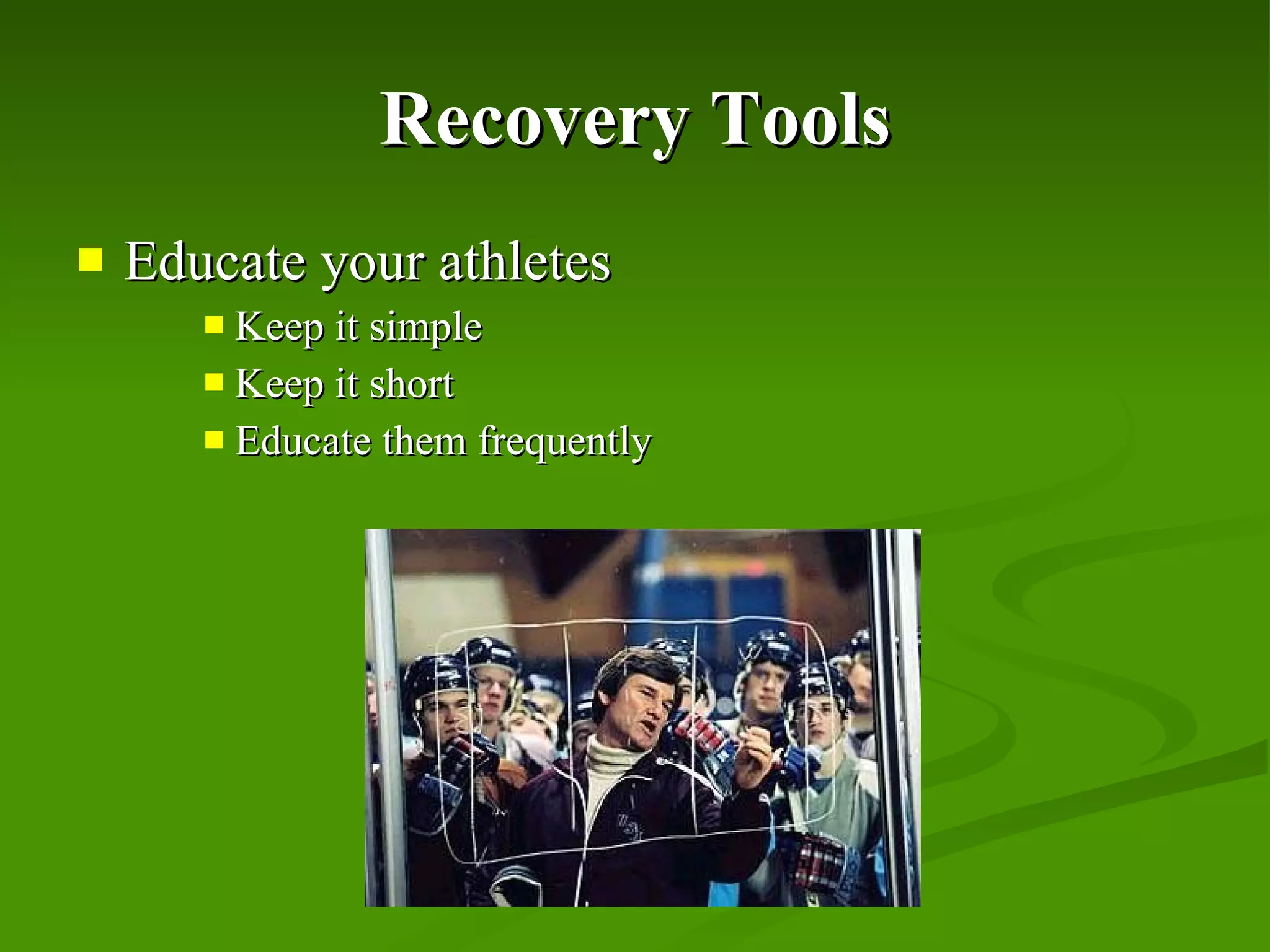
Recovery Tools Educate your athletes Keep it simple Keep it short Educate them frequently
Sources Francis, C.  The Charlie Francis Training System , 1997 Issurin, V.  Block Periodization – Breakthrough in Sport Training , 2008 Ivy, J. & Portman, R.  Nutrient Timing , 2004 Kellman, M. (Ed.)  Enhancing Recovery , 2003 Radcliffe, J.C.  University of Oregon Football Power Development Conditioning Programming Siff, M.C.  Supertraining , 2003 Smith, J.  High/Low Sequences of Programming and Organizing Training , 2005 Valle, C.  Devil’s Advocate – Building Speed Demons Pt. 1 http://www.elitefts.com/documents/warmup2.pdf Selye, H.  The Stress of Life , 1997 Zatsiorsky, V.M.  Science and Practice of Strength Training , 1995
Questions? Thank You Contact Info: 254-710-8113 [email_address]

Ruf - Recovery Strategies

  • 1.
    Recovery Strategies ChrisRuf Associate Strength & Conditioning Coach
  • 2.
    Thanks to ourClinic Sponsors Young Champions http://www.youngchampions.com Power Lift http://www.power-lift.com Xtreme Formulations/Black Star Labs http://www.xtremeformulations.com http://www.blackstarlabs.com IronMind http://www.ironmind.com
  • 3.
    What this presentationisn’t: Examples of all the recovery tools available Protocols for all the recovery tools available A carbon copy of what we do to enhance recovery
  • 4.
    What this presentationis: A look at the factors that influence recovery from training A look at ways to manage training stress A brief look at some of the recovery tools that are available
  • 5.
    What is training?Systematic stress imposed on the body Disruption of homeostasis This comes in many forms
  • 6.
    What is fatigue?Resulting decrease in body’s functional state after imposed stress Physical capabilities will be suppressed Central Fatigue CNS fatigue Reduced motivation and recruitment of motor neurons Peripheral Fatigue Fatigue of the neuromuscular system and PNS Muscular, metabolic, and nervous system
  • 7.
    What is recovery?The body’s compensation for the disruption of homeostasis A return back to pre-fatigue state Supercompensation – Realizing a new, higher level of ability
  • 8.
    What are thetwo most important goals of a training program? 1. Reduce the chance of injuries 2. Improve athletic performance
  • 9.
    What is themost important and often overlooked aspect of recovering from training?
  • 10.
    Setting up yourprogram in a manner that will allow your athletes to recover from the training.
  • 11.
    Common Misperceptions Moreis better Rest is for the weak If you’re not training, your opponent is getting an advantage
  • 12.
    Ask yourself: Willthe athlete see better results performing a high volume of low to medium quality work? OR Will the athlete see better results performing an optimal volume of high quality work?
  • 13.
    Different way ofthinking Less is more Better to undertrain rather than overtrain Do as much as necessary but as little as possible Train efficiently
  • 14.
    End Goal SportResults Athlete must train at a high level to achieve great results Athlete must recover at a high level to train at a high level
  • 15.
    All stress onthe body is cumulative Good stress Bad stress Physical stress Mental stress Body does not know the difference
  • 16.
    During training, allthe different stressors in athlete’s life come into play School Job Sleep Social life Etc. These will all affect athlete’s ability to recover
  • 17.
    If training volume,intensity, density and/or frequency are too high to allow for the athlete to recover from all stressors, training results will be compromised
  • 18.
    Do our bestto account for the different stressors Reduce training load when necessary and we will get better results in the long run Adjusted training load = higher quality training sessions
  • 19.
    Organizing the TrainingContext is important Preparedness Readiness Goal of training Other stressors Place in daily training, microcycle, mesocycle, and macrocycle/annual plan
  • 20.
    Organizing the TrainingPreparedness Athlete’s physical and mental capabilities of performing a task Similar to training maturity Slow changing Does the prescribed training reflect the preparedness of the athlete?
  • 21.
    Organizing the TrainingReadiness Ability at a certain point in time to perform a task Fast Changing This becomes increasingly important as the level of preparedness rises Ability to perform after a taper vs. after a difficult training session
  • 22.
    Organizing the TrainingReadiness Tests VJ or other measurable power tests Bert Sorin – Tendo Unit evaluation Grip strength on hand dynamometer Resting heart rate Blood pressure Body weight How does the athlete look/feel? Athlete self-assessment Omegawave (Heart Rate Variability)
  • 23.
    Organizing the TrainingGoal of Training What quality are you trying to develop Quality of speed and power work is more dependent on readiness than strength and conditioning work Too much energy spent on training one quality will diminish results of other qualities being trained Keep volume and intensity at reasonable levels
  • 24.
    Organizing the TrainingOther Stressors What else needs to be accounted for? Training camp In-Season/Spring Ball Finals & other periods of high academic load
  • 25.
    Organizing the TrainingPlace in Training Cycle - Daily In general it is best to perform high-neural demand activities first-these are most easily affected by fatigue Skill  Speed/Agility  Power  Strength  Conditioning Placement of some elements can be changed provided: 1. Enough recovery is provided between sessions 2. Volume and/or Intensity of earlier elements does not interfere with subsequent training
  • 26.
    Organizing the TrainingRecovery within the training session Keep lifting sessions brief – 45 to 60 min Neural fatigue is longer lasting than metabolic fatigue Provide adequate recovery between sets and exercises Use complete recoveries during Skill/Speed/Agility/Power work to ensure highest quality work is attained Skill work can be low intensity or high intensity
  • 27.
    Organizing the TrainingPlace in Training Cycle – Daily The quality of each training session will be determined by what was done in the previous session and what was done to recover from that session Stiffness/soreness is not good for athletes Reduced force output, speed of movement, and ROM Reduced quality of training and movement Increased chance of injury Be mindful of the tissue stress certain movements/loads/speeds place on the athlete
  • 28.
    Organizing the TrainingPlace in Training Cycle – Microcycle Organization of training week will look much like an individual day Most Recovered Least Recovered Skill/Speed/Agility  Power  Strength  Conditioning Look at it as a continuum Emphasis early in the week will be more on speed/power work and on strength/conditioning at the end of the week
  • 29.
    Organizing the TrainingPlace in Training Cycle – Microcycle Many different ways to organize the week High CNS stress activities require at least 48 hours between bouts for recovery Volume of work can be determinant of intensiveness High/Low Sequencing – alternate hard days & easy days More thoughtful planning needed as 4 and 5 days/week of high intensity work are introduced
  • 30.
    Organizing the TrainingPlace in Training Cycle – Microcycle Elements of each quality may be present on each day, but in appropriate volumes and sequences High/Low sequencing may not always be possible Arrange training elements in the best way possible under your circumstances
  • 31.
    Organizing the TrainingPlace in Training Cycle – Mesocycle Deload every 3 rd or 4 th week after intense loading As intensity of training means rises during mesocycle, overall volume of work should decrease High level athlete – focused blocks of training
  • 32.
    Organizing the TrainingPlace in Training Cycle – Macrocycle We would consider this our annual plan Different targets of training depending on time of year Off-season – Improve general qualities In-Season/Spring Ball – Improve sport skill/SPP
  • 33.
    Organizing the TrainingIn Summary: Look at how your high intensity stressors are arranged Provide your athletes with a quantity of work that they can recover from High stressors on same days – Low days in between Provide periodic deloads
  • 34.
  • 35.
    Recovery Tools Recoverystarts with a proper warm-up Reduce acute & chronic soft-tissue injuries Improve and maintain mobility Increase quality and efficiency of movement Increase elasticity of tissues Serves as a physical and psychological bridge between no intensity and high intensity
  • 36.
    Recovery Tools GeneralWarm-up Low intensity/speed total body movement Increase temperature, blood flow & metabolic rate Decrease viscosity of muscle tissues Gradually progress ROM Begin to assess athlete’s readiness and needs for the day Get Hot!
  • 37.
    Recovery Tools SpecificWarm-up Begin progressing to higher speed movements Prepare for movements/ROM/speeds to be performed in training session Stimulate nervous system Continue to assess athlete’s readiness Fatigue ROM Power
  • 38.
    Recovery Tools SleepMost under-rated recovery tool 7-9 hrs. for adults, 8-10 for children Brief naps are beneficial Large HGH release-growth and repair Dreaming is beneficial for stress reduction
  • 39.
    Recovery Tools ImprovingSleep Try to establish a routine Allow yourself to wind down prior to bed Cool, comfortable room White noise if necessary Try to avoid caffeine altogether Zinc & Magnesium Aspartate (ZMA) may help some fall asleep
  • 40.
    Recovery Tools HydrationBeat hydration into their heads #1 Factor for increasing muscle mass Use water bottles as their ticket to train Monitor body weight/urine color
  • 41.
    Recovery Tools NutritionEncourage athletes to eat 5-6 servings of fruit and vegetables each day Vitamin and mineral benefits are numerous Aid in hydration Best case scenario: All whole foods come directly from animal, fruit, vegetable, or grain sources
  • 42.
    Recovery Tools NutritionNutrient Timing is critical Post-training “45 minute window of opportunity” After strenuous sessions, consume carbohydrate+protein recovery mix containing ~ .4 g/lb of CHO and .2 g/lb of PRO as soon as possible Replenish glycogen Decrease catabolism Promote anabolism Re-hydrate
  • 43.
    Recovery Tools NutritionWatch for fat in recovery mixes Avoid outlandish claims Chocolate Milk is an option Gatorade is better than nothing, but inferior to CHO + PRO product
  • 44.
    Recovery Tools SupplementationStick with the basics Positive Benefits: Creatine Branch Chain Amino Acids Beta Alanine Fish Oils
  • 45.
    Recovery Tools SoftTissue Recovery Want optimal tonus of tissue Proper warm-up and training over time should prevent build-up of knots/adhesions Muscle is most susceptible to pulls directly above and below knots Can apply soft tissue recovery by applying tension (stretching) or pressure (massage)
  • 46.
    Recovery Tools SoftTissue Recovery - Stretching Post-workout provides large benefit Better blood flow Can be relaxing for the whole body Can’t rely on this alone for flexibility development Program should include dynamic mobility drills as well at varying speeds
  • 47.
    Recovery Tools SoftTissue Recovery – Stretching Many different types of stretching PNF, AIS, Static, Microstretching, Ballistic, etc. For most purposes, a light static stretch held for 20-30 seconds will work well – Also easiest to coach Be aware of body positioning-don’t cheat the stretch Can use jump-stretch bands, stretch straps, football belts, pieces of inner-tubes, homemade straps
  • 48.
    Recovery Tools SoftTissue Recovery – Massage/SMFR Good massage therapy is a great tool if you can afford it Self Myofascial Release (Foam Rolling) is not as effective as a massage, but much cheaper Foam Rolling can help to reduce muscle tension and release knots/adhesions Foam Rolling needs to be coached and taught Beneficial prior to static stretching
  • 49.
    Recovery Tools SoftTissue Recovery – Massage/SMFR The Stick is a good portable tool Can perform on yourself, but usually is more effective to have someone else do it Much better at targeting the hamstrings and calves than a foam roller
  • 50.
    Recovery Tools HydrotherapyWater is a great recovery tool Low intensity pool workouts between intense sessions can help speed recovery Cold tub immersion post training Immerse for 10-15 minutes Hot/Cold Contrast Baths/Showers Recommended 3:1 ratio of hot:cold ranging from 1:30 – 3 minutes hot and 30 – 60 seconds cold
  • 51.
    Recovery Tools Educateyour athletes Keep it simple Keep it short Educate them frequently
  • 52.
    Sources Francis, C. The Charlie Francis Training System , 1997 Issurin, V. Block Periodization – Breakthrough in Sport Training , 2008 Ivy, J. & Portman, R. Nutrient Timing , 2004 Kellman, M. (Ed.) Enhancing Recovery , 2003 Radcliffe, J.C. University of Oregon Football Power Development Conditioning Programming Siff, M.C. Supertraining , 2003 Smith, J. High/Low Sequences of Programming and Organizing Training , 2005 Valle, C. Devil’s Advocate – Building Speed Demons Pt. 1 http://www.elitefts.com/documents/warmup2.pdf Selye, H. The Stress of Life , 1997 Zatsiorsky, V.M. Science and Practice of Strength Training , 1995
  • 53.
    Questions? Thank YouContact Info: 254-710-8113 [email_address]

Editor's Notes

  • #6 Homeostasis is the ability to maintain internal stability despite changes in the environment Stress can be all forms of training – Strength, Movement, Power, Conditioning, Skill, Mental, etc.
  • #7 PNS fatigue – reduced activity of ions such as calcium and neurotransmitters
  • #15 Training must serve the purpose of supporting the end goal: Better Sport Results OL weightlifter – bigger total is their sport end goal Training must be set up so the athlete can recover-this has an effect on recovery Athlete must recover at a high level to continually train at a high level
  • #27 Takes the body longer to regenerate sufficient neurotransmitters to perform a task than it does to regenerate ATP Low intensive skill work ex: stationary receivers catching balls, walk through type activities
  • #30 Extreme loads of CNS stress may take more than 72 hours to recover from Elite athletes hitting world records may need 1 to 2 weeks to recover Point 2 – You may use a jump test as a readiness test-This will not be fatiguing b/c volume is low – Conditioning will be b/c volume is so high
  • #31 Due to coaching, or other restraints, a high/low set up may not be possible. Prior to training camp, may be advantageous to get away from high/low to prepare athletes for demands they will face in camp practices
  • #32 Highest volume of work should be directed at the quality that is the aim of training Organize training means in a way that several different qualities are not competing for the same resources
  • #33 General qualities must still be trained, however their training must not interfere with skill development – “As much as necessary but as little as possible” Many general qualities will be addressed via sport practice
  • #34 Be smart in how you introduce your training means – throw too much at an athlete at once, very stressful, poor adaptation High/Low – provide low intensive days in between to help promote recovery
  • #48 Easy thing to do is spend 5 minutes performing a team stretch after practice
  • #49 Also are more targeted therapies such as ART – Dan Pfaff having ART therapist work on sprinter between reps
  • #51 Add some notes here on the benefits of hydrotherapy