CCNA 
CISCO CERTIFIED NETWORK ASSOCIATE 640-802
CISCO 
 American multinational company located in California, USA 
 Started in1984 
 Deals with designing, manufacturing, selling, networking equipments 
 Also deals with product certifications 
 Inventors of Router
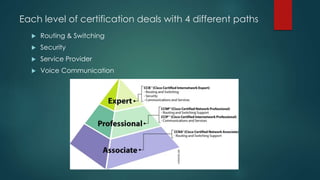
Each level of certification deals with 4 different paths 
 Routing & Switching 
 Security 
 Service Provider 
 Voice Communication
CCNA Exam 
 Code 640-802 
 Objective 
 Drag & Drop 
 Simulations (Lab) 
 Marks out of 1000 
 Pass mark 820
Networking 
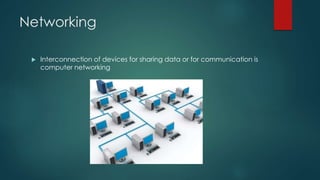
 Interconnection of devices for sharing data or for communication is 
computer networking
Benefits of Networking 
 Resource Sharing- Hardware Resources (sharing devices like printer, 
scanner, etc.) and Software Resources (sharing data between a 
network or file sharing. E.g.- email.) 
 Communication- Communication between two pcs. E.g.- email, 
chatting, video chatting, etc. 
 Critical Storage- Storage of data from one machine to another in 
case of damage of the main machine.
Sneakernet 
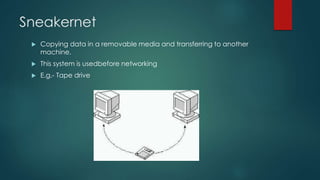
 Copying data in a removable media and transferring to another 
machine. 
 This system is usedbefore networking 
 E.g.- Tape drive
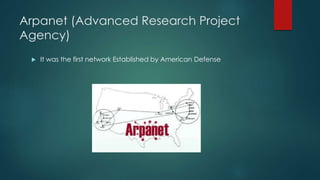
Arpanet (Advanced Research Project 
Agency) 
 It was the first network Established by American Defense
Types of Network 
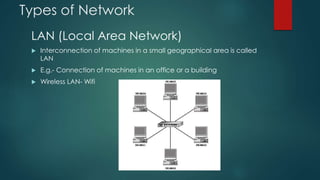
LAN (Local Area Network) 
 Interconnection of machines in a small geographical area is called 
LAN 
 E.g.- Connection of machines in an office or a building 
 Wireless LAN- Wifi
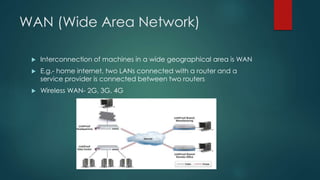
WAN (Wide Area Network) 
 Interconnection of machines in a wide geographical area is WAN 
 E.g.- home internet, two LANs connected with a router and a 
service provider is connected between two routers 
 Wireless WAN- 2G, 3G, 4G
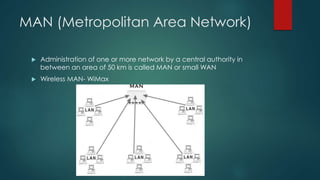
MAN (Metropolitan Area Network) 
 Administration of one or more network by a central authority in 
between an area of 50 km is called MAN or small WAN 
 Wireless MAN- WiMax
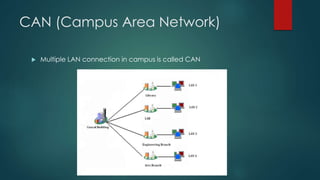
CAN (Campus Area Network) 
 Multiple LAN connection in campus is called CAN
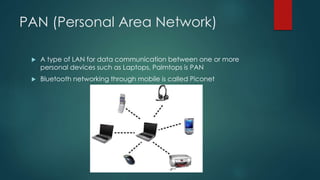
PAN (Personal Area Network) 
 A type of LAN for data communication between one or more 
personal devices such as Laptops, Palmtops is PAN 
 Bluetooth networking through mobile is called Piconet
Minimum requirements of LAN 
configuration 
 Two PCs 
 Network Operating System 
 NIC (Network Interface Card) 
 Drivers 
 Cables and Connectors 
 Protocols
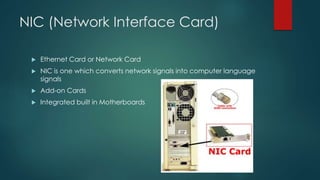
NIC (Network Interface Card) 
 Ethernet Card or Network Card 
 NIC is one which converts network signals into computer language 
signals 
 Add-on Cards 
 Integrated built in Motherboards
MAC (Media Access Control) 
 It is a unique address stored in NICs 
 Hardware address or Physical address 
 48 bit hexadecimal address 
 Eg- 00-0c-76-5e-c3-06 
 To find MAC address-start- 
run- cmd- getmac 
or 
start- run- cmd- ipconfig /all
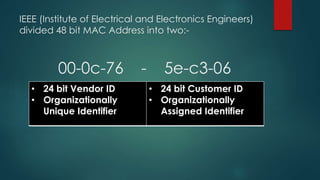
IEEE (Institute of Electrical and Electronics Engineers) 
divided 48 bit MAC Address into two:- 
00-0c-76 - 5e-c3-06 
• 24 bit Vendor ID 
• Organizationally 
Unique Identifier 
• 24 bit Customer ID 
• Organizationally 
Assigned Identifier
Common Network Devices 
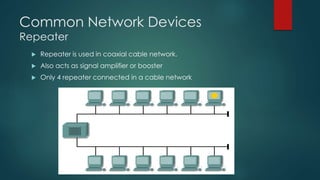
Repeater 
 Repeater is used in coaxial cable network. 
 Also acts as signal amplifier or booster 
 Only 4 repeater connected in a cable network
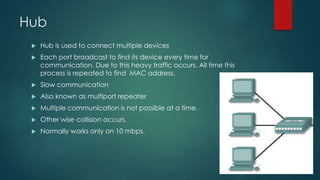
Hub 
 Hub is used to connect multiple devices 
 Each port broadcast to find its device every time for 
communication. Due to this heavy traffic occurs. All time this 
process is repeated to find MAC address. 
 Slow communication 
 Also known as multiport repeater 
 Multiple communication is not possible at a time. 
 Other wise collision occurs. 
 Normally works only on 10 mbps.
Switch 
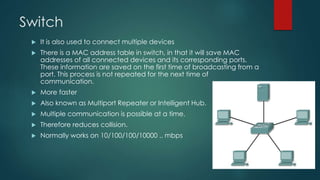
 It is also used to connect multiple devices 
 There is a MAC address table in switch, in that it will save MAC 
addresses of all connected devices and its corresponding ports. 
These information are saved on the first time of broadcasting from a 
port. This process is not repeated for the next time of 
communication. 
 More faster 
 Also known as Multiport Repeater or Intelligent Hub. 
 Multiple communication is possible at a time. 
 Therefore reduces collision. 
 Normally works on 10/100/100/10000 .. mbps
Bridge 
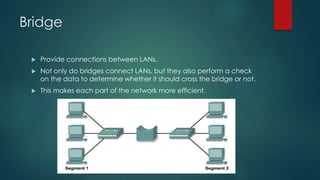
 Provide connections between LANs. 
 Not only do bridges connect LANs, but they also perform a check 
on the data to determine whether it should cross the bridge or not. 
 This makes each part of the network more efficient.
Router 
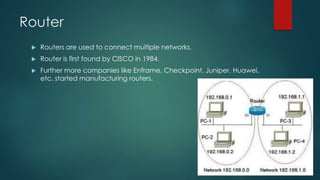
 Routers are used to connect multiple networks. 
 Router is first found by CISCO in 1984. 
 Further more companies like Enframe, Checkpoint, Juniper, Huawei, 
etc. started manufacturing routers.
Cloud 
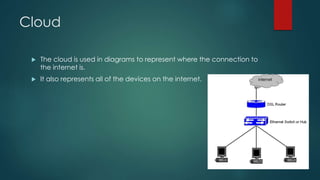
 The cloud is used in diagrams to represent where the connection to 
the internet is. 
 It also represents all of the devices on the internet.
Topology 
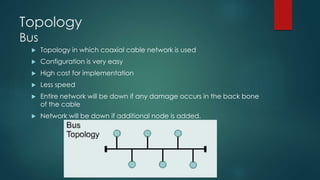
Bus 
 Topology in which coaxial cable network is used 
 Configuration is very easy 
 High cost for implementation 
 Less speed 
 Entire network will be down if any damage occurs in the back bone 
of the cable 
 Network will be down if additional node is added.
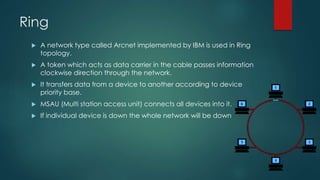
Ring 
 A network type called Arcnet implemented by IBM is used in Ring 
topology. 
 A token which acts as data carrier in the cable passes information 
clockwise direction through the network. 
 It transfers data from a device to another according to device 
priority base. 
 MSAU (Multi station access unit) connects all devices into it. 
 If individual device is down the whole network will be down
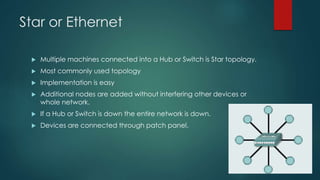
Star or Ethernet 
 Multiple machines connected into a Hub or Switch is Star topology. 
 Most commonly used topology 
 Implementation is easy 
 Additional nodes are added without interfering other devices or 
whole network. 
 If a Hub or Switch is down the entire network is down. 
 Devices are connected through patch panel.
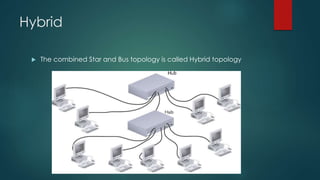
Hybrid 
 The combined Star and Bus topology is called Hybrid topology
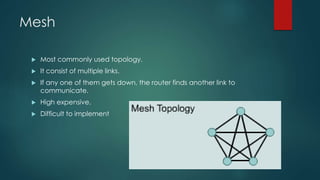
Mesh 
 Most commonly used topology. 
 It consist of multiple links. 
 If any one of them gets down, the router finds another link to 
communicate. 
 High expensive. 
 Difficult to implement
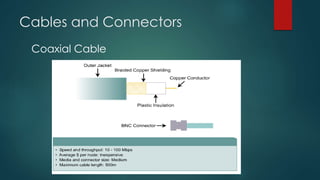
Cables and Connectors 
Coaxial Cable
OFC (Optical Fiber Cable) 
 Network signals are converted into light signals in this cable. 
 It works under ‘Total Internal Reflection’ principle. 
 Used for under sea connection. 
 Transmits at a speed of 3 X 10^8 m/s
Twisted Pair Cables 
 Contains 8 colored wires 
 Each twisted as 4 pairs 
 Two types:- 
1. Shielded Twisted Pair 
2. Unshielded twisted pair
STP (Shielded twisted pair) 
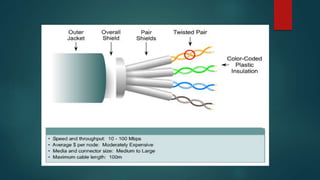
 Each pair of cables are shielded. 
 It is used in high level industries or machineries. 
 High expensive. 
 It is shielded due to protect from external signals
Unshielded Twisted Pair 
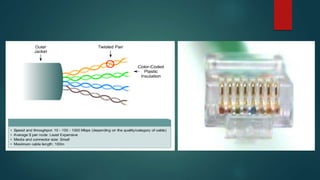
 Contains of 8 twisted wires 
 Theses wires are twisted as pairs to reduce EMI (Electromagnetic 
Interference) 
 Connectors of UTP are called RJ45 (Registered Jack) 
 Connectors used in telephone cable is called RJ11 
 8 contact legs for RJ45 
 4 contact legs for RJ11
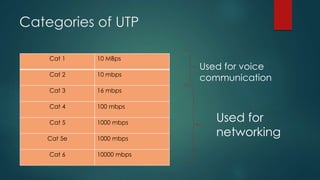
Categories of UTP 
Cat 1 10 MBps 
Cat 2 10 mbps 
Cat 3 16 mbps 
Cat 4 100 mbps 
Cat 5 1000 mbps 
Cat 5e 1000 mbps 
Cat 6 10000 mbps 
Used for voice 
communication 
Used for 
networking
Cable Specifications 
 10BASE-T 
The T stands for twisted pair. 
 10BASE5 
The 5 represents the fact that a signal can travel for approximately 500 
meters 10BASE5 is often referred to as Thicknet. 
 10BASE2 
The 2 represents the fact that a signal can travel for approximately 200 
meters 10BASE2 is often referred to as Thinnet. 
Thinnet and Thicknet are actually a type of networks, while 10BASE2 & 
10BASE5 are the types of cabling used in these networks.
Types of UTP cables 
1. Straight through 
2. Crossover cables 
3. Rollover or Console 
 Straight through cables are used to connect dissimilar devices such 
as PC-Switch, PC- Hub, Router-Switch, etc. 
 Crossover cables are used to connect similar devices such as PC-PC, 
Switch-Switch, Hub- Hub, PC- Router 
 Rollover or Console cables are used to configure Router and Switch
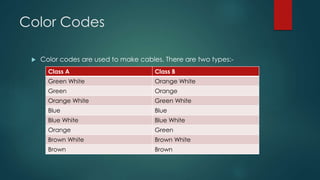
Color Codes 
 Color codes are used to make cables. There are two types:- 
Class A Class B 
Green White Orange White 
Green Orange 
Orange White Green White 
Blue Blue 
Blue White Blue White 
Orange Green 
Brown White Brown White 
Brown Brown
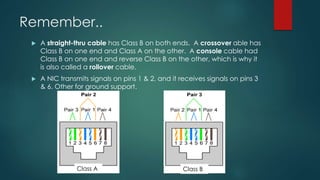
Remember.. 
 A straight-thru cable has Class B on both ends. A crossover able has 
Class B on one end and Class A on the other. A console cable had 
Class B on one end and reverse Class B on the other, which is why it 
is also called a rollover cable. 
 A NIC transmits signals on pins 1 & 2, and it receives signals on pins 3 
& 6. Other for ground support. 
Class A Class B
Crimping.. 
 Connecting jack into the Twisted Pair cable using crimping tool is 
called Crimping

CCNA ppt Day 1

  • 1.
    CCNA CISCO CERTIFIEDNETWORK ASSOCIATE 640-802
  • 2.
    CISCO  Americanmultinational company located in California, USA  Started in1984  Deals with designing, manufacturing, selling, networking equipments  Also deals with product certifications  Inventors of Router
  • 3.
    Each level ofcertification deals with 4 different paths  Routing & Switching  Security  Service Provider  Voice Communication
  • 4.
    CCNA Exam Code 640-802  Objective  Drag & Drop  Simulations (Lab)  Marks out of 1000  Pass mark 820
  • 5.
    Networking  Interconnectionof devices for sharing data or for communication is computer networking
  • 6.
    Benefits of Networking  Resource Sharing- Hardware Resources (sharing devices like printer, scanner, etc.) and Software Resources (sharing data between a network or file sharing. E.g.- email.)  Communication- Communication between two pcs. E.g.- email, chatting, video chatting, etc.  Critical Storage- Storage of data from one machine to another in case of damage of the main machine.
  • 7.
    Sneakernet  Copyingdata in a removable media and transferring to another machine.  This system is usedbefore networking  E.g.- Tape drive
  • 8.
    Arpanet (Advanced ResearchProject Agency)  It was the first network Established by American Defense
  • 9.
    Types of Network LAN (Local Area Network)  Interconnection of machines in a small geographical area is called LAN  E.g.- Connection of machines in an office or a building  Wireless LAN- Wifi
  • 10.
    WAN (Wide AreaNetwork)  Interconnection of machines in a wide geographical area is WAN  E.g.- home internet, two LANs connected with a router and a service provider is connected between two routers  Wireless WAN- 2G, 3G, 4G
  • 11.
    MAN (Metropolitan AreaNetwork)  Administration of one or more network by a central authority in between an area of 50 km is called MAN or small WAN  Wireless MAN- WiMax
  • 12.
    CAN (Campus AreaNetwork)  Multiple LAN connection in campus is called CAN
  • 13.
    PAN (Personal AreaNetwork)  A type of LAN for data communication between one or more personal devices such as Laptops, Palmtops is PAN  Bluetooth networking through mobile is called Piconet
  • 14.
    Minimum requirements ofLAN configuration  Two PCs  Network Operating System  NIC (Network Interface Card)  Drivers  Cables and Connectors  Protocols
  • 15.
    NIC (Network InterfaceCard)  Ethernet Card or Network Card  NIC is one which converts network signals into computer language signals  Add-on Cards  Integrated built in Motherboards
  • 16.
    MAC (Media AccessControl)  It is a unique address stored in NICs  Hardware address or Physical address  48 bit hexadecimal address  Eg- 00-0c-76-5e-c3-06  To find MAC address-start- run- cmd- getmac or start- run- cmd- ipconfig /all
  • 17.
    IEEE (Institute ofElectrical and Electronics Engineers) divided 48 bit MAC Address into two:- 00-0c-76 - 5e-c3-06 • 24 bit Vendor ID • Organizationally Unique Identifier • 24 bit Customer ID • Organizationally Assigned Identifier
  • 18.
    Common Network Devices Repeater  Repeater is used in coaxial cable network.  Also acts as signal amplifier or booster  Only 4 repeater connected in a cable network
  • 19.
    Hub  Hubis used to connect multiple devices  Each port broadcast to find its device every time for communication. Due to this heavy traffic occurs. All time this process is repeated to find MAC address.  Slow communication  Also known as multiport repeater  Multiple communication is not possible at a time.  Other wise collision occurs.  Normally works only on 10 mbps.
  • 20.
    Switch  Itis also used to connect multiple devices  There is a MAC address table in switch, in that it will save MAC addresses of all connected devices and its corresponding ports. These information are saved on the first time of broadcasting from a port. This process is not repeated for the next time of communication.  More faster  Also known as Multiport Repeater or Intelligent Hub.  Multiple communication is possible at a time.  Therefore reduces collision.  Normally works on 10/100/100/10000 .. mbps
  • 21.
    Bridge  Provideconnections between LANs.  Not only do bridges connect LANs, but they also perform a check on the data to determine whether it should cross the bridge or not.  This makes each part of the network more efficient.
  • 22.
    Router  Routersare used to connect multiple networks.  Router is first found by CISCO in 1984.  Further more companies like Enframe, Checkpoint, Juniper, Huawei, etc. started manufacturing routers.
  • 23.
    Cloud  Thecloud is used in diagrams to represent where the connection to the internet is.  It also represents all of the devices on the internet.
  • 24.
    Topology Bus Topology in which coaxial cable network is used  Configuration is very easy  High cost for implementation  Less speed  Entire network will be down if any damage occurs in the back bone of the cable  Network will be down if additional node is added.
  • 25.
    Ring  Anetwork type called Arcnet implemented by IBM is used in Ring topology.  A token which acts as data carrier in the cable passes information clockwise direction through the network.  It transfers data from a device to another according to device priority base.  MSAU (Multi station access unit) connects all devices into it.  If individual device is down the whole network will be down
  • 26.
    Star or Ethernet  Multiple machines connected into a Hub or Switch is Star topology.  Most commonly used topology  Implementation is easy  Additional nodes are added without interfering other devices or whole network.  If a Hub or Switch is down the entire network is down.  Devices are connected through patch panel.
  • 27.
    Hybrid  Thecombined Star and Bus topology is called Hybrid topology
  • 28.
    Mesh  Mostcommonly used topology.  It consist of multiple links.  If any one of them gets down, the router finds another link to communicate.  High expensive.  Difficult to implement
  • 29.
    Cables and Connectors Coaxial Cable
  • 30.
    OFC (Optical FiberCable)  Network signals are converted into light signals in this cable.  It works under ‘Total Internal Reflection’ principle.  Used for under sea connection.  Transmits at a speed of 3 X 10^8 m/s
  • 31.
    Twisted Pair Cables  Contains 8 colored wires  Each twisted as 4 pairs  Two types:- 1. Shielded Twisted Pair 2. Unshielded twisted pair
  • 32.
    STP (Shielded twistedpair)  Each pair of cables are shielded.  It is used in high level industries or machineries.  High expensive.  It is shielded due to protect from external signals
  • 34.
    Unshielded Twisted Pair  Contains of 8 twisted wires  Theses wires are twisted as pairs to reduce EMI (Electromagnetic Interference)  Connectors of UTP are called RJ45 (Registered Jack)  Connectors used in telephone cable is called RJ11  8 contact legs for RJ45  4 contact legs for RJ11
  • 36.
    Categories of UTP Cat 1 10 MBps Cat 2 10 mbps Cat 3 16 mbps Cat 4 100 mbps Cat 5 1000 mbps Cat 5e 1000 mbps Cat 6 10000 mbps Used for voice communication Used for networking
  • 37.
    Cable Specifications 10BASE-T The T stands for twisted pair.  10BASE5 The 5 represents the fact that a signal can travel for approximately 500 meters 10BASE5 is often referred to as Thicknet.  10BASE2 The 2 represents the fact that a signal can travel for approximately 200 meters 10BASE2 is often referred to as Thinnet. Thinnet and Thicknet are actually a type of networks, while 10BASE2 & 10BASE5 are the types of cabling used in these networks.
  • 38.
    Types of UTPcables 1. Straight through 2. Crossover cables 3. Rollover or Console  Straight through cables are used to connect dissimilar devices such as PC-Switch, PC- Hub, Router-Switch, etc.  Crossover cables are used to connect similar devices such as PC-PC, Switch-Switch, Hub- Hub, PC- Router  Rollover or Console cables are used to configure Router and Switch
  • 39.
    Color Codes Color codes are used to make cables. There are two types:- Class A Class B Green White Orange White Green Orange Orange White Green White Blue Blue Blue White Blue White Orange Green Brown White Brown White Brown Brown
  • 40.
    Remember..  Astraight-thru cable has Class B on both ends. A crossover able has Class B on one end and Class A on the other. A console cable had Class B on one end and reverse Class B on the other, which is why it is also called a rollover cable.  A NIC transmits signals on pins 1 & 2, and it receives signals on pins 3 & 6. Other for ground support. Class A Class B
  • 41.
    Crimping..  Connectingjack into the Twisted Pair cable using crimping tool is called Crimping