Coulometry
.
INTRODUTION
PRINCIPAL
TYPES OF COULOMETRY
INSTRUMENTATION
APPLICATION
coulometry
Coulometry method of analysis are the base on
measurment of quantity of electricity that passed
through a solution an electrochemical reaction.
The coulometry method are the mainly base on the
measurment of quantity of electricity .
The sample which is to be determined undergoes the
reaction at electrod which is measure at the electrod .
INTODUCTION
 The completion of the reaction is indicated by the
decrease in the current to zero .
 This can be measured by the coulometer.
 The main principle involved in the coulometry is the
measurment of the quantity of the electricity .
 which is directly proportional to the chemical
reaction at the electrode. This is given by faraday
low.
 Q = nFNA………..(1)
Where
n is the number of electrons per mole of analyte.
F is Faraday’s constant (96487Cmol-1).
NA is the moles of analyte.
PRINCIPAL
Potentiostatic coulometry
Coulometric tritration
TYPES OF COULOMETRY
An electrochemical technique where the total
Coulombs of electricity required to complete (fully
oxidise or fully reduce the sample in) an
electrochemical reaction is measured whilst the
potential of the working electrode is held at a
constant value.
POTETInOSTATIC COULOMETRY
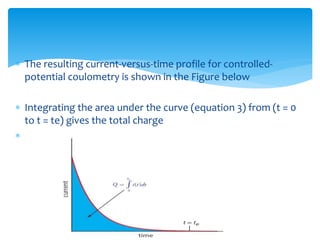
 The resulting current-versus-time profile for controlled-
potential coulometry is shown in the Figure below
 Integrating the area under the curve (equation 3) from (t = 0
to t = te) gives the total charge

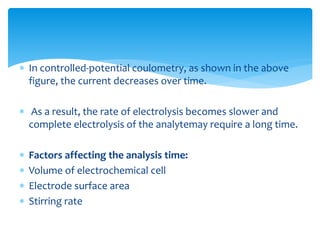
 In controlled-potential coulometry, as shown in the above
figure, the current decreases over time.
 As a result, the rate of electrolysis becomes slower and
complete electrolysis of the analytemay require a long time.
 Factors affecting the analysis time:
 Volume of electrochemical cell
 Electrode surface area
 Stirring rate
COULOMETRIC TITRATION
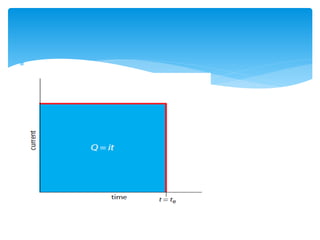
 Coulometric titrations use a constant current system to
accurately quantify the concentration of a species. In this
experiment, the applied current is equivalent to a titrant.
Current is applied to the unknown solution until all of the
unknown species is either oxidized or reduced to a new
state, at which point the potential of the working electrode
shifts dramatically.

 The endpoint of the titration can be analytically by using
an indicator that is placed in the sample and signals when
the system reaches equilibrium.
 Alternatively, the endpoint can be determined from data
provided by potentiometric, amperometric
or conductance measurements .
 The analysis time is shorter because the current does not
decrease over time. A typical analysis time for controlled-
current coulometry is less than 10 min
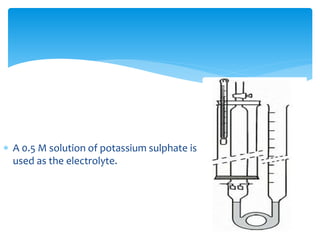
1] Gasometric coulometers (Hydrogen-oxygen coulometers)
Hydrogen-oxygen coulometer consists of a glass tube of about 50 cm
long and a diameter of 2 cm.
Two platinum sheets of about l.5 sq.cm are joined with a stout
platinum wire serve as the electrodes.
A calibrated tube (gas burette) is connected to the electrolysis tube by
means of a pressure rubber tube and is capable of moving vertically so
as to adjust the pressure of the collected gases to atmospheric
pressure before measuring the volumes of gases.
A 0.5 M solution of potassium sulphate is used as the electrolyte
 A 0.5 M solution of potassium sulphate is
used as the electrolyte.
 Silver coulometer
 A silver coulometer is an example of a gravimetric
coulometer in which the amount of metal deposited
at cathode or the amount of metal stripped from an
anode is determined.
 A silver coulometer is shown in is the most
satisfactory either in the cathodic deposition mode or
better still, in the anodic stripping mode in perchloric
acid media.
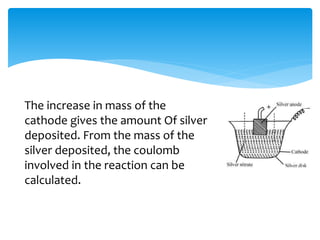
The increase in mass of the
cathode gives the amount Of silver
deposited. From the mass of the
silver deposited, the coulomb
involved in the reaction can be
calculated.
 1) Inorganic Analysis
 Determination of several metal ions.Eg iron, calcium etc
To Determine purity of Inorganic compound.
To Determine Impurity of Inorganic compound.
Applications
2) Analysis of radioactive materials
 The technique is widely adopted for the determination of
uranium and pluotinum and thus finds extensive use in the
nuclear energy field.
3) Micro analysis
 This technique is especially useful for the determination of small
amounts of analyte (0.01– l mg) with an accuracy of (± 0.5 %).
4)Electrolytic determination of organic compounds:
 Controlled potential coulometry offers a new step for the
electrolytic determination of organic compounds.
THANK YOU

coulorometry

  • 1.
  • 2.
  • 3.
    Coulometry method ofanalysis are the base on measurment of quantity of electricity that passed through a solution an electrochemical reaction. The coulometry method are the mainly base on the measurment of quantity of electricity . The sample which is to be determined undergoes the reaction at electrod which is measure at the electrod . INTODUCTION
  • 4.
     The completionof the reaction is indicated by the decrease in the current to zero .  This can be measured by the coulometer.
  • 5.
     The mainprinciple involved in the coulometry is the measurment of the quantity of the electricity .  which is directly proportional to the chemical reaction at the electrode. This is given by faraday low.  Q = nFNA………..(1) Where n is the number of electrons per mole of analyte. F is Faraday’s constant (96487Cmol-1). NA is the moles of analyte. PRINCIPAL
  • 6.
  • 7.
    An electrochemical techniquewhere the total Coulombs of electricity required to complete (fully oxidise or fully reduce the sample in) an electrochemical reaction is measured whilst the potential of the working electrode is held at a constant value. POTETInOSTATIC COULOMETRY
  • 8.
     The resultingcurrent-versus-time profile for controlled- potential coulometry is shown in the Figure below  Integrating the area under the curve (equation 3) from (t = 0 to t = te) gives the total charge 
  • 9.
     In controlled-potentialcoulometry, as shown in the above figure, the current decreases over time.  As a result, the rate of electrolysis becomes slower and complete electrolysis of the analytemay require a long time.  Factors affecting the analysis time:  Volume of electrochemical cell  Electrode surface area  Stirring rate
  • 10.
    COULOMETRIC TITRATION  Coulometrictitrations use a constant current system to accurately quantify the concentration of a species. In this experiment, the applied current is equivalent to a titrant. Current is applied to the unknown solution until all of the unknown species is either oxidized or reduced to a new state, at which point the potential of the working electrode shifts dramatically.
  • 11.
  • 12.
     The endpointof the titration can be analytically by using an indicator that is placed in the sample and signals when the system reaches equilibrium.  Alternatively, the endpoint can be determined from data provided by potentiometric, amperometric or conductance measurements .  The analysis time is shorter because the current does not decrease over time. A typical analysis time for controlled- current coulometry is less than 10 min
  • 13.
    1] Gasometric coulometers(Hydrogen-oxygen coulometers) Hydrogen-oxygen coulometer consists of a glass tube of about 50 cm long and a diameter of 2 cm. Two platinum sheets of about l.5 sq.cm are joined with a stout platinum wire serve as the electrodes. A calibrated tube (gas burette) is connected to the electrolysis tube by means of a pressure rubber tube and is capable of moving vertically so as to adjust the pressure of the collected gases to atmospheric pressure before measuring the volumes of gases. A 0.5 M solution of potassium sulphate is used as the electrolyte
  • 14.
     A 0.5M solution of potassium sulphate is used as the electrolyte.
  • 15.
     Silver coulometer A silver coulometer is an example of a gravimetric coulometer in which the amount of metal deposited at cathode or the amount of metal stripped from an anode is determined.  A silver coulometer is shown in is the most satisfactory either in the cathodic deposition mode or better still, in the anodic stripping mode in perchloric acid media.
  • 16.
    The increase inmass of the cathode gives the amount Of silver deposited. From the mass of the silver deposited, the coulomb involved in the reaction can be calculated.
  • 17.
     1) InorganicAnalysis  Determination of several metal ions.Eg iron, calcium etc To Determine purity of Inorganic compound. To Determine Impurity of Inorganic compound. Applications
  • 18.
    2) Analysis ofradioactive materials  The technique is widely adopted for the determination of uranium and pluotinum and thus finds extensive use in the nuclear energy field. 3) Micro analysis  This technique is especially useful for the determination of small amounts of analyte (0.01– l mg) with an accuracy of (± 0.5 %). 4)Electrolytic determination of organic compounds:  Controlled potential coulometry offers a new step for the electrolytic determination of organic compounds.
  • 19.