COLLOIDS
ADITI AGARWAL
Contents
• Difference between true solution, colloidal solution and suspension
• Identify phases of colloidal solution, classify colloidal solutions, describe methods
of preparation of colloids, explain some properties of colloidal solutions
• Hardy Schultz Rule
• Recognize the difference between gel and emulsion
• Tyndall Effect
• Brownian movement
• Electrophoresis and coagulation
• Industrial applications of colloids
• Purification of water
• Cleansing action of soap
• Tanning of leather and sewage disposal.
• Smoke precipitation by Cottrell’s method
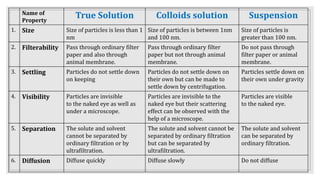
Name of
Property
True Solution Colloids solution Suspension
1. Size Size of particles is less than 1
nm
Size of particles is between 1nm
and 100 nm.
Size of particles is
greater than 100 nm.
2. Filterability Pass through ordinary filter
paper and also through
animal membrane.
Pass through ordinary filter
paper but not through animal
membrane.
Do not pass through
filter paper or animal
membrane.
3. Settling Particles do not settle down
on keeping
Particles do not settle down on
their own but can be made to
settle down by centrifugation.
Particles settle down on
their own under gravity
4. Visibility Particles are invisible
to the naked eye as well as
under a microscope.
Particles are invisible to the
naked eye but their scattering
effect can be observed with the
help of a microscope.
Particles are visible
to the naked eye.
5. Separation The solute and solvent
cannot be separated by
ordinary filtration or by
ultrafiltration.
The solute and solvent cannot be
separated by ordinary filtration
but can be separated by
ultrafiltration.
The solute and solvent
can be separated by
ordinary filtration.
6. Diffusion Diffuse quickly Diffuse slowly Do not diffuse
Phases of Colloid
Solutions
• Colloids solutions are
heterogenous in nature
and always consist of at
least two phases: the
dispersed phase and the
dispersion medium.
• Dispersed Phase: It is the
substance present in small
proportion and consists of
particles of colloids size (1
to 100 nm).
• Dispersion Medium: It is
the medium in which the
colloids particles are
dispersed. For example, in
a colloidal solution of
sulphur in water, sulphur
particles constitute the
‘dispersed phase’ and
water is the ‘dispersion
medium’.
Out of the various types of colloidal solutions listed above, the most
common are sols (solid in liquid type), gels (liquid in solid type) and
emulsions (liquid in liquid type). If the dispersion medium is water then the
‘sol’ is called a hydrosol; and if the dispersion medium is alcohol then the
‘sol’ is called an alcosol.
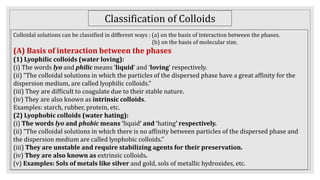
Classification of Colloids
Colloidal solutions can be classified in different ways : (a) on the basis of interaction between the phases.
(b) on the basis of molecular size.
(A) Basis of interaction between the phases
(1) Lyophilic colloids (water loving):
(i) The words lyo and philic means ‘liquid’ and ‘loving’ respectively.
(ii) “The colloidal solutions in which the particles of the dispersed phase have a great affinity for the
dispersion medium, are called lyophilic colloids.”
(iii) They are difficult to coagulate due to their stable nature.
(iv) They are also known as intrinsic colloids.
Examples: starch, rubber, protein, etc.
(2) Lyophobic colloids (water hating):
(i) The words lyo and phobic means ‘liquid’ and ‘hating’ respectively.
(ii) “The colloidal solutions in which there is no affinity between particles of the dispersed phase and
the dispersion medium are called lyophobic colloids.”
(iii) They are unstable and require stabilizing agents for their preservation.
(iv) They are also known as extrinsic colloids.
(v) Examples: Sols of metals like silver and gold, sols of metallic hydroxides, etc.
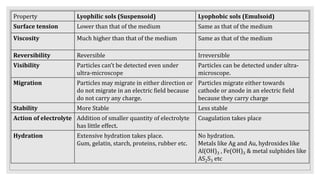
Property Lyophilic sols (Suspensoid) Lyophobic sols (Emulsoid)
Surface tension Lower than that of the medium Same as that of the medium
Viscosity Much higher than that of the medium Same as that of the medium
Reversibility Reversible Irreversible
Visibility Particles can’t be detected even under
ultra-microscope
Particles can be detected under ultra-
microscope.
Migration Particles may migrate in either direction or
do not migrate in an electric field because
do not carry any charge.
Particles migrate either towards
cathode or anode in an electric field
because they carry charge
Stability More Stable Less stable
Action of electrolyte Addition of smaller quantity of electrolyte
has little effect.
Coagulation takes place
Hydration Extensive hydration takes place.
Gum, gelatin, starch, proteins, rubber etc.
No hydration.
Metals like Ag and Au, hydroxides like
Al(OH)3 , Fe(OH)3 & metal sulphides like
AS2S3 etc
(B) Basis of molecular size
(1) Multimolecular colloids:
• When a large number of atoms or smaller molecules of substances (having diameter less than
1nm) aggregate together to form particles of colloidal dimensions, the particles thus formed are
called multimolecular colloids.
• In these colloids, the particles are held together by Vander Waal's forces.
• They have usually lyophilic character.
• Example: Gold sol, Sulphur sol.
(2) Macromolecular colloids:
• These are the substances having big size molecules (called macromolecules) which on
dissolution form size in the colloidal range. Such substances are called macromolecular colloids.
• These macromolecules forming the dispersed phase are generally polymers having very high
molecular masses.
• They have usually lyophobic character.
• Example: Naturally occurring macromolecules are starch, cellulose, proteins, enzymes, gelatin
etc. Artificial macromolecules are synthetic polymers such as nylon, polythene, plastics,
polystyrene etc.
(3) Associated colloids (Micelles):
• These are the substances which on dissolved in a medium behave as normal electrolytes at low
concentration but behave, as colloidal particles at higher concentration due to the formation of aggregated
particles. The aggregates particles thus formed are called micelles.
• Their molecules contain both lyophilic and lyophobic groups.
Micelles:
• Micelles are the cluster or aggregated particles formed by association of colloid in solution.
• The common examples of micelles are soaps and detergents.
• The formation of micelles takes place above a particular temperature called Kraft temperature (Tk) and
above a particular concentration called critical micellization concentration (CMC).
• They are capable of forming ions.
• Micelles may contain as many as 100 molecules or more.
• Example- sodium stearate (C17H35COONa) is a typical example of such type of molecules.
• Some other examples of micelles are sodium palmitate (C15H31COONa), Sodium lauryl sulphate, Cetyl
trimethyl ammonium bromide (CTAB) etc.
• When sodium stearate is dissolved in water, it gives Na+ and C17H35COO- ions.
C17 H35COONa Na+ + C17H35COO-
(sodium stearate) (Stearate ion)
• The stearate ions associate to form ionic micelles of colloidal size.
Preparation of Lyophobic Colloidal Solutions
◦ The primary consideration in the preparation of colloidal solutions is that the dispersed particles
should be within the size range of 1 μm-200 μm.
◦ The lyophobic sols can be prepared by breaking down the coarser aggregates into particles of colloidal
size (Dispersion method) or grouping molecules into larger aggregates of colloidal size (Condensation
method).
Dispersion Methods:
1. Mechanical Dispersion: The most obvious method of dispersion consists in breaking down the
coarser solid particles by mechanical grinding.
◦ This is done in the so called 'colloid mill' which generally consists of two metal discs held at a very
small distance apart from one another which are capable of revolving at a high speed (of the order of
7000 rpm) in opposite direction.
◦ The material to be ground is fed in between the two discs in the form of a wet slurry. The particles get
broken to colloidal dimensions by the operating shearing force.
◦ However, this method produces particles non-uniformly of colloidal dimensions. 9
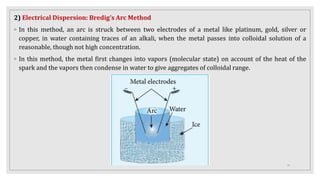
2) Electrical Dispersion: Bredig’s Arc Method
◦ In this method, an arc is struck between two electrodes of a metal like platinum, gold, silver or
copper, in water containing traces of an alkali, when the metal passes into colloidal solution of a
reasonable, though not high concentration.
◦ In this method, the metal first changes into vapors (molecular state) on account of the heat of the
spark and the vapors then condense in water to give aggregates of colloidal range.
10
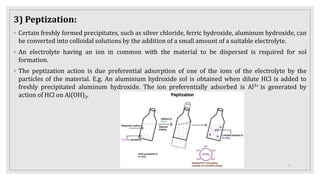
3) Peptization:
◦ Certain freshly formed precipitates, such as silver chloride, ferric hydroxide, aluminum hydroxide, can
be converted into colloidal solutions by the addition of a small amount of a suitable electrolyte.
◦ An electrolyte having an ion in common with the material to be dispersed is required for sol
formation.
◦ The peptization action is due preferential adsorption of one of the ions of the electrolyte by the
particles of the material. E.g. An aluminium hydroxide sol is obtained when dilute HCl is added to
freshly precipitated aluminum hydroxide. The ion preferentially adsorbed is Al3+ is generated by
action of HCl on Al(OH)3.
11
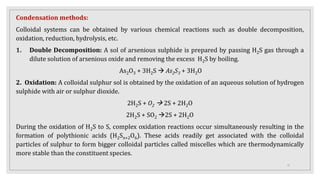
Condensation methods:
Colloidal systems can be obtained by various chemical reactions such as double decomposition,
oxidation, reduction, hydrolysis, etc.
1. Double Decomposition: A sol of arsenious sulphide is prepared by passing H2S gas through a
dilute solution of arsenious oxide and removing the excess H2S by boiling.
As2O3 + 3H2S  As2S3 + 3H2O
2. Oxidation: A colloidal sulphur sol is obtained by the oxidation of an aqueous solution of hydrogen
sulphide with air or sulphur dioxide.
2H2S + O2  2S + 2H2O
2H2S + SO2 2S + 2H2O
During the oxidation of H2S to S, complex oxidation reactions occur simultaneously resulting in the
formation of polythionic acids (H2Sn+2O6). These acids readily get associated with the colloidal
particles of sulphur to form bigger colloidal particles called miscelles which are thermodynamically
more stable than the constituent species.
12
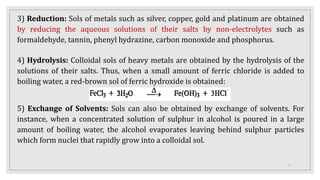
3) Reduction: Sols of metals such as silver, copper, gold and platinum are obtained
by reducing the aqueous solutions of their salts by non-electrolytes such as
formaldehyde, tannin, phenyl hydrazine, carbon monoxide and phosphorus.
4) Hydrolysis: Colloidal sols of heavy metals are obtained by the hydrolysis of the
solutions of their salts. Thus, when a small amount of ferric chloride is added to
boiling water, a red-brown sol of ferric hydroxide is obtained:
5) Exchange of Solvents: Sols can also be obtained by exchange of solvents. For
instance, when a concentrated solution of sulphur in alcohol is poured in a large
amount of boiling water, the alcohol evaporates leaving behind sulphur particles
which form nuclei that rapidly grow into a colloidal sol.
13
Purification of Colloidal Solutions
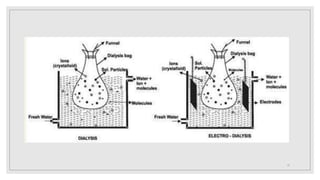
Dialysis:
◦ It has already been stated that while particles in true solution can easily diffuse through parchment and other
fine membranes, the colloidal particles, being much larger cannot do so readily.
◦ If a mixture, containing colloidal particles as well as particles in true solution is placed in a parchment bag
which is then held in a wider vessel containing pure water, the substances in true solution pass out while the
colloids remain in the bag.
◦ The distilled water in the wider vessel is renewed frequently. The process to separate substances in colloidal
state from those present in true solution with the help of fine membranes, is known as dialysis and the
membrane used for the purpose is known as dialyser.
Electrodialysis:
◦ The process of dialysis is quite slow but it can be quickened by applying an electric field if the substance in true
solution is an electrolyte. The process is then called electrodialysis.
◦ The mixture is placed between two dialysing membranes while pure water is contained in a compartment on
each side. There is one electrode in each compartment by means of which the required voltage is applied.
◦ The ions of the electrolyte migrate out to the oppositely charged electrodes while the colloidal particles are
held back. 14
15
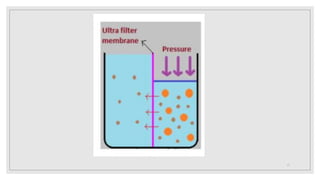
◦ Ultrafiltration:
◦ The separation of solutes from colloidal systems can also be carried out by the process known as
ultra-filtration. Ordinarily, filter papers have pores larger than 1 μm so that the colloidal particles
which are less than 200 μm can readily pass through along with the ions or molecules in solution.
◦ But the pores can be made smaller by soaking the filter papers in a solution of gelatin and
subsequently hardening them by soaking in formaldehyde. The pores thus become very small
and the colloidal particles may be retained on the treated filter paper.
◦ The treated filters are known as ultrafilters. This process of separating colloids from solutes is known
as ultra-filtration. A series of graded ultra-filters can be prepared by soaking filter papers in solutions
of collodion of different concentrations.
◦ The pores even in the finest ultra-filters will be large enough to permit the passage of ions or
molecules in true solution but these will be small enough to withhold the colloidal particles.
◦ By using a series of graded ultra-filters, it may be possible to separate colloidal particles of different
sizes from one another The process is very slow and sometimes a small pressure is needed to drive
the solute particles through the filters.
17
PROPERTIES OF COLLOIDS
The properties of colloids are discussed below :
a) Heterogeneous character : Colloidal particles remain within their own boundary surfaces
which separates them from the dispersion medium. So a colloidal system is a heterogeneous
mixture of two phases. The two phases are dispersed phase and dispersion medium.
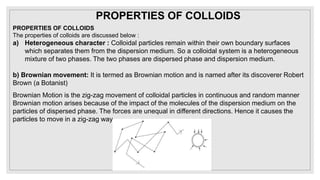
b) Brownian movement: It is termed as Brownian motion and is named after its discoverer Robert
Brown (a Botanist)
Brownian Motion is the zig-zag movement of colloidal particles in continuous and random manner
Brownian motion arises because of the impact of the molecules of the dispersion medium on the
particles of dispersed phase. The forces are unequal in different directions. Hence it causes the
particles to move in a zig-zag way.
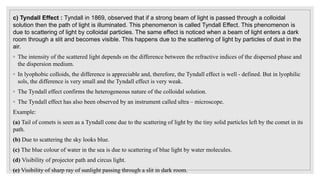
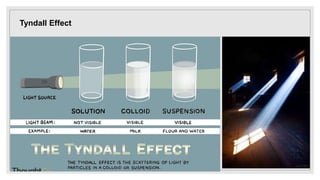
c) Tyndall Effect : Tyndall in 1869, observed that if a strong beam of light is passed through a colloidal
solution then the path of light is illuminated. This phenomenon is called Tyndall Effect. This phenomenon is
due to scattering of light by colloidal particles. The same effect is noticed when a beam of light enters a dark
room through a slit and becomes visible. This happens due to the scattering of light by particles of dust in the
air.
◦ The intensity of the scattered light depends on the difference between the refractive indices of the dispersed phase and
the dispersion medium.
◦ In lyophobic colloids, the difference is appreciable and, therefore, the Tyndall effect is well - defined. But in lyophilic
sols, the difference is very small and the Tyndall effect is very weak.
◦ The Tyndall effect confirms the heterogeneous nature of the colloidal solution.
◦ The Tyndall effect has also been observed by an instrument called ultra – microscope.
Example:
(a) Tail of comets is seen as a Tyndall cone due to the scattering of light by the tiny solid particles left by the comet in its
path.
(b) Due to scattering the sky looks blue.
(c) The blue colour of water in the sea is due to scattering of blue light by water molecules.
(d) Visibility of projector path and circus light.
(e) Visibility of sharp ray of sunlight passing through a slit in dark room.
Tyndall Effect
COAGULATION OR PRECIPITATION (lyophobic sols)
The stability of the lyophobic sols is due to the presence of charge on colloidal
particles. If, somehow, the charge is removed, the particles will come nearer to
each other to form aggregates (or coagulate) and settle down under the force of
gravity.
The process of settling of colloidal particles is called coagulation or
precipitation of the sol.
The coagulation of the lyophobic sols can be carried out in the following ways:
(i) By electrophoresis: The colloidal particles move towards oppositely charged
electrodes, get discharged and precipitated.
(ii) By mixing two oppositely charged sols: Oppositely charged sols when mixed in
almost equal proportions, neutralise their charges and get partially or completely
precipitated. Mixing of hydrated ferric oxide (+ve sol) and arsenious sulphide (–ve
sol) bring them in the precipitated forms. This type of coagulation is called mutual
coagulation.
(iii) By boiling: When a sol is boiled, the adsorbed layer is disturbed
due to increased collisions with the molecules of dispersion
medium. This reduces the charge on the particles and ultimately
lead to settling down in the form of a precipitate.
(iv) By addition of electrolytes: When excess of an electrolyte is
added, the colloidal particles are precipitated. The reason is that
colloids interact with ions carrying charge opposite to that present
on themselves. This causes neutralisation leading to their
coagulation.
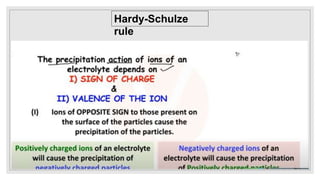
The ion responsible for neutralisation of charge on the particles is
called the coagulating ion. A negative ion causes the precipitation
of positively charged sol and vice versa.
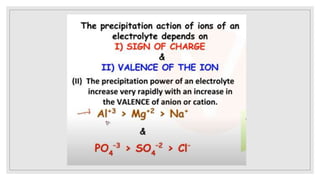
Hardy-Schulze
rule
Coagulation of lyophilic sols
There are mainly two factors which are responsible for the stability
of lyophilic sols. These factors are the charge and solvation of the
colloidal particles. When these two factors are removed, a lyophilic
sol can be coagulated. This is done
(i) by adding an electrolyte and
(ii) by adding a suitable solvent.
When solvents such as alcohol and acetone are added to
hydrophilic sols, the dehydration of dispersed phase occurs. Under
this condition, a small quantity of electrolyte can bring about
coagulation.
Colloids play a very important role in our daily life. Some of
these applications are discussed below:
(i) Sewage disposal : Colloidal particles of dirt, etc. carry
electric charge. When sewage is allowed to pass through
metallic plates kept at a high potential the colloidal particles
move to the oppositely charged electrode and get
precipitated there. Hence sewage water is purified.
APPLICATIONS OF COLLOIDAL SOLUTIONS
colloidal
colloidal

colloidal

  • 1.
  • 2.
    Contents • Difference betweentrue solution, colloidal solution and suspension • Identify phases of colloidal solution, classify colloidal solutions, describe methods of preparation of colloids, explain some properties of colloidal solutions • Hardy Schultz Rule • Recognize the difference between gel and emulsion • Tyndall Effect • Brownian movement • Electrophoresis and coagulation • Industrial applications of colloids • Purification of water • Cleansing action of soap • Tanning of leather and sewage disposal. • Smoke precipitation by Cottrell’s method
  • 3.
    Name of Property True SolutionColloids solution Suspension 1. Size Size of particles is less than 1 nm Size of particles is between 1nm and 100 nm. Size of particles is greater than 100 nm. 2. Filterability Pass through ordinary filter paper and also through animal membrane. Pass through ordinary filter paper but not through animal membrane. Do not pass through filter paper or animal membrane. 3. Settling Particles do not settle down on keeping Particles do not settle down on their own but can be made to settle down by centrifugation. Particles settle down on their own under gravity 4. Visibility Particles are invisible to the naked eye as well as under a microscope. Particles are invisible to the naked eye but their scattering effect can be observed with the help of a microscope. Particles are visible to the naked eye. 5. Separation The solute and solvent cannot be separated by ordinary filtration or by ultrafiltration. The solute and solvent cannot be separated by ordinary filtration but can be separated by ultrafiltration. The solute and solvent can be separated by ordinary filtration. 6. Diffusion Diffuse quickly Diffuse slowly Do not diffuse
  • 4.
    Phases of Colloid Solutions •Colloids solutions are heterogenous in nature and always consist of at least two phases: the dispersed phase and the dispersion medium. • Dispersed Phase: It is the substance present in small proportion and consists of particles of colloids size (1 to 100 nm). • Dispersion Medium: It is the medium in which the colloids particles are dispersed. For example, in a colloidal solution of sulphur in water, sulphur particles constitute the ‘dispersed phase’ and water is the ‘dispersion medium’. Out of the various types of colloidal solutions listed above, the most common are sols (solid in liquid type), gels (liquid in solid type) and emulsions (liquid in liquid type). If the dispersion medium is water then the ‘sol’ is called a hydrosol; and if the dispersion medium is alcohol then the ‘sol’ is called an alcosol.
  • 5.
    Classification of Colloids Colloidalsolutions can be classified in different ways : (a) on the basis of interaction between the phases. (b) on the basis of molecular size. (A) Basis of interaction between the phases (1) Lyophilic colloids (water loving): (i) The words lyo and philic means ‘liquid’ and ‘loving’ respectively. (ii) “The colloidal solutions in which the particles of the dispersed phase have a great affinity for the dispersion medium, are called lyophilic colloids.” (iii) They are difficult to coagulate due to their stable nature. (iv) They are also known as intrinsic colloids. Examples: starch, rubber, protein, etc. (2) Lyophobic colloids (water hating): (i) The words lyo and phobic means ‘liquid’ and ‘hating’ respectively. (ii) “The colloidal solutions in which there is no affinity between particles of the dispersed phase and the dispersion medium are called lyophobic colloids.” (iii) They are unstable and require stabilizing agents for their preservation. (iv) They are also known as extrinsic colloids. (v) Examples: Sols of metals like silver and gold, sols of metallic hydroxides, etc.
  • 6.
    Property Lyophilic sols(Suspensoid) Lyophobic sols (Emulsoid) Surface tension Lower than that of the medium Same as that of the medium Viscosity Much higher than that of the medium Same as that of the medium Reversibility Reversible Irreversible Visibility Particles can’t be detected even under ultra-microscope Particles can be detected under ultra- microscope. Migration Particles may migrate in either direction or do not migrate in an electric field because do not carry any charge. Particles migrate either towards cathode or anode in an electric field because they carry charge Stability More Stable Less stable Action of electrolyte Addition of smaller quantity of electrolyte has little effect. Coagulation takes place Hydration Extensive hydration takes place. Gum, gelatin, starch, proteins, rubber etc. No hydration. Metals like Ag and Au, hydroxides like Al(OH)3 , Fe(OH)3 & metal sulphides like AS2S3 etc
  • 7.
    (B) Basis ofmolecular size (1) Multimolecular colloids: • When a large number of atoms or smaller molecules of substances (having diameter less than 1nm) aggregate together to form particles of colloidal dimensions, the particles thus formed are called multimolecular colloids. • In these colloids, the particles are held together by Vander Waal's forces. • They have usually lyophilic character. • Example: Gold sol, Sulphur sol. (2) Macromolecular colloids: • These are the substances having big size molecules (called macromolecules) which on dissolution form size in the colloidal range. Such substances are called macromolecular colloids. • These macromolecules forming the dispersed phase are generally polymers having very high molecular masses. • They have usually lyophobic character. • Example: Naturally occurring macromolecules are starch, cellulose, proteins, enzymes, gelatin etc. Artificial macromolecules are synthetic polymers such as nylon, polythene, plastics, polystyrene etc.
  • 8.
    (3) Associated colloids(Micelles): • These are the substances which on dissolved in a medium behave as normal electrolytes at low concentration but behave, as colloidal particles at higher concentration due to the formation of aggregated particles. The aggregates particles thus formed are called micelles. • Their molecules contain both lyophilic and lyophobic groups. Micelles: • Micelles are the cluster or aggregated particles formed by association of colloid in solution. • The common examples of micelles are soaps and detergents. • The formation of micelles takes place above a particular temperature called Kraft temperature (Tk) and above a particular concentration called critical micellization concentration (CMC). • They are capable of forming ions. • Micelles may contain as many as 100 molecules or more. • Example- sodium stearate (C17H35COONa) is a typical example of such type of molecules. • Some other examples of micelles are sodium palmitate (C15H31COONa), Sodium lauryl sulphate, Cetyl trimethyl ammonium bromide (CTAB) etc. • When sodium stearate is dissolved in water, it gives Na+ and C17H35COO- ions. C17 H35COONa Na+ + C17H35COO- (sodium stearate) (Stearate ion) • The stearate ions associate to form ionic micelles of colloidal size.
  • 9.
    Preparation of LyophobicColloidal Solutions ◦ The primary consideration in the preparation of colloidal solutions is that the dispersed particles should be within the size range of 1 μm-200 μm. ◦ The lyophobic sols can be prepared by breaking down the coarser aggregates into particles of colloidal size (Dispersion method) or grouping molecules into larger aggregates of colloidal size (Condensation method). Dispersion Methods: 1. Mechanical Dispersion: The most obvious method of dispersion consists in breaking down the coarser solid particles by mechanical grinding. ◦ This is done in the so called 'colloid mill' which generally consists of two metal discs held at a very small distance apart from one another which are capable of revolving at a high speed (of the order of 7000 rpm) in opposite direction. ◦ The material to be ground is fed in between the two discs in the form of a wet slurry. The particles get broken to colloidal dimensions by the operating shearing force. ◦ However, this method produces particles non-uniformly of colloidal dimensions. 9
  • 10.
    2) Electrical Dispersion:Bredig’s Arc Method ◦ In this method, an arc is struck between two electrodes of a metal like platinum, gold, silver or copper, in water containing traces of an alkali, when the metal passes into colloidal solution of a reasonable, though not high concentration. ◦ In this method, the metal first changes into vapors (molecular state) on account of the heat of the spark and the vapors then condense in water to give aggregates of colloidal range. 10
  • 11.
    3) Peptization: ◦ Certainfreshly formed precipitates, such as silver chloride, ferric hydroxide, aluminum hydroxide, can be converted into colloidal solutions by the addition of a small amount of a suitable electrolyte. ◦ An electrolyte having an ion in common with the material to be dispersed is required for sol formation. ◦ The peptization action is due preferential adsorption of one of the ions of the electrolyte by the particles of the material. E.g. An aluminium hydroxide sol is obtained when dilute HCl is added to freshly precipitated aluminum hydroxide. The ion preferentially adsorbed is Al3+ is generated by action of HCl on Al(OH)3. 11
  • 12.
    Condensation methods: Colloidal systemscan be obtained by various chemical reactions such as double decomposition, oxidation, reduction, hydrolysis, etc. 1. Double Decomposition: A sol of arsenious sulphide is prepared by passing H2S gas through a dilute solution of arsenious oxide and removing the excess H2S by boiling. As2O3 + 3H2S  As2S3 + 3H2O 2. Oxidation: A colloidal sulphur sol is obtained by the oxidation of an aqueous solution of hydrogen sulphide with air or sulphur dioxide. 2H2S + O2  2S + 2H2O 2H2S + SO2 2S + 2H2O During the oxidation of H2S to S, complex oxidation reactions occur simultaneously resulting in the formation of polythionic acids (H2Sn+2O6). These acids readily get associated with the colloidal particles of sulphur to form bigger colloidal particles called miscelles which are thermodynamically more stable than the constituent species. 12
  • 13.
    3) Reduction: Solsof metals such as silver, copper, gold and platinum are obtained by reducing the aqueous solutions of their salts by non-electrolytes such as formaldehyde, tannin, phenyl hydrazine, carbon monoxide and phosphorus. 4) Hydrolysis: Colloidal sols of heavy metals are obtained by the hydrolysis of the solutions of their salts. Thus, when a small amount of ferric chloride is added to boiling water, a red-brown sol of ferric hydroxide is obtained: 5) Exchange of Solvents: Sols can also be obtained by exchange of solvents. For instance, when a concentrated solution of sulphur in alcohol is poured in a large amount of boiling water, the alcohol evaporates leaving behind sulphur particles which form nuclei that rapidly grow into a colloidal sol. 13
  • 14.
    Purification of ColloidalSolutions Dialysis: ◦ It has already been stated that while particles in true solution can easily diffuse through parchment and other fine membranes, the colloidal particles, being much larger cannot do so readily. ◦ If a mixture, containing colloidal particles as well as particles in true solution is placed in a parchment bag which is then held in a wider vessel containing pure water, the substances in true solution pass out while the colloids remain in the bag. ◦ The distilled water in the wider vessel is renewed frequently. The process to separate substances in colloidal state from those present in true solution with the help of fine membranes, is known as dialysis and the membrane used for the purpose is known as dialyser. Electrodialysis: ◦ The process of dialysis is quite slow but it can be quickened by applying an electric field if the substance in true solution is an electrolyte. The process is then called electrodialysis. ◦ The mixture is placed between two dialysing membranes while pure water is contained in a compartment on each side. There is one electrode in each compartment by means of which the required voltage is applied. ◦ The ions of the electrolyte migrate out to the oppositely charged electrodes while the colloidal particles are held back. 14
  • 15.
  • 16.
    ◦ Ultrafiltration: ◦ Theseparation of solutes from colloidal systems can also be carried out by the process known as ultra-filtration. Ordinarily, filter papers have pores larger than 1 μm so that the colloidal particles which are less than 200 μm can readily pass through along with the ions or molecules in solution. ◦ But the pores can be made smaller by soaking the filter papers in a solution of gelatin and subsequently hardening them by soaking in formaldehyde. The pores thus become very small and the colloidal particles may be retained on the treated filter paper. ◦ The treated filters are known as ultrafilters. This process of separating colloids from solutes is known as ultra-filtration. A series of graded ultra-filters can be prepared by soaking filter papers in solutions of collodion of different concentrations. ◦ The pores even in the finest ultra-filters will be large enough to permit the passage of ions or molecules in true solution but these will be small enough to withhold the colloidal particles. ◦ By using a series of graded ultra-filters, it may be possible to separate colloidal particles of different sizes from one another The process is very slow and sometimes a small pressure is needed to drive the solute particles through the filters.
  • 17.
  • 18.
    PROPERTIES OF COLLOIDS PROPERTIESOF COLLOIDS The properties of colloids are discussed below : a) Heterogeneous character : Colloidal particles remain within their own boundary surfaces which separates them from the dispersion medium. So a colloidal system is a heterogeneous mixture of two phases. The two phases are dispersed phase and dispersion medium. b) Brownian movement: It is termed as Brownian motion and is named after its discoverer Robert Brown (a Botanist) Brownian Motion is the zig-zag movement of colloidal particles in continuous and random manner Brownian motion arises because of the impact of the molecules of the dispersion medium on the particles of dispersed phase. The forces are unequal in different directions. Hence it causes the particles to move in a zig-zag way.
  • 20.
    c) Tyndall Effect: Tyndall in 1869, observed that if a strong beam of light is passed through a colloidal solution then the path of light is illuminated. This phenomenon is called Tyndall Effect. This phenomenon is due to scattering of light by colloidal particles. The same effect is noticed when a beam of light enters a dark room through a slit and becomes visible. This happens due to the scattering of light by particles of dust in the air. ◦ The intensity of the scattered light depends on the difference between the refractive indices of the dispersed phase and the dispersion medium. ◦ In lyophobic colloids, the difference is appreciable and, therefore, the Tyndall effect is well - defined. But in lyophilic sols, the difference is very small and the Tyndall effect is very weak. ◦ The Tyndall effect confirms the heterogeneous nature of the colloidal solution. ◦ The Tyndall effect has also been observed by an instrument called ultra – microscope. Example: (a) Tail of comets is seen as a Tyndall cone due to the scattering of light by the tiny solid particles left by the comet in its path. (b) Due to scattering the sky looks blue. (c) The blue colour of water in the sea is due to scattering of blue light by water molecules. (d) Visibility of projector path and circus light. (e) Visibility of sharp ray of sunlight passing through a slit in dark room.
  • 22.
  • 23.
    COAGULATION OR PRECIPITATION(lyophobic sols) The stability of the lyophobic sols is due to the presence of charge on colloidal particles. If, somehow, the charge is removed, the particles will come nearer to each other to form aggregates (or coagulate) and settle down under the force of gravity. The process of settling of colloidal particles is called coagulation or precipitation of the sol. The coagulation of the lyophobic sols can be carried out in the following ways: (i) By electrophoresis: The colloidal particles move towards oppositely charged electrodes, get discharged and precipitated. (ii) By mixing two oppositely charged sols: Oppositely charged sols when mixed in almost equal proportions, neutralise their charges and get partially or completely precipitated. Mixing of hydrated ferric oxide (+ve sol) and arsenious sulphide (–ve sol) bring them in the precipitated forms. This type of coagulation is called mutual coagulation.
  • 24.
    (iii) By boiling:When a sol is boiled, the adsorbed layer is disturbed due to increased collisions with the molecules of dispersion medium. This reduces the charge on the particles and ultimately lead to settling down in the form of a precipitate. (iv) By addition of electrolytes: When excess of an electrolyte is added, the colloidal particles are precipitated. The reason is that colloids interact with ions carrying charge opposite to that present on themselves. This causes neutralisation leading to their coagulation. The ion responsible for neutralisation of charge on the particles is called the coagulating ion. A negative ion causes the precipitation of positively charged sol and vice versa.
  • 25.
  • 27.
    Coagulation of lyophilicsols There are mainly two factors which are responsible for the stability of lyophilic sols. These factors are the charge and solvation of the colloidal particles. When these two factors are removed, a lyophilic sol can be coagulated. This is done (i) by adding an electrolyte and (ii) by adding a suitable solvent. When solvents such as alcohol and acetone are added to hydrophilic sols, the dehydration of dispersed phase occurs. Under this condition, a small quantity of electrolyte can bring about coagulation.
  • 28.
    Colloids play avery important role in our daily life. Some of these applications are discussed below: (i) Sewage disposal : Colloidal particles of dirt, etc. carry electric charge. When sewage is allowed to pass through metallic plates kept at a high potential the colloidal particles move to the oppositely charged electrode and get precipitated there. Hence sewage water is purified. APPLICATIONS OF COLLOIDAL SOLUTIONS