Contents of thepresentation
1. Sorenson’s pH scale
2. pH determination ( calorimetric and electrometric method )
3. Applications of buffers
4. Buffer equation
5. Buffer capacity
6. Buffers in biological and pharmaceutical systems
7. Buffered isotonic solutions
3.
Sorenson’s pH scale
Theconcept of pH was first introduced by Sorenson in 1909.
Sorenson defined pH as logarithm of reciprocal of hydrogen ion concentration.
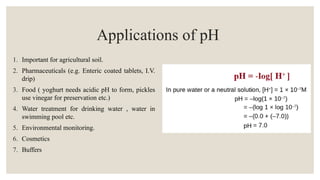
This can be rearranged as , pH = -log[H+
]
Thus, pH can also be defined as negative logarithm of hydrogen ion concentration.
It is used to determine the acidity or basicity of a solution.
4.
Sorenson’s pH scale
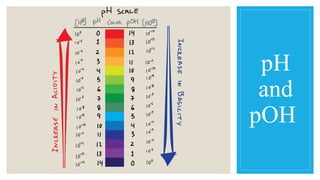
Thescale starts with 0, indicating that the hydrogen
ion concentration is 100
, which means that the
solution is strongly acidic in nature and vice versa for
base.
The central point of the scale is 7, indicating that
[H+
] is equal to [OH-
], the hydrogen ion
concentration is 10-7
and the solution is neutral in
nature.
Solutions with a pH less than 7 are acidic and
solutions with a pH of more than 7 are basic.
Pure water is neither acidic nor basic in nature. It is
neutral.
5.
Applications of pH
1.Important for agricultural soil.
2. Pharmaceuticals (e.g. Enteric coated tablets, I.V.
drip)
3. Food ( yoghurt needs acidic pH to form, pickles
use vinegar for preservation etc.)
4. Water treatment for drinking water , water in
swimming pool etc.
5. Environmental monitoring.
6. Cosmetics
7. Buffers
pH determination
2 methodsare used –
1. Colorimetric method
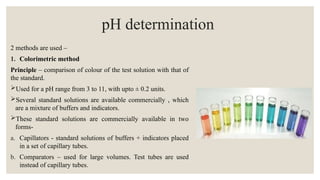
Principle – comparison of colour of the test solution with that of
the standard.
Used for a pH range from 3 to 11, with upto ± 0.2 units.
Several standard solutions are available commercially , which
are a mixture of buffers and indicators.
These standard solutions are commercially available in two
forms-
a. Capillators - standard solutions of buffers + indicators placed
in a set of capillary tubes.
b. Comparators – used for large volumes. Test tubes are used
instead of capillary tubes.
8.
Colorimetric method
Method-
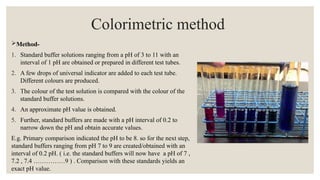
1. Standardbuffer solutions ranging from a pH of 3 to 11 with an
interval of 1 pH are obtained or prepared in different test tubes.
2. A few drops of universal indicator are added to each test tube.
Different colours are produced.
3. The colour of the test solution is compared with the colour of the
standard buffer solutions.
4. An approximate pH value is obtained.
5. Further, standard buffers are made with a pH interval of 0.2 to
narrow down the pH and obtain accurate values.
E.g. Primary comparison indicated the pH to be 8. so for the next step,
standard buffers ranging from pH 7 to 9 are created/obtained with an
interval of 0.2 pH. ( i.e. the standard buffers will now have a pH of 7 ,
7.2 , 7.4 ……………9 ) . Comparison with these standards yields an
exact pH value.
9.
Advantages
1. Affordable
2. Simpleprocedure.
3. Doesn’t require expensive equipment.
Disadvantages
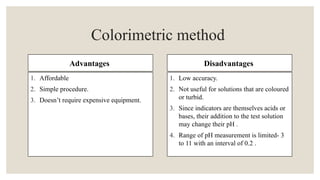
1. Low accuracy.
2. Not useful for solutions that are coloured
or turbid.
3. Since indicators are themselves acids or
bases, their addition to the test solution
may change their pH .
4. Range of pH measurement is limited- 3
to 11 with an interval of 0.2 .
Colorimetric method
10.
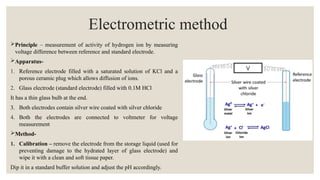
Principle – measurementof activity of hydrogen ion by measuring
voltage difference between reference and standard electrode.
Apparatus-
1. Reference electrode filled with a saturated solution of KCl and a
porous ceramic plug which allows diffusion of ions.
2. Glass electrode (standard electrode) filled with 0.1M HCl
It has a thin glass bulb at the end.
3. Both electrodes contain silver wire coated with silver chloride
4. Both the electrodes are connected to voltmeter for voltage
measurement
Method-
1. Calibration – remove the electrode from the storage liquid (used for
preventing damage to the hydrated layer of glass electrode) and
wipe it with a clean and soft tissue paper.
Dip it in a standard buffer solution and adjust the pH accordingly.
Electrometric method
V
11.
2. The electrodecan now be dipped in the test solution and pH reading
is noted down from the display.
How it works ?
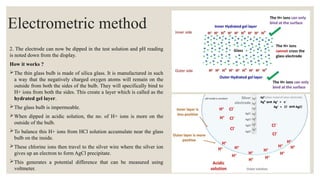
The thin glass bulb is made of silica glass. It is manufactured in such
a way that the negatively charged oxygen atoms will remain on the
outside from both the sides of the bulb. They will specifically bind to
H+ ions from both the sides. This create a layer which is called as the
hydrated gel layer.
The glass bulb is impermeable.
When dipped in acidic solution, the no. of H+ ions is more on the
outside of the bulb.
To balance this H+ ions from HCl solution accumulate near the glass
bulb on the inside.
These chlorine ions then travel to the silver wire where the silver ion
gives up an electron to form AgCl precipitate.
This generates a potential difference that can be measured using
voltmeter.
Electrometric method
12.
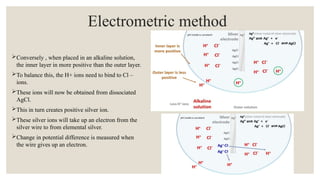
Conversely , whenplaced in an alkaline solution,
the inner layer in more positive than the outer layer.
To balance this, the H+ ions need to bind to Cl –
ions.
These ions will now be obtained from dissociated
AgCl.
This in turn creates positive silver ion.
These silver ions will take up an electron from the
silver wire to from elemental silver.
Change in potential difference is measured when
the wire gives up an electron.
13.
Advantages
1. Accurate
2. Testsolution remains uncontaminated
3. The range of pH measurement is high
Disadvantages
1. Cost is higher as compared to
colorimetric method
2. Not suitable for viscous solutions and
gels due to low ionic mobility
Electrometric method
14.
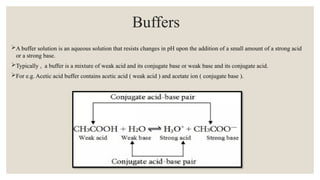
Buffers
A buffer solutionis an aqueous solution that resists changes in pH upon the addition of a small amount of a strong acid
or a strong base.
Typically , a buffer is a mixture of weak acid and its conjugate base or weak base and its conjugate acid.
For e.g. Acetic acid buffer contains acetic acid ( weak acid ) and acetate ion ( conjugate base ).
15.
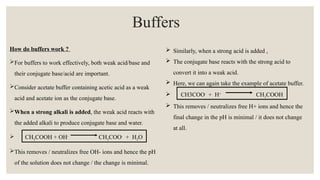
How do bufferswork ?
For buffers to work effectively, both weak acid/base and
their conjugate base/acid are important.
Consider acetate buffer containing acetic acid as a weak
acid and acetate ion as the conjugate base.
When a strong alkali is added, the weak acid reacts with
the added alkali to produce conjugate base and water.
CH3COOH + OH-
CH3COO-
+ H2O
This removes / neutralizes free OH- ions and hence the pH
of the solution does not change / the change is minimal.
Buffers
Similarly, when a strong acid is added ,
The conjugate base reacts with the strong acid to
convert it into a weak acid.
Here, we can again take the example of acetate buffer.
CH3COO-
+ H+
CH3COOH
This removes / neutralizes free H+ ions and hence the
final change in the pH is minimal / it does not change
at all.
16.
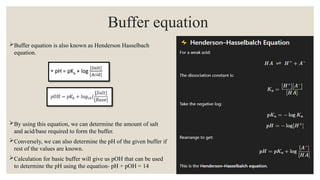
Buffer equation isalso known as Henderson Hasselbach
equation.
By using this equation, we can determine the amount of salt
and acid/base required to form the buffer.
Conversely, we can also determine the pH of the given buffer if
rest of the values are known.
Calculation for basic buffer will give us pOH that can be used
to determine the pH using the equation- pH + pOH = 14
Buffer equation
17.
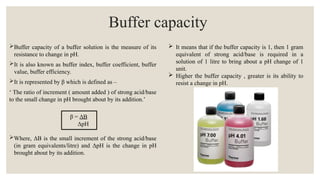
Buffer capacity ofa buffer solution is the measure of its
resistance to change in pH.
It is also known as buffer index, buffer coefficient, buffer
value, buffer efficiency.
It is represented by β which is defined as –
‘ The ratio of increment ( amount added ) of strong acid/base
to the small change in pH brought about by its addition.’
β = ΔB
ΔpH
Where, ΔB is the small increment of the strong acid/base
(in gram equivalents/litre) and ΔpH is the change in pH
brought about by its addition.
Buffer capacity
It means that if the buffer capacity is 1, then 1 gram
equivalent of strong acid/base is required in a
solution of 1 litre to bring about a pH change of 1
unit.
Higher the buffer capacity , greater is its ability to
resist a change in pH.
18.
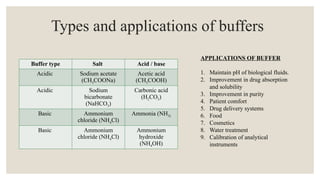
Buffer type SaltAcid / base
Acidic Sodium acetate
(CH3COONa)
Acetic acid
(CH3COOH)
Acidic Sodium
bicarbonate
(NaHCO3)
Carbonic acid
(H2CO3)
Basic Ammonium
chloride (NH4Cl)
Ammonia (NH3)
Basic Ammonium
chloride (NH4Cl)
Ammonium
hydroxide
(NH4OH)
Types and applications of buffers
APPLICATIONS OF BUFFER
1. Maintain pH of biological fluids.
2. Improvement in drug absorption
and solubility
3. Improvement in purity
4. Patient comfort
5. Drug delivery systems
6. Food
7. Cosmetics
8. Water treatment
9. Calibration of analytical
instruments
19.
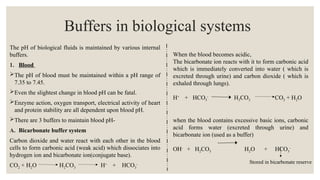
The pH ofbiological fluids is maintained by various internal
buffers.
1. Blood
The pH of blood must be maintained within a pH range of
7.35 to 7.45.
Even the slightest change in blood pH can be fatal.
Enzyme action, oxygen transport, electrical activity of heart
and protein stability are all dependent upon blood pH.
There are 3 buffers to maintain blood pH-
A. Bicarbonate buffer system
Carbon dioxide and water react with each other in the blood
cells to form carbonic acid (weak acid) which dissociates into
hydrogen ion and bicarbonate ion(conjugate base).
CO2 + H2O H2CO3 H+
+ HCO3
-
Buffers in biological systems
When the blood becomes acidic,
The bicarbonate ion reacts with it to form carbonic acid
which is immediately converted into water ( which is
excreted through urine) and carbon dioxide ( which is
exhaled through lungs).
H+
+ HCO3
-
H2CO3 CO2 + H2O
when the blood contains excessive basic ions, carbonic
acid forms water (excreted through urine) and
bicarbonate ion (used as a buffer)
OH-
+ H2CO3 H2O + HCO3
-
Stored in bicarbonate reserve
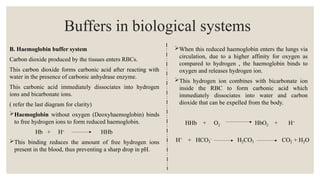
B. Haemoglobin buffersystem
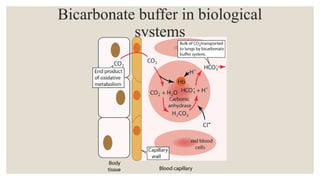
Carbon dioxide produced by the tissues enters RBCs.
This carbon dioxide forms carbonic acid after reacting with
water in the presence of carbonic anhydrase enzyme.
This carbonic acid immediately dissociates into hydrogen
ions and bicarbonate ions.
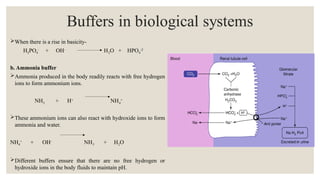
( refer the last diagram for clarity)
Haemoglobin without oxygen (Deoxyhaemoglobin) binds
to free hydrogen ions to form reduced haemoglobin.
Hb + H+
HHb
This binding reduces the amount of free hydrogen ions
present in the blood, thus preventing a sharp drop in pH.
Buffers in biological systems
When this reduced haemoglobin enters the lungs via
circulation, due to a higher affinity for oxygen as
compared to hydrogen , the haemoglobin binds to
oxygen and releases hydrogen ion.
This hydrogen ion combines with bicarbonate ion
inside the RBC to form carbonic acid which
immediately dissociates into water and carbon
dioxide that can be expelled from the body.
HHb + O2 HbO2 + H+
22.
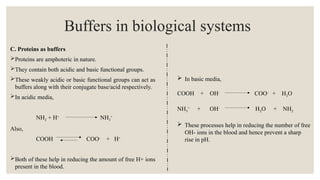
C. Proteins asbuffers
Proteins are amphoteric in nature.
They contain both acidic and basic functional groups.
These weakly acidic or basic functional groups can act as
buffers along with their conjugate base/acid respectively.
In acidic media,
NH2 + H+
NH3
+
Also,
COOH COO-
+ H+
Both of these help in reducing the amount of free H+ ions
present in the blood.
Buffers in biological systems
In basic media,
COOH + OH-
COO-
+ H2O
NH3
+
+ OH-
H2O + NH2
These processes help in reducing the number of free
OH- ions in the blood and hence prevent a sharp
rise in pH.
23.
2. Lacrimal fluid
ThepH of lacrimal fluid needs to be maintained
between 6.5 - 7.4 .
This pH is crucial for protecting the cornea and the
conjunctiva.
Significant deviations can cause discomfort or
increased tear flow.
The antimicrobial activity of various proteins and
enzymes present in the eye are dependant upon the pH.
Two crucial buffers –
a. Bicarbonate buffer system
b. Protein buffer system
Both of the above systems have been discussed in
previous slides.
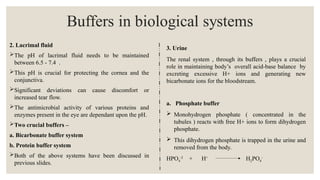
3. Urine
The renal system , through its buffers , plays a crucial
role in maintaining body’s overall acid-base balance by
excreting excessive H+ ions and generating new
bicarbonate ions for the bloodstream.
a. Phosphate buffer
Monohydrogen phosphate ( concentrated in the
tubules ) reacts with free H+ ions to form dihydrogen
phosphate.
This dihydrogen phosphate is trapped in the urine and
removed from the body.
HPO4
-2
+ H+
H2PO4
-
24.
When there isa rise in basicity-
H2PO4
-
+ OH-
H2O + HPO4
-2
b. Ammonia buffer
Ammonia produced in the body readily reacts with free hydrogen
ions to form ammonium ions.
NH3 + H+
NH4
+
These ammonium ions can also react with hydroxide ions to form
ammonia and water.
NH4
+
+ OH-
NH3 + H2O
Different buffers ensure that there are no free hydrogen or
hydroxide ions in the body fluids to maintain pH.
25.
Steps to makea buffer solution
1. Select a weak acid/base whose pKa/pKb is almost equal to pH
2. Calculate the ratio of salt and acid/base required using Henderson-Hasselbach
equation
3. Weigh the salt and acid/base
4. Dissolve in the selected solvent
5. Check pH using pH meter
6. Adjust the pH using NaOH or HCl as required
7. Make up the final volume and mix well
26.
Buffers in pharmaceuticals
1.Drug stability
Many drugs undergo hydrolysis , oxidation , isomerization etc.
depending upon the pH.
e.g. penicillin , vitamin C, Cephalosporin require acidic buffers
whereas Pantoprazole, Erythromycin and adrenaline require
basic buffers to ensure stability and long shelf-life.
2. Solubility of drugs
Weakly acidic drugs dissolve better in basic media and vice
versa.
This is because an increase in ionization.
Ionic species can interact better with water molecules due to
presence of charge.
HA H+
+ A-
B + H2O BH+
+ OH-
3. Drug absorption
Drug absorption across biological membrane depends
largely upon whether the drug is ionized or not.
Unionized drug in lipophilic in nature.
Ionized drug is hydrophilic in nature.
Thus, weakly acidic drugs will absorb better in
acidic media and vice versa for weakly basic drugs.
Buffers help in achieving this balance between
hydrophilicity and lipophilicity.
4. Patient comfort and safety
Different pharmaceutical preparations utilize buffers
to ensure that there is no tissue damage, pain ,
irritation etc.
a. Ophthalmic (pH=6.5-7.4)
b. Parenteral (pH=7.35-7.45)
27.
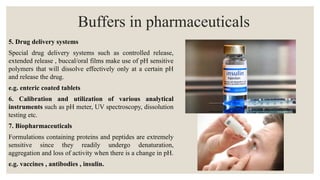
5. Drug deliverysystems
Special drug delivery systems such as controlled release,
extended release , buccal/oral films make use of pH sensitive
polymers that will dissolve effectively only at a certain pH
and release the drug.
e.g. enteric coated tablets
6. Calibration and utilization of various analytical
instruments such as pH meter, UV spectroscopy, dissolution
testing etc.
7. Biopharmaceuticals
Formulations containing proteins and peptides are extremely
sensitive since they readily undergo denaturation,
aggregation and loss of activity when there is a change in pH.
e.g. vaccines , antibodies , insulin.
Buffers in pharmaceuticals
28.
Buffered isotonic solutions
Theseare the solutions which are both buffered ( resists pH
change ) and isotonic ( has the same osmotic pressure as that of
the body fluids ).
Isotonicity is important to prevent shrinkage/swelling of cells.
E.g. Saline 0.9% NaCl
Saline, eye drops, nasal sprays are all buffered isotonic solutions.
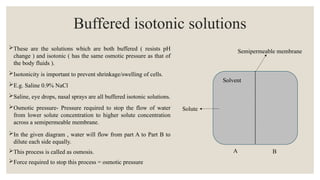
Osmotic pressure- Pressure required to stop the flow of water
from lower solute concentration to higher solute concentration
across a semipermeable membrane.
In the given diagram , water will flow from part A to Part B to
dilute each side equally.
This process is called as osmosis.
Force required to stop this process = osmotic pressure
Semipermeable membrane
Solute
B
Solvent
A
29.
Methods to determinetonicity
1. Haemolytic method (RBC method)
In this method, we observe the behavior of red blood cells to determine the tonicity of the solution.
Haemolysis refers to the breakdown of red blood cells.
Principle-
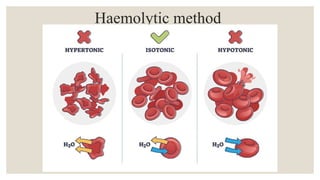
When RBCs are placed in isotonic solution, no movement of water takes place and the RBCs remain normal. E.g. 0.9%
NaCl solution.
When placed in hypertonic solution, the concentration of solute is more in the solution as compared to the RBCs. As
we studied earlier, the solvent molecules will flow from a region of lower solute concentration to a region of higher solute
concentration. This causes the water to flow from the RBCs to the solution , causing the shrinkage of cells known as
crenation.
In hypotonic solutions ( where the concentration of the solute is less in the solution as compared to the RBC), the
water molecules flow from the solution ( lower solute concentration ) into the RBC ( higher solute concentration ). This
causes the red blood cells to swell up and may cause their bursting known as Haemolysis.
Methods to determinetonicity
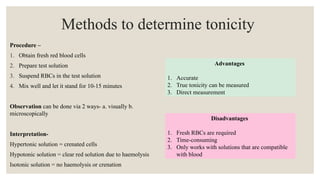
Procedure –
1. Obtain fresh red blood cells
2. Prepare test solution
3. Suspend RBCs in the test solution
4. Mix well and let it stand for 10-15 minutes
Observation can be done via 2 ways- a. visually b.
microscopically
Interpretation-
Hypertonic solution = crenated cells
Hypotonic solution = clear red solution due to haemolysis
Isotonic solution = no haemolysis or crenation
Advantages
1. Accurate
2. True tonicity can be measured
3. Direct measurement
Disadvantages
1. Fresh RBCs are required
2. Time-consuming
3. Only works with solutions that are compatible
with blood
32.
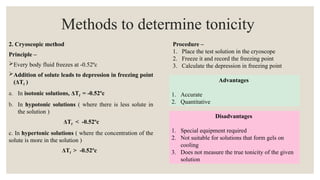
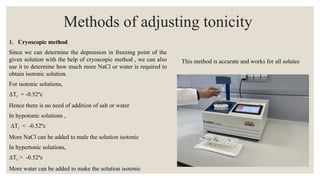
2. Cryoscopic method
Principle–
Every body fluid freezes at -0.52ºc
Addition of solute leads to depression in freezing point
(ΔTf )
a. In isotonic solutions, ΔTf = -0.52ºc
b. In hypotonic solutions ( where there is less solute in
the solution )
ΔTf < -0.52ºc
c. In hypertonic solutions ( where the concentration of the
solute is more in the solution )
ΔTf > -0.52ºc
Methods to determine tonicity
Procedure –
1. Place the test solution in the cryoscope
2. Freeze it and record the freezing point
3. Calculate the depression in freezing point
Advantages
1. Accurate
2. Quantitative
Disadvantages
1. Special equipment required
2. Not suitable for solutions that form gels on
cooling
3. Does not measure the true tonicity of the given
solution
33.
Methods of adjustingtonicity
1. Cryoscopic method
Since we can determine the depression in freezing point of the
given solution with the help of cryoscopic method , we can also
use it to determine how much more NaCl or water is required to
obtain isotonic solution.
For isotonic solutions,
ΔTf = -0.52ºc
Hence there is no need of addition of salt or water
In hypotonic solutions ,
ΔTf < -0.52ºc
More NaCl can be added to male the solution isotonic
In hypertonic solutions,
ΔTf > -0.52ºc
More water can be added to make the solution isotonic
This method is accurate and works for all solutes
34.
2. Sodium chlorideequivalent method ( E method )
Here , we use an E-value.
E value tells us - 1 g of the sample drug is equivalent to how many grams of NaCl ?
It tells us the quantity of the sample drug required if we want our drug to behave like NaCl ( in terms of tonicity )
This is useful since we want to prepare an isotonic solution (0.9 % NaCl)
e.g. if E = 0.2 ,
It means that 1 g of the sample drug=0.2 g of NaCl
Now we can calculate the quantity of sample drug required to formulate a solution with the tonicity same as that of 0.9%
NaCl by cross multiplication.
Procedure –
1. Find E-value for the given drug from the table
2. Multiply it by the quantity of drug under consideration
3. Calculate the amount of salt/water required to make the solution isotonic
Methods of adjusting tonicity
35.
3. White-Vincent method
Here, we use the formula - V = W x E x 111.1
Where ,
V = volume of water required to make the solution isotonic
W= weight of the drug
E = E value of the drug
111.1 = constant
If the volume required is too large, saline is added in place of
just water.
This method is more useful for hypotonic solutions where NaCl
cannot be added.
Hypertonic solutions can be directly diluted.
There are only 2 ways to make a hypotonic solution isotonic-
add more salt or reduce the amount of water used.
Methods of adjusting tonicity
4. Sprowl’s method
Simpler version of White-Vincent method.
We just refer the table made by Sprowl
The math is already done
Sprowls table tells us directly how many milliliters of
solvent/water is required to make 1 gram of drug
solution isotonic.
We can simply cross multiply and calculate the amount
of solvent/water required to make the given sample of
drug isotonic.
It is comparatively fast with low chances for errors.
36.
Vision, mission andprogram educational
objectives
Vision –
To Impart Quality Education to the Students
and Mold them into Proactive Multifaceted
Pharmacists
Mission –
To establish a Centre of Academic
Excellence and Research in Pharmacy
Education and thereby Produce
Professionally Competent and Ethically
Sound Pharmacists to Cater to the needs
of the Global Society.
Program educational objectives- (PEOs)
1. Reflect critical thinking and problem-solving skills
through their Pharmaceutical knowledge,
expertise, and competency in industry, higher studies,
and research.
2. Practice ethics and values in their profession.
3. Contribute effectively in various fields of the social
healthcare system.
4. Inculcate leadership and entrepreneurship
capabilities through effective communications,
appropriate time management, and self-upgradation.
5. Foster interdisciplinary engagement in evolving
healthcare sector.


![Sorenson’s pH scale
The concept of pH was first introduced by Sorenson in 1909.
Sorenson defined pH as logarithm of reciprocal of hydrogen ion concentration.
This can be rearranged as , pH = -log[H+
]
Thus, pH can also be defined as negative logarithm of hydrogen ion concentration.
It is used to determine the acidity or basicity of a solution.](https://image.slidesharecdn.com/unit-5pptpp-1-251210093726-5eae31ad/85/UNIT-5-PPT-PP-1-pptx-buffer-second-year-3-320.jpg)
![Sorenson’s pH scale
The scale starts with 0, indicating that the hydrogen
ion concentration is 100
, which means that the
solution is strongly acidic in nature and vice versa for
base.
The central point of the scale is 7, indicating that
[H+
] is equal to [OH-
], the hydrogen ion
concentration is 10-7
and the solution is neutral in
nature.
Solutions with a pH less than 7 are acidic and
solutions with a pH of more than 7 are basic.
Pure water is neither acidic nor basic in nature. It is
neutral.](https://image.slidesharecdn.com/unit-5pptpp-1-251210093726-5eae31ad/85/UNIT-5-PPT-PP-1-pptx-buffer-second-year-4-320.jpg)