WATER –A GREEN SOLVENT
Karunya institute of technology and
science.
Department of chemistry
P.JEYAKIRUBA(PRK18CH1025)
VINAYA JOSE(PRK18CH1002)
1
WATER : A GREEN SOLVENT...
Water is the best solvent among all the green solvents because of its
many advantages such as.....
 Environmental benefits
 Safety
 Synthetic efficiency
 Potential for new synthetic methodologies
 Cost
 Simple operation
2
WATER – Physical properties …
 Low viscosity
 High specific heat
 High surface tension
 High dielectric constant
 Large cohesive energy density
 Internal pressure of water
3
STRUCTURE OF WATER …
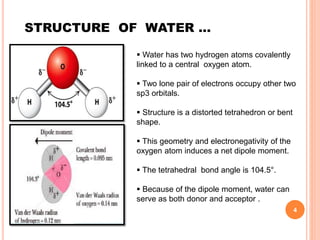
 Water has two hydrogen atoms covalently
linked to a central oxygen atom.
 Two lone pair of electrons occupy other two
sp3 orbitals.
 Structure is a distorted tetrahedron or bent
shape.
 This geometry and electronegativity of the
oxygen atom induces a net dipole moment.
 The tetrahedral bond angle is 104.5°.
 Because of the dipole moment, water can
serve as both donor and acceptor .
4
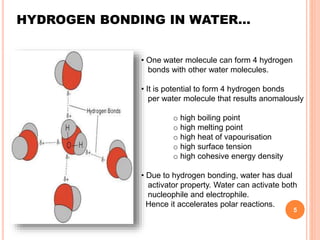
HYDROGEN BONDING IN WATER…
• One water molecule can form 4 hydrogen
bonds with other water molecules.
• It is potential to form 4 hydrogen bonds
per water molecule that results anomalously
o high boiling point
o high melting point
o high heat of vapourisation
o high surface tension
o high cohesive energy density
• Due to hydrogen bonding, water has dual
activator property. Water can activate both
nucleophile and electrophile.
Hence it accelerates polar reactions.
5
REACTIONS IN AQUEOUS MEDIUM…
A. DIELS – ALDER REACTION :-
It is [4+2] cycloaddition reaction between a conjugated diene (4
electron system) and a dienophile (2 electron system) to form an adduct.
B. CLAISEN REARRANGEMENT :-
The reaction involves allyl phenyl ether on heating undergo 3,3-
sigmatropic rearrangement.
6
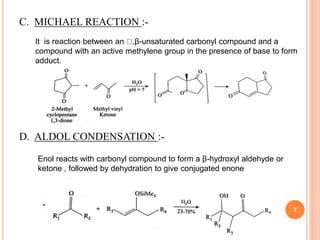
C. MICHAEL REACTION :-
It is reaction between an ,β-unsaturated carbonyl compound and a
compound with an active methylene group in the presence of base to form
adduct.
D. ALDOL CONDENSATION :-
Enol reacts with carbonyl compound to form a β-hydroxyl aldehyde or
ketone , followed by dehydration to give conjugated enone
7
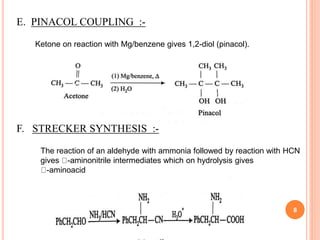
E. PINACOL COUPLING :-
Ketone on reaction with Mg/benzene gives 1,2-diol (pinacol).
F. STRECKER SYNTHESIS :-
The reaction of an aldehyde with ammonia followed by reaction with HCN
gives -aminonitrile intermediates which on hydrolysis gives
-aminoacid
8
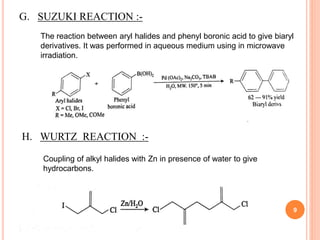
G. SUZUKI REACTION :-
The reaction between aryl halides and phenyl boronic acid to give biaryl
derivatives. It was performed in aqueous medium using in microwave
irradiation.
H. WURTZ REACTION :-
Coupling of alkyl halides with Zn in presence of water to give
hydrocarbons.
9
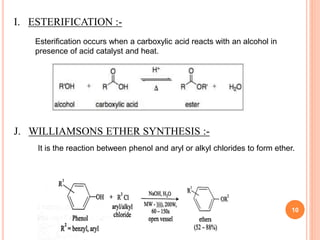
I. ESTERIFICATION :-
Esterification occurs when a carboxylic acid reacts with an alcohol in
presence of acid catalyst and heat.
J. WILLIAMSONS ETHER SYNTHESIS :-
It is the reaction between phenol and aryl or alkyl chlorides to form ether.
10
CONCULSION…
 With increasing attention towards greener approaches for organic synthesis
adaptation of greener method is the demand of modern chemistry and in
such a scenario, water is going to be the solvent of choice because of its
unique advantage.
 The use of water as solvent may not cause problems of pollution ,which is
major concern in using volatile organic solvent. Water can be readily
recycled.
 Unlike organic solvent, which are inflammable, potentially explosive and
carcinogenic, water is free of all these disadvantages and is a safe solvent.
 A special advantage is that organic synthesis in water can significantly
reduce the number of steps when designed properly .
 The use of water as a medium for organic reaction will provide economical,
health and environmental benefits….
11
12

Water as green solvent.

  • 1.
    WATER –A GREENSOLVENT Karunya institute of technology and science. Department of chemistry P.JEYAKIRUBA(PRK18CH1025) VINAYA JOSE(PRK18CH1002) 1
  • 2.
    WATER : AGREEN SOLVENT... Water is the best solvent among all the green solvents because of its many advantages such as.....  Environmental benefits  Safety  Synthetic efficiency  Potential for new synthetic methodologies  Cost  Simple operation 2
  • 3.
    WATER – Physicalproperties …  Low viscosity  High specific heat  High surface tension  High dielectric constant  Large cohesive energy density  Internal pressure of water 3
  • 4.
    STRUCTURE OF WATER…  Water has two hydrogen atoms covalently linked to a central oxygen atom.  Two lone pair of electrons occupy other two sp3 orbitals.  Structure is a distorted tetrahedron or bent shape.  This geometry and electronegativity of the oxygen atom induces a net dipole moment.  The tetrahedral bond angle is 104.5°.  Because of the dipole moment, water can serve as both donor and acceptor . 4
  • 5.
    HYDROGEN BONDING INWATER… • One water molecule can form 4 hydrogen bonds with other water molecules. • It is potential to form 4 hydrogen bonds per water molecule that results anomalously o high boiling point o high melting point o high heat of vapourisation o high surface tension o high cohesive energy density • Due to hydrogen bonding, water has dual activator property. Water can activate both nucleophile and electrophile. Hence it accelerates polar reactions. 5
  • 6.
    REACTIONS IN AQUEOUSMEDIUM… A. DIELS – ALDER REACTION :- It is [4+2] cycloaddition reaction between a conjugated diene (4 electron system) and a dienophile (2 electron system) to form an adduct. B. CLAISEN REARRANGEMENT :- The reaction involves allyl phenyl ether on heating undergo 3,3- sigmatropic rearrangement. 6
  • 7.
    C. MICHAEL REACTION:- It is reaction between an ,β-unsaturated carbonyl compound and a compound with an active methylene group in the presence of base to form adduct. D. ALDOL CONDENSATION :- Enol reacts with carbonyl compound to form a β-hydroxyl aldehyde or ketone , followed by dehydration to give conjugated enone 7
  • 8.
    E. PINACOL COUPLING:- Ketone on reaction with Mg/benzene gives 1,2-diol (pinacol). F. STRECKER SYNTHESIS :- The reaction of an aldehyde with ammonia followed by reaction with HCN gives -aminonitrile intermediates which on hydrolysis gives -aminoacid 8
  • 9.
    G. SUZUKI REACTION:- The reaction between aryl halides and phenyl boronic acid to give biaryl derivatives. It was performed in aqueous medium using in microwave irradiation. H. WURTZ REACTION :- Coupling of alkyl halides with Zn in presence of water to give hydrocarbons. 9
  • 10.
    I. ESTERIFICATION :- Esterificationoccurs when a carboxylic acid reacts with an alcohol in presence of acid catalyst and heat. J. WILLIAMSONS ETHER SYNTHESIS :- It is the reaction between phenol and aryl or alkyl chlorides to form ether. 10
  • 11.
    CONCULSION…  With increasingattention towards greener approaches for organic synthesis adaptation of greener method is the demand of modern chemistry and in such a scenario, water is going to be the solvent of choice because of its unique advantage.  The use of water as solvent may not cause problems of pollution ,which is major concern in using volatile organic solvent. Water can be readily recycled.  Unlike organic solvent, which are inflammable, potentially explosive and carcinogenic, water is free of all these disadvantages and is a safe solvent.  A special advantage is that organic synthesis in water can significantly reduce the number of steps when designed properly .  The use of water as a medium for organic reaction will provide economical, health and environmental benefits…. 11
  • 12.