Dr. SURENDRAN PARAMBADATH
           (M.Sc, M.Phil, M.Tech)


  Formerly: Post Doctoral Research Associate,
Nano-Information Materials Research Laboratory,
 Pusan National University, Busan-South Korea

         Currently: Assistant Professor
   Govt. Polytechnic College, Perinthalmanna
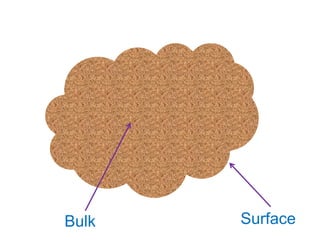
Bulk   Surface
Surface of solids and liquids
has the tendency to attract
and retain other molecules
with which it is brought in to
contact.
This is due to unbalanced
residual inward forces of
attraction or free valencies
at the surface of solids and
liquids.
Due to these residual forces,
surface of solid or liquid has
a higher concentration of
other molecular species than
the bulk.
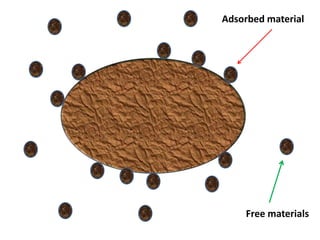
Adsorbed material


    Free materials
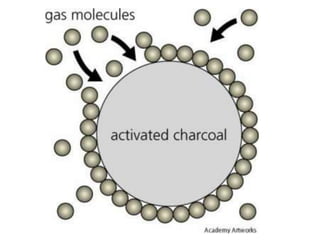
Adsorption: The accumulation
of molecular species at the
surface of a solid or liquid
rather than in the bulk is called
adsorption.
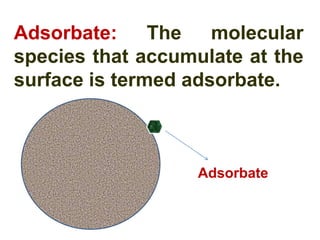
Adsorbate:     The   molecular
species that accumulate at the
surface is termed adsorbate.


                   Adsorbate
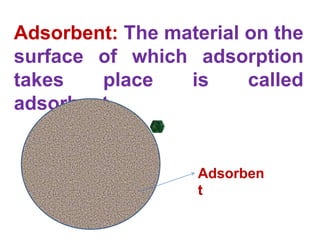
Adsorbent: The material on the
surface of which adsorption
takes   place    is     called
adsorbent.


                   Adsorben
                   t
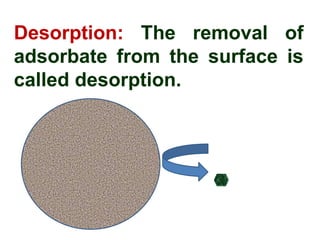
Desorption: The removal of
adsorbate from the surface is
called desorption.
Occlusion: The adsorption of
gases on the surface of metals
is called occlusion.
Examples for adsorption…………

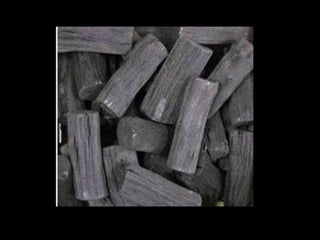
1. If a gas like H2, O2, Cl2 etc is taken in a vessel
   containing powdered charcoal, pressure of the gas
   slowly decreases as the gas is adsorbed on the surface
   of charcoal.
2. Air becomes dry in presence of silica gel because

   adsorption of water takes place on the surface of the
   gel.
3. Aqueous solution of raw sugar becomes colourless
   when passed over a bed of animal charcoal. The
   coloring matter is adsorbed by the charcoal.
4. Litmus solution or a solution of a dye like methylene
   blue when shaken with animal charcoal turns
   colourless due to adsorption of coloring material.
Absorption:
Sorption:
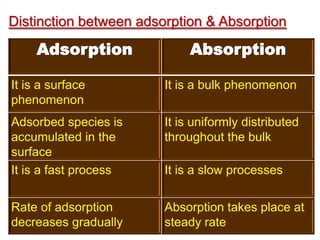
Distinction between adsorption & Absorption

     Adsorption              Absorption

It is a surface         It is a bulk phenomenon
phenomenon
Adsorbed species is     It is uniformly distributed
accumulated in the      throughout the bulk
surface
It is a fast process    It is a slow processes

Rate of adsorption      Absorption takes place at
decreases gradually     steady rate
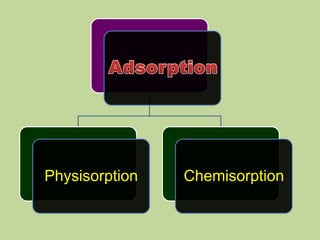
Physisorption   Chemisorption
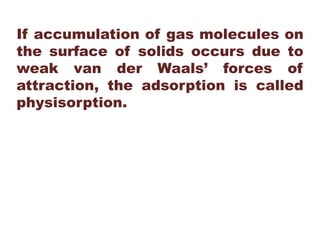
If accumulation of gas molecules on
the surface of solids occurs due to
weak van der Waals’ forces of
attraction, the adsorption is called
physisorption.
When atoms or molecules of gases
are held by solids on its surface by
chemical bonds, the adsorption is
called chemisorption.
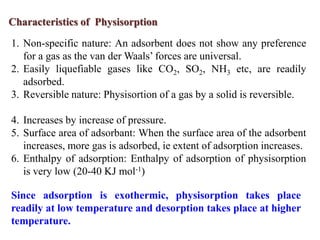
Characteristics of Physisorption

1. Non-specific nature: An adsorbent does not show any preference
   for a gas as the van der Waals’ forces are universal.
2. Easily liquefiable gases like CO2, SO2, NH3 etc, are readily
   adsorbed.
3. Reversible nature: Physisortion of a gas by a solid is reversible.

4. Increases by increase of pressure.
5. Surface area of adsorbant: When the surface area of the adsorbent
   increases, more gas is adsorbed, ie extent of adsorption increases.
6. Enthalpy of adsorption: Enthalpy of adsorption of physisorption
   is very low (20-40 KJ mol-1)

Since adsorption is exothermic, physisorption takes place
readily at low temperature and desorption takes place at higher
temperature.
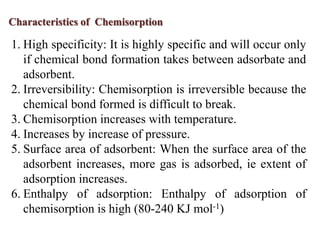
Characteristics of Chemisorption

1. High specificity: It is highly specific and will occur only
   if chemical bond formation takes between adsorbate and
   adsorbent.
2. Irreversibility: Chemisorption is irreversible because the
   chemical bond formed is difficult to break.
3. Chemisorption increases with temperature.
4. Increases by increase of pressure.
5. Surface area of adsorbent: When the surface area of the
   adsorbent increases, more gas is adsorbed, ie extent of
   adsorption increases.
6. Enthalpy of adsorption: Enthalpy of adsorption of
   chemisorption is high (80-240 KJ mol-1)
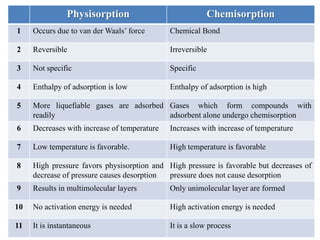
Physisorption                             Chemisorption
1    Occurs due to van der Waals’ force       Chemical Bond

2    Reversible                               Irreversible

3    Not specific                             Specific

4    Enthalpy of adsorption is low            Enthalpy of adsorption is high

5    More liquefiable gases are adsorbed Gases which form compounds with
     readily                             adsorbent alone undergo chemisorption
6    Decreases with increase of temperature   Increases with increase of temperature

7    Low temperature is favorable.            High temperature is favorable

8    High pressure favors physisorption and High pressure is favorable but decreases of
     decrease of pressure causes desorption pressure does not cause desorption
9    Results in multimolecular layers         Only unimolecular layer are formed

10   No activation energy is needed           High activation energy is needed

11   It is instantaneous                      It is a slow process
Factors Influencing
    Adsorption
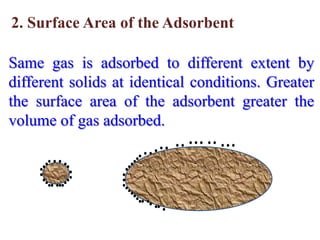
2. Surface Area of the Adsorbent

Same gas is adsorbed to different extent by
different solids at identical conditions. Greater
the surface area of the adsorbent greater the
volume of gas adsorbed.
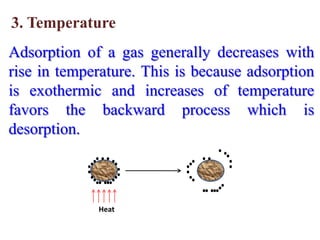
3. Temperature
Adsorption of a gas generally decreases with
rise in temperature. This is because adsorption
is exothermic and increases of temperature
favors the backward process which is
desorption.


             Heat
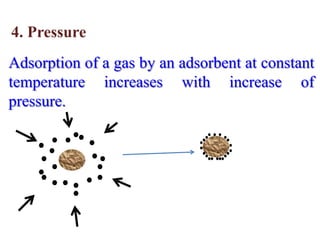
4. Pressure
Adsorption of a gas by an adsorbent at constant
temperature increases with increase of
pressure.
Applications
 Adsorption
1. In Gas Masks
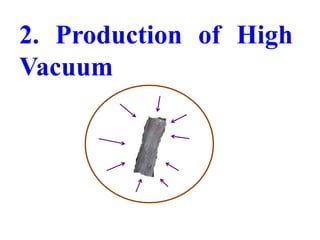
2. Production of High
Vacuum
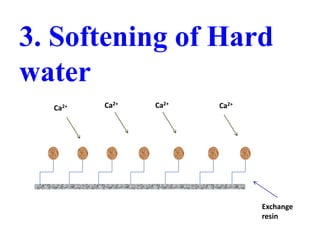
3. Softening of Hard
water
  Ca2+   Ca2+   Ca2+   Ca2+


                              Exchange
                              resin
4. Heterogeneous
Catalysis
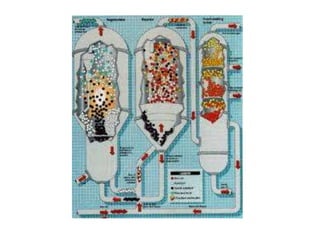
5. Refining of Petroleum
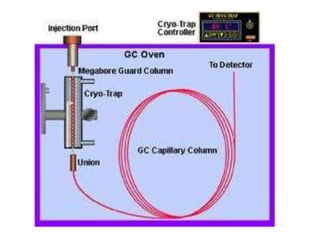
6. Chromatographic Seperation
Surface chemistry-Dr. Surendran Parambadath

Surface chemistry-Dr. Surendran Parambadath

  • 2.
    Dr. SURENDRAN PARAMBADATH (M.Sc, M.Phil, M.Tech) Formerly: Post Doctoral Research Associate, Nano-Information Materials Research Laboratory, Pusan National University, Busan-South Korea Currently: Assistant Professor Govt. Polytechnic College, Perinthalmanna
  • 3.
    Bulk Surface
  • 4.
    Surface of solidsand liquids has the tendency to attract and retain other molecules with which it is brought in to contact.
  • 6.
    This is dueto unbalanced residual inward forces of attraction or free valencies at the surface of solids and liquids.
  • 7.
    Due to theseresidual forces, surface of solid or liquid has a higher concentration of other molecular species than the bulk.
  • 9.
    Adsorbed material Free materials
  • 11.
    Adsorption: The accumulation ofmolecular species at the surface of a solid or liquid rather than in the bulk is called adsorption.
  • 13.
    Adsorbate: The molecular species that accumulate at the surface is termed adsorbate. Adsorbate
  • 14.
    Adsorbent: The materialon the surface of which adsorption takes place is called adsorbent. Adsorben t
  • 15.
    Desorption: The removalof adsorbate from the surface is called desorption.
  • 16.
    Occlusion: The adsorptionof gases on the surface of metals is called occlusion.
  • 17.
    Examples for adsorption………… 1.If a gas like H2, O2, Cl2 etc is taken in a vessel containing powdered charcoal, pressure of the gas slowly decreases as the gas is adsorbed on the surface of charcoal. 2. Air becomes dry in presence of silica gel because adsorption of water takes place on the surface of the gel. 3. Aqueous solution of raw sugar becomes colourless when passed over a bed of animal charcoal. The coloring matter is adsorbed by the charcoal. 4. Litmus solution or a solution of a dye like methylene blue when shaken with animal charcoal turns colourless due to adsorption of coloring material.
  • 19.
  • 20.
  • 21.
    Distinction between adsorption& Absorption Adsorption Absorption It is a surface It is a bulk phenomenon phenomenon Adsorbed species is It is uniformly distributed accumulated in the throughout the bulk surface It is a fast process It is a slow processes Rate of adsorption Absorption takes place at decreases gradually steady rate
  • 23.
    Physisorption Chemisorption
  • 25.
    If accumulation ofgas molecules on the surface of solids occurs due to weak van der Waals’ forces of attraction, the adsorption is called physisorption.
  • 27.
    When atoms ormolecules of gases are held by solids on its surface by chemical bonds, the adsorption is called chemisorption.
  • 28.
    Characteristics of Physisorption 1.Non-specific nature: An adsorbent does not show any preference for a gas as the van der Waals’ forces are universal. 2. Easily liquefiable gases like CO2, SO2, NH3 etc, are readily adsorbed. 3. Reversible nature: Physisortion of a gas by a solid is reversible. 4. Increases by increase of pressure. 5. Surface area of adsorbant: When the surface area of the adsorbent increases, more gas is adsorbed, ie extent of adsorption increases. 6. Enthalpy of adsorption: Enthalpy of adsorption of physisorption is very low (20-40 KJ mol-1) Since adsorption is exothermic, physisorption takes place readily at low temperature and desorption takes place at higher temperature.
  • 29.
    Characteristics of Chemisorption 1.High specificity: It is highly specific and will occur only if chemical bond formation takes between adsorbate and adsorbent. 2. Irreversibility: Chemisorption is irreversible because the chemical bond formed is difficult to break. 3. Chemisorption increases with temperature. 4. Increases by increase of pressure. 5. Surface area of adsorbent: When the surface area of the adsorbent increases, more gas is adsorbed, ie extent of adsorption increases. 6. Enthalpy of adsorption: Enthalpy of adsorption of chemisorption is high (80-240 KJ mol-1)
  • 30.
    Physisorption Chemisorption 1 Occurs due to van der Waals’ force Chemical Bond 2 Reversible Irreversible 3 Not specific Specific 4 Enthalpy of adsorption is low Enthalpy of adsorption is high 5 More liquefiable gases are adsorbed Gases which form compounds with readily adsorbent alone undergo chemisorption 6 Decreases with increase of temperature Increases with increase of temperature 7 Low temperature is favorable. High temperature is favorable 8 High pressure favors physisorption and High pressure is favorable but decreases of decrease of pressure causes desorption pressure does not cause desorption 9 Results in multimolecular layers Only unimolecular layer are formed 10 No activation energy is needed High activation energy is needed 11 It is instantaneous It is a slow process
  • 31.
  • 32.
    2. Surface Areaof the Adsorbent Same gas is adsorbed to different extent by different solids at identical conditions. Greater the surface area of the adsorbent greater the volume of gas adsorbed.
  • 33.
    3. Temperature Adsorption ofa gas generally decreases with rise in temperature. This is because adsorption is exothermic and increases of temperature favors the backward process which is desorption. Heat
  • 34.
    4. Pressure Adsorption ofa gas by an adsorbent at constant temperature increases with increase of pressure.
  • 35.
  • 36.
    1. In GasMasks
  • 38.
    2. Production ofHigh Vacuum
  • 39.
    3. Softening ofHard water Ca2+ Ca2+ Ca2+ Ca2+ Exchange resin
  • 40.
  • 41.
    5. Refining ofPetroleum
  • 43.