TOPICS
• Conductance of electrolytic solution
• Specific conductance, Equivalent conductance,
Molar conductance
• Kohlrausch's law
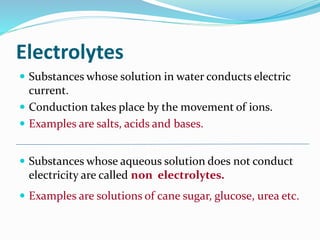
Electrolytes
 Substances whose solution in water conducts electric
current.
 Conduction takes place by the movement of ions.
 Examples are salts, acids and bases.
 Substances whose aqueous solution does not conduct
electricity are called non electrolytes.
 Examples are solutions of cane sugar, glucose, urea etc.
Types of Electrolytes:
 Strong electrolyte are highly ionized in the solution.
Examples are HCl, H2SO4, NaOH, KOH etc
 Weak electrolytes are only feebly ionized in the
solution.
Examples are H2CO3, CH3COOH, NH4OH etc
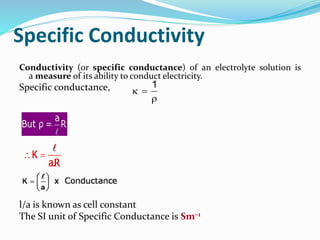
Specific Conductivity
Conductivity (or specific conductance) of an electrolyte solution is
a measure of its ability to conduct electricity.
Specific conductance,
l/a is known as cell constant
The SI unit of Specific Conductance is Sm–1
1
 

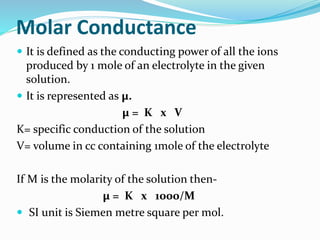
Molar Conductance
 It is defined as the conducting power of all the ions
produced by 1 mole of an electrolyte in the given
solution.
 It is represented as µ.
µ = K x V
K= specific conduction of the solution
V= volume in cc containing 1mole of the electrolyte
If M is the molarity of the solution then-
µ = K x 1000/M
 SI unit is Siemen metre square per mol.
Equivalent Conductance
 It is defined as the conducting power of all the ions
produced by 1 gram of an electrolyte in the given
solution.
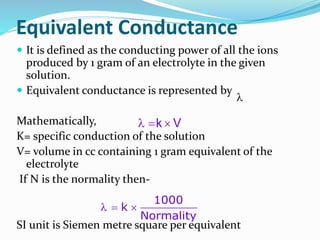
 Equivalent conductance is represented by
Mathematically,
K= specific conduction of the solution
V= volume in cc containing 1 gram equivalent of the
electrolyte
If N is the normality then-
SI unit is Siemen metre square per equivalent

  k V
1000
k
Normality
  
Effect of Dilution on Conductivity
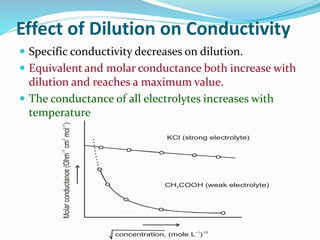
 Specific conductivity decreases on dilution.
 Equivalent and molar conductance both increase with
dilution and reaches a maximum value.
 The conductance of all electrolytes increases with
temperature
concentration, (mole L )–1 1/2
CH COOH (weak electrolyte)3
KCl (strong electrolyte)
Relation between equivalent
conductivity and molar conductivity
μ = valency factor(or n - factor)× λ
i.e.
Molar conductivity = n- factor x equivalent
conductivity
Kohlrausch’s Law
    a c
“Limiting molar conductivity of an electrolyte can be
represented as the sum of the individual contributions of the
anion and cation of the electrolyte.”
Where are known as ionic conductance of anion
and cation at infinite dilution respectively.
 a cand
Physical chemistry presentation

Physical chemistry presentation

  • 2.
    TOPICS • Conductance ofelectrolytic solution • Specific conductance, Equivalent conductance, Molar conductance • Kohlrausch's law
  • 3.
    Electrolytes  Substances whosesolution in water conducts electric current.  Conduction takes place by the movement of ions.  Examples are salts, acids and bases.  Substances whose aqueous solution does not conduct electricity are called non electrolytes.  Examples are solutions of cane sugar, glucose, urea etc.
  • 4.
    Types of Electrolytes: Strong electrolyte are highly ionized in the solution. Examples are HCl, H2SO4, NaOH, KOH etc  Weak electrolytes are only feebly ionized in the solution. Examples are H2CO3, CH3COOH, NH4OH etc
  • 5.
    Specific Conductivity Conductivity (orspecific conductance) of an electrolyte solution is a measure of its ability to conduct electricity. Specific conductance, l/a is known as cell constant The SI unit of Specific Conductance is Sm–1 1   
  • 6.
    Molar Conductance  Itis defined as the conducting power of all the ions produced by 1 mole of an electrolyte in the given solution.  It is represented as µ. µ = K x V K= specific conduction of the solution V= volume in cc containing 1mole of the electrolyte If M is the molarity of the solution then- µ = K x 1000/M  SI unit is Siemen metre square per mol.
  • 7.
    Equivalent Conductance  Itis defined as the conducting power of all the ions produced by 1 gram of an electrolyte in the given solution.  Equivalent conductance is represented by Mathematically, K= specific conduction of the solution V= volume in cc containing 1 gram equivalent of the electrolyte If N is the normality then- SI unit is Siemen metre square per equivalent    k V 1000 k Normality   
  • 8.
    Effect of Dilutionon Conductivity  Specific conductivity decreases on dilution.  Equivalent and molar conductance both increase with dilution and reaches a maximum value.  The conductance of all electrolytes increases with temperature concentration, (mole L )–1 1/2 CH COOH (weak electrolyte)3 KCl (strong electrolyte)
  • 9.
    Relation between equivalent conductivityand molar conductivity μ = valency factor(or n - factor)× λ i.e. Molar conductivity = n- factor x equivalent conductivity
  • 10.
    Kohlrausch’s Law    a c “Limiting molar conductivity of an electrolyte can be represented as the sum of the individual contributions of the anion and cation of the electrolyte.” Where are known as ionic conductance of anion and cation at infinite dilution respectively.  a cand