Physical Chemistry 2
Code: CHE403
Dr Fateh Eltaboni
NATIONAL BOARD FOR TECHNICAL & VOCATIONAL EDUCATION
College of Mechanical Engineering Technology / Benghazi
Department of Chemical Engineering Technology
Colloids and Macromolecules
2
WHAT ARE COLLOIDS?
Mixture = Solvent + Solute There are 3 kinds of
mixtures:
1.True Solution:
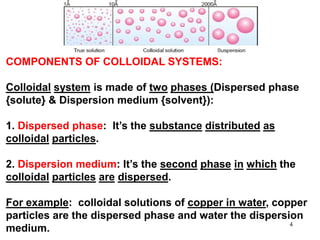
It’s a homogeneous mixture in which the solute particles
are dispersed in the solvent as single molecules or ions.
Examples sugar or salt in water
The diameter of the dispersed particles ranges from (1Å) to
(10 Å).
3
2. Suspension:
Its a heterogeneous mixture in which the dispersed
particles are aggregates of millions of molecules.
Examples coffee Stirred in water
The diameter of these particles is of the order (2,000 Å) or
more.
3. Colloidal Solutions (or colloidal dispersions):
They are intermediate between true solutions and
suspensions.
When the diameter of the particles of a substance dispersed
in a solvent ranges from (10 Å) to (2,000 Å), the mixture is
called a colloidal solution or a colloid.
4
COMPONENTS OF COLLOIDAL SYSTEMS:
Colloidal system is made of two phases (Dispersed phase
{solute} & Dispersion medium {solvent}):
1. Dispersed phase: It’s the substance distributed as
colloidal particles.
2. Dispersion medium: It’s the second phase in which the
colloidal particles are dispersed.
For example: colloidal solutions of copper in water, copper
particles are the dispersed phase and water the dispersion
medium.
5
The dispersed phase or the
dispersion medium can be a
(gas), (liquid) or (solid).
TYPES OF COLLOIDAL SYSTEMS:
6
NOTE: A colloidal dispersion of one gas in another is not
possible since the two gases would give a homogeneous
molecular mixture.
LYOPHILIC AND LYOPHOBIC SOLS:
Sols are colloidal systems in which a solid is dispersed
in a liquid.
Sols can be subdivided into two classes :
1. Lyophilic sols (solvent-loving)
2. Lyophobic sols (solvent-hating)
1. Lyophilic sols: in which the dispersed phase exhibits an
attraction (loving) for the medium (solvent)
An example of lyophilic sols is dispersions of starch,
in water.
7
• The attraction of the sol particles for the medium, in a
lyophilic sol, is due to hydrogen bonding (HB) with water
Lyophobic sols : in which the dispersed phase has no
attraction for the medium.
An example of lyophobic sols is dispersion of copper in
water.
• There are no attraction forces (HB) when copper is
dispersed in water.
8
COMPARISON OF LYOPHILIC AND LYOPHOBIC SOLS
PREPARATION OF LYOPHILIC SOLS
• Lyophilic sols prepared by simply warming of the
solid with the liquid dispersion medium. e.g., starch
with water.
9
PREPARATION OF LYOPHILIC SOLS:
• Lyophobic sols have to be prepared by special methods:
1. Dispersion Methods: in which larger macro-sized
particles are broken down to colloidal size.
2. Aggregation Methods: in which colloidal size particles
are built up by aggregating single ions or molecules.
1. DISPERSION METHODS
1. Mechanical dispersion using Colloid mill:
Examples: ‘Colloidal graphite’ (a lubricant) and
printing inks are made by this method.
10
Macro-sized
+ dispersion
medium
2. Electrical dispersion using Bredig’s Arc Method
• It is used for preparing hydrosols of metals e.g., silver,
gold and platinum.
• An arc is struck between the two metal electrodes held
close together under de-ionized water in KOH. AND sols
form in two steps:
11
1.The intense heat of the spark across the electrodes
vaporises some of the metal and the vapour condenses
under water.
2. The atoms of the metal present in the vapour aggregate
to form colloidal particles in water.
12
3. Chemical Dispersion By Peptization
• The dispersal of a precipitated material into colloidal
solution by the action of an electrolyte in solution, is
termed peptization.
• The electrolyte used is called a peptizing agent. And the
peptization is the reverse of precipitation of a sol.
• The precipitate adsorbs the
common ions (Fe+3) and then
split from the precipitate as
colloidal particles.
13
2. AGGREGATION METHODS:
• Aggregation methods consists of chemical reactions or
change of solvent by which the atoms or molecules
aggregate to form colloidal particles.
• The more important methods for preparing hydrophobic
sols are listed below :
1. Double Decomposition:
As2O3 + 3 H2S --------> As2S3 (Yellow Sol) + 3H2O
arsenious oxide + hydrogen sulphide arsenic sulphide
2. Reduction:
14
H2S + (O)-------->S + H2O
3. Oxidation:
4. Hydrolysis:
5. Change of Solvent:
When a solution of sulphur in ethanol is added to an
excess of water, the sulphur sol is formed due to decrease
in solubility.
PURIFICATION OF SOLS
• The purification of sols can be carried out by three
methods :
(1) Dialysis
(2) Electrodialysis
(3) Ultrafiltration
15
(1) DIALYSIS
• The process of removing ions or molecules
(impurities) from a sol by diffusion through a
permeable membrane is called Dialysis
• The apparatus used for dialysis is called a Dialyser:
16
(2) ELECTRODIALYSIS
• Electrodialysis is carried under the influence of
electric field. This speeds up the migration of ions to
the opposite electrode.
17
(3) ULTRAFILTRATION
• Sols pass through an ordinary filter paper (cellulose), Its
pores are too large to retain the colloidal particles.
• If filter paper is steeped with a regenerated
cellulose such as (cellophane), the pore size is much
reduced. Such a modified filter paper is called an ultrafilter.
• The separation of the sol particles from the liquid
medium and electrolytes by filtration through an ultrafilter
is called ultrafiltration.
• Ultrafiltration is a slow process. Gas pressure is
applied to speed it up.
18
• By using graded ultrafilters, the technique of
ultrafiltration can be employed to separate sol particles
of different sizes.
19
OPTICAL PROPERTIES OF SOLS
• Optical properties are: 1. Tyndall effect 2. Colour
1. Sols exhibit Tyndall effect (Scattering of light)
• The phenomenon of the scattering of light by the sol
particles is called Tyndall effect.
• True solutions do not show Tyndall effect
20
• Sol particles can be seen with an Electron microscope
as individual particles
21
2. Colour of sols
• The colour of a hydrophobic sol depends on the
wavelength of the light scattered by the dispersed
particles.
• The wavelength of the scattered light depends on the
size and the nature of the particles
22
KINETIC PROPERTIES OF SOLS
(1)Brownian Movement
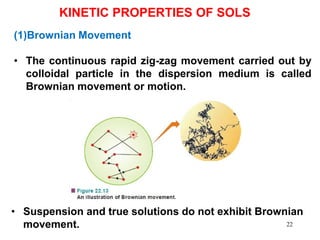
• The continuous rapid zig-zag movement carried out by
colloidal particle in the dispersion medium is called
Brownian movement or motion.
• Suspension and true solutions do not exhibit Brownian
movement.
23
ELECTRICAL PROPERTIES OF SOLS
(1) Sol Particle Charge:
• The sol particles carry a positive (+) or a negative (-)
charge, which play a vital role in stability of sol.
• The repulsion forces between similarly charged particles
prevent them from aggregating and settling under the
action of gravity. This gives stability to the sol.
STABILITY OF SOLS
Fe(OH)3 sol
+ Fe3+ of FeCl3 from preparation
- Cl- as an counterion
• Electrical properties are: 1. Sol charge 2. Electrophoresis 3. Electroosmosis
24
ELECTRICAL DOUBLE LAYER
The double layer is made of:
1. A COMPACT LAYER of (+ve) and (-ve) charges which are
fixed on the particle surface.
2. A DIFFUSE LAYER of counterions diffused into the
medium containing positive ions.
25
• The combination of the compact and diffuse layer is
referred to as the Stern Double layer
• The difference in potential between the compact layer
and the diffuse layer called Zeta potential.
• Zeta potential = 0 when (+ve) = (-ve))
• The zeta potential can be calculated from the following
properties: (a) Electrophoresis (b) Electro-osmosis of
colloids.
26
(2) Electrophoresis
• The movement of sol particles under an applied electric
potential is called Electrophoresis.
• Negative sol migrates to positive electrode and Positive
sole migrates to negative electrode.
Using water as the dispersion
medium, the charge on the
particles of some common sols
determined electrophoresis is
given below:
27
3.Electroosmosis
• The movement of the dispersion medium under the
influence of applied potential is known as
electroosmosis.
Electroosmosis is applied in:
1. Removal of water from peat
2. Dewatering of moist clay
3. Drying dye pastes.
28
COAGULATION
(PRECIPITATION OF SOLS)
• The flocculation and settling down of the discharged sol
particles under the action of gravity is called
coagulation or precipitation.
• The coagulation of a given sol can be done in four ways:
(1) By addition of electrolytes (2) By electrophoresis
(3) By mixing two oppositely charged sols (4) By boiling
(1) BY ADDITION OF ELECTROLYTES
29
• The precipitating effect of an ion on dispersed phase of
opposite charge increases with the valence of the ion:
Negative sol (As2S3): Al3+> Ba2+>Na+
Positive sol (Fe (OH)3): [Fe(CN)6]3– > SO4
2– > Cl
(2)BY ELECTROPHORESIS
• The charged sol particles migrate to the electrode of
opposite sign. Hence, they are discharged and
precipitated.
(3)BY MIXING TWO OPPOSITELY CHARGED SOLS
• The (+ve) particles of one sol are attracted by the (-ve)
particles of the second sol. This is followed by
precipitation of both the sols.
30
(4)BY BOILING
• Sols such as silver halides (AgX) dispersed in water,
are coagulated by boiling.
• Boiling Increases collisions between the sol particles
and water molecules, which remove the adsorbed
electrolyte. This takes away the charge from the
particles which settle down..
ORIGIN OF CHARGE ON SOL PARTICLES
1. Adsorption of ions from the aqueous medium:
31
2. Ionization of Surface groups
32
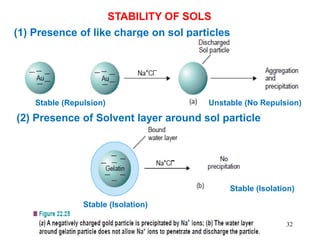
STABILITY OF SOLS
(1) Presence of like charge on sol particles
Stable (Repulsion) Unstable (No Repulsion)
(2) Presence of Solvent layer around sol particle
Stable (Isolation)
Stable (Isolation)
33
ASSOCIATED COLLOIDS (SURFACTANTS)
• Surfactants are organic molecules that are amphiphilic,
they contain both hydrophobic groups (their tails) and
hydrophilic groups (their heads)
• Surfactants act as soaps or detergents.
• The colloidal aggregates of surfactants are called Micelles.
34
Anionic surfactant
An example : Sodium dodecyl sulfate (SDS)
Cationic surfactant
An example : Benzethonium chloride (BZT)
*An example: Cocamidopropy betaine
amphoteric/zwitterionic
35
• The cleansing action of soap is due to:
(1) Solubilisation of
grease into the micelle
(2) Emulsification of grease
36
EMULSIONS
• An emulsion may be defined as a dispersion of finely
divided liquid droplets in another liquid.
Types of Emulsions:
(a) Oil-in-Water type (O/W type)
(b) Water-in-Oil type (W/O type)
37
WHAT ARE GELS ?
• A gel is a jelly-like colloidal system in which a liquid is
dispersed in a solid medium.
APPLICATIONS OF COLLOIDS
1. Foods: Milk, Whipped cream, Ice cream and Bread.
38
2. Medicines: Antibiotics such as penicillin is produced in
colloidal form suitable for injections.
3. Non-drip paints
4. Clarification of natural water
5. Artificial Kidney machine:
39
MACROMOLECULES (POLYMERS)
• A macromolecule (Polymer) is a very large molecule
created by polymerization of smaller subunit AND
dissolve in a solvent to yield colloidal solutions
directly.
Examples:
1. Biopolymer: Proteins, cellulose and starch
2. Synthetic polymers: (plastics) and poly (acrylic acid)
• Solutions of macromolecules possess high viscosity
and can carry a negative or positive charges (then
called: Polyelectrolytes).
40
MOLECULAR WEIGHT OF MACROMOLECULES
• Molecules of a polymer may not be of the same size.
Therefore all the experimental methods of molecular
weight determination will give an average value.
• Types of average molecular weights
1. Number average molecular weight ( ): can be
measured by osmotic pressure experiment
41
2. Weight average molecular weight ( ):can be
measured by Light scattering experiment
• Where m1 and m2, represent mass of macromolecules
having molecular weights M1 and M2
3. Volume average molecular weight ( ):can be
measured by Gel permeation chromatography (GPC)
experiment
42
43
44
DETERMINATION OF MOLECULAR WEIGHTS OF
MACROMOLECULES:
(1) Osmotic Pressure Method
Where π (p) = osmotic
pressure, atm ; c =
concentration of solution
gl–1; R = gas constant,
0.08205 l atm deg–1 mol–1;
T = kelvin temperature ; M
= molecular weight of the
solute (polymer).
45
(2) Viscosity method
• The relative viscosity:
Where h is viscosity of solution and h0 is the viscosity of
solvent
• The specific viscosity:
• Huggins equation:
46
where (k) and (a) are constants for a
specific polymer in a specific
solvent.
3. Gel permeation chromatography (GPC) method
47
Electrochemistry
• Water-soluble substances are distinguished as
electrolytes or nonelectrolytes.
• Electrolytes are substances that form ions in solution
which conduct an electric current. NaCl, CuSO4 and
KNO3 are examples of electrolytes.
• Nonelectrolytes are substances which form neutral
molecules in solution. Their water-solutions do not
conduct an electric current. Sugar, alcohol are typical
nonelectrolytes.
• Electrolysis The decomposition of an electrolyte by
passing electric current through its solution is
termed Electrolysis ( lyo = breaking).
48
• ELECTROLYTIC CELL. The cell contains water-solution
of an electrolyte in which two metallic rods
(electrodes) are dipped .These rods are connected to
the two terminals of a battery (source of electricity).
• The electrode connected to the positive end of the
battery attracts the negative ions (anions) and is called
anode.
• The other electrode connected to the negative end of
the battery attracts the positive ions (cations) and is
called cathode.
49
MECHANISM OF ELECTROLYSIS
Example: Electrolysis of hydrochloric acid (HCl)
• At cathode:
• At anode:
• Overall reaction:
50
ELECTRICAL UNITS
• A coulomb (Q): is a unit of electricity. It is the amount of
electricity which will deposit 0.001118 gram of silver from a
15 per cent solution of silver nitrate in a coulometer.
• Ampere (I): is a unit rate of flow of electricity. It is a current
of one coulomb per second. (I = Q/t)
• Ohm is a unit of electrical resistance.
• Volt is a unit of electromotive force. It is the difference in
electrical potential required to send a current of one
ampere through a resistance of one ohm.
51
FARADAY’S LAWS OF ELECTROLYSIS
• If m is the mass of substance (in grams) deposited on
electrode by passing Q coulombs of electricity, then:
1. First law:
2. Second law:
• Where Z is the constant known as the
Electrochemical equivalent of the electrolyte.
52
THE FARADY:
VERIFICATION OF THE SECOND LAW OF ELECTROLYSIS
• According to this law when the same quantity of
electricity is passed through different electrolyte
solutions, the masses of the substances deposited
on the electrodes are proportional to their chemical
equivalents.
53
54
CONDUCTANCE OF ELECTROLYTES
• Electrolyte solutions conduct electric current by
movement of the ions to the electrodes. The power of
electrolytes to conduct electric currents is termed
conductivity or conductance.
• Like metallic conductors, electrolytes obey Ohm’s
law:
• Where E is the potential difference at two ends (in
volts); and R is the resistance measured in ohms (or
Ω).
• The resistance R of a conductor is directly
proportional to its length, l, and inversely
proportional to the area of its cross-section, A:
55
• Where ρ “rho” is a constant of proportionality and
is called resistivity or specific resistance. Its value
depends upon the material of the conductor. From
above we can write:
• Specific resistance: It is resistance in ohm of 1cm3 of a
solution of an electrolyte.
• Specific conductance or Specific conductivity.
It is the conductance of 1cm3 of a solution of an
electrolyte.
56
Units of Specific conductance:
or
• The specific conductance increases with : (i)
ionic concentration, and (ii) speeds of the ions.
57
• Equivalent Conductance ():
• It is defined as the conductance of an electrolyte
obtained by dissolving one gram-equivalent of it in
V cm3 of water.
58
Strong electrolytes
are completely
ionised at all
concentrations (or
dilutions). But weak
electrolytes are
partially ionised.
59
• As the solution becomes more and more dilute, the
equivalent conductance increases, till it reaches a
limitary value. This value is known as equivalent
conductance at infinite dilution (zero concentration)
and is denoted by 0.
• In case of a weak electrolyte Λ∝ is the equivalent
conductance when ionisation is complete. So, the
conductance ratio Λ / Λ∝ is the degree of ionisation.
That is,
60
61
• Molar Concentration (μ):
It is defined as : the conductance of all ions produced
by one mole of an electrolyte when dissolved in a
certain volume V cm3.
Upon dilution
specific
conductance
decreases, while
Equivalent
conductance and
Molar
conductance
increases.
62
MEASUREMENT OF ELECTROLYTIC CONDUCTANCE
• This can be done in the laboratory with the help of a
Wheatstone bridge.The solution whose conductance is
to be determined is placed in a special type of cell
known as the conductance cell.
63
64
DETERMINATION OF THE CELL CONSTANT
65
66

Colloids

  • 1.
    Physical Chemistry 2 Code:CHE403 Dr Fateh Eltaboni NATIONAL BOARD FOR TECHNICAL & VOCATIONAL EDUCATION College of Mechanical Engineering Technology / Benghazi Department of Chemical Engineering Technology
  • 2.
    Colloids and Macromolecules 2 WHATARE COLLOIDS? Mixture = Solvent + Solute There are 3 kinds of mixtures: 1.True Solution: It’s a homogeneous mixture in which the solute particles are dispersed in the solvent as single molecules or ions. Examples sugar or salt in water The diameter of the dispersed particles ranges from (1Å) to (10 Å).
  • 3.
    3 2. Suspension: Its aheterogeneous mixture in which the dispersed particles are aggregates of millions of molecules. Examples coffee Stirred in water The diameter of these particles is of the order (2,000 Å) or more. 3. Colloidal Solutions (or colloidal dispersions): They are intermediate between true solutions and suspensions. When the diameter of the particles of a substance dispersed in a solvent ranges from (10 Å) to (2,000 Å), the mixture is called a colloidal solution or a colloid.
  • 4.
    4 COMPONENTS OF COLLOIDALSYSTEMS: Colloidal system is made of two phases (Dispersed phase {solute} & Dispersion medium {solvent}): 1. Dispersed phase: It’s the substance distributed as colloidal particles. 2. Dispersion medium: It’s the second phase in which the colloidal particles are dispersed. For example: colloidal solutions of copper in water, copper particles are the dispersed phase and water the dispersion medium.
  • 5.
    5 The dispersed phaseor the dispersion medium can be a (gas), (liquid) or (solid). TYPES OF COLLOIDAL SYSTEMS:
  • 6.
    6 NOTE: A colloidaldispersion of one gas in another is not possible since the two gases would give a homogeneous molecular mixture. LYOPHILIC AND LYOPHOBIC SOLS: Sols are colloidal systems in which a solid is dispersed in a liquid. Sols can be subdivided into two classes : 1. Lyophilic sols (solvent-loving) 2. Lyophobic sols (solvent-hating) 1. Lyophilic sols: in which the dispersed phase exhibits an attraction (loving) for the medium (solvent) An example of lyophilic sols is dispersions of starch, in water.
  • 7.
    7 • The attractionof the sol particles for the medium, in a lyophilic sol, is due to hydrogen bonding (HB) with water Lyophobic sols : in which the dispersed phase has no attraction for the medium. An example of lyophobic sols is dispersion of copper in water. • There are no attraction forces (HB) when copper is dispersed in water.
  • 8.
    8 COMPARISON OF LYOPHILICAND LYOPHOBIC SOLS PREPARATION OF LYOPHILIC SOLS • Lyophilic sols prepared by simply warming of the solid with the liquid dispersion medium. e.g., starch with water.
  • 9.
    9 PREPARATION OF LYOPHILICSOLS: • Lyophobic sols have to be prepared by special methods: 1. Dispersion Methods: in which larger macro-sized particles are broken down to colloidal size. 2. Aggregation Methods: in which colloidal size particles are built up by aggregating single ions or molecules. 1. DISPERSION METHODS 1. Mechanical dispersion using Colloid mill: Examples: ‘Colloidal graphite’ (a lubricant) and printing inks are made by this method.
  • 10.
    10 Macro-sized + dispersion medium 2. Electricaldispersion using Bredig’s Arc Method • It is used for preparing hydrosols of metals e.g., silver, gold and platinum. • An arc is struck between the two metal electrodes held close together under de-ionized water in KOH. AND sols form in two steps:
  • 11.
    11 1.The intense heatof the spark across the electrodes vaporises some of the metal and the vapour condenses under water. 2. The atoms of the metal present in the vapour aggregate to form colloidal particles in water.
  • 12.
    12 3. Chemical DispersionBy Peptization • The dispersal of a precipitated material into colloidal solution by the action of an electrolyte in solution, is termed peptization. • The electrolyte used is called a peptizing agent. And the peptization is the reverse of precipitation of a sol. • The precipitate adsorbs the common ions (Fe+3) and then split from the precipitate as colloidal particles.
  • 13.
    13 2. AGGREGATION METHODS: •Aggregation methods consists of chemical reactions or change of solvent by which the atoms or molecules aggregate to form colloidal particles. • The more important methods for preparing hydrophobic sols are listed below : 1. Double Decomposition: As2O3 + 3 H2S --------> As2S3 (Yellow Sol) + 3H2O arsenious oxide + hydrogen sulphide arsenic sulphide 2. Reduction:
  • 14.
    14 H2S + (O)-------->S+ H2O 3. Oxidation: 4. Hydrolysis: 5. Change of Solvent: When a solution of sulphur in ethanol is added to an excess of water, the sulphur sol is formed due to decrease in solubility. PURIFICATION OF SOLS • The purification of sols can be carried out by three methods : (1) Dialysis (2) Electrodialysis (3) Ultrafiltration
  • 15.
    15 (1) DIALYSIS • Theprocess of removing ions or molecules (impurities) from a sol by diffusion through a permeable membrane is called Dialysis • The apparatus used for dialysis is called a Dialyser:
  • 16.
    16 (2) ELECTRODIALYSIS • Electrodialysisis carried under the influence of electric field. This speeds up the migration of ions to the opposite electrode.
  • 17.
    17 (3) ULTRAFILTRATION • Solspass through an ordinary filter paper (cellulose), Its pores are too large to retain the colloidal particles. • If filter paper is steeped with a regenerated cellulose such as (cellophane), the pore size is much reduced. Such a modified filter paper is called an ultrafilter. • The separation of the sol particles from the liquid medium and electrolytes by filtration through an ultrafilter is called ultrafiltration. • Ultrafiltration is a slow process. Gas pressure is applied to speed it up.
  • 18.
    18 • By usinggraded ultrafilters, the technique of ultrafiltration can be employed to separate sol particles of different sizes.
  • 19.
    19 OPTICAL PROPERTIES OFSOLS • Optical properties are: 1. Tyndall effect 2. Colour 1. Sols exhibit Tyndall effect (Scattering of light) • The phenomenon of the scattering of light by the sol particles is called Tyndall effect. • True solutions do not show Tyndall effect
  • 20.
    20 • Sol particlescan be seen with an Electron microscope as individual particles
  • 21.
    21 2. Colour ofsols • The colour of a hydrophobic sol depends on the wavelength of the light scattered by the dispersed particles. • The wavelength of the scattered light depends on the size and the nature of the particles
  • 22.
    22 KINETIC PROPERTIES OFSOLS (1)Brownian Movement • The continuous rapid zig-zag movement carried out by colloidal particle in the dispersion medium is called Brownian movement or motion. • Suspension and true solutions do not exhibit Brownian movement.
  • 23.
    23 ELECTRICAL PROPERTIES OFSOLS (1) Sol Particle Charge: • The sol particles carry a positive (+) or a negative (-) charge, which play a vital role in stability of sol. • The repulsion forces between similarly charged particles prevent them from aggregating and settling under the action of gravity. This gives stability to the sol. STABILITY OF SOLS Fe(OH)3 sol + Fe3+ of FeCl3 from preparation - Cl- as an counterion • Electrical properties are: 1. Sol charge 2. Electrophoresis 3. Electroosmosis
  • 24.
    24 ELECTRICAL DOUBLE LAYER Thedouble layer is made of: 1. A COMPACT LAYER of (+ve) and (-ve) charges which are fixed on the particle surface. 2. A DIFFUSE LAYER of counterions diffused into the medium containing positive ions.
  • 25.
    25 • The combinationof the compact and diffuse layer is referred to as the Stern Double layer • The difference in potential between the compact layer and the diffuse layer called Zeta potential. • Zeta potential = 0 when (+ve) = (-ve)) • The zeta potential can be calculated from the following properties: (a) Electrophoresis (b) Electro-osmosis of colloids.
  • 26.
    26 (2) Electrophoresis • Themovement of sol particles under an applied electric potential is called Electrophoresis. • Negative sol migrates to positive electrode and Positive sole migrates to negative electrode. Using water as the dispersion medium, the charge on the particles of some common sols determined electrophoresis is given below:
  • 27.
    27 3.Electroosmosis • The movementof the dispersion medium under the influence of applied potential is known as electroosmosis. Electroosmosis is applied in: 1. Removal of water from peat 2. Dewatering of moist clay 3. Drying dye pastes.
  • 28.
    28 COAGULATION (PRECIPITATION OF SOLS) •The flocculation and settling down of the discharged sol particles under the action of gravity is called coagulation or precipitation. • The coagulation of a given sol can be done in four ways: (1) By addition of electrolytes (2) By electrophoresis (3) By mixing two oppositely charged sols (4) By boiling (1) BY ADDITION OF ELECTROLYTES
  • 29.
    29 • The precipitatingeffect of an ion on dispersed phase of opposite charge increases with the valence of the ion: Negative sol (As2S3): Al3+> Ba2+>Na+ Positive sol (Fe (OH)3): [Fe(CN)6]3– > SO4 2– > Cl (2)BY ELECTROPHORESIS • The charged sol particles migrate to the electrode of opposite sign. Hence, they are discharged and precipitated. (3)BY MIXING TWO OPPOSITELY CHARGED SOLS • The (+ve) particles of one sol are attracted by the (-ve) particles of the second sol. This is followed by precipitation of both the sols.
  • 30.
    30 (4)BY BOILING • Solssuch as silver halides (AgX) dispersed in water, are coagulated by boiling. • Boiling Increases collisions between the sol particles and water molecules, which remove the adsorbed electrolyte. This takes away the charge from the particles which settle down.. ORIGIN OF CHARGE ON SOL PARTICLES 1. Adsorption of ions from the aqueous medium:
  • 31.
    31 2. Ionization ofSurface groups
  • 32.
    32 STABILITY OF SOLS (1)Presence of like charge on sol particles Stable (Repulsion) Unstable (No Repulsion) (2) Presence of Solvent layer around sol particle Stable (Isolation) Stable (Isolation)
  • 33.
    33 ASSOCIATED COLLOIDS (SURFACTANTS) •Surfactants are organic molecules that are amphiphilic, they contain both hydrophobic groups (their tails) and hydrophilic groups (their heads) • Surfactants act as soaps or detergents. • The colloidal aggregates of surfactants are called Micelles.
  • 34.
    34 Anionic surfactant An example: Sodium dodecyl sulfate (SDS) Cationic surfactant An example : Benzethonium chloride (BZT) *An example: Cocamidopropy betaine amphoteric/zwitterionic
  • 35.
    35 • The cleansingaction of soap is due to: (1) Solubilisation of grease into the micelle (2) Emulsification of grease
  • 36.
    36 EMULSIONS • An emulsionmay be defined as a dispersion of finely divided liquid droplets in another liquid. Types of Emulsions: (a) Oil-in-Water type (O/W type) (b) Water-in-Oil type (W/O type)
  • 37.
    37 WHAT ARE GELS? • A gel is a jelly-like colloidal system in which a liquid is dispersed in a solid medium. APPLICATIONS OF COLLOIDS 1. Foods: Milk, Whipped cream, Ice cream and Bread.
  • 38.
    38 2. Medicines: Antibioticssuch as penicillin is produced in colloidal form suitable for injections. 3. Non-drip paints 4. Clarification of natural water 5. Artificial Kidney machine:
  • 39.
    39 MACROMOLECULES (POLYMERS) • Amacromolecule (Polymer) is a very large molecule created by polymerization of smaller subunit AND dissolve in a solvent to yield colloidal solutions directly. Examples: 1. Biopolymer: Proteins, cellulose and starch 2. Synthetic polymers: (plastics) and poly (acrylic acid) • Solutions of macromolecules possess high viscosity and can carry a negative or positive charges (then called: Polyelectrolytes).
  • 40.
    40 MOLECULAR WEIGHT OFMACROMOLECULES • Molecules of a polymer may not be of the same size. Therefore all the experimental methods of molecular weight determination will give an average value. • Types of average molecular weights 1. Number average molecular weight ( ): can be measured by osmotic pressure experiment
  • 41.
    41 2. Weight averagemolecular weight ( ):can be measured by Light scattering experiment • Where m1 and m2, represent mass of macromolecules having molecular weights M1 and M2 3. Volume average molecular weight ( ):can be measured by Gel permeation chromatography (GPC) experiment
  • 42.
  • 43.
  • 44.
    44 DETERMINATION OF MOLECULARWEIGHTS OF MACROMOLECULES: (1) Osmotic Pressure Method Where π (p) = osmotic pressure, atm ; c = concentration of solution gl–1; R = gas constant, 0.08205 l atm deg–1 mol–1; T = kelvin temperature ; M = molecular weight of the solute (polymer).
  • 45.
    45 (2) Viscosity method •The relative viscosity: Where h is viscosity of solution and h0 is the viscosity of solvent • The specific viscosity: • Huggins equation:
  • 46.
    46 where (k) and(a) are constants for a specific polymer in a specific solvent. 3. Gel permeation chromatography (GPC) method
  • 47.
    47 Electrochemistry • Water-soluble substancesare distinguished as electrolytes or nonelectrolytes. • Electrolytes are substances that form ions in solution which conduct an electric current. NaCl, CuSO4 and KNO3 are examples of electrolytes. • Nonelectrolytes are substances which form neutral molecules in solution. Their water-solutions do not conduct an electric current. Sugar, alcohol are typical nonelectrolytes. • Electrolysis The decomposition of an electrolyte by passing electric current through its solution is termed Electrolysis ( lyo = breaking).
  • 48.
    48 • ELECTROLYTIC CELL.The cell contains water-solution of an electrolyte in which two metallic rods (electrodes) are dipped .These rods are connected to the two terminals of a battery (source of electricity). • The electrode connected to the positive end of the battery attracts the negative ions (anions) and is called anode. • The other electrode connected to the negative end of the battery attracts the positive ions (cations) and is called cathode.
  • 49.
    49 MECHANISM OF ELECTROLYSIS Example:Electrolysis of hydrochloric acid (HCl) • At cathode: • At anode: • Overall reaction:
  • 50.
    50 ELECTRICAL UNITS • Acoulomb (Q): is a unit of electricity. It is the amount of electricity which will deposit 0.001118 gram of silver from a 15 per cent solution of silver nitrate in a coulometer. • Ampere (I): is a unit rate of flow of electricity. It is a current of one coulomb per second. (I = Q/t) • Ohm is a unit of electrical resistance. • Volt is a unit of electromotive force. It is the difference in electrical potential required to send a current of one ampere through a resistance of one ohm.
  • 51.
    51 FARADAY’S LAWS OFELECTROLYSIS • If m is the mass of substance (in grams) deposited on electrode by passing Q coulombs of electricity, then: 1. First law: 2. Second law: • Where Z is the constant known as the Electrochemical equivalent of the electrolyte.
  • 52.
    52 THE FARADY: VERIFICATION OFTHE SECOND LAW OF ELECTROLYSIS • According to this law when the same quantity of electricity is passed through different electrolyte solutions, the masses of the substances deposited on the electrodes are proportional to their chemical equivalents.
  • 53.
  • 54.
    54 CONDUCTANCE OF ELECTROLYTES •Electrolyte solutions conduct electric current by movement of the ions to the electrodes. The power of electrolytes to conduct electric currents is termed conductivity or conductance. • Like metallic conductors, electrolytes obey Ohm’s law: • Where E is the potential difference at two ends (in volts); and R is the resistance measured in ohms (or Ω). • The resistance R of a conductor is directly proportional to its length, l, and inversely proportional to the area of its cross-section, A:
  • 55.
    55 • Where ρ“rho” is a constant of proportionality and is called resistivity or specific resistance. Its value depends upon the material of the conductor. From above we can write: • Specific resistance: It is resistance in ohm of 1cm3 of a solution of an electrolyte. • Specific conductance or Specific conductivity. It is the conductance of 1cm3 of a solution of an electrolyte.
  • 56.
    56 Units of Specificconductance: or • The specific conductance increases with : (i) ionic concentration, and (ii) speeds of the ions.
  • 57.
    57 • Equivalent Conductance(): • It is defined as the conductance of an electrolyte obtained by dissolving one gram-equivalent of it in V cm3 of water.
  • 58.
    58 Strong electrolytes are completely ionisedat all concentrations (or dilutions). But weak electrolytes are partially ionised.
  • 59.
    59 • As thesolution becomes more and more dilute, the equivalent conductance increases, till it reaches a limitary value. This value is known as equivalent conductance at infinite dilution (zero concentration) and is denoted by 0. • In case of a weak electrolyte Λ∝ is the equivalent conductance when ionisation is complete. So, the conductance ratio Λ / Λ∝ is the degree of ionisation. That is,
  • 60.
  • 61.
    61 • Molar Concentration(μ): It is defined as : the conductance of all ions produced by one mole of an electrolyte when dissolved in a certain volume V cm3. Upon dilution specific conductance decreases, while Equivalent conductance and Molar conductance increases.
  • 62.
    62 MEASUREMENT OF ELECTROLYTICCONDUCTANCE • This can be done in the laboratory with the help of a Wheatstone bridge.The solution whose conductance is to be determined is placed in a special type of cell known as the conductance cell.
  • 63.
  • 64.
  • 65.
  • 66.