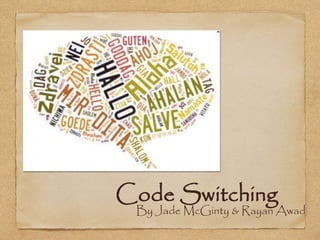
Code Switching 
By Jade McGinty & Rayan Awad
What is Code Switching? 
The practice of alternating between two or more 
languages or varieties of language in conversation. 
The juxtaposition within the same speech exchange 
of passages of speech belonging to two different 
grammatical systems or sub-systems. (Li Wei, 2002, 
2004; Gumperz, 1982) 
example ;)
Why do Bilinguals Code 
Switch?
DifferentTypes of Code 
Switching. 
rayan_awad_1@hotmail.com 
What is Code-Mixing? 
• Mixing refers to the co-occurrence of elements from 
two or more languages in a single utterance. Mixing 
includes single-word utterances from two languages 
during the same stretch of conversation between a 
child and caregiver (Genesee, 1989).
Different Types of Code 
Switching 
Intra-sentential Code-switching - within a 
language vs. inter-sentential code switching 
- outside specific language spoken 
Code-mixing vs. code-switching 
Borrowing vs. code-switching 
syntactic vs semantic switching 
Cultural differences 
Code-Switching (CS) is often divided 
into single-word CS, Multi- word CS and 
Turn-switching
FUNCTIONS OF CODE SWITCHING 
Language choice and code-switching are regarded as 
symbolic of the social relationships between individuals. 
Situational code-switching – the change of language which 
corresponds to changes in the situation, particularly 
participants, setting and activity type. 
Metaphorical code-switching – speakers switch from one 
language to another in order to achieve special 
communicative effects, while the participant and setting 
remain the same.
“identity is a discursive construct that 
emerges in linguistic interaction”
Example 
Video of Code 
Switching
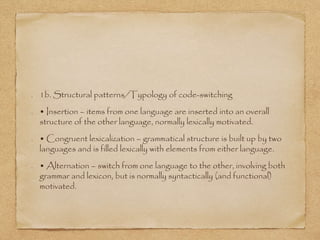
1b. Structural patterns/Typology of code-switching 
• Insertion – items from one language are inserted into an overall 
structure of the other language, normally lexically motivated. 
• Congruent lexicalization – grammatical structure is built up by two 
languages and is filled lexically with elements from either language. 
• Alternation – switch from one language to the other, involving both 
grammar and lexicon, but is normally syntactically (and functional) 
motivated.
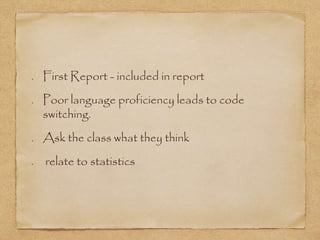
First Report - included in report 
Poor language proficiency leads to code 
switching. 
Ask the class what they think 
relate to statistics
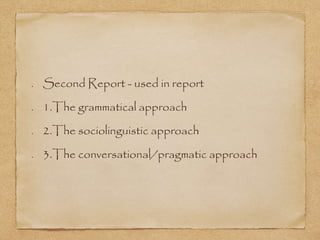
Second Report - used in report 
1.The grammatical approach 
2.The sociolinguistic approach 
3.The conversational/pragmatic approach
“Code-switching is a verbal skill requiring a large 
degree of linguistic competence in more than one 
language, rather than a defect arising from insufficient 
knowledge of one or the other ... [R]ather than 
representing deviant behavior, [it] is actually a 
suggestive indicator of degree of bilingual 
competence.” 
(cf. Grosjean, 2010, p57)
References

Code switching presentation387

  • 1.
    Code Switching ByJade McGinty & Rayan Awad
  • 2.
    What is CodeSwitching? The practice of alternating between two or more languages or varieties of language in conversation. The juxtaposition within the same speech exchange of passages of speech belonging to two different grammatical systems or sub-systems. (Li Wei, 2002, 2004; Gumperz, 1982) example ;)
  • 3.
    Why do BilingualsCode Switch?
  • 4.
    DifferentTypes of Code Switching. rayan_awad_1@hotmail.com What is Code-Mixing? • Mixing refers to the co-occurrence of elements from two or more languages in a single utterance. Mixing includes single-word utterances from two languages during the same stretch of conversation between a child and caregiver (Genesee, 1989).
  • 5.
    Different Types ofCode Switching Intra-sentential Code-switching - within a language vs. inter-sentential code switching - outside specific language spoken Code-mixing vs. code-switching Borrowing vs. code-switching syntactic vs semantic switching Cultural differences Code-Switching (CS) is often divided into single-word CS, Multi- word CS and Turn-switching
  • 6.
    FUNCTIONS OF CODESWITCHING Language choice and code-switching are regarded as symbolic of the social relationships between individuals. Situational code-switching – the change of language which corresponds to changes in the situation, particularly participants, setting and activity type. Metaphorical code-switching – speakers switch from one language to another in order to achieve special communicative effects, while the participant and setting remain the same.
  • 7.
    “identity is adiscursive construct that emerges in linguistic interaction”
  • 8.
    Example Video ofCode Switching
  • 9.
    1b. Structural patterns/Typologyof code-switching • Insertion – items from one language are inserted into an overall structure of the other language, normally lexically motivated. • Congruent lexicalization – grammatical structure is built up by two languages and is filled lexically with elements from either language. • Alternation – switch from one language to the other, involving both grammar and lexicon, but is normally syntactically (and functional) motivated.
  • 10.
    First Report -included in report Poor language proficiency leads to code switching. Ask the class what they think relate to statistics
  • 11.
    Second Report -used in report 1.The grammatical approach 2.The sociolinguistic approach 3.The conversational/pragmatic approach
  • 12.
    “Code-switching is averbal skill requiring a large degree of linguistic competence in more than one language, rather than a defect arising from insufficient knowledge of one or the other ... [R]ather than representing deviant behavior, [it] is actually a suggestive indicator of degree of bilingual competence.” (cf. Grosjean, 2010, p57)
  • 13.