Chapter 6
Language Variation
Presenter
Amire Jabbariniya
Social Variation
The relationship between
linguistic variation and social variation.
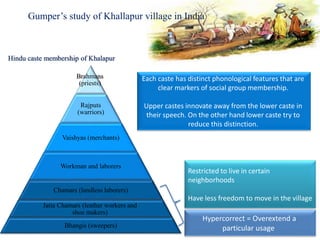
Gumper’s study of Khallapur village in India
Brahmans
(priests)
Rajputs
(warriors)
Vaishyas (merchants)
Workman and laborers
Chamars (landless laborers)
Jatia Chamars (leather workers and
shoe makers)
Bhangis (sweepers)
Restricted to live in certain
neighborhoods
Have less freedom to move in the village
Hindu caste membership of Khalapur
Each caste has distinct phonological features that are
clear markers of social group membership.
Upper castes innovate away from the lower caste in
their speech. On the other hand lower caste try to
reduce this distinction.
Hypercorrect = Overextend a
particular usage
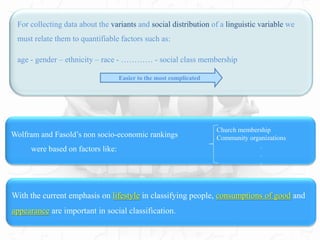
Wolfram and Fasold’s non socio-economic rankings
were based on factors like:
With the current emphasis on lifestyle in classifying people, consumptions of good and
appearance are important in social classification.
For collecting data about the variants and social distribution of a linguistic variable we
must relate them to quantifiable factors such as:
age - gender – ethnicity – race - ………… - social class membership
Easier to the most complicated
Church membership
Community organizations
.
.
.
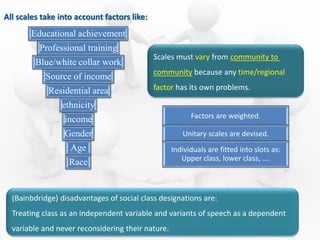
All scales take into account factors like:
Educational achievement
Professional training
Blue/white collar work
Source of income
Residential area
ethnicity
income
Gender
Age
Race
Scales must vary from community to
community because any time/regional
factor has its own problems.
(Bainbdridge) disadvantages of social class designations are:
Treating class as an independent variable and variants of speech as a dependent
variable and never reconsidering their nature.
Factors are weighted.
Unitary scales are devised.
Individuals are fitted into slots as:
Upper class, lower class, ….
Chambers Class is not a clear concept and fuzziness is always present.
Disadvantage Lack of generalizability of results
Social space is multidimensional but systems of social classification are
one-dimensional.
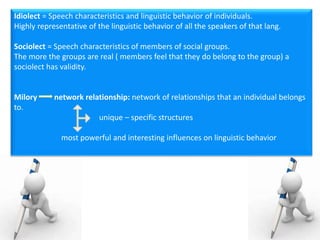
Idiolect = Speech characteristics and linguistic behavior of individuals.
Highly representative of the linguistic behavior of all the speakers of that lang.
Sociolect = Speech characteristics of members of social groups.
The more the groups are real ( members feel that they do belong to the group) a
sociolect has validity.
Milory network relationship: network of relationships that an individual belongs
to.
unique – specific structures
most powerful and interesting influences on linguistic behavior
Data Collection and Analysis
2 basic dimensions of examining hypothesis:
1) Devising a plan for collecting data
2) Collecting data from a representative sample of speakers
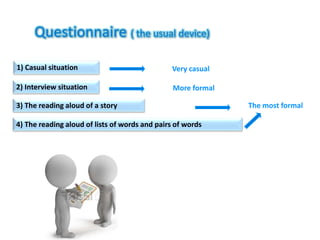
Questionnaire ( the usual device)
1) Casual situation
2) Interview situation
3) The reading aloud of a story
4) The reading aloud of lists of words and pairs of words
Very casual
More formal
The most formal
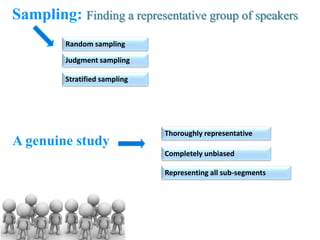
Sampling: Finding a representative group of speakers
Random sampling
Judgment sampling
Stratified sampling
A genuine study
Thoroughly representative
Completely unbiased
Representing all sub-segments
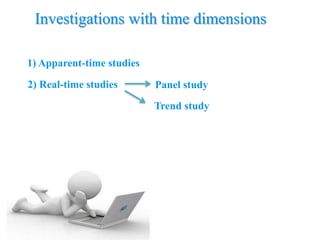
Investigations with time dimensions
1) Apparent-time studies
2) Real-time studies Panel study
Trend study
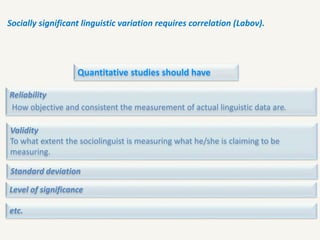
Socially significant linguistic variation requires correlation (Labov).
Quantitative studies should have
Reliability
How objective and consistent the measurement of actual linguistic data are.
Validity
To what extent the sociolinguist is measuring what he/she is claiming to be
measuring.
Standard deviation
Level of significance
etc.
THE END

Chapter 6 sociolinguistics

  • 1.
  • 2.
    Social Variation The relationshipbetween linguistic variation and social variation.
  • 3.
    Gumper’s study ofKhallapur village in India Brahmans (priests) Rajputs (warriors) Vaishyas (merchants) Workman and laborers Chamars (landless laborers) Jatia Chamars (leather workers and shoe makers) Bhangis (sweepers) Restricted to live in certain neighborhoods Have less freedom to move in the village Hindu caste membership of Khalapur Each caste has distinct phonological features that are clear markers of social group membership. Upper castes innovate away from the lower caste in their speech. On the other hand lower caste try to reduce this distinction. Hypercorrect = Overextend a particular usage
  • 4.
    Wolfram and Fasold’snon socio-economic rankings were based on factors like: With the current emphasis on lifestyle in classifying people, consumptions of good and appearance are important in social classification. For collecting data about the variants and social distribution of a linguistic variable we must relate them to quantifiable factors such as: age - gender – ethnicity – race - ………… - social class membership Easier to the most complicated Church membership Community organizations . . .
  • 5.
    All scales takeinto account factors like: Educational achievement Professional training Blue/white collar work Source of income Residential area ethnicity income Gender Age Race Scales must vary from community to community because any time/regional factor has its own problems. (Bainbdridge) disadvantages of social class designations are: Treating class as an independent variable and variants of speech as a dependent variable and never reconsidering their nature. Factors are weighted. Unitary scales are devised. Individuals are fitted into slots as: Upper class, lower class, ….
  • 6.
    Chambers Class isnot a clear concept and fuzziness is always present. Disadvantage Lack of generalizability of results Social space is multidimensional but systems of social classification are one-dimensional.
  • 7.
    Idiolect = Speechcharacteristics and linguistic behavior of individuals. Highly representative of the linguistic behavior of all the speakers of that lang. Sociolect = Speech characteristics of members of social groups. The more the groups are real ( members feel that they do belong to the group) a sociolect has validity. Milory network relationship: network of relationships that an individual belongs to. unique – specific structures most powerful and interesting influences on linguistic behavior
  • 8.
    Data Collection andAnalysis 2 basic dimensions of examining hypothesis: 1) Devising a plan for collecting data 2) Collecting data from a representative sample of speakers
  • 9.
    Questionnaire ( theusual device) 1) Casual situation 2) Interview situation 3) The reading aloud of a story 4) The reading aloud of lists of words and pairs of words Very casual More formal The most formal
  • 10.
    Sampling: Finding arepresentative group of speakers Random sampling Judgment sampling Stratified sampling A genuine study Thoroughly representative Completely unbiased Representing all sub-segments
  • 11.
    Investigations with timedimensions 1) Apparent-time studies 2) Real-time studies Panel study Trend study
  • 12.
    Socially significant linguisticvariation requires correlation (Labov). Quantitative studies should have Reliability How objective and consistent the measurement of actual linguistic data are. Validity To what extent the sociolinguist is measuring what he/she is claiming to be measuring. Standard deviation Level of significance etc.
  • 13.