CODE SWITCHING
AND CODE MIXING
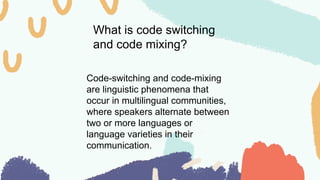
Code-switching and code-mixing
are linguistic phenomena that
occur in multilingual communities,
where speakers alternate between
two or more languages or
language varieties in their
communication.
What is code switching
and code mixing?
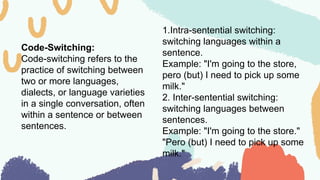
Code-Switching:
Code-switching refers to the
practice of switching between
two or more languages,
dialects, or language varieties
in a single conversation, often
within a sentence or between
sentences.
1.Intra-sentential switching:
switching languages within a
sentence.
Example: "I'm going to the store,
pero (but) I need to pick up some
milk."
2. Inter-sentential switching:
switching languages between
sentences.
Example: "I'm going to the store."
"Pero (but) I need to pick up some
milk."
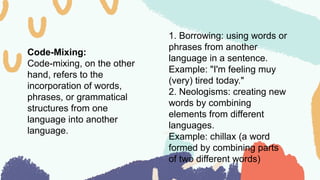
Code-Mixing:
Code-mixing, on the other
hand, refers to the
incorporation of words,
phrases, or grammatical
structures from one
language into another
language.
1. Borrowing: using words or
phrases from another
language in a sentence.
Example: "I'm feeling muy
(very) tired today."
2. Neologisms: creating new
words by combining
elements from different
languages.
Example: chillax (a word
formed by combining parts
of two different words)
THANKS
Mwuahh 😘

code switching and code mixing report.pptx

  • 1.
  • 2.
    Code-switching and code-mixing arelinguistic phenomena that occur in multilingual communities, where speakers alternate between two or more languages or language varieties in their communication. What is code switching and code mixing?
  • 3.
    Code-Switching: Code-switching refers tothe practice of switching between two or more languages, dialects, or language varieties in a single conversation, often within a sentence or between sentences. 1.Intra-sentential switching: switching languages within a sentence. Example: "I'm going to the store, pero (but) I need to pick up some milk." 2. Inter-sentential switching: switching languages between sentences. Example: "I'm going to the store." "Pero (but) I need to pick up some milk."
  • 4.
    Code-Mixing: Code-mixing, on theother hand, refers to the incorporation of words, phrases, or grammatical structures from one language into another language. 1. Borrowing: using words or phrases from another language in a sentence. Example: "I'm feeling muy (very) tired today." 2. Neologisms: creating new words by combining elements from different languages. Example: chillax (a word formed by combining parts of two different words)
  • 5.