,
Presentation compiled by
HUMAIRA AZIZ SHAH
SESSION:
2019-2020
DEPARTMENT OF ENGLISH
MEASURING LANGUAGE
ATTITUDE
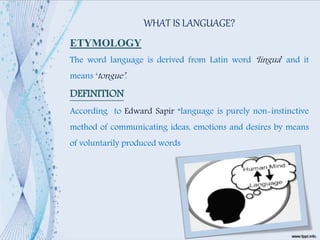
WHAT IS LANGUAGE?
ETYMOLOGY
The word language is derived from Latin word ‘lingua’ and it
means ‘tongue’.
DEFINITION
According to Edward Sapir “language is purely non-instinctive
method of communicating ideas, emotions and desires by means
of voluntarily produced words
What is attitude?
ETYMOLOGY
The word attitude is derived from Latin word ‘aptitudo’ and it
means ‘disposition or posture.
DEFINITION
An attitude is hypothetical construction that represent an
individual’s degree of like or dislike for an item.
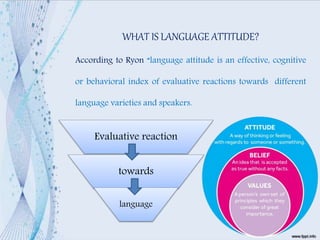
WHAT IS LANGUAGE ATTITUDE?
According to Ryon “language attitude is an effective, cognitive
or behavioral index of evaluative reactions towards different
language varieties and speakers.
Evaluative reaction
towards
language
HISTORICAL BACKGROUND
 Before 1960’s, attitude bout language is not seen as
important.
 In early 1960’s in Canada change of attitude towards
language took place.
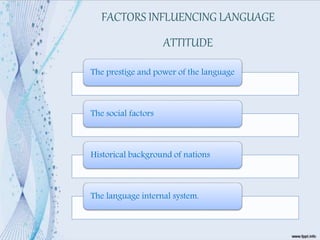
The prestige and power of the language
The social factors
Historical background of nations
The language internal system.
FACTORS INFLUENCING LANGUAGE
ATTITUDE
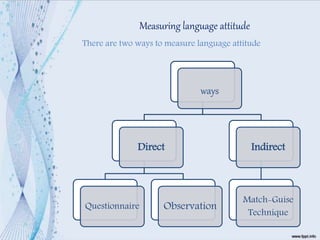
Measuring language attitude
There are two ways to measure language attitude
ways
Direct
Questionnaire Observation
Indirect
Match-Guise
Technique
INDIRECT method
An indirect method is applied in a way that the participants are
unaware that their attitudes are being measure.
Match –Guise Technique
 proponent ----Wallace Lambert
 sociolinguistic technique used to determine the true feelings
of an individual towards specific language.
 Procedure
FRENCH ENG ENG FRENCH ENG FRENCH
A B B A B A
ARRANGEMENT OF RECORDINGS
Semantic Differential scale.
 The format for listener responses which is very much used
with match-guise technique involves Semantic Differential
Scale.
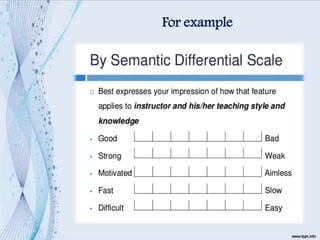
 This scale designate opposite extremes of trait at two ends
and leave number of spaces between theme.
For example
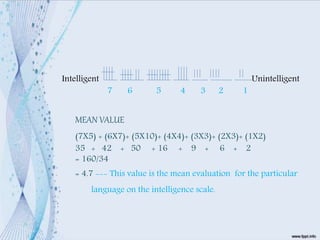
Intelligent Unintelligent
7 6 5 4 3 2 1
MEAN VALUE
(7X5) + (6X7)+ (5X10)+ (4X4)+ (3X3)+ (2X3)+ (1X2)
35 + 42 + 50 + 16 + 9 + 6 + 2
= 160/34
= 4.7 --- This value is the mean evaluation for the particular
language on the intelligence scale.
Some Researches
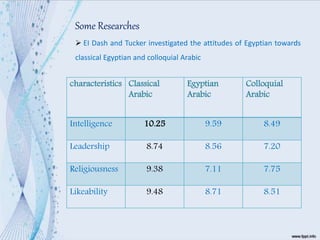
 EI Dash and Tucker investigated the attitudes of Egyptian towards
classical Egyptian and colloquial Arabic
characteristics Classical
Arabic
Egyptian
Arabic
Colloquial
Arabic
Intelligence 10.25 9.59 8.49
Leadership 8.74 8.56 7.20
Religiousness 9.38 7.11 7.75
Likeability 9.48 8.71 8.51
EI Dash and tucker investigated the attitudes of Mexican
Americans towards English and Spanish.
Home School Solidarity Status
English 4.60 4.94 4.82 4.72
Spanish 4.73 4.51 4.77 4.47
Unexpected result = solidarity is showed more
towards English
 in my research entitled ‘The Impact of English
Globalization and English Imperialism on Cultural
Identities of Pakistan’ I have asked question related to
language attitude in interview i-e Did your attitudes
towards regional languages change after learning English
and western culture?
The result showed that out of 5 students 3 were having
positive attitude towards English language.

Measuring Language Attitude

  • 2.
    , Presentation compiled by HUMAIRAAZIZ SHAH SESSION: 2019-2020 DEPARTMENT OF ENGLISH
  • 3.
  • 4.
    WHAT IS LANGUAGE? ETYMOLOGY Theword language is derived from Latin word ‘lingua’ and it means ‘tongue’. DEFINITION According to Edward Sapir “language is purely non-instinctive method of communicating ideas, emotions and desires by means of voluntarily produced words
  • 5.
    What is attitude? ETYMOLOGY Theword attitude is derived from Latin word ‘aptitudo’ and it means ‘disposition or posture. DEFINITION An attitude is hypothetical construction that represent an individual’s degree of like or dislike for an item.
  • 6.
    WHAT IS LANGUAGEATTITUDE? According to Ryon “language attitude is an effective, cognitive or behavioral index of evaluative reactions towards different language varieties and speakers. Evaluative reaction towards language
  • 7.
    HISTORICAL BACKGROUND  Before1960’s, attitude bout language is not seen as important.  In early 1960’s in Canada change of attitude towards language took place.
  • 8.
    The prestige andpower of the language The social factors Historical background of nations The language internal system. FACTORS INFLUENCING LANGUAGE ATTITUDE
  • 10.
    Measuring language attitude Thereare two ways to measure language attitude ways Direct Questionnaire Observation Indirect Match-Guise Technique
  • 11.
    INDIRECT method An indirectmethod is applied in a way that the participants are unaware that their attitudes are being measure. Match –Guise Technique  proponent ----Wallace Lambert  sociolinguistic technique used to determine the true feelings of an individual towards specific language.  Procedure
  • 12.
    FRENCH ENG ENGFRENCH ENG FRENCH A B B A B A ARRANGEMENT OF RECORDINGS
  • 13.
    Semantic Differential scale. The format for listener responses which is very much used with match-guise technique involves Semantic Differential Scale.  This scale designate opposite extremes of trait at two ends and leave number of spaces between theme.
  • 14.
  • 15.
    Intelligent Unintelligent 7 65 4 3 2 1 MEAN VALUE (7X5) + (6X7)+ (5X10)+ (4X4)+ (3X3)+ (2X3)+ (1X2) 35 + 42 + 50 + 16 + 9 + 6 + 2 = 160/34 = 4.7 --- This value is the mean evaluation for the particular language on the intelligence scale.
  • 16.
    Some Researches  EIDash and Tucker investigated the attitudes of Egyptian towards classical Egyptian and colloquial Arabic characteristics Classical Arabic Egyptian Arabic Colloquial Arabic Intelligence 10.25 9.59 8.49 Leadership 8.74 8.56 7.20 Religiousness 9.38 7.11 7.75 Likeability 9.48 8.71 8.51
  • 17.
    EI Dash andtucker investigated the attitudes of Mexican Americans towards English and Spanish. Home School Solidarity Status English 4.60 4.94 4.82 4.72 Spanish 4.73 4.51 4.77 4.47 Unexpected result = solidarity is showed more towards English
  • 18.
     in myresearch entitled ‘The Impact of English Globalization and English Imperialism on Cultural Identities of Pakistan’ I have asked question related to language attitude in interview i-e Did your attitudes towards regional languages change after learning English and western culture? The result showed that out of 5 students 3 were having positive attitude towards English language.