


Language Contact And Language
Choice
Submitted To:
Dr. Moazzam Ali Malik
Submitted By:
Ayman Batool
20014002-002
Content
•Language contact
•Sources of contact
•Results of language contact
•Diglossia/Polyglossia
•Code-switching/Code-mixing
•Bilingualism/Multilingualism
•Pidgin/Creole
Language contact
•It is a linguistic and social phenomenon by which
speakers of different languages or dialects
communicate with each other.
•This situation is studied in Contact Linguistics
•This phenomenon leads to transfer of linguistic
features.
Sources of language contact
•Resettling
•Communication purposes
•Wars
•Business
•Trading
•Colonialization
Results of language contact
•Diglossia/polyglossia
•Code-switching/Code-mixing
•Bilingualism
•Multilingualism
•Pidgin and Creole
Diglossia
Definition
• The speaking of two different languages or varieties by the members
of same society under different situations is called diglossia.
• According to Oxford a situation in which two languages or two forms
of a language are used under different conditions in a community.
• According to George yule: A situation where a speaker uses two
distinct varieties of a language .
Varieties of diglossia
Ferguson calls in a stable situation in which there are two varieties
High and low varieties. This situation generally occurs in a bilingual
community.
• Low Variety:
The low variety is used in ordinary conversations. It is less prestigious.
• High Variety:
It is used in certain situations such as literature, formal education, or
other specific settings, but not used normally for ordinary converstion. It
is high prestigious.
Features of diglossia:
•Prestige
•Acquisition
•Standardization
•Grammar
•Lexicon
•phonology
Diglossia situation in different
countries:
 Diglossia in Pakistan
 Diglossia in Arabic speaking country.
 Diglossia in Switzerland.
 Diglossia in Haiti.
Polyglossia:
Polyglossia is a useful term for describing situations where more than
two distinct language.
• Varieties are used for clearly distinct purposes.
• Existence of more than two languages within the same speech
community.
• This situation generally occurs in a multilingual community.
• They may have different low and high varities.
• Mandarin H (a Chinese) has 2 L and formal Singapore has both are H
examples for polyglossia.
Code-switching
•Code-switching is the use of more than one
language, variety or style by a speaker within an
utterance or discourse or between different
interlocuters and situations. (Romaine,1992:110)
Code-mixing
•Words of one language are borrowed for second
language.
•This contact phenomenon occurs within a
sentence or a phrase.
•It occurs within a bilingual or multilingual speech
community.
Bilingualism
Trudgill’s definition
•‘Ability of an individual to speak Two or more
languages.’
Merits of bilingualism
•Cultural merits
•Education
•Brain power
•Business circles
•Mutual understanding
Types of bilingualism
•Compound
•Additive
•Subtractive
•Coordinate
•Subordinate
•Bimodel
•Simaltaneous
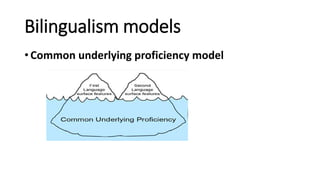
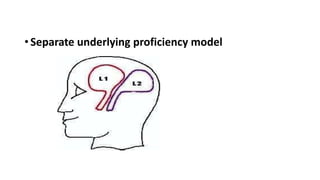
Bilingualism models
• Common underlying proficiency model
• Separate underlying proficiency model
Bilingualism vs Diglossia
•Fishman(1967)
•Bilingualism with diglossia
•Bilingualism without diglossia
•Diglossia without bilngualism
•Neither Bilingualism nor diglossia
Pidgin
•A language with no native speaker
•Reduced grammar
•Contact language
Creole
•A language with native speakers
•Mixed language
•First language
#language contact and language choice

#language contact and language choice