
DIGLOSSIA
What is Diglossia?
• Diglossia is a situation in which
two dialects or languages are used
by a single language community.
Wikipedia
History of Diglossia.
• The word “Diglossia” derived from
the Greek word “diglossos”
meaning ‘bilingual’ based on the
pattern of French “diglossie”.
History of Diglossia.
• The term Diglossia was first
introduced in English by Charles A.
Ferguson in 1959. He is credited to
be the first linguist who used the
specific term, “diglossia in his
article‟(1959) entitled, “Diglossia”
in the journal “Word”
Definition of Diglossia.
• According to Charles A. Ferguson
term diglossia refers to a situation
“where two varieties of a language
exist side by side throughout the
community, with each having a
definite role to play”
Definition of Diglossia.
• According to Ferguson, “diglossia is a relatively
stable language situation in which, in addition to the
primary dialects of the language (which may include
a standard or regional standards), there is a very
divergent, highly codified (often grammatically more
complex) superposed variety, the vehicle of a large
and respected body of written literature, either of
an earlier period or in another speech community,
which is learned largely by formal education and
used for most written and formal spoken purposes
but is not used by any sector of the community for
ordinary conversation”
Definition of Diglossia.
• When two languages or language
varieties exist side by side in a
community and each one is used for
different purposes, this is called
diglossia”
Longman Dictionary of Applied
Linguistics,
Definition of Diglossia.
• “Diglossia refers to the societies with two
distinctive codes of speech which are
employed in different situation”
Wardhaugh,
Definition of Diglossia.
• Diglossia is the characteristic of a speech
community, groups of people with
common rules of speaking – rather than
individuality
Holmes
• Joshua Fishman gave a
modification of Ferguson’s
(1959) original concept and
rather strict definition of
diglossia in1967.
Fishman presented an expansion of
Ferguson’s definition
of diglossia in two respects:
1. A diglossic speech
community is not
characterized by the use of
two language varieties only.
There may be more than
two language varieties used
within a diglossic
community
2. Diglossia refers to all kinds of
language varieties which show
functional distribution in a speech
community. Diglossia, as a
consequence describes a number
of sociolinguistic situations, from
stylistic differences within one
language or the use of separate
dialects (Ferguson’s standard – with
– dialects’ distinction) to the use of
(related or unrelated) separate
languages
FEATURES OF DIGLOSSIA
Diglossia has been used both in a narrow and in a much
broader sense. In the narrow and original
sense of the term, it has three crucial features
1. Two distinct varieties of the same language
are used in the community, with one
regarded as a high (or H) variety and the
other a low (or L) variety.
2. Each variety is used for quite distinct
functions, H and L complement each other.
3. No one uses the H variety in everyday
conversation.
Varieties of Diglossia.
• Diglossia has two types of variety:
1. High variety
2. Low variety
High Variety
• A more standard variety is called the high
variety or H – variety .
(Longman Dictionary of Applied Linguistics)
High Variety
• High variety (H) is regarded as the standard variety and
people use it as formal or official situations such as
government, conference event, formal letters, broadcasts,
religious services and teaching etc. High variety is used
for literary and literacy purposes and for formal, public
and official uses. A more standard variety called the high
variety or H – variety .
Spolsky
Low Variety
• “A non – prestige variety is called the low
variety”.
(Longman Dictionary of Applied Linguistics)
Low Variety
• Low variety (L) is regarded as the non – standard
variety and people use it as informal situations such
as family member, neighbors, local markets and
talking between friends or close friends etc.” Low
variety is used for informal conversation and daily
use”.
Spolsky
• Everyone can speak the L variety and will do so in
informal situation, but not everyone can use the H
variety.
• This phenomenon is due to the distinct level of linguistic
knowledge the speakers have.
• In diglossic community, the High variety which is
linguistically related to but significantly different from the
vernacular of Low varieties has no native speakers.
CHARACTERISTICS OF DIGLOSSIA
• Ferguson listed following specific
characteristics of a diglossia language
situation involving the function, prestige,
literary heritage, acquisition, standardization,
morphology, syntax, lexicon, and phonology
of the high and low variety
Function
• Diglossia is different from Bilingualism.
Diglossia has H and L varieties that are
used for different purposes. H is a
more formal variety and L is used for
less politically important functions.
They have their respective domains in
which they are normally used.
Function
• Diglossia is different from Bilingualism.
Diglossia has H and L varieties that are
used for different purposes. H is a
more formal variety and L is used for
less politically important functions.
They have their respective domains in
which they are normally used.
Prestige
• H is highly valued, prestigious variety.
People have more positive attitude
towards H. it is the language of „great‟
literature, religious texts etc. The L-
variety is felt to be less worthy,
corrupt, `broken', vulgar, undignified,
and „the stigmatized variety‟ etc.
Literary Heritage
• H usually has a long literary tradition
and is used in writing. The H variety is
considered to be a language. The L
variety is used in novels, plays etc; to
show characters as uneducated and
rustic. The L-variety is also used often
by servants and children.
Acquisition
• L-variety is usually acquired as a first
language while H-variety is learned
through schooling in a formal
educational setting.
Standardization
• H is strictly standardized. Grammars
and dictionaries are written by native
grammarians in H-variety. L is rarely
standardized. Grammars of L-variety
are usually written by foreigners.
Stability
• Diglossias are generally stable and
long-lived phenomena. They persist for
centuries or even millennia. Diglossia
in Arab countries has survived for
centuries. H and L borrow from one
another. L-varieties displace the H-
variety, but H only displaces L if H is
the mother tongue of an elite
Grammar
• The grammars of H are more complex
than the grammars of L-variety. They
have more complex morphology, tense
systems, gender systems, agreement,
syntax than L variety. Cases and verb
inflections are reduced in L.
Lexicon
• Lexicon is often somewhat shared, but
generally there is differentiation; H has
vocabulary that L lacks, and vice-versa.
There paired lexical items. L and H
have different terms for the same
object.
Phonology
• There are two phonological systems.
The phonology of H is more complex. H
has usually underlying phonological
system while L diverges from this
system in the course of development
of thousands of years.
Distribution of Diglossia in Language
Families, Space, and Time.
• Diglossia is not limited to any
geographical area or language family,
and diglossias have existed for
centuries or millennia (Arabic, South
Asia). Most diglossias involve literacy,
but oral diglossias are conceivable.
What Engenders Diglossia and under
What Conditions.
1. Existence of an ancient or prestigious
literature, composed in the H-variety,
which the linguistic culture wishes to
preserve as such.
What Engenders Diglossia and under
What Conditions.
2. Literacy is usually a condition, but is
usually restricted to a small elite. When
conditions require universal literacy in H,
pedagogical problems ensue.
What Engenders Diglossia and under
What Conditions.
3. Diglossias do not spring up overnight;
they take time to develop.
FUNCTIONS OF DIGLOSSIA
High variety
• Sermon in church or
mosque.
• Speech in parliament,
political speech .
• University lectures.
Low variety
• Instruction to servants,
waiters, workmen, clerks.
• Personal letter
• Conversation with family,
friends, colleagues.
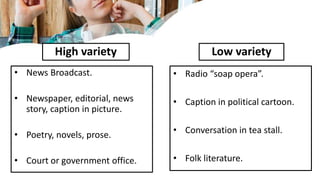
High variety
• News Broadcast.
• Newspaper, editorial, news
story, caption in picture.
• Poetry, novels, prose.
• Court or government office.
Low variety
• Radio “soap opera”.
• Caption in political cartoon.
• Conversation in tea stall.
• Folk literature.
EXAMPLES OF DIGLOSSIA
• In medieval Europe, Latin was the H
variety alongside daughter language
such as Italian, Spanish and French,
• In Swiss German country, the students will use
standard German in their school because mostly
the books and newspapers that they use is
standard German, but when they get home, they
will switch their language and use the local Swiss
German in their home as the dialect on daily
conversation
DIGLOSSIA IN PAKISTAN
Urdu VS. English
Function
• A key defining characteristics of diglossia is that the two
varieties (High and Low) are kept apart functionally. One is
used in one set of circumstances and the other in an entirely
different set. For example, English (H variety) in Pakistan is
used for delivering formal speeches in the functions of high
Government officials and inter offices communication. In
contrast, Urdu (L variety) is used in giving instructions to
workers in low prestige occupations or household servants or
in conversation with familiars, in popular program Function:
mes on the radio and television.
Prestige
• The H variety is the prestige variety while the low variety
lacks the prestige. Although people frequently use L-
variety, yet they may deny that they do not know it. The H
variety is considered more beautiful, logical, and
expressive than the L variety. These characteristics are
also attributed to English in Pakistan. And in highly formal
situations in Pakistan the use of Urdu is considered a sign
of low social status.
Literary Heritage
• The superiority of the H variety is undoubtedly
reinforced by a considerable body of literature
in H variety. The literature associated with the
L variety will have none of the same prestige.
The Urdu literature is not considered equal to
the literature in English in Pakistan.
Acquisition
• An important difference between English and
Urdu in Pakistan is that English is learnt in Formal
settings e.g. classroom whereas Urdu is learnt in
informal situations.
Standardization
• H variety is standardized but L variety is rarely
standardized. In case of, use of two different
languages both the varieties may be
standardized e.g. use of English as H variety and
Urdu as L variety in Pakistan. However, the fact
cannot be denied that interest in the grammar
of Urdu is not there.
Stability
• Diglossia is extremely stable phenomenon
and there are many cases that have lasted
for centuries. Diglossic situation as regards
English and Urdu has been prevailing for
more than hundred years.
Grammar
• Grammar of H variety is highly defined and
standardized in case of using two varieties of the
same language. But in case of using two different
languages both may have highly prescribed
grammar as English and Urdu in Pakistan.
Lexicon
• There is marked difference between lexical
items of the two varieties. English and Urdu
have different lexicons. Lexicon of English is
growing at higher pace than that of Urdu.
Phonology
• Phonological systems of the two varieties can
easily be distinguished. Both English and Urdu
have two different phonological systems. But
both are affecting each other to a
considerable extent
DIGLOSSIA IN PUNJAB
Punjabi VS. Urdu
Punjab of Pakistan is dominated with
three main languages:
• Punjabi
• Urdu
• English
• Punjabi is vernacular of common folks’
informal discussion.
• Urdu being the national language.
• English as lingua franca of elite class.
• Urdu is considered more prestigious with
respect to Punjabi.
Function
• H variety is used in formal where L variety is used in
informal linguistics situation. Urdu is used in formal
contexts like in classrooms, law offices, etc., whereas
Punjabi is used in informal contexts like home, with
friends’, etc. It is obvious from the functional
perspective that Urdu and Punjabi are used in
different linguistics contexts, Urdu being formal and
Punjabi being informal.
Acquisition
• H variety is acquired consciously in predetermined linguistics
settings whereas L variety is learned in casual way. Urdu is
being learnt at schools and collages but not the Punjabi.
Although being the language of 44.15% (Census, 1998) of the
entire population of Pakistan, Punjabi language does not have
any primary school textbook for the children and it is an
optional subject after High School education. As compared to
Punjabi, Urdu is a compulsory subject at the primary level of
education. Punjabi language is being learnt unconsciously but
Urdu is learnt consciously as well as unconsciously up to some
extent.
Prestige
• H variety is considered more prestigious as compared to L
variety. Prestige is associated with social power. Urdu is
associated with educated and social power group whereas
Punjabi is normally associated with villagers and uneducated
people. Because of these complex social structures, Urdu is
considered more prestigious as compared to Punjabi. Now,
even people from villages do not want to be labeled as
uneducated due to Punjabi language use. Due to prestige,
literature in H variety is more abundant and flourishing as
compared to L variety. Same situation is prevailing with Urdu
and Punjabi.
Standardization
• H variety is more standardized with respect to L
variety. Urdu is more standardized with dictionaries
and grammar books in increasing numbers, but this is
not the case with Punjabi, where one hardly finds any
recent book on its grammar and any modern
dictionary of Punjabi in Pakistan. Urdu is more
standardized than Punjabi language.
Grammar
• Grammar of H variety is more clearly defined
but not the L variety as much. Urdu grammar
is being taught in schools but this is not the
case with Punjabi. Grammar of Punjabi is not
clearly defined to people and students in
schools unlike Urdu.
Lexicon
• Lexicon of H variety is larger and is ever
expanding as compared to L variety. The
same is the case with Urdu and Punjabi,
where Urdu lexicon is larger but not the
Punjabi lexicon.
Phonology
• Phonology of both varieties is different but
some features may be overlapping. This is
also true with Urdu and Punjabi languages.
Phonology of Punjabi is different from
Urdu. But there are certain characteristics
which are present in both languages as
well.
Stability
• Diglossic situation is present for a
considerable period of time. This is also
true for Urdu and Punjabi as well
because the diglossic situation in Urdu
and Punjabi is a persistent one for a
considerable period.
Diglossia

Diglossia

  • 1.
  • 2.
    What is Diglossia? •Diglossia is a situation in which two dialects or languages are used by a single language community. Wikipedia
  • 3.
    History of Diglossia. •The word “Diglossia” derived from the Greek word “diglossos” meaning ‘bilingual’ based on the pattern of French “diglossie”.
  • 4.
    History of Diglossia. •The term Diglossia was first introduced in English by Charles A. Ferguson in 1959. He is credited to be the first linguist who used the specific term, “diglossia in his article‟(1959) entitled, “Diglossia” in the journal “Word”
  • 5.
    Definition of Diglossia. •According to Charles A. Ferguson term diglossia refers to a situation “where two varieties of a language exist side by side throughout the community, with each having a definite role to play”
  • 6.
    Definition of Diglossia. •According to Ferguson, “diglossia is a relatively stable language situation in which, in addition to the primary dialects of the language (which may include a standard or regional standards), there is a very divergent, highly codified (often grammatically more complex) superposed variety, the vehicle of a large and respected body of written literature, either of an earlier period or in another speech community, which is learned largely by formal education and used for most written and formal spoken purposes but is not used by any sector of the community for ordinary conversation”
  • 7.
    Definition of Diglossia. •When two languages or language varieties exist side by side in a community and each one is used for different purposes, this is called diglossia” Longman Dictionary of Applied Linguistics,
  • 8.
    Definition of Diglossia. •“Diglossia refers to the societies with two distinctive codes of speech which are employed in different situation” Wardhaugh,
  • 9.
    Definition of Diglossia. •Diglossia is the characteristic of a speech community, groups of people with common rules of speaking – rather than individuality Holmes
  • 10.
    • Joshua Fishmangave a modification of Ferguson’s (1959) original concept and rather strict definition of diglossia in1967.
  • 11.
    Fishman presented anexpansion of Ferguson’s definition of diglossia in two respects: 1. A diglossic speech community is not characterized by the use of two language varieties only. There may be more than two language varieties used within a diglossic community 2. Diglossia refers to all kinds of language varieties which show functional distribution in a speech community. Diglossia, as a consequence describes a number of sociolinguistic situations, from stylistic differences within one language or the use of separate dialects (Ferguson’s standard – with – dialects’ distinction) to the use of (related or unrelated) separate languages
  • 12.
  • 13.
    Diglossia has beenused both in a narrow and in a much broader sense. In the narrow and original sense of the term, it has three crucial features 1. Two distinct varieties of the same language are used in the community, with one regarded as a high (or H) variety and the other a low (or L) variety. 2. Each variety is used for quite distinct functions, H and L complement each other. 3. No one uses the H variety in everyday conversation.
  • 14.
    Varieties of Diglossia. •Diglossia has two types of variety: 1. High variety 2. Low variety
  • 16.
    High Variety • Amore standard variety is called the high variety or H – variety . (Longman Dictionary of Applied Linguistics)
  • 17.
    High Variety • Highvariety (H) is regarded as the standard variety and people use it as formal or official situations such as government, conference event, formal letters, broadcasts, religious services and teaching etc. High variety is used for literary and literacy purposes and for formal, public and official uses. A more standard variety called the high variety or H – variety . Spolsky
  • 18.
    Low Variety • “Anon – prestige variety is called the low variety”. (Longman Dictionary of Applied Linguistics)
  • 19.
    Low Variety • Lowvariety (L) is regarded as the non – standard variety and people use it as informal situations such as family member, neighbors, local markets and talking between friends or close friends etc.” Low variety is used for informal conversation and daily use”. Spolsky
  • 20.
    • Everyone canspeak the L variety and will do so in informal situation, but not everyone can use the H variety. • This phenomenon is due to the distinct level of linguistic knowledge the speakers have. • In diglossic community, the High variety which is linguistically related to but significantly different from the vernacular of Low varieties has no native speakers.
  • 21.
  • 22.
    • Ferguson listedfollowing specific characteristics of a diglossia language situation involving the function, prestige, literary heritage, acquisition, standardization, morphology, syntax, lexicon, and phonology of the high and low variety
  • 23.
    Function • Diglossia isdifferent from Bilingualism. Diglossia has H and L varieties that are used for different purposes. H is a more formal variety and L is used for less politically important functions. They have their respective domains in which they are normally used.
  • 24.
    Function • Diglossia isdifferent from Bilingualism. Diglossia has H and L varieties that are used for different purposes. H is a more formal variety and L is used for less politically important functions. They have their respective domains in which they are normally used.
  • 25.
    Prestige • H ishighly valued, prestigious variety. People have more positive attitude towards H. it is the language of „great‟ literature, religious texts etc. The L- variety is felt to be less worthy, corrupt, `broken', vulgar, undignified, and „the stigmatized variety‟ etc.
  • 26.
    Literary Heritage • Husually has a long literary tradition and is used in writing. The H variety is considered to be a language. The L variety is used in novels, plays etc; to show characters as uneducated and rustic. The L-variety is also used often by servants and children.
  • 27.
    Acquisition • L-variety isusually acquired as a first language while H-variety is learned through schooling in a formal educational setting.
  • 28.
    Standardization • H isstrictly standardized. Grammars and dictionaries are written by native grammarians in H-variety. L is rarely standardized. Grammars of L-variety are usually written by foreigners.
  • 29.
    Stability • Diglossias aregenerally stable and long-lived phenomena. They persist for centuries or even millennia. Diglossia in Arab countries has survived for centuries. H and L borrow from one another. L-varieties displace the H- variety, but H only displaces L if H is the mother tongue of an elite
  • 30.
    Grammar • The grammarsof H are more complex than the grammars of L-variety. They have more complex morphology, tense systems, gender systems, agreement, syntax than L variety. Cases and verb inflections are reduced in L.
  • 31.
    Lexicon • Lexicon isoften somewhat shared, but generally there is differentiation; H has vocabulary that L lacks, and vice-versa. There paired lexical items. L and H have different terms for the same object.
  • 32.
    Phonology • There aretwo phonological systems. The phonology of H is more complex. H has usually underlying phonological system while L diverges from this system in the course of development of thousands of years.
  • 33.
    Distribution of Diglossiain Language Families, Space, and Time. • Diglossia is not limited to any geographical area or language family, and diglossias have existed for centuries or millennia (Arabic, South Asia). Most diglossias involve literacy, but oral diglossias are conceivable.
  • 34.
    What Engenders Diglossiaand under What Conditions. 1. Existence of an ancient or prestigious literature, composed in the H-variety, which the linguistic culture wishes to preserve as such.
  • 35.
    What Engenders Diglossiaand under What Conditions. 2. Literacy is usually a condition, but is usually restricted to a small elite. When conditions require universal literacy in H, pedagogical problems ensue.
  • 36.
    What Engenders Diglossiaand under What Conditions. 3. Diglossias do not spring up overnight; they take time to develop.
  • 37.
  • 38.
    High variety • Sermonin church or mosque. • Speech in parliament, political speech . • University lectures. Low variety • Instruction to servants, waiters, workmen, clerks. • Personal letter • Conversation with family, friends, colleagues.
  • 39.
    High variety • NewsBroadcast. • Newspaper, editorial, news story, caption in picture. • Poetry, novels, prose. • Court or government office. Low variety • Radio “soap opera”. • Caption in political cartoon. • Conversation in tea stall. • Folk literature.
  • 40.
  • 41.
    • In medievalEurope, Latin was the H variety alongside daughter language such as Italian, Spanish and French,
  • 42.
    • In SwissGerman country, the students will use standard German in their school because mostly the books and newspapers that they use is standard German, but when they get home, they will switch their language and use the local Swiss German in their home as the dialect on daily conversation
  • 43.
  • 44.
    Function • A keydefining characteristics of diglossia is that the two varieties (High and Low) are kept apart functionally. One is used in one set of circumstances and the other in an entirely different set. For example, English (H variety) in Pakistan is used for delivering formal speeches in the functions of high Government officials and inter offices communication. In contrast, Urdu (L variety) is used in giving instructions to workers in low prestige occupations or household servants or in conversation with familiars, in popular program Function: mes on the radio and television.
  • 45.
    Prestige • The Hvariety is the prestige variety while the low variety lacks the prestige. Although people frequently use L- variety, yet they may deny that they do not know it. The H variety is considered more beautiful, logical, and expressive than the L variety. These characteristics are also attributed to English in Pakistan. And in highly formal situations in Pakistan the use of Urdu is considered a sign of low social status.
  • 46.
    Literary Heritage • Thesuperiority of the H variety is undoubtedly reinforced by a considerable body of literature in H variety. The literature associated with the L variety will have none of the same prestige. The Urdu literature is not considered equal to the literature in English in Pakistan.
  • 47.
    Acquisition • An importantdifference between English and Urdu in Pakistan is that English is learnt in Formal settings e.g. classroom whereas Urdu is learnt in informal situations.
  • 48.
    Standardization • H varietyis standardized but L variety is rarely standardized. In case of, use of two different languages both the varieties may be standardized e.g. use of English as H variety and Urdu as L variety in Pakistan. However, the fact cannot be denied that interest in the grammar of Urdu is not there.
  • 49.
    Stability • Diglossia isextremely stable phenomenon and there are many cases that have lasted for centuries. Diglossic situation as regards English and Urdu has been prevailing for more than hundred years.
  • 50.
    Grammar • Grammar ofH variety is highly defined and standardized in case of using two varieties of the same language. But in case of using two different languages both may have highly prescribed grammar as English and Urdu in Pakistan.
  • 51.
    Lexicon • There ismarked difference between lexical items of the two varieties. English and Urdu have different lexicons. Lexicon of English is growing at higher pace than that of Urdu.
  • 52.
    Phonology • Phonological systemsof the two varieties can easily be distinguished. Both English and Urdu have two different phonological systems. But both are affecting each other to a considerable extent
  • 53.
  • 54.
    Punjab of Pakistanis dominated with three main languages: • Punjabi • Urdu • English
  • 55.
    • Punjabi isvernacular of common folks’ informal discussion. • Urdu being the national language. • English as lingua franca of elite class. • Urdu is considered more prestigious with respect to Punjabi.
  • 56.
    Function • H varietyis used in formal where L variety is used in informal linguistics situation. Urdu is used in formal contexts like in classrooms, law offices, etc., whereas Punjabi is used in informal contexts like home, with friends’, etc. It is obvious from the functional perspective that Urdu and Punjabi are used in different linguistics contexts, Urdu being formal and Punjabi being informal.
  • 57.
    Acquisition • H varietyis acquired consciously in predetermined linguistics settings whereas L variety is learned in casual way. Urdu is being learnt at schools and collages but not the Punjabi. Although being the language of 44.15% (Census, 1998) of the entire population of Pakistan, Punjabi language does not have any primary school textbook for the children and it is an optional subject after High School education. As compared to Punjabi, Urdu is a compulsory subject at the primary level of education. Punjabi language is being learnt unconsciously but Urdu is learnt consciously as well as unconsciously up to some extent.
  • 58.
    Prestige • H varietyis considered more prestigious as compared to L variety. Prestige is associated with social power. Urdu is associated with educated and social power group whereas Punjabi is normally associated with villagers and uneducated people. Because of these complex social structures, Urdu is considered more prestigious as compared to Punjabi. Now, even people from villages do not want to be labeled as uneducated due to Punjabi language use. Due to prestige, literature in H variety is more abundant and flourishing as compared to L variety. Same situation is prevailing with Urdu and Punjabi.
  • 59.
    Standardization • H varietyis more standardized with respect to L variety. Urdu is more standardized with dictionaries and grammar books in increasing numbers, but this is not the case with Punjabi, where one hardly finds any recent book on its grammar and any modern dictionary of Punjabi in Pakistan. Urdu is more standardized than Punjabi language.
  • 60.
    Grammar • Grammar ofH variety is more clearly defined but not the L variety as much. Urdu grammar is being taught in schools but this is not the case with Punjabi. Grammar of Punjabi is not clearly defined to people and students in schools unlike Urdu.
  • 61.
    Lexicon • Lexicon ofH variety is larger and is ever expanding as compared to L variety. The same is the case with Urdu and Punjabi, where Urdu lexicon is larger but not the Punjabi lexicon.
  • 62.
    Phonology • Phonology ofboth varieties is different but some features may be overlapping. This is also true with Urdu and Punjabi languages. Phonology of Punjabi is different from Urdu. But there are certain characteristics which are present in both languages as well.
  • 63.
    Stability • Diglossic situationis present for a considerable period of time. This is also true for Urdu and Punjabi as well because the diglossic situation in Urdu and Punjabi is a persistent one for a considerable period.