ENG 511:
English as a World Language
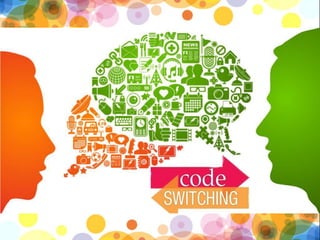
Topic: Code-switching
Presented by:
• Sharifun Nahar
• Rafasa Binthe Rafiq
• Mohammad Mustafizur Rahman
2
An introduction to code-switching
Code-switching is one of the phenomenon of
language which occurs in societies to make the
communication more effective and
meaningful.
The term “code-switching” is first used by
Uriel Weinreich (1953) in the first article
“Language Contacts” of Hans Vogt.
3
What is code-switching?
Code-switching
When two or more languages are in use
in one single conversation side by side
and express an authentic form from both
of the basic language.
“The practice of alternating between
two or more languages or varieties of
language in conversation”
- Oxford Dictionary
5
When it occurs?
When occur:
In linguistics, code-switching
occurs when a speaker alternates
between two or more languages
or language varieties, in the
context of a single conversation.
7
Example of code-switching
Example:
The bilingual leaflet of Hong Kong
Bank which were distributed in
Filipino workers in 1994. They used
Tagalog and English together to
express their point of view.
9
Why switch or
why it occurs?
Reasons for code-switching
To hide fluency or memory problems in
the second language.
To mark switching from informal
situations to formal situations.
To change a topic and tress that by using
an appropriate code.
To exert control, especially between
parents and children.
Influence of western cultural.
To express someone’s emotion. 11
Nick names of code-switching
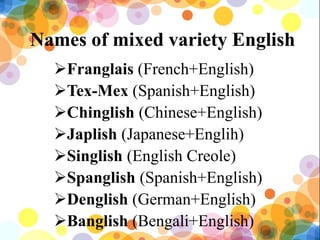
Names of mixed variety English
Franglais (French+English)
Tex-Mex (Spanish+English)
Chinglish (Chinese+English)
Japlish (Japanese+Englih)
Singlish (English Creole)
Spanglish (Spanish+English)
Denglish (German+English)
Banglish (Bengali+English) 13
General attitude towards code-switching
In past, code-switching had a
negative effect but at present the
practice of code-switching is
increasing.
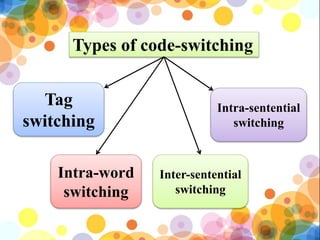
Types of code-switching
Tag
switching
Inter-sentential
switching
Intra-sentential
switching
Intra-word
switching
16
Types of code-switching
Tag switching: It occurs at end of a sentence with
question. E.g. “It is a nice weather, taina?”
Intra-word switching: A change occurs within
word. E.g. “Tenshito.”
Inter-sentential switching: When change takes
place at the end of a clause or sentence and two
different sentences will be in two different
languages but topic will be the same. E.g. “Bachte
hole amader taka dorkar. It is must.”
Intra-sentential switching: A change occurs
within a clause or sentence. E.g. “Eto late keno.”
17
Code-switching on conversation
Rahim: Hey Karim! Why are you late?
Class to shuru hoye jabe.
Karim: Road a huge traffic. When have
you come?
Rahim: Traffic our problem. However,
eito ektu age aslam. Colo classroom a jai.
Karim: Hm. Let’s go.
is
18
McArthur:
“World wide communication centres on
standard English, which however radiates
out into many kinds of English and many
other languages, producing clarity here,
confusion there, and novelties and
nonsenses everywhere. The result can be
– often is – chaotic, but despite the
blurred edges, this latter-day Babel
manages to work.”
19
20
21

Presentation on Code Switching

  • 2.
    ENG 511: English asa World Language Topic: Code-switching Presented by: • Sharifun Nahar • Rafasa Binthe Rafiq • Mohammad Mustafizur Rahman 2
  • 3.
    An introduction tocode-switching Code-switching is one of the phenomenon of language which occurs in societies to make the communication more effective and meaningful. The term “code-switching” is first used by Uriel Weinreich (1953) in the first article “Language Contacts” of Hans Vogt. 3
  • 4.
  • 5.
    Code-switching When two ormore languages are in use in one single conversation side by side and express an authentic form from both of the basic language. “The practice of alternating between two or more languages or varieties of language in conversation” - Oxford Dictionary 5
  • 6.
  • 7.
    When occur: In linguistics,code-switching occurs when a speaker alternates between two or more languages or language varieties, in the context of a single conversation. 7
  • 8.
  • 9.
    Example: The bilingual leafletof Hong Kong Bank which were distributed in Filipino workers in 1994. They used Tagalog and English together to express their point of view. 9
  • 10.
  • 11.
    Reasons for code-switching Tohide fluency or memory problems in the second language. To mark switching from informal situations to formal situations. To change a topic and tress that by using an appropriate code. To exert control, especially between parents and children. Influence of western cultural. To express someone’s emotion. 11
  • 12.
    Nick names ofcode-switching
  • 13.
    Names of mixedvariety English Franglais (French+English) Tex-Mex (Spanish+English) Chinglish (Chinese+English) Japlish (Japanese+Englih) Singlish (English Creole) Spanglish (Spanish+English) Denglish (German+English) Banglish (Bengali+English) 13
  • 14.
    General attitude towardscode-switching In past, code-switching had a negative effect but at present the practice of code-switching is increasing.
  • 15.
  • 16.
  • 17.
    Types of code-switching Tagswitching: It occurs at end of a sentence with question. E.g. “It is a nice weather, taina?” Intra-word switching: A change occurs within word. E.g. “Tenshito.” Inter-sentential switching: When change takes place at the end of a clause or sentence and two different sentences will be in two different languages but topic will be the same. E.g. “Bachte hole amader taka dorkar. It is must.” Intra-sentential switching: A change occurs within a clause or sentence. E.g. “Eto late keno.” 17
  • 18.
    Code-switching on conversation Rahim:Hey Karim! Why are you late? Class to shuru hoye jabe. Karim: Road a huge traffic. When have you come? Rahim: Traffic our problem. However, eito ektu age aslam. Colo classroom a jai. Karim: Hm. Let’s go. is 18
  • 19.
    McArthur: “World wide communicationcentres on standard English, which however radiates out into many kinds of English and many other languages, producing clarity here, confusion there, and novelties and nonsenses everywhere. The result can be – often is – chaotic, but despite the blurred edges, this latter-day Babel manages to work.” 19
  • 20.
  • 21.