Dr. K. Lakehal-Ayat
Mentouri University Constantine
Outline
  Bilingualism


  Code-Switching


  Code-mixing


  Borrowings

               Dr. K. Lakehal-Ayat
               Mentouri University Constantine
Introduction
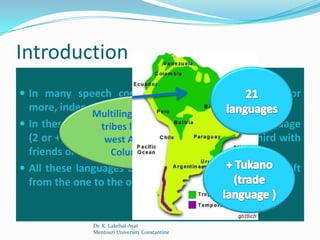
 In many speech communities, one can see two, or
  more, independent languages living side by side.
                Multilingualism of the Indian
 In these communities people use more than 1 language
                  tribes living in the north-
  (2 or +): one at west Amazon (between and a third with
                   home, another at work,
  friends or the outside world. Brazil)
                     Columbia and
 All these languages are learned naturally, and the shift
  from the one to the other is made without hesitation.


               Dr. K. Lakehal-Ayat
               Mentouri University Constantine
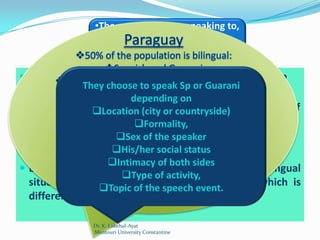
•The people you are speaking to,
               •The social context
               •The situation

 Similar cases can be observed all over the world, from
  Singapore to Paraguay. to speak Sp or Guarani
              They choose
                        depending on
 People in these communities have access to a number of
                Location (city or countryside)
  languages—called codes—which they may choose from
                         Formality,
  in speaking to others. of the speaker
                     Sex
 What determinesHis/her social status language?
                     the choice of a specific
                   Intimacy of both sides
 Each of the available languages in a multilingual
                      Type of activity,
  situation has Topic of the speech to perform, which is
                 a certain function event.
 different from those of the others.

               Dr. K. Lakehal-Ayat
               Mentouri University Constantine
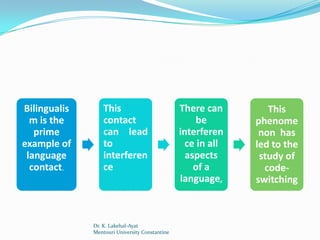
Bilingualis       This                          There can        This
  m is the        contact                            be       phenome
   prime          can lead                      interferen     non has
example of        to                              ce in all   led to the
 language         interferen                      aspects      study of
  contact.        ce                                of a        code-
                                                language,     switching


              Dr. K. Lakehal-Ayat
              Mentouri University Constantine
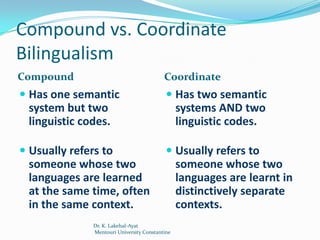
Compound vs. Coordinate
Bilingualism
Compound                                  Coordinate
 Has one semantic                          Has two semantic
  system but two                             systems AND two
  linguistic codes.                          linguistic codes.

 Usually refers to                         Usually refers to
  someone whose two                          someone whose two
  languages are learned                      languages are learnt in
 at the same time, often                        distinctively separate
 in the same context.                           contexts.
              Dr. K. Lakehal-Ayat
              Mentouri University Constantine
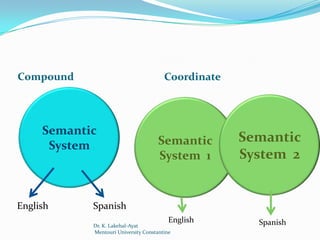
Compound                                Coordinate


     Semantic
                                      Semantic       Semantic
      System
                                      System 1       System 2


English     Spanish
                                          English      Spanish
            Dr. K. Lakehal-Ayat
            Mentouri University Constantine
Code-Switching
 Code-switching is a term in linguistics referring to
  using more than one language or variety in
  conversation.
 Bilinguals who can speak at least two languages,
  have the ability to use elements of both languages
  when conversing with another bilingual.
 Code-switching     is    the    syntactically    and
  phonologically appropriate use of multiple varieties.
 Weinreich (1953) describes bilingualism as
              Dr. K. Lakehal-Ayat
              Mentouri University Constantine
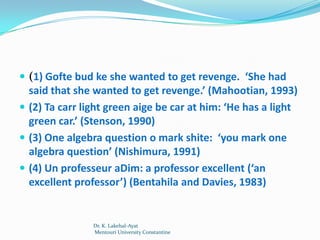
 (1) Gofte bud ke she wanted to get revenge. ‘She had
  said that she wanted to get revenge.’ (Mahootian, 1993)
 (2) Ta carr light green aige be car at him: ‘He has a light
  green car.’ (Stenson, 1990)
 (3) One algebra question o mark shite: ‘you mark one
  algebra question’ (Nishimura, 1991)
 (4) Un professeur aDim: a professor excellent (‘an
  excellent professor’) (Bentahila and Davies, 1983)


                Dr. K. Lakehal-Ayat
                Mentouri University Constantine
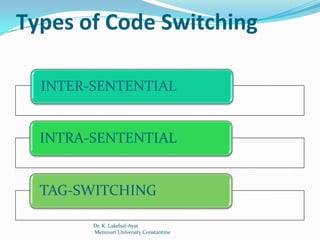
Types of Code Switching

  INTER-SENTENTIAL


  INTRA-SENTENTIAL


  TAG-SWITCHING

        Dr. K. Lakehal-Ayat
        Mentouri University Constantine
Examples
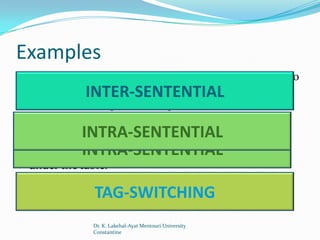
 (5) Sometimes I’ll start a sentence in English y termino
  en espanol: INTER-SENTENTIAL
               ‘Sometimes I’ll start a sentence in English
  and finish it in Spanish.’ (Poplack, 1980)
 (6) I’m shuxi-ing with you. ‘I’m joking with you.’
              INTRA-SENTENTIAL
  (Mahootian, 1993)
              INTRA-SENTENTIAL
 (7) Your bag is zir-e miz under of table: ‘Your bag is
  under the table.’
 (8) It was a good performance, nae? ‘It was a good
  performance,TAG-SWITCHING
                 wasn’t it?’

               Dr. K. Lakehal-Ayat Mentouri University
               Constantine
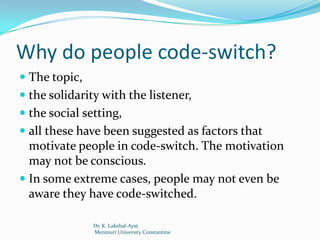
Why do people code-switch?
 The topic,
 the solidarity with the listener,
 the social setting,
 all these have been suggested as factors that
  motivate people in code-switch. The motivation
  may not be conscious.
 In some extreme cases, people may not even be
 aware they have code-switched.

               Dr. K. Lakehal-Ayat
               Mentouri University Constantine
 Although switching has at times been associated
  with language attrition, indicative of weakness in
  one of the bilingual’s languages, many researchers
  believe that code switching is in fact a natural
 consequence of competence in more than one
 language and that it should not be mistaken for a
 language deficit.


             Dr. K. Lakehal-Ayat
             Mentouri University Constantine
Kinds of Code-Switching
SITUATIONAL                                     METAPHORICAL
 occurs when the speaker                         occurs when a change of the
  changes the language                        topic of the discourse
  because of the change in                    requires a change in the
  the situation.                              language used.
                                           Thus, a language used in a
 One language is used in
                                              situation which is different
  one situation (for example which is
             For instance, a language         from the one it is usually used
  during ausually used atwith the
            breakfast home is occasionally because the topic of the
                                              in,
              heard in a government office,
  family members) the other
                because the topic that the conversation is one that is
  in a different one (e.g. in
               participants are discussing is associated with the situation
  government offices) with home. it is usually used in.
                   associated
                    Dr. K. Lakehal-Ayat
                    Mentouri University Constantine
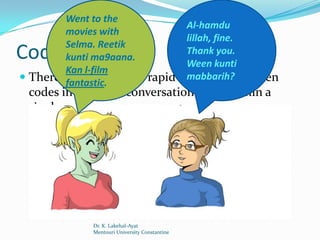
Went to the
                                 Al-hamdu
         movies with
         Hello, Majda.           lillah, fine.
         Selma. Reetik
Code-mixing
         How are you?
         kunti ma9aana.
         Shu akhbarik?
                                 Thank you.
                                 Ween kunti
         Kan l-film
 There is also a kind of rapid switching between
         fantastic.
                                 mabbarih?
 codes in the same conversation, even within a
 single sentence.


             Dr. K. Lakehal-Ayat
             Mentouri University Constantine
Borrowings
 Borrowing usually occurs when the speaker does not
  know a suitable equivalent for the borrowed item in the
  first language.
 The borrowed word is part of the lexicon of the first
  language. The borrowed items are almost always single
  words—usually, bur not exclusively, nouns— and are
  adapted      to   the    first   language     in   their
  pronunciation, morphology and grammar. An example of
  a borrowing into Arabic is the word ‘baguette' from the
  French "baguette" (sandwich) or the word ‘mgripi’ from
  the French word "grippe" (influenza, or flu).
               Dr. K. Lakehal-Ayat
               Mentouri University Constantine
 In code-switching, people switch not because they
  cannot come up with an item in one of the codes; they
  switch codes for important social considerations.
 They switch from one code to another completely—in
  pronunciation, morphology, grammar and vocabulary.
  There is no modification or adaptation to the rules of
  the other code.
 Scholars assert that borrowings are morphologically
  and syntactically integrated into the host language but
  code switches are not.
              Dr. K. Lakehal-Ayat
              Mentouri University Constantine

Bilingualism, code switching, and code mixing

  • 1.
    Dr. K. Lakehal-Ayat MentouriUniversity Constantine
  • 2.
    Outline Bilingualism Code-Switching Code-mixing Borrowings Dr. K. Lakehal-Ayat Mentouri University Constantine
  • 3.
    Introduction  In manyspeech communities, one can see two, or more, independent languages living side by side. Multilingualism of the Indian  In these communities people use more than 1 language tribes living in the north- (2 or +): one at west Amazon (between and a third with home, another at work, friends or the outside world. Brazil) Columbia and  All these languages are learned naturally, and the shift from the one to the other is made without hesitation. Dr. K. Lakehal-Ayat Mentouri University Constantine
  • 4.
    •The people youare speaking to, •The social context •The situation  Similar cases can be observed all over the world, from Singapore to Paraguay. to speak Sp or Guarani They choose depending on  People in these communities have access to a number of Location (city or countryside) languages—called codes—which they may choose from Formality, in speaking to others. of the speaker Sex  What determinesHis/her social status language? the choice of a specific Intimacy of both sides  Each of the available languages in a multilingual Type of activity, situation has Topic of the speech to perform, which is a certain function event. different from those of the others. Dr. K. Lakehal-Ayat Mentouri University Constantine
  • 5.
    Bilingualis This There can This m is the contact be phenome prime can lead interferen non has example of to ce in all led to the language interferen aspects study of contact. ce of a code- language, switching Dr. K. Lakehal-Ayat Mentouri University Constantine
  • 6.
    Compound vs. Coordinate Bilingualism Compound Coordinate  Has one semantic  Has two semantic system but two systems AND two linguistic codes. linguistic codes.  Usually refers to  Usually refers to someone whose two someone whose two languages are learned languages are learnt in at the same time, often distinctively separate in the same context. contexts. Dr. K. Lakehal-Ayat Mentouri University Constantine
  • 7.
    Compound Coordinate Semantic Semantic Semantic System System 1 System 2 English Spanish English Spanish Dr. K. Lakehal-Ayat Mentouri University Constantine
  • 8.
    Code-Switching  Code-switching isa term in linguistics referring to using more than one language or variety in conversation.  Bilinguals who can speak at least two languages, have the ability to use elements of both languages when conversing with another bilingual.  Code-switching is the syntactically and phonologically appropriate use of multiple varieties.  Weinreich (1953) describes bilingualism as Dr. K. Lakehal-Ayat Mentouri University Constantine
  • 9.
     (1) Goftebud ke she wanted to get revenge. ‘She had said that she wanted to get revenge.’ (Mahootian, 1993)  (2) Ta carr light green aige be car at him: ‘He has a light green car.’ (Stenson, 1990)  (3) One algebra question o mark shite: ‘you mark one algebra question’ (Nishimura, 1991)  (4) Un professeur aDim: a professor excellent (‘an excellent professor’) (Bentahila and Davies, 1983) Dr. K. Lakehal-Ayat Mentouri University Constantine
  • 10.
    Types of CodeSwitching INTER-SENTENTIAL INTRA-SENTENTIAL TAG-SWITCHING Dr. K. Lakehal-Ayat Mentouri University Constantine
  • 11.
    Examples  (5) SometimesI’ll start a sentence in English y termino en espanol: INTER-SENTENTIAL ‘Sometimes I’ll start a sentence in English and finish it in Spanish.’ (Poplack, 1980)  (6) I’m shuxi-ing with you. ‘I’m joking with you.’ INTRA-SENTENTIAL (Mahootian, 1993) INTRA-SENTENTIAL  (7) Your bag is zir-e miz under of table: ‘Your bag is under the table.’  (8) It was a good performance, nae? ‘It was a good performance,TAG-SWITCHING wasn’t it?’ Dr. K. Lakehal-Ayat Mentouri University Constantine
  • 12.
    Why do peoplecode-switch?  The topic,  the solidarity with the listener,  the social setting,  all these have been suggested as factors that motivate people in code-switch. The motivation may not be conscious.  In some extreme cases, people may not even be aware they have code-switched. Dr. K. Lakehal-Ayat Mentouri University Constantine
  • 13.
     Although switchinghas at times been associated with language attrition, indicative of weakness in one of the bilingual’s languages, many researchers believe that code switching is in fact a natural consequence of competence in more than one language and that it should not be mistaken for a language deficit. Dr. K. Lakehal-Ayat Mentouri University Constantine
  • 14.
    Kinds of Code-Switching SITUATIONAL METAPHORICAL  occurs when the speaker  occurs when a change of the changes the language topic of the discourse because of the change in requires a change in the the situation. language used.  Thus, a language used in a  One language is used in situation which is different one situation (for example which is For instance, a language from the one it is usually used during ausually used atwith the breakfast home is occasionally because the topic of the in, heard in a government office, family members) the other because the topic that the conversation is one that is in a different one (e.g. in participants are discussing is associated with the situation government offices) with home. it is usually used in. associated Dr. K. Lakehal-Ayat Mentouri University Constantine
  • 15.
    Went to the Al-hamdu movies with Hello, Majda. lillah, fine. Selma. Reetik Code-mixing How are you? kunti ma9aana. Shu akhbarik? Thank you. Ween kunti Kan l-film  There is also a kind of rapid switching between fantastic. mabbarih? codes in the same conversation, even within a single sentence. Dr. K. Lakehal-Ayat Mentouri University Constantine
  • 16.
    Borrowings  Borrowing usuallyoccurs when the speaker does not know a suitable equivalent for the borrowed item in the first language.  The borrowed word is part of the lexicon of the first language. The borrowed items are almost always single words—usually, bur not exclusively, nouns— and are adapted to the first language in their pronunciation, morphology and grammar. An example of a borrowing into Arabic is the word ‘baguette' from the French "baguette" (sandwich) or the word ‘mgripi’ from the French word "grippe" (influenza, or flu). Dr. K. Lakehal-Ayat Mentouri University Constantine
  • 17.
     In code-switching,people switch not because they cannot come up with an item in one of the codes; they switch codes for important social considerations.  They switch from one code to another completely—in pronunciation, morphology, grammar and vocabulary. There is no modification or adaptation to the rules of the other code.  Scholars assert that borrowings are morphologically and syntactically integrated into the host language but code switches are not. Dr. K. Lakehal-Ayat Mentouri University Constantine