Language Choice
in Multilingual
Communities
(Including Code-Choice, Code-
Switching, and Code-Mixing)
•Gifena Farah Mahardika
21202244027
•Ahmad Nuryusuf Widigdoyo
21202244052
•Petrusclaver Samudera Wicaksana
21202244066
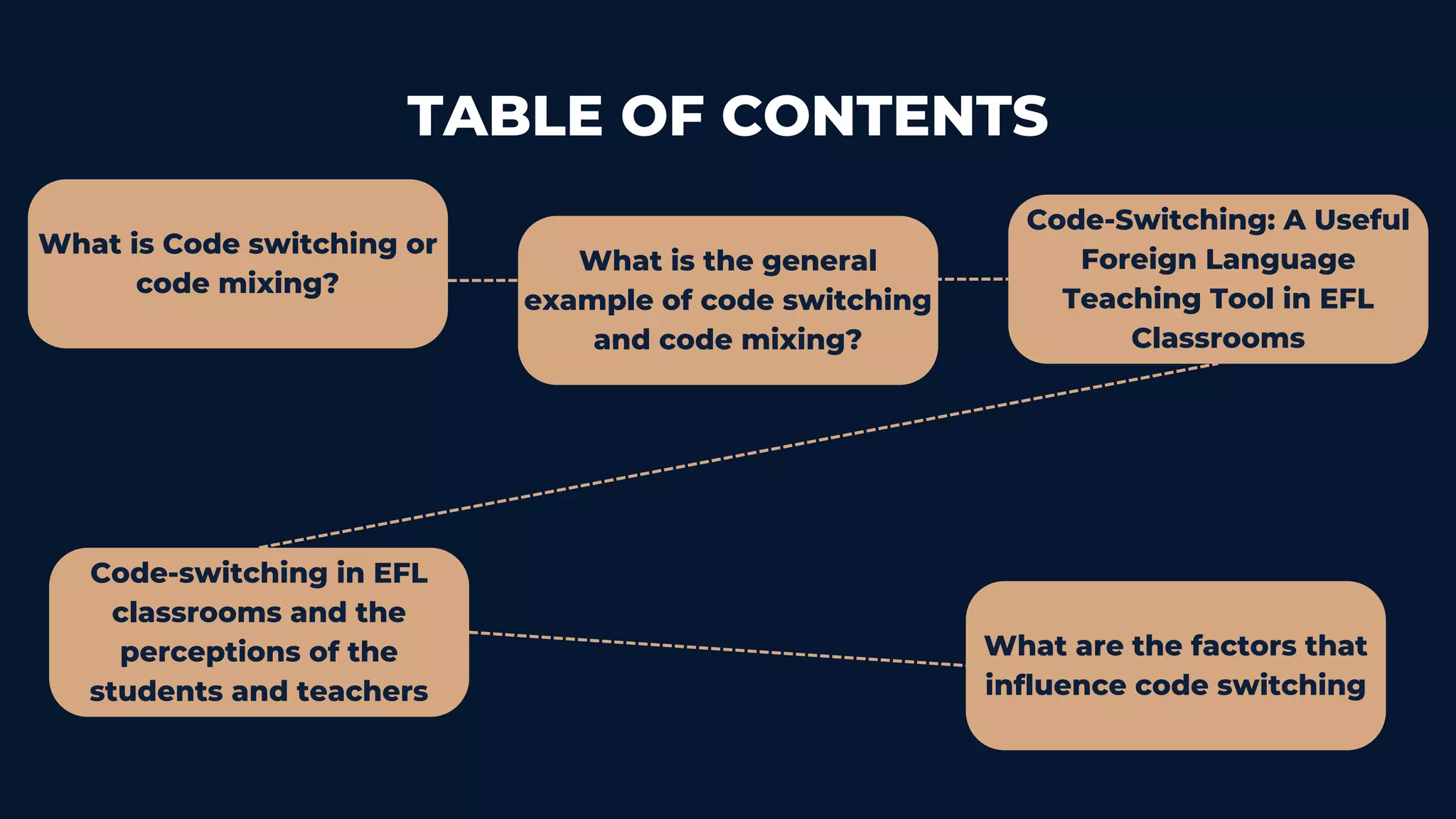
What is Code switching or
code mixing?
What is the general
example of code switching
and code mixing?
Code-Switching: A Useful
Foreign Language
Teaching Tool in EFL
Classrooms
Code-switching in EFL
classrooms and the
perceptions of the
students and teachers
What are the factors that
influence code switching
TABLE OF CONTENTS
What is Code
switching or
code mixing?
People sometimes switch code within a domain
or social situation. When there is some obvious
change in the situation, such as the arrival of a
new person, it is easy to explain the switch. So
a code-switch may be related to a particular
participant or addressee. What Is Code-
Switching? The term code-switching refers to a
person changing languages or dialects
throughout a single conversation and
sometimes even over the course of a single
sentence. This sociolinguistic concept
sometimes also referred to as “code-mixing”
applies to both monolingual and bilingual
speakers
What is the general example of
code switching and code mixing?
“Hasta la vista, baby”
A quote from a movie named
Terminator 2: Judgement Day (1991).
“Hasta la vista” is Spanish, but “baby”
is English. The 2 words are in the same
clause, yet it is using 2 languages, it is
called code-mixing.
“Mi casa, su casa. My house is your house”
This is an example of code-switching. It is a
lyric cut from one of Perry Como’s songs. The
first clause is “Mi casa, su casa”. That clause is
from the Spanish language. On the other hand,
the second clause which is “My house is your
house” is in English. It is called code-switching
because the first clause is a full sentence using
Spanish, and so with the second clause.
Code Mixing Code Switching
Code-Switching: A
Useful Foreign
Language Teaching
Tool in EFL
Classrooms
Due to globalism is rapidly expanding,
bilinguals are not uncommon thing
anymore in our society. Nowadays
English is a compulsory curriculum in
most developing countries such as
Indonesia. In order to teach another
language to another human being, we
need a media to deliver our messages
and the easiest way to convey our
understanding to our students is
through use code switching to a
language that the teacher and the
students understand.
Students practice more code switching than teachers, especially some
teachers practice code switching when answering students' questions.
The teacher practices code switching in intra-sentential and inter-
sentential types during activities such as discussing classroom
management rules, teaching new vocabulary and teaching new grammar
items. In addition to providing a substitute for language, translation here
can be used to facilitate explanations between teachers and students.
The student's perception could be that when he is nervous he explains
using Indonesian, and the teacher also does the same thing so that the
students don't get tired of hearing the explanation in English.
Code-switching in EFL classrooms and the
perceptions of the students and teachers
Teachers’ Code Switching in
Indonesian EFL Classrooms
Indonesian teachers alternately use L1 and L2 depending on their logical
rationales; code switching must be adjusted to learners' needs.
Indonesian teachers used intra-sentential switching, inter-sentential
switching, and emblematic switching to explain grammar, maintain the
class, facilitate comprehension, translate unknown words or terms, make
clear the message or important points, give instruction, and display emotive
and affective expressions.
Intra-sentential switching is more suitable for low proficient teachers in L2.
this type of code switching to present more comprehensible learning inputs
to the students
What are
the factors
that
influence
code
switching
Quoting somebody else
Interjection
Intention of clarifying the speech content for
interlocutor
Talking about a particular topic
Repetition used for clarification
Being Emphatic about something
Expressing group identity
References
Mei Lyna Girsang (2015). An analysis of
code switching and code mixing as found
in television advertisement. Medan,
Indonesia.
Meutia, R. (2021). Teachers ’ Code
Switching in Indonesian EFL Classrooms.
3(3), 213–227.
Holmes, J. (2001). An introduction to
sociolinguistics. Longman.
THANK YOU

Presentasi Sederhana Biru Tua Cokelat Gelap.pdf

  • 1.
    Language Choice in Multilingual Communities (IncludingCode-Choice, Code- Switching, and Code-Mixing)
  • 2.
    •Gifena Farah Mahardika 21202244027 •AhmadNuryusuf Widigdoyo 21202244052 •Petrusclaver Samudera Wicaksana 21202244066
  • 3.
    What is Codeswitching or code mixing? What is the general example of code switching and code mixing? Code-Switching: A Useful Foreign Language Teaching Tool in EFL Classrooms Code-switching in EFL classrooms and the perceptions of the students and teachers What are the factors that influence code switching TABLE OF CONTENTS
  • 4.
    What is Code switchingor code mixing? People sometimes switch code within a domain or social situation. When there is some obvious change in the situation, such as the arrival of a new person, it is easy to explain the switch. So a code-switch may be related to a particular participant or addressee. What Is Code- Switching? The term code-switching refers to a person changing languages or dialects throughout a single conversation and sometimes even over the course of a single sentence. This sociolinguistic concept sometimes also referred to as “code-mixing” applies to both monolingual and bilingual speakers
  • 5.
    What is thegeneral example of code switching and code mixing? “Hasta la vista, baby” A quote from a movie named Terminator 2: Judgement Day (1991). “Hasta la vista” is Spanish, but “baby” is English. The 2 words are in the same clause, yet it is using 2 languages, it is called code-mixing. “Mi casa, su casa. My house is your house” This is an example of code-switching. It is a lyric cut from one of Perry Como’s songs. The first clause is “Mi casa, su casa”. That clause is from the Spanish language. On the other hand, the second clause which is “My house is your house” is in English. It is called code-switching because the first clause is a full sentence using Spanish, and so with the second clause. Code Mixing Code Switching
  • 6.
    Code-Switching: A Useful Foreign LanguageTeaching Tool in EFL Classrooms Due to globalism is rapidly expanding, bilinguals are not uncommon thing anymore in our society. Nowadays English is a compulsory curriculum in most developing countries such as Indonesia. In order to teach another language to another human being, we need a media to deliver our messages and the easiest way to convey our understanding to our students is through use code switching to a language that the teacher and the students understand.
  • 7.
    Students practice morecode switching than teachers, especially some teachers practice code switching when answering students' questions. The teacher practices code switching in intra-sentential and inter- sentential types during activities such as discussing classroom management rules, teaching new vocabulary and teaching new grammar items. In addition to providing a substitute for language, translation here can be used to facilitate explanations between teachers and students. The student's perception could be that when he is nervous he explains using Indonesian, and the teacher also does the same thing so that the students don't get tired of hearing the explanation in English. Code-switching in EFL classrooms and the perceptions of the students and teachers
  • 8.
    Teachers’ Code Switchingin Indonesian EFL Classrooms Indonesian teachers alternately use L1 and L2 depending on their logical rationales; code switching must be adjusted to learners' needs. Indonesian teachers used intra-sentential switching, inter-sentential switching, and emblematic switching to explain grammar, maintain the class, facilitate comprehension, translate unknown words or terms, make clear the message or important points, give instruction, and display emotive and affective expressions. Intra-sentential switching is more suitable for low proficient teachers in L2. this type of code switching to present more comprehensible learning inputs to the students
  • 9.
    What are the factors that influence code switching Quotingsomebody else Interjection Intention of clarifying the speech content for interlocutor Talking about a particular topic Repetition used for clarification Being Emphatic about something Expressing group identity
  • 10.
    References Mei Lyna Girsang(2015). An analysis of code switching and code mixing as found in television advertisement. Medan, Indonesia. Meutia, R. (2021). Teachers ’ Code Switching in Indonesian EFL Classrooms. 3(3), 213–227. Holmes, J. (2001). An introduction to sociolinguistics. Longman.
  • 11.