Code Switching
 Code switching the practice of alternating
between two or more languages or varieties of
language in conversation.
 a verbal skill requiring a large degree of linguistic
competence in more than one language
 Matrix Language (ML), Embedded Language
(EL)
 Code-switching is not arbitrary – there is always
a reason
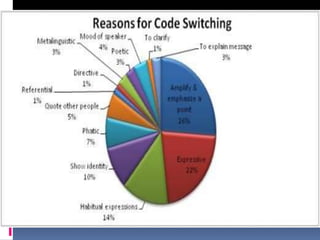
Reasons for code switching
 Inability to express
 To express solidarity
 To fit in certain linguistic environment
 To express certain feelings
TYPES OF CODE SWITCHING:
GRAMMATICAL PATTERNS
.
TYPES OF CODE SWITCHING:
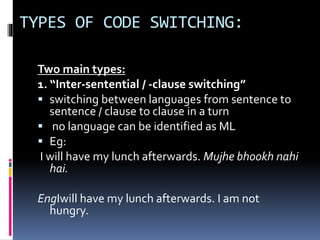
Two main types:
1. “Inter-sentential / -clause switching”
 switching between languages from sentence to
sentence / clause to clause in a turn
 no language can be identified as ML
 Eg:
I will have my lunch afterwards. Mujhe bhookh nahi
hai.
EngIwill have my lunch afterwards. I am not
hungry.
TYPES OF CODE SWITCHING:
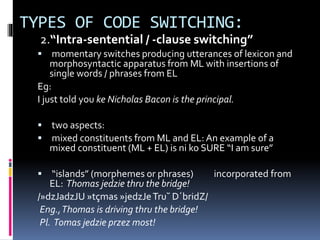
2.“Intra-sentential / -clause switching”
 momentary switches producing utterances of lexicon and
morphosyntactic apparatus from ML with insertions of
single words / phrases from EL
Eg:
I just told you ke Nicholas Bacon is the principal.
 two aspects:
 mixed constituents from ML and EL: An example of a
mixed constituent (ML + EL) is ni ko SURE “I am sure”
 “islands” (morphemes or phrases) incorporated from
EL: Thomas jedzie thru the bridge!
/»dzJadzJU »tçmas »jedzJeTru˘ D´bridZ/
Eng.,Thomas is driving thru the bridge!
Pl. Tomas jedzie przez most!
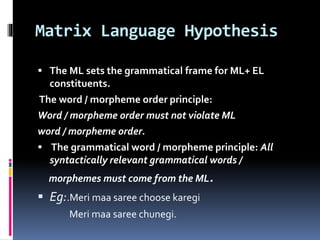
Matrix Language Hypothesis
 The ML sets the grammatical frame for ML+ EL
constituents.
The word / morpheme order principle:
Word / morpheme order must not violate ML
word / morpheme order.
 The grammatical word / morpheme principle: All
syntactically relevant grammatical words /
morphemes must come from the ML.
 Eg:.Meri maa saree choose karegi
Meri maa saree chunegi.
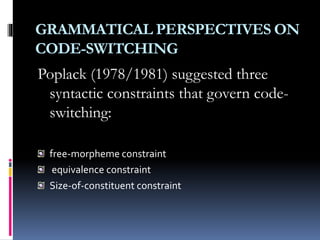
GRAMMATICAL PERSPECTIVES ON
CODE-SWITCHING
Poplack (1978/1981) suggested three
syntactic constraints that govern code-
switching:
free-morpheme constraint
equivalence constraint
Size-of-constituent constraint
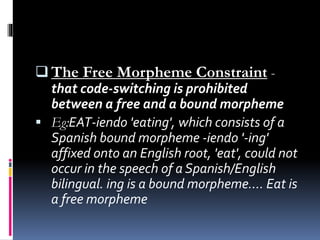
 The Free Morpheme Constraint -
that code-switching is prohibited
between a free and a bound morpheme
 Eg:EAT-iendo 'eating', which consists of a
Spanish bound morpheme -iendo '-ing'
affixed onto an English root, 'eat', could not
occur in the speech of a Spanish/English
bilingual. ing is a bound morpheme.... Eat is
a free morpheme
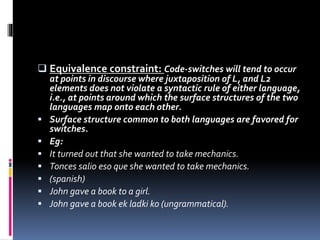
 Equivalence constraint: Code-switches will tend to occur
at points in discourse where juxtaposition of L, and L2
elements does not violate a syntactic rule of either language,
i.e., at points around which the surface structures of the two
languages map onto each other.
 Surface structure common to both languages are favored for
switches.
 Eg:
 It turned out that she wanted to take mechanics.
 Tonces salio eso que she wanted to take mechanics.
 (spanish)
 John gave a book to a girl.
 John gave a book ek ladki ko (ungrammatical).
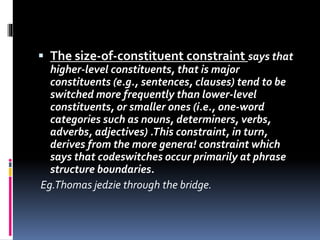
 The size-of-constituent constraint says that
higher-level constituents, that is major
constituents (e.g., sentences, clauses) tend to be
switched more frequently than lower-level
constituents, or smaller ones (i.e., one-word
categories such as nouns, determiners, verbs,
adverbs, adjectives) .This constraint, in turn,
derives from the more genera! constraint which
says that codeswitches occur primarily at phrase
structure boundaries.
Eg.Thomas jedzie through the bridge.
CODE SWITCHING
vs.
BORROWING
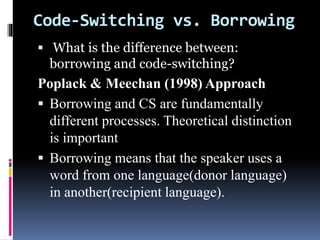
Code-Switching vs. Borrowing
 What is the difference between:
borrowing and code-switching?
Poplack & Meechan (1998) Approach
 Borrowing and CS are fundamentally
different processes. Theoretical distinction
is important
 Borrowing means that the speaker uses a
word from one language(donor language)
in another(recipient language).
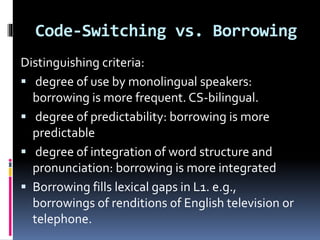
Code-Switching vs. Borrowing
Distinguishing criteria:
 degree of use by monolingual speakers:
borrowing is more frequent. CS-bilingual.
 degree of predictability: borrowing is more
predictable
 degree of integration of word structure and
pronunciation: borrowing is more integrated
 Borrowing fills lexical gaps in L1. e.g.,
borrowings of renditions of English television or
telephone.
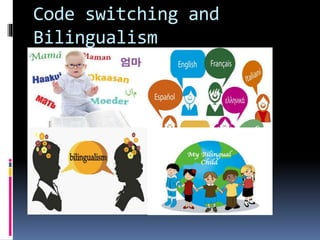
Code switching and
Bilingualism
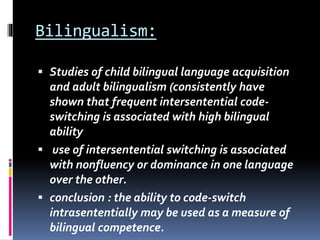
Bilingualism:
 a situation in which “monolingual speakers
are put into an environment that prompts
them to learn another language”
(Myers-Scotton 2002: 30).
 “Bilinguals sometimes exhibit … switching
from one language to the other in the middle
of a conversation or even the same sentence”
Bilingualism:
 Studies of child bilingual language acquisition
and adult bilingualism (consistently have
shown that frequent intersentential code-
switching is associated with high bilingual
ability
 use of intersentential switching is associated
with nonfluency or dominance in one language
over the other.
 conclusion : the ability to code-switch
intrasententially may be used as a measure of
bilingual competence.

Codeswitching by KRISHNAKSHI THAKURIA

  • 2.
    Code Switching  Codeswitching the practice of alternating between two or more languages or varieties of language in conversation.  a verbal skill requiring a large degree of linguistic competence in more than one language  Matrix Language (ML), Embedded Language (EL)  Code-switching is not arbitrary – there is always a reason
  • 4.
    Reasons for codeswitching  Inability to express  To express solidarity  To fit in certain linguistic environment  To express certain feelings
  • 5.
    TYPES OF CODESWITCHING: GRAMMATICAL PATTERNS .
  • 6.
    TYPES OF CODESWITCHING: Two main types: 1. “Inter-sentential / -clause switching”  switching between languages from sentence to sentence / clause to clause in a turn  no language can be identified as ML  Eg: I will have my lunch afterwards. Mujhe bhookh nahi hai. EngIwill have my lunch afterwards. I am not hungry.
  • 7.
    TYPES OF CODESWITCHING: 2.“Intra-sentential / -clause switching”  momentary switches producing utterances of lexicon and morphosyntactic apparatus from ML with insertions of single words / phrases from EL Eg: I just told you ke Nicholas Bacon is the principal.  two aspects:  mixed constituents from ML and EL: An example of a mixed constituent (ML + EL) is ni ko SURE “I am sure”  “islands” (morphemes or phrases) incorporated from EL: Thomas jedzie thru the bridge! /»dzJadzJU »tçmas »jedzJeTru˘ D´bridZ/ Eng.,Thomas is driving thru the bridge! Pl. Tomas jedzie przez most!
  • 8.
    Matrix Language Hypothesis The ML sets the grammatical frame for ML+ EL constituents. The word / morpheme order principle: Word / morpheme order must not violate ML word / morpheme order.  The grammatical word / morpheme principle: All syntactically relevant grammatical words / morphemes must come from the ML.  Eg:.Meri maa saree choose karegi Meri maa saree chunegi.
  • 9.
    GRAMMATICAL PERSPECTIVES ON CODE-SWITCHING Poplack(1978/1981) suggested three syntactic constraints that govern code- switching: free-morpheme constraint equivalence constraint Size-of-constituent constraint
  • 10.
     The FreeMorpheme Constraint - that code-switching is prohibited between a free and a bound morpheme  Eg:EAT-iendo 'eating', which consists of a Spanish bound morpheme -iendo '-ing' affixed onto an English root, 'eat', could not occur in the speech of a Spanish/English bilingual. ing is a bound morpheme.... Eat is a free morpheme
  • 11.
     Equivalence constraint:Code-switches will tend to occur at points in discourse where juxtaposition of L, and L2 elements does not violate a syntactic rule of either language, i.e., at points around which the surface structures of the two languages map onto each other.  Surface structure common to both languages are favored for switches.  Eg:  It turned out that she wanted to take mechanics.  Tonces salio eso que she wanted to take mechanics.  (spanish)  John gave a book to a girl.  John gave a book ek ladki ko (ungrammatical).
  • 12.
     The size-of-constituentconstraint says that higher-level constituents, that is major constituents (e.g., sentences, clauses) tend to be switched more frequently than lower-level constituents, or smaller ones (i.e., one-word categories such as nouns, determiners, verbs, adverbs, adjectives) .This constraint, in turn, derives from the more genera! constraint which says that codeswitches occur primarily at phrase structure boundaries. Eg.Thomas jedzie through the bridge.
  • 13.
  • 14.
    Code-Switching vs. Borrowing What is the difference between: borrowing and code-switching? Poplack & Meechan (1998) Approach  Borrowing and CS are fundamentally different processes. Theoretical distinction is important  Borrowing means that the speaker uses a word from one language(donor language) in another(recipient language).
  • 15.
    Code-Switching vs. Borrowing Distinguishingcriteria:  degree of use by monolingual speakers: borrowing is more frequent. CS-bilingual.  degree of predictability: borrowing is more predictable  degree of integration of word structure and pronunciation: borrowing is more integrated  Borrowing fills lexical gaps in L1. e.g., borrowings of renditions of English television or telephone.
  • 16.
  • 17.
    Bilingualism:  a situationin which “monolingual speakers are put into an environment that prompts them to learn another language” (Myers-Scotton 2002: 30).  “Bilinguals sometimes exhibit … switching from one language to the other in the middle of a conversation or even the same sentence”
  • 18.
    Bilingualism:  Studies ofchild bilingual language acquisition and adult bilingualism (consistently have shown that frequent intersentential code- switching is associated with high bilingual ability  use of intersentential switching is associated with nonfluency or dominance in one language over the other.  conclusion : the ability to code-switch intrasententially may be used as a measure of bilingual competence.