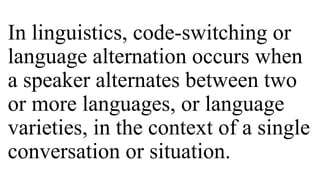
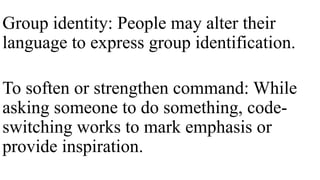
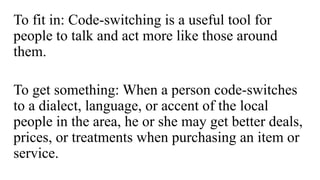
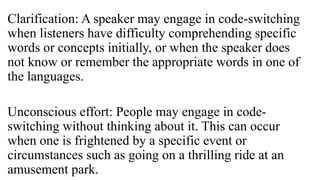
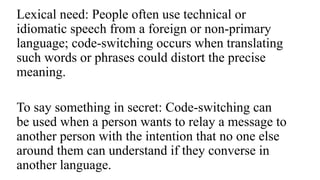
ode-switching, process of shifting from one linguistic code (a language or dialect) to another, depending on the social context or conversational setting. Sociolinguists, social psychologists, and identity researchers are interested in the ways in which code-switching, particularly by members of minority ethnic groups, is used to shape and maintain a sense of identity and a sense of belonging to a larger community.
In the United States, code-switching was originally studied in the context of second-language acquisition as the process whereby native speakers of Spanish shifted from Spanish to English and vice versa. Sociolinguists such as John J. Gumperz were interested more generally in the circumstances that prompted members of a speech community to alternate between their native language and that of the majority population.
Code-switching was also studied among African Americans who shifted between standard English (a dialect of English that is recognized as the national norm in the United States and is spoken or written by the educated classes) and African American English (AAE), an Africanized dialect widely spoken by Americans of African descent. Other terms for African American English are African American Language, African American Vernacular English, Black English, Standard Black English, and Ebonics.
Code-switching among African American students has been recognized since the 1970s and has informed different views of those students’ home dialect (AAE) and different approaches to the teaching of standard English. The “correctionist” approach to code-switching suggests that the students’ home speech amounts to “broken English” or “poor grammar.” Correctionists may also apply derogatory labels such as “ghetto” or “country.” From the perspective of the correctionist, if the students’ home speech is broken, then it needs to be corrected by getting them to use the appropriate language—standard English. For the correctionist, the students’ home speech is nothing more than a set of bad habits that prevent them from mastering correct English.n response to the correctionist approach, the contrastivist approach emphasizes the importance of language plurality. Those who have adopted this perspective believe that the African American students’ home dialect is equally as important as standard English. Moreover, the students’ home dialect can be used as a “bridge language” for acquiring standard English. For example, African American students may come to school and say to the teacher something like the following: “My brother, he smart.” The contrastivist teacher will recognize this phrase as having a West African sentence structure known as topic-comment: “my brother” is the topic, and “he smart” is the comment. Recognizing that the phrase lacks a verb (a deficit only in standard English), the contrastivist educator will show the students the difference between the phrase “My brother, he smart” and its equivalent in standard English and, more genera