Code Switching
Sociolinguistics
An introduction to Code Switching
 There are some phenomena of language occur in
societies to make the communication more effective and
meaningful.
 One of these phenomenon is code switching which we
can observe mostly in second/foreign language
classrooms. It refers to the use of two languages within
a sentence or discourse.
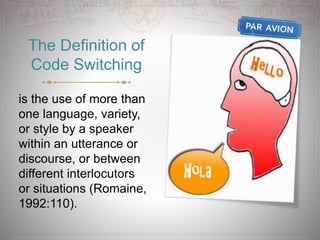
The Definition of
Code Switching
is the use of more than
one language, variety,
or style by a speaker
within an utterance or
discourse, or between
different interlocutors
or situations (Romaine,
1992:110).
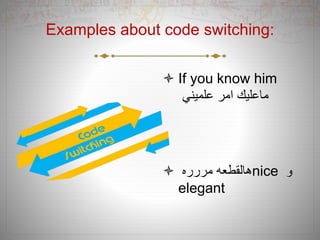
Examples about code switching:
 If you know him
‫علميني‬ ‫امر‬ ‫ماعليك‬
 ‫مررره‬ ‫هالقطعه‬nice ‫و‬
elegant
 Speakers of more than one language are known for
their ability to code switch or mix their language during
their communication.
 People switch code within a domain or social situation
 The switch will be clear, when there is an obvious
change in the situation ( Example)
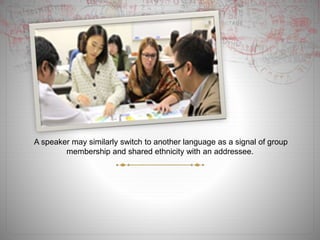
A speaker may similarly switch to another language as a signal of group
membership and shared ethnicity with an addressee.
 Such switches are often very short that it is called
emblematic switching or tag switching and they are
made primarily for social reasons.
 The tag served as an ethnic identity maker or
solidarity maker
 For example:
1- Günaydìn girls, did you study for today’s quiz?
(Switch between English and Turkish)
 2- ‫أي‬ ‫عندك‬ question?
(Switch between Arabic and English)
Situational switching refers to
the tendency in a bilingual or
multilingual community to use
different languages or
language varieties in different
social situations. It may be
based on the topic, on the
addressee, the institution, or on
any specific combination of
situational factors.
o Code switching in multilingual communities
For example:
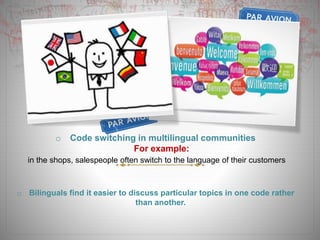
in the shops, salespeople often switch to the language of their customers
o Bilinguals find it easier to discuss particular topics in one code rather
than another.
 when a speaker switches code to quote a person or give a proverb
For example:
1) My father used to say to “ ‫الجد‬ ‫مع‬ ‫سهل‬ ‫يصير‬ ‫شي‬ ‫كل‬ ، ‫بالحياه‬ ‫صعب‬ ‫شي‬ ‫مافي‬
‫واالجتهاد‬”
2) some people used to postpone doing their work and they ended
up wasting their time without achieving anything. Arabic proverb said
“‫الغد‬ ‫الى‬ ‫اليوم‬ ‫عمل‬ ‫تؤجل‬ ‫”ال‬
The functions of Code Switching
① To show identity with a group to
stress the fact that they all belong to
this group
② Lack of Facility ; switch when they
cannot find an appropriate
expression or vocabulary item .
③ Lack of Register; : When speakers
are not equally competent in two
languages .
④ To attract attention ; shows that in
advertisements (in both, written as
well as in spoken) in India, code
switching is used to attract the
attention of the readers/listeners
⑤ language switch from L to H
can signal disapproval . We
switch to express anger using
different styles of English
⑥ used for amusement and
dramatic a fact by telling joke for
expressing emotions.
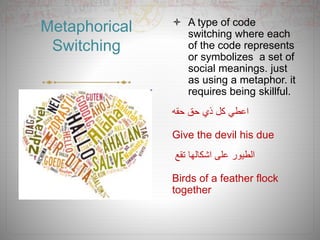
Metaphorical
Switching
 A type of code
switching where each
of the code represents
or symbolizes a set of
social meanings. just
as using a metaphor. it
requires being skillful.
‫حقه‬ ‫حق‬ ‫ذي‬ ‫كل‬ ‫اعطي‬
Give the devil his due
‫تقع‬ ‫اشكالها‬ ‫على‬ ‫الطيور‬
Birds of a feather flock
together
Lexical borrowing
 Lexical borrowing is the adoption of individual
words or even large sets of vocabulary items
from another language or dialect.
 Lexical borrowing is results from the lack of
vocabulary and it is motivated by lexical need.
 When speaking a second
language, people will often use a
term from their first language
because they don't know the
appropriate word in their second
language.
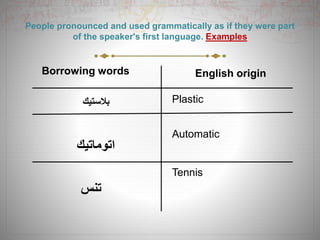
People pronounced and used grammatically as if they were part
of the speaker's first language. Examples
Borrowing words
‫بالس‬‫ت‬‫يك‬
‫اتوماتيك‬
‫تنس‬
English origin
Plastic
Automatic
Tennis
linguistic constraints
 There are very general rules for switching. These
rules are universal.
 The switches occur within sentences( intra-sentential
switching) when there is
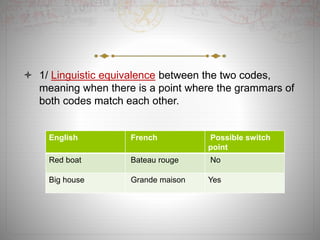
 1/ Linguistic equivalence between the two codes,
meaning when there is a point where the grammars of
both codes match each other.
English French Possible switch
point
Red boat Bateau rouge No
Big house Grande maison Yes
 2/ The matrix language frame (MLF) which imposes
structural constraints on code switched utterances. So
all system morphemes (such as tense and aspect
inflections) will come from this matrix, and any switch
will be determined or governed by this matrix. For
example:‫المحاضره‬ ‫كنسلت‬ ‫األستاذه‬
 3/ the level of proficiency in each code of the people
switching.
 less-proficient people will tend to switch at sentence
boundaries (inter-sentential switching) or use only
short phrases or tags at the end of the sentence for
example : ‫بليز‬ ‫كتابك‬ ‫عطيني‬
Attitudes to code-switching
 People are often unaware of the fact that they code-
switching.
 When their attention is drawn to this behaviour ,many tend
to apologize for it .
 For Example: among Mexican Americans the derogatory
term Tex Mex is used to describe rapid code-switching
between Spanish and English .
 Reaction to code-switching styles are negative in
many communities .
 Despite the fact that proficiency in intra sentential
code-switching requires a good control of both codes .
In conclusion, code switching is a phenomenon that is
inevitable in bilingual communities. It occurs mostly in
second/foreign language teaching and it can be used
beneficially in classroom activities.
In Conclusion
 The definition of Code Switching
 Tag switching ( very short switches)
 The first type of code switching which is the situational switching
 The second type of code switching which is the metaphorical switching
 The functions of code switching ( 7 functions)
 Definition of Lexical borrowing
 Why we use Lexical borrowing
 General rules for switching and examples.
 Attitudes to code-switching

Code Switching

  • 1.
  • 2.
    An introduction toCode Switching  There are some phenomena of language occur in societies to make the communication more effective and meaningful.  One of these phenomenon is code switching which we can observe mostly in second/foreign language classrooms. It refers to the use of two languages within a sentence or discourse.
  • 3.
    The Definition of CodeSwitching is the use of more than one language, variety, or style by a speaker within an utterance or discourse, or between different interlocutors or situations (Romaine, 1992:110).
  • 4.
    Examples about codeswitching:  If you know him ‫علميني‬ ‫امر‬ ‫ماعليك‬  ‫مررره‬ ‫هالقطعه‬nice ‫و‬ elegant
  • 5.
     Speakers ofmore than one language are known for their ability to code switch or mix their language during their communication.  People switch code within a domain or social situation  The switch will be clear, when there is an obvious change in the situation ( Example)
  • 7.
    A speaker maysimilarly switch to another language as a signal of group membership and shared ethnicity with an addressee.
  • 8.
     Such switchesare often very short that it is called emblematic switching or tag switching and they are made primarily for social reasons.  The tag served as an ethnic identity maker or solidarity maker  For example: 1- Günaydìn girls, did you study for today’s quiz? (Switch between English and Turkish)  2- ‫أي‬ ‫عندك‬ question? (Switch between Arabic and English)
  • 9.
    Situational switching refersto the tendency in a bilingual or multilingual community to use different languages or language varieties in different social situations. It may be based on the topic, on the addressee, the institution, or on any specific combination of situational factors.
  • 11.
    o Code switchingin multilingual communities For example: in the shops, salespeople often switch to the language of their customers o Bilinguals find it easier to discuss particular topics in one code rather than another.
  • 12.
     when aspeaker switches code to quote a person or give a proverb For example: 1) My father used to say to “ ‫الجد‬ ‫مع‬ ‫سهل‬ ‫يصير‬ ‫شي‬ ‫كل‬ ، ‫بالحياه‬ ‫صعب‬ ‫شي‬ ‫مافي‬ ‫واالجتهاد‬” 2) some people used to postpone doing their work and they ended up wasting their time without achieving anything. Arabic proverb said “‫الغد‬ ‫الى‬ ‫اليوم‬ ‫عمل‬ ‫تؤجل‬ ‫”ال‬
  • 13.
    The functions ofCode Switching ① To show identity with a group to stress the fact that they all belong to this group ② Lack of Facility ; switch when they cannot find an appropriate expression or vocabulary item . ③ Lack of Register; : When speakers are not equally competent in two languages . ④ To attract attention ; shows that in advertisements (in both, written as well as in spoken) in India, code switching is used to attract the attention of the readers/listeners
  • 14.
    ⑤ language switchfrom L to H can signal disapproval . We switch to express anger using different styles of English ⑥ used for amusement and dramatic a fact by telling joke for expressing emotions.
  • 15.
    Metaphorical Switching  A typeof code switching where each of the code represents or symbolizes a set of social meanings. just as using a metaphor. it requires being skillful. ‫حقه‬ ‫حق‬ ‫ذي‬ ‫كل‬ ‫اعطي‬ Give the devil his due ‫تقع‬ ‫اشكالها‬ ‫على‬ ‫الطيور‬ Birds of a feather flock together
  • 16.
    Lexical borrowing  Lexicalborrowing is the adoption of individual words or even large sets of vocabulary items from another language or dialect.  Lexical borrowing is results from the lack of vocabulary and it is motivated by lexical need.
  • 17.
     When speakinga second language, people will often use a term from their first language because they don't know the appropriate word in their second language.
  • 18.
    People pronounced andused grammatically as if they were part of the speaker's first language. Examples Borrowing words ‫بالس‬‫ت‬‫يك‬ ‫اتوماتيك‬ ‫تنس‬ English origin Plastic Automatic Tennis
  • 19.
    linguistic constraints  Thereare very general rules for switching. These rules are universal.  The switches occur within sentences( intra-sentential switching) when there is
  • 20.
     1/ Linguisticequivalence between the two codes, meaning when there is a point where the grammars of both codes match each other. English French Possible switch point Red boat Bateau rouge No Big house Grande maison Yes
  • 21.
     2/ Thematrix language frame (MLF) which imposes structural constraints on code switched utterances. So all system morphemes (such as tense and aspect inflections) will come from this matrix, and any switch will be determined or governed by this matrix. For example:‫المحاضره‬ ‫كنسلت‬ ‫األستاذه‬
  • 22.
     3/ thelevel of proficiency in each code of the people switching.  less-proficient people will tend to switch at sentence boundaries (inter-sentential switching) or use only short phrases or tags at the end of the sentence for example : ‫بليز‬ ‫كتابك‬ ‫عطيني‬
  • 23.
    Attitudes to code-switching People are often unaware of the fact that they code- switching.  When their attention is drawn to this behaviour ,many tend to apologize for it .  For Example: among Mexican Americans the derogatory term Tex Mex is used to describe rapid code-switching between Spanish and English .
  • 24.
     Reaction tocode-switching styles are negative in many communities .  Despite the fact that proficiency in intra sentential code-switching requires a good control of both codes . In conclusion, code switching is a phenomenon that is inevitable in bilingual communities. It occurs mostly in second/foreign language teaching and it can be used beneficially in classroom activities.
  • 25.
    In Conclusion  Thedefinition of Code Switching  Tag switching ( very short switches)  The first type of code switching which is the situational switching  The second type of code switching which is the metaphorical switching  The functions of code switching ( 7 functions)  Definition of Lexical borrowing  Why we use Lexical borrowing  General rules for switching and examples.  Attitudes to code-switching