CODE SWITCHING
AND CODE MIXING
TERMS YOU SHOULD KNOW:
1. CODE
• Language peculiar to a specific group.
• Codes are particular "grammars" of specific tongues: rules for
constructing and deriving words and sentences, inventories
of sounds to convey meaning, rules for uttering those
sounds, rules for translating those sounds into graphic
symbols (writing) etc.
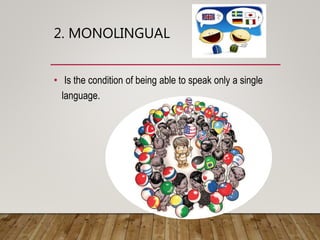
2. MONOLINGUAL
• Is the condition of being able to speak only a single
language.
• being bilingual means being able to communicate
effortlessly in two languages, even if one was
learned later in life and communication takes an
occasional detour
bilinguals are ‘people who need and use two (or more)
languages in their everyday lives (Grosjean 1992:51)
3. BILINGUAL
4. MULTILINGUAL
• A person that speaks more that three languages.
5. LEXICAL: Relating to the word or vocabulary of
language
6.
UNPREDICTABLE: likely to change suddenly and
without reason and therefore notable to
be predicted (= expected before
it happens) or depended on.
7. PHONOLOGY: the study of how sounds are
organized and used in natural languages. The
phonological system of a language includes an
inventory of sounds and their features, and rules which
specify how sounds interact with each other
FACTORS THAT MODIFY CODE
CHOICE
• Participants
• solidarity and status
• Social Distance
• Status Relationship
• Formality
• Function
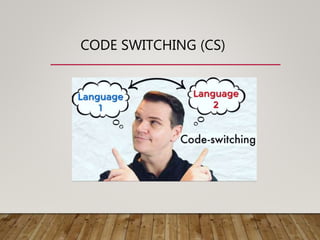
CODE SWITCHING (CS)
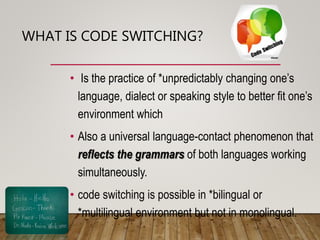
• Is the practice of *unpredictably changing one’s
language, dialect or speaking style to better fit one’s
environment which
• Also a universal language-contact phenomenon that
reflects the grammars of both languages working
simultaneously.
• code switching is possible in *bilingual or
*multilingual environment but not in monolingual.
WHAT IS CODE SWITCHING?
CONTINUE…….
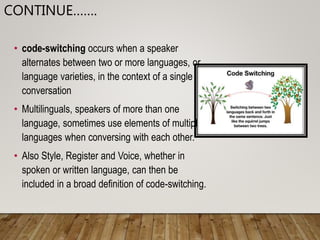
• code-switching occurs when a speaker
alternates between two or more languages, or
language varieties, in the context of a single
conversation
• Multilinguals, speakers of more than one
language, sometimes use elements of multiple
languages when conversing with each other.
• Also Style, Register and Voice, whether in
spoken or written language, can then be
included in a broad definition of code-switching.
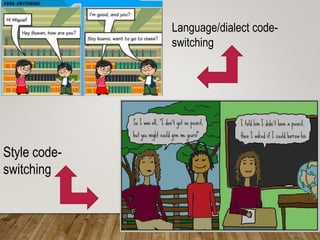
Language/dialect code-
switching
Style code-
switching
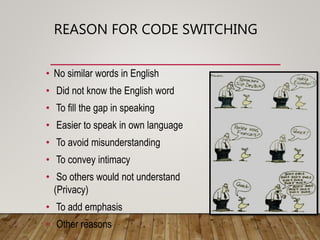
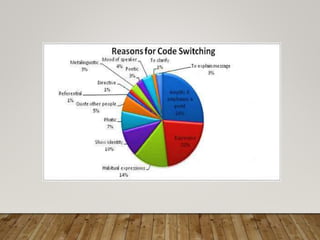
REASON FOR CODE SWITCHING
• No similar words in English
• Did not know the English word
• To fill the gap in speaking
• Easier to speak in own language
• To avoid misunderstanding
• To convey intimacy
• So others would not understand
(Privacy)
• To add emphasis
• Other reasons
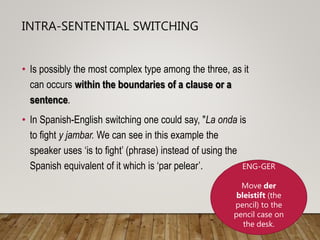
INTRA-SENTENTIAL SWITCHING
• Is possibly the most complex type among the three, as it
can occurs within the boundaries of a clause or a
sentence.
• In Spanish-English switching one could say, "La onda is
to fight y jambar. We can see in this example the
speaker uses ‘is to fight’ (phrase) instead of using the
Spanish equivalent of it which is ‘par pelear’. ENG-GER
Move der
bleistift (the
pencil) to the
pencil case on
the desk.
ENG-SPA
Move the pencil
to the blue
pencil case on
the table.
Ya lo hiciste?
(did you do it?)
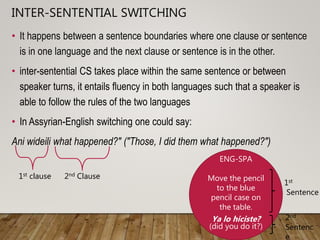
INTER-SENTENTIAL SWITCHING
• It happens between a sentence boundaries where one clause or sentence
is in one language and the next clause or sentence is in the other.
• inter-sentential CS takes place within the same sentence or between
speaker turns, it entails fluency in both languages such that a speaker is
able to follow the rules of the two languages
• In Assyrian-English switching one could say:
Ani wideili what happened?" ("Those, I did them what happened?")
1st clause 2nd Clause
1st
Sentence
2nd
Sentenc
e
TAG-SWITCHING
• Is the switching of either a tag phrase or
a word, or both, from one language to another,
(common in intra-sentential switches).
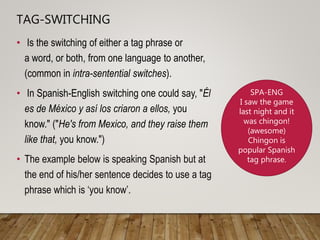
• In Spanish-English switching one could say, "Él
es de México y así los criaron a ellos, you
know." ("He's from Mexico, and they raise them
like that, you know.")
• The example below is speaking Spanish but at
the end of his/her sentence decides to use a tag
phrase which is ‘you know’.
SPA-ENG
I saw the game
last night and it
was chingon!
(awesome)
Chingon is
popular Spanish
tag phrase.
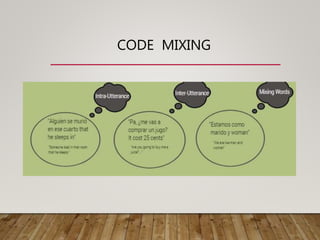
CODE MIXING
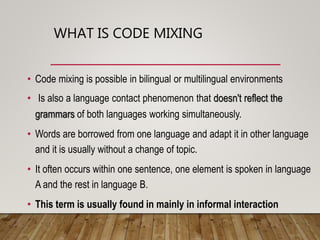
WHAT IS CODE MIXING
• Code mixing is possible in bilingual or multilingual environments
• Is also a language contact phenomenon that doesn't reflect the
grammars of both languages working simultaneously.
• Words are borrowed from one language and adapt it in other language
and it is usually without a change of topic.
• It often occurs within one sentence, one element is spoken in language
A and the rest in language B.
• This term is usually found in mainly in informal interaction
REASONS FOR CODE MIXING
• Interjection
• Quoting somebody else
• Expressing group identity
• Because of real lexical need
• Talking about a particular topic
• Repetition used for clarification
• Being emphatic about something
• To soften or strengthen request or command
• Intention of clarifying the speech content for interlocutor
• To exclude other people when a comment is intended for only a limited audience
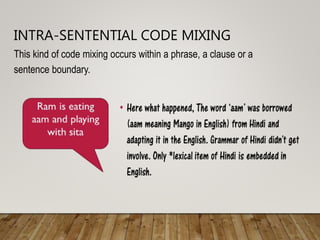
INTRA-SENTENTIAL CODE MIXING
This kind of code mixing occurs within a phrase, a clause or a
sentence boundary.
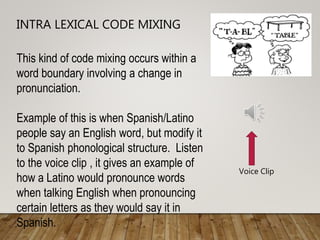
INTRA LEXICAL CODE MIXING
This kind of code mixing occurs within a
word boundary involving a change in
pronunciation.
Example of this is when Spanish/Latino
people say an English word, but modify it
to Spanish phonological structure. Listen
to the voice clip , it gives an example of
how a Latino would pronounce words
when talking English when pronouncing
certain letters as they would say it in
Spanish.
Voice Clip
For
watching!

Code Switching and Code Mixing

  • 1.
  • 2.
  • 3.
    1. CODE • Languagepeculiar to a specific group. • Codes are particular "grammars" of specific tongues: rules for constructing and deriving words and sentences, inventories of sounds to convey meaning, rules for uttering those sounds, rules for translating those sounds into graphic symbols (writing) etc.
  • 4.
    2. MONOLINGUAL • Isthe condition of being able to speak only a single language.
  • 5.
    • being bilingualmeans being able to communicate effortlessly in two languages, even if one was learned later in life and communication takes an occasional detour bilinguals are ‘people who need and use two (or more) languages in their everyday lives (Grosjean 1992:51) 3. BILINGUAL
  • 6.
    4. MULTILINGUAL • Aperson that speaks more that three languages.
  • 7.
    5. LEXICAL: Relatingto the word or vocabulary of language 6. UNPREDICTABLE: likely to change suddenly and without reason and therefore notable to be predicted (= expected before it happens) or depended on. 7. PHONOLOGY: the study of how sounds are organized and used in natural languages. The phonological system of a language includes an inventory of sounds and their features, and rules which specify how sounds interact with each other
  • 8.
    FACTORS THAT MODIFYCODE CHOICE • Participants • solidarity and status • Social Distance • Status Relationship • Formality • Function
  • 9.
  • 10.
    • Is thepractice of *unpredictably changing one’s language, dialect or speaking style to better fit one’s environment which • Also a universal language-contact phenomenon that reflects the grammars of both languages working simultaneously. • code switching is possible in *bilingual or *multilingual environment but not in monolingual. WHAT IS CODE SWITCHING?
  • 11.
    CONTINUE……. • code-switching occurswhen a speaker alternates between two or more languages, or language varieties, in the context of a single conversation • Multilinguals, speakers of more than one language, sometimes use elements of multiple languages when conversing with each other. • Also Style, Register and Voice, whether in spoken or written language, can then be included in a broad definition of code-switching.
  • 12.
  • 13.
    REASON FOR CODESWITCHING • No similar words in English • Did not know the English word • To fill the gap in speaking • Easier to speak in own language • To avoid misunderstanding • To convey intimacy • So others would not understand (Privacy) • To add emphasis • Other reasons
  • 15.
    INTRA-SENTENTIAL SWITCHING • Ispossibly the most complex type among the three, as it can occurs within the boundaries of a clause or a sentence. • In Spanish-English switching one could say, "La onda is to fight y jambar. We can see in this example the speaker uses ‘is to fight’ (phrase) instead of using the Spanish equivalent of it which is ‘par pelear’. ENG-GER Move der bleistift (the pencil) to the pencil case on the desk.
  • 16.
    ENG-SPA Move the pencil tothe blue pencil case on the table. Ya lo hiciste? (did you do it?) INTER-SENTENTIAL SWITCHING • It happens between a sentence boundaries where one clause or sentence is in one language and the next clause or sentence is in the other. • inter-sentential CS takes place within the same sentence or between speaker turns, it entails fluency in both languages such that a speaker is able to follow the rules of the two languages • In Assyrian-English switching one could say: Ani wideili what happened?" ("Those, I did them what happened?") 1st clause 2nd Clause 1st Sentence 2nd Sentenc e
  • 17.
    TAG-SWITCHING • Is theswitching of either a tag phrase or a word, or both, from one language to another, (common in intra-sentential switches). • In Spanish-English switching one could say, "Él es de México y así los criaron a ellos, you know." ("He's from Mexico, and they raise them like that, you know.") • The example below is speaking Spanish but at the end of his/her sentence decides to use a tag phrase which is ‘you know’. SPA-ENG I saw the game last night and it was chingon! (awesome) Chingon is popular Spanish tag phrase.
  • 19.
  • 20.
    WHAT IS CODEMIXING • Code mixing is possible in bilingual or multilingual environments • Is also a language contact phenomenon that doesn't reflect the grammars of both languages working simultaneously. • Words are borrowed from one language and adapt it in other language and it is usually without a change of topic. • It often occurs within one sentence, one element is spoken in language A and the rest in language B. • This term is usually found in mainly in informal interaction
  • 21.
    REASONS FOR CODEMIXING • Interjection • Quoting somebody else • Expressing group identity • Because of real lexical need • Talking about a particular topic • Repetition used for clarification • Being emphatic about something • To soften or strengthen request or command • Intention of clarifying the speech content for interlocutor • To exclude other people when a comment is intended for only a limited audience
  • 23.
    INTRA-SENTENTIAL CODE MIXING Thiskind of code mixing occurs within a phrase, a clause or a sentence boundary.
  • 24.
    INTRA LEXICAL CODEMIXING This kind of code mixing occurs within a word boundary involving a change in pronunciation. Example of this is when Spanish/Latino people say an English word, but modify it to Spanish phonological structure. Listen to the voice clip , it gives an example of how a Latino would pronounce words when talking English when pronouncing certain letters as they would say it in Spanish. Voice Clip
  • 25.