Pidgins and
creoles

Presented by : Amal
Mustafa Elsinousy
The main points :
 Introduction
 Lingua

franca

 Pidgins
 Pidginization
 creole
 Creolization
 Decreolization
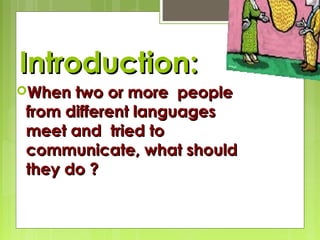
Introduction:
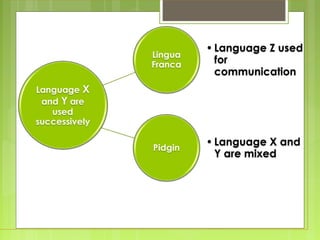
When

two or more people
from different languages
meet and tried to
communicate, what should
they do ?
Answers :
1.
2.

Use a third language (Lingua
Franca)
Mix the two languages (Pidgin
/Creole)
Lingua Franca
A

lingua franca is a language which
is used habitually by people whose
mother tongues are different in
order to facilitate communication
between them.
Other terms that are used to refer
to Lingua francas:
a trade language e.g., Swahili in East
Africa.
 A contact language e.g., Greek koine
 An international language e.g., English
 An auxiliary language e.g., Esperanto.
 A mixed language .e.g., Mitchif in
Canada

English – lingua franca:
Spoken in

many countries as a
native language .
Spoken as a second language
in other countries e.g., India and
the Philippines.
Other languages – lingua francas:
•

Many Languages throughout the history
served as lingua franca:
o Chinese
o French
o Arabic
o Chinook Jargon ( American Indian)
• We can conclude that mainly political
and economical power defines the
Lingua Franca.
pidgins
 Origin:

to be coming from a Chinese
attempt to pronounce the English word
business during trades in the Far East.
 Historically, pidgins arose in colonial
situations where the representatives of
the particular colonial power, officials,
tradesmen, sailors, etc., came in contact
with natives
 Assumed
Definition:
or contact language is a restricted
and extended language which arises with
an urgency of communication to serve
specific needs between social groups that
are ethnically and linguistically different from
each other .
 One of these groups is in a more dominant
position than the other; the less dominant
group is the one which develops the pidgin.
 A pidgin
Pidginization:
Is

a complex combination of different
processes of change, including
reduction and simplification of input
materials ,internal innovation, and
regularization of structure, with L1
influence also playing role.
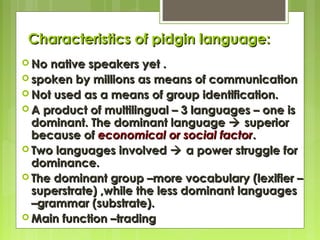
Characteristics of pidgin language:
 No

native speakers yet .
 spoken by millions as means of communication
 Not used as a means of group identification.
 A product of multilingual – 3 languages – one is
dominant. The dominant language  superior
because of economical or social factor.
 Two languages involved  a power struggle for
dominance.
 The dominant group –more vocabulary (lexifier –
superstrate) ,while the less dominant languages
–grammar (substrate).
 Main function –trading
•

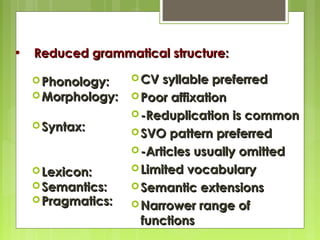
Reduced grammatical structure:
syllable preferred
 Morphology:  Poor affixation
 -Reduplication is common
 Syntax:
 SVO pattern preferred
 -Articles usually omitted
 Limited vocabulary
 Lexicon:
 Semantics:
 Semantic extensions
 Pragmatics:
 Narrower range of
functions
 Phonology:

 CV
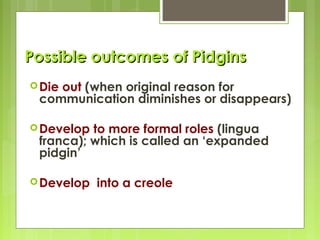
Possible outcomes of Pidgins
 Die

out (when original reason for
communication diminishes or disappears)

 Develop

to more formal roles (lingua
franca); which is called an ‘expanded
pidgin’

 Develop

into a creole
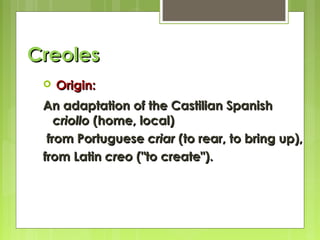
Creoles


Origin:

An adaptation of the Castilian Spanish
criollo (home, local)
from Portuguese criar (to rear, to bring up),
from Latin creo ("to create").
Definition:
A

creole is a pidgin that has
become the first language of a
new generation of speakers.
Creolization:
Is

a process where a pidgin
expanded in structure and
vocabulary in order to express the
range of meanings and serve the
range of functions required of a first
language.
characteristics of Creoles
pidgins adopted as the native language.
 Nativization is when pidgin passed onto
new generations and became a mother
tongue which is acquired by children.
 Often classified as English/French/Spanish…
based
 speech becomes faster,
o

 Expansion

of morphology and syntax.
 Expansion of phonology.
 Expansion of the lexicon.
Decreolization
It

 is a hypothetical phenomenon
whereby over time a 
creole language reconverges with
one of the standard languages from
which it originally derived. the
theory of creole continua.
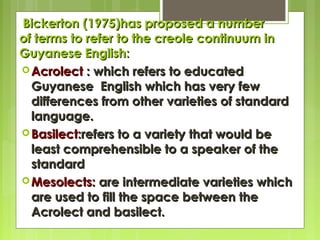
Bickerton (1975)has proposed a number
of terms to refer to the creole continuum in
Guyanese English:
 Acrolect : which refers to educated
Guyanese English which has very few
differences from other varieties of standard
language.
 Basilect:refers to a variety that would be
least comprehensible to a speaker of the
standard
 Mesolects: are intermediate varieties which
are used to fill the space between the
Acrolect and basilect.
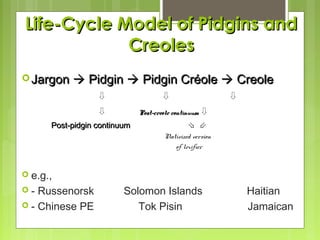
Life-Cycle Model of Pidgins and
Creoles
 Jargon

 Pidgin  Pidgin Créole  Creole
⇩
⇩

⇩

⇩

Post-creole continuum ⇩

Post-pidgin continuum

⇘ ⇙
Nativized version
of lexifier

 e.g.,
-

Russenorsk
 - Chinese PE

Solomon Islands
Tok Pisin

Haitian
Jamaican
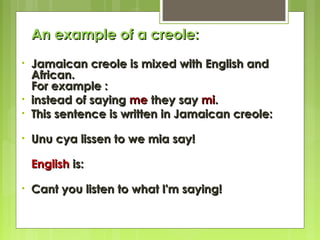
An example of a creole:

•

Jamaican creole is mixed with English and
African.
For example :
instead of saying me they say mi.
This sentence is written in Jamaican creole:

•

Unu cya lissen to we mia say!

•

•

English is:
•

Cant you listen to what I'm saying!
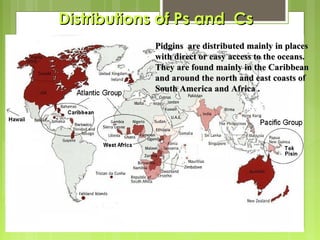
Distributions of Ps and Cs
Pidgins are distributed mainly in places
with direct or easy access to the oceans.
They are found mainly in the Caribbean
and around the north and east coasts of
South America and Africa .
Thanks for
Listening
Pidgins   creoles - sociolinguistics

Pidgins creoles - sociolinguistics

  • 1.
    Pidgins and creoles Presented by: Amal Mustafa Elsinousy
  • 2.
    The main points:  Introduction  Lingua franca  Pidgins  Pidginization  creole  Creolization  Decreolization
  • 3.
    Introduction: When two or morepeople from different languages meet and tried to communicate, what should they do ?
  • 4.
    Answers : 1. 2. Use athird language (Lingua Franca) Mix the two languages (Pidgin /Creole)
  • 6.
    Lingua Franca A lingua francais a language which is used habitually by people whose mother tongues are different in order to facilitate communication between them.
  • 7.
    Other terms thatare used to refer to Lingua francas: a trade language e.g., Swahili in East Africa.  A contact language e.g., Greek koine  An international language e.g., English  An auxiliary language e.g., Esperanto.  A mixed language .e.g., Mitchif in Canada 
  • 8.
    English – linguafranca: Spoken in many countries as a native language . Spoken as a second language in other countries e.g., India and the Philippines.
  • 9.
    Other languages –lingua francas: • Many Languages throughout the history served as lingua franca: o Chinese o French o Arabic o Chinook Jargon ( American Indian) • We can conclude that mainly political and economical power defines the Lingua Franca.
  • 10.
    pidgins  Origin: to becoming from a Chinese attempt to pronounce the English word business during trades in the Far East.  Historically, pidgins arose in colonial situations where the representatives of the particular colonial power, officials, tradesmen, sailors, etc., came in contact with natives  Assumed
  • 11.
    Definition: or contact languageis a restricted and extended language which arises with an urgency of communication to serve specific needs between social groups that are ethnically and linguistically different from each other .  One of these groups is in a more dominant position than the other; the less dominant group is the one which develops the pidgin.  A pidgin
  • 12.
    Pidginization: Is a complex combinationof different processes of change, including reduction and simplification of input materials ,internal innovation, and regularization of structure, with L1 influence also playing role.
  • 13.
    Characteristics of pidginlanguage:  No native speakers yet .  spoken by millions as means of communication  Not used as a means of group identification.  A product of multilingual – 3 languages – one is dominant. The dominant language  superior because of economical or social factor.  Two languages involved  a power struggle for dominance.  The dominant group –more vocabulary (lexifier – superstrate) ,while the less dominant languages –grammar (substrate).  Main function –trading
  • 14.
    • Reduced grammatical structure: syllablepreferred  Morphology:  Poor affixation  -Reduplication is common  Syntax:  SVO pattern preferred  -Articles usually omitted  Limited vocabulary  Lexicon:  Semantics:  Semantic extensions  Pragmatics:  Narrower range of functions  Phonology:  CV
  • 15.
    Possible outcomes ofPidgins  Die out (when original reason for communication diminishes or disappears)  Develop to more formal roles (lingua franca); which is called an ‘expanded pidgin’  Develop into a creole
  • 16.
    Creoles  Origin: An adaptation ofthe Castilian Spanish criollo (home, local) from Portuguese criar (to rear, to bring up), from Latin creo ("to create").
  • 17.
    Definition: A creole is apidgin that has become the first language of a new generation of speakers.
  • 18.
    Creolization: Is a process wherea pidgin expanded in structure and vocabulary in order to express the range of meanings and serve the range of functions required of a first language.
  • 19.
    characteristics of Creoles pidginsadopted as the native language.  Nativization is when pidgin passed onto new generations and became a mother tongue which is acquired by children.  Often classified as English/French/Spanish… based  speech becomes faster, o  Expansion of morphology and syntax.  Expansion of phonology.  Expansion of the lexicon.
  • 20.
    Decreolization It  is a hypotheticalphenomenon whereby over time a  creole language reconverges with one of the standard languages from which it originally derived. the theory of creole continua.
  • 21.
    Bickerton (1975)has proposeda number of terms to refer to the creole continuum in Guyanese English:  Acrolect : which refers to educated Guyanese English which has very few differences from other varieties of standard language.  Basilect:refers to a variety that would be least comprehensible to a speaker of the standard  Mesolects: are intermediate varieties which are used to fill the space between the Acrolect and basilect.
  • 22.
    Life-Cycle Model ofPidgins and Creoles  Jargon  Pidgin  Pidgin Créole  Creole ⇩ ⇩ ⇩ ⇩ Post-creole continuum ⇩ Post-pidgin continuum ⇘ ⇙ Nativized version of lexifier  e.g., - Russenorsk  - Chinese PE Solomon Islands Tok Pisin Haitian Jamaican
  • 23.
    An example ofa creole: • Jamaican creole is mixed with English and African. For example : instead of saying me they say mi. This sentence is written in Jamaican creole: • Unu cya lissen to we mia say! • • English is: • Cant you listen to what I'm saying!
  • 24.
    Distributions of Psand Cs Pidgins are distributed mainly in places with direct or easy access to the oceans. They are found mainly in the Caribbean and around the north and east coasts of South America and Africa .
  • 25.