LUCIA PRATAMA
1210733003
Background of the Study
 Language as the system of communication in speech
and writing that used is used by a people of a
particular country and language is a major means of
identifying a set of people nation or country.
 A code is “a system used for communication between
two or more parties used on any occasions.”(Ronald
Wardaugh 1986:101).
 “Code-mixing occurs when conversant use both
languages together to the extent that they change from
one language to other in the course of a single
utterance.” ( Wardhaugh 1994:108).
 “Code-switching as “ the alternative used by bilinguals
of two or more languages in the same conversation.”
( Milroy and Musyken 1995, p. 7).
Limitation of the Study
 This research focuses on know how many the writer
use Indonesia to English in this novel, and how does
reader understand when the writer use code mixing
and code switching in this novel. And find out the
dominant process which related to code switching and
code mixing. Because the writer needs to know
analysis the type, and reason of their code mixing and
code switching language.
Research Problems
 What type of code switching and code mixing were
found in novel Love You Anyway by Alamanda
Hindersah?
 What is the reason the novel “Love You Anyway” use
code mixing and code switching in this novel?
Objective of the Study
 To find out what type of code switching and code
mixing found in the novel Love You Anyway by
Alamanda Hindersah?
 To find what is the reason of code mixing and
switching in the novel Love You Anyway by Alamanda
Hindersah?
Theoretical Framework
 Pateda in his book "Sosiolinguistics", 1987 which discuss
about all aspects in sociolinguistics (including language
use, language variety, language change, language plan).
 Janet Holmes in his book 1992 sociolinguistics study the
relationship between language and society
 Wardough, Introduction to Sociolinguistics. This book
provides information and knowledge about
Sociolinguistics and Sociology of language, and the
discussion of the relationship between language and
society or the various functions of language in society
The Method of Research
 Source Data
In this research, data are collected from a the novel “
Love You Anyway”. After writer collect the data then,
writer will try to find which type, categories and
reason code mixing and code switching.
 Data of Collecting
In collecting data, writer must be reading a novel and
writer must be analyzing type code mixing about the
conversation or the story from this novel. After that,
writer can describes why does the writer use code
mixing and code switching in the novel.
Research Method
The writer tries to apply the descriptive quantitative
research method. In this method, there are some steps
that the writer is going to do:
 Collecting the data: picking out all the dialogue of the
characters in the novel.
 Classifying the data: classifying the important data
based on the scope of the analysis.
 Identifying the data: characterizing the utterance
based on which belong to code switching and code
mixing.
Method of Analyzing Data
 The data are analyzed by using descriptive quantitative
and qualitative methods by Arikunto (2006:239) and
applied some procedures or steps. First, the writer
presenting all the data (dialogues) from the selected
chapter of the novel. Second, the writer classifies the
data and then identifying the data by characterizing
the utterances which belong to code switching and
code mixing. Third, the writer gives a brief description
or explanation based on the category of each data, and
also describes the data in table’s form of each chapters
Code-Switching
 According (Hymes,1875) “Code-Switching has become
a common term for alternate use of two or more
languages, or varieties of language, or even speech
styles ". For example the conversations below, which
taken from novel Love You Anyway by Alamanda
Hindersah:
Lubang hidung Boat langsung kembang kempis, “I
smell something fishy.” James nyengir.”Aku bertemu
perempuan itu beberapa hari lalu lewat
gaoukon.Lumayan lucu orangnya.
Three types of code switching
 Tag Code Switching
A tag code switching happens when a bilingual inserts short
expression (tag) from different language at the end of
his/her utterances. Here the examples below are taken
from the dialogues in novel Love You Anyway by Alamanda
Hindersah:
“Bukan, maksudku…” Aksa terdiam sejenak, menyesal
karena mulutnya terlanjur melontarkan hal yang cukup
pribadi. “Maksudku, aku hanya pulang sebentar. Kakak
laki-lakiku sepertinya akan menikah akhir tahun ini.”
“Wow selamat!”
“Thanks.”
 Inter sentential code switching
An inter sentential code switching happens when there
is a complete sentence in a foreign language uttered
between two sentences in a base language. for
examples of this type of switching below are taken
from novel Love You Anyway by Alamanda Hindersah:
“ Dia sendiri tidak mengerti mengapa harus membuat
pertanyaan sebodoh itu. Kesal dengan kebodohannya
sendiri, Aksa melanjutkan, “You know what…… Kamu
tidak perlu menjawab pertanyaan itu. “Don’t mind it.”
 Intra sentential code switching
Intra sentential code switching is found when a word, a
phrase, or a clause of a foreign language is found
within the sentence in a base language.
Two examples are as the following, which taken from
(Rene Apel and Pieter Muysken, 1987):
a. An English bilingual switches from English to French;
the hotel, il est grand, is really huge and unbelievably
majestic.
b. A Tanzanian bilingual switches from Swahili to
English, e.g: lle accident llitokea alipose control Na
Aka overturn and landed in a ditch.
Types of Code-Mixing
 Intra-sentential mixing
Intra-sentential mixing may range form the
alternation of single words, phrases to clauses within a
single sentence or utterance.
example: Really? James menaikkan sebelah alis….
(single word)
 Extra-sentential mixing
Normally extra-sentential mixing occurs between
sentences because it occurs at sentence boundaries. It
requires less complex syntactic interaction between
two languages involved in code mixing.
Example: I wanna focus on my carrer, aku mau….
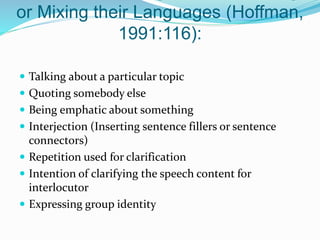
or Mixing their Languages (Hoffman,
1991:116):
 Talking about a particular topic
 Quoting somebody else
 Being emphatic about something
 Interjection (Inserting sentence fillers or sentence
connectors)
 Repetition used for clarification
 Intention of clarifying the speech content for
interlocutor
 Expressing group identity

Code-Mixing and Code Switching

  • 1.
  • 2.
    Background of theStudy  Language as the system of communication in speech and writing that used is used by a people of a particular country and language is a major means of identifying a set of people nation or country.  A code is “a system used for communication between two or more parties used on any occasions.”(Ronald Wardaugh 1986:101).
  • 3.
     “Code-mixing occurswhen conversant use both languages together to the extent that they change from one language to other in the course of a single utterance.” ( Wardhaugh 1994:108).  “Code-switching as “ the alternative used by bilinguals of two or more languages in the same conversation.” ( Milroy and Musyken 1995, p. 7).
  • 4.
    Limitation of theStudy  This research focuses on know how many the writer use Indonesia to English in this novel, and how does reader understand when the writer use code mixing and code switching in this novel. And find out the dominant process which related to code switching and code mixing. Because the writer needs to know analysis the type, and reason of their code mixing and code switching language.
  • 5.
    Research Problems  Whattype of code switching and code mixing were found in novel Love You Anyway by Alamanda Hindersah?  What is the reason the novel “Love You Anyway” use code mixing and code switching in this novel?
  • 6.
    Objective of theStudy  To find out what type of code switching and code mixing found in the novel Love You Anyway by Alamanda Hindersah?  To find what is the reason of code mixing and switching in the novel Love You Anyway by Alamanda Hindersah?
  • 7.
    Theoretical Framework  Patedain his book "Sosiolinguistics", 1987 which discuss about all aspects in sociolinguistics (including language use, language variety, language change, language plan).  Janet Holmes in his book 1992 sociolinguistics study the relationship between language and society  Wardough, Introduction to Sociolinguistics. This book provides information and knowledge about Sociolinguistics and Sociology of language, and the discussion of the relationship between language and society or the various functions of language in society
  • 8.
    The Method ofResearch  Source Data In this research, data are collected from a the novel “ Love You Anyway”. After writer collect the data then, writer will try to find which type, categories and reason code mixing and code switching.  Data of Collecting In collecting data, writer must be reading a novel and writer must be analyzing type code mixing about the conversation or the story from this novel. After that, writer can describes why does the writer use code mixing and code switching in the novel.
  • 9.
    Research Method The writertries to apply the descriptive quantitative research method. In this method, there are some steps that the writer is going to do:  Collecting the data: picking out all the dialogue of the characters in the novel.  Classifying the data: classifying the important data based on the scope of the analysis.  Identifying the data: characterizing the utterance based on which belong to code switching and code mixing.
  • 10.
    Method of AnalyzingData  The data are analyzed by using descriptive quantitative and qualitative methods by Arikunto (2006:239) and applied some procedures or steps. First, the writer presenting all the data (dialogues) from the selected chapter of the novel. Second, the writer classifies the data and then identifying the data by characterizing the utterances which belong to code switching and code mixing. Third, the writer gives a brief description or explanation based on the category of each data, and also describes the data in table’s form of each chapters
  • 11.
    Code-Switching  According (Hymes,1875)“Code-Switching has become a common term for alternate use of two or more languages, or varieties of language, or even speech styles ". For example the conversations below, which taken from novel Love You Anyway by Alamanda Hindersah: Lubang hidung Boat langsung kembang kempis, “I smell something fishy.” James nyengir.”Aku bertemu perempuan itu beberapa hari lalu lewat gaoukon.Lumayan lucu orangnya.
  • 12.
    Three types ofcode switching  Tag Code Switching A tag code switching happens when a bilingual inserts short expression (tag) from different language at the end of his/her utterances. Here the examples below are taken from the dialogues in novel Love You Anyway by Alamanda Hindersah: “Bukan, maksudku…” Aksa terdiam sejenak, menyesal karena mulutnya terlanjur melontarkan hal yang cukup pribadi. “Maksudku, aku hanya pulang sebentar. Kakak laki-lakiku sepertinya akan menikah akhir tahun ini.” “Wow selamat!” “Thanks.”
  • 13.
     Inter sententialcode switching An inter sentential code switching happens when there is a complete sentence in a foreign language uttered between two sentences in a base language. for examples of this type of switching below are taken from novel Love You Anyway by Alamanda Hindersah: “ Dia sendiri tidak mengerti mengapa harus membuat pertanyaan sebodoh itu. Kesal dengan kebodohannya sendiri, Aksa melanjutkan, “You know what…… Kamu tidak perlu menjawab pertanyaan itu. “Don’t mind it.”
  • 14.
     Intra sententialcode switching Intra sentential code switching is found when a word, a phrase, or a clause of a foreign language is found within the sentence in a base language. Two examples are as the following, which taken from (Rene Apel and Pieter Muysken, 1987): a. An English bilingual switches from English to French; the hotel, il est grand, is really huge and unbelievably majestic. b. A Tanzanian bilingual switches from Swahili to English, e.g: lle accident llitokea alipose control Na Aka overturn and landed in a ditch.
  • 15.
    Types of Code-Mixing Intra-sentential mixing Intra-sentential mixing may range form the alternation of single words, phrases to clauses within a single sentence or utterance. example: Really? James menaikkan sebelah alis…. (single word)  Extra-sentential mixing Normally extra-sentential mixing occurs between sentences because it occurs at sentence boundaries. It requires less complex syntactic interaction between two languages involved in code mixing. Example: I wanna focus on my carrer, aku mau….
  • 16.
    or Mixing theirLanguages (Hoffman, 1991:116):  Talking about a particular topic  Quoting somebody else  Being emphatic about something  Interjection (Inserting sentence fillers or sentence connectors)  Repetition used for clarification  Intention of clarifying the speech content for interlocutor  Expressing group identity