1 
Bilingualism 
• Diglossia 
• Borrowing 
• Code-switching 
Diglossia 
A sociolinguistic situation in which 
two languages ar varieties are spoken 
in a community with one language 
having higher status or prestige 
Borrowing 
• Language contact results in borrowing even 
when there isn’t widespread bilingualism: 
chow mein, spaghetti, pad thai, tacos, 
crepes, soba noodles (‘noodle noodles’), 
bratwurst, tabouleh, samosas, couscous, 
maize, chocolate... 
• Bilingual people can borrow even more 
words: 
– Get me my [®ejb √ws √w] 
Code Switching 
People who are bilingual tend to 
switch back and forth between two 
languages not only in different social 
situations but also within the same 
conversation. 
Codeswitching is different from 
borrowing, even though bilinguals may 
borrow words that monolinguals are not 
familiar with 
• Honey, can you get me my [m√w»tSil´]? 
vs. 
• I’m going to [»meçiko] 
Codeswitching examples from 
My Journey Home 
• Armando, pero my god 
• Chip---como se le llama, Armando? (A. 
answers My Three Sons)---Chip from My 
Three Sons…y este es Ernie 
• There’s something I’ve been meaning to tell 
you, pero I didn’t
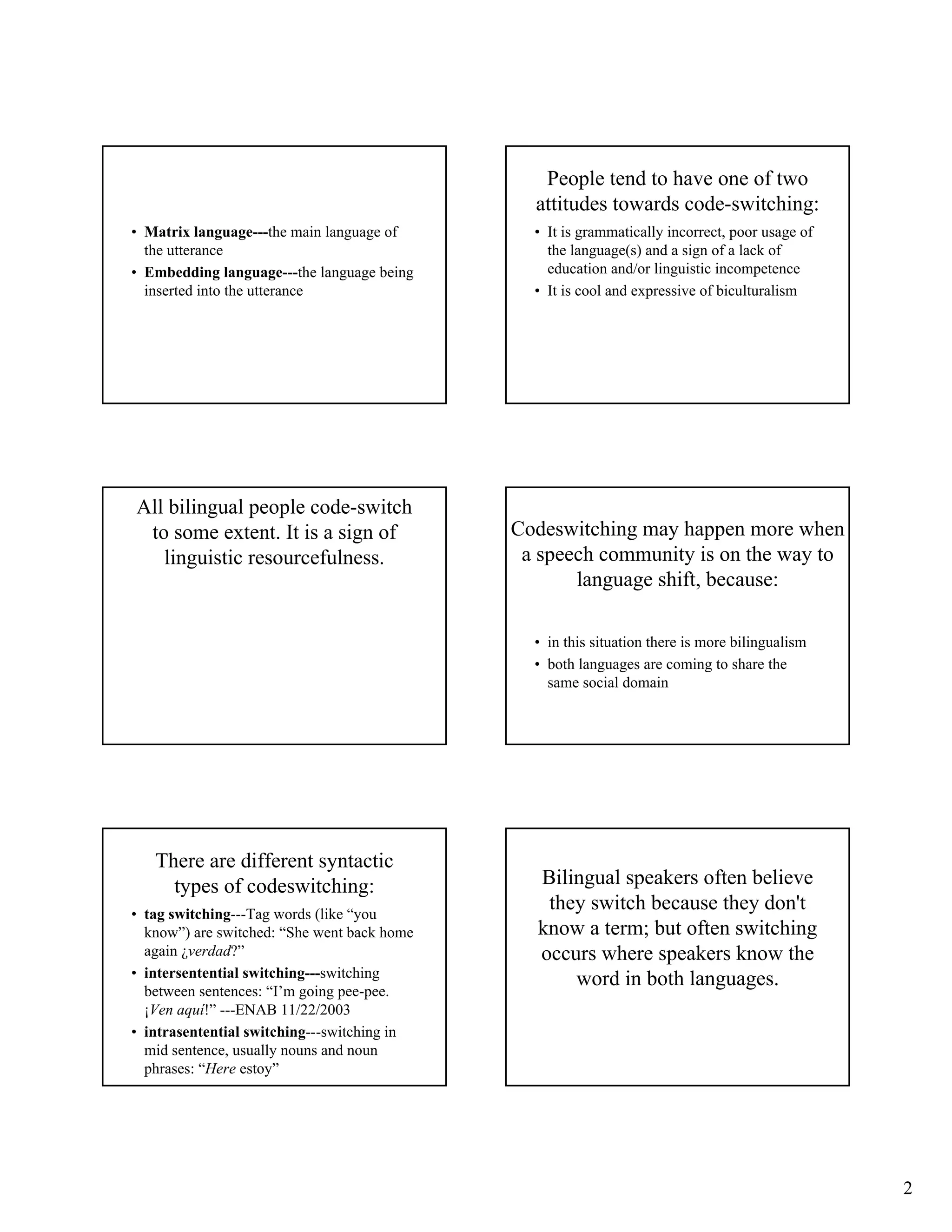
2 
• Matrix language---the main language of 
the utterance 
• Embedding language---the language being 
inserted into the utterance 
People tend to have one of two 
attitudes towards code-switching: 
• It is grammatically incorrect, poor usage of 
the language(s) and a sign of a lack of 
education and/or linguistic incompetence 
• It is cool and expressive of biculturalism 
All bilingual people code-switch 
to some extent. It is a sign of 
linguistic resourcefulness. 
Codeswitching may happen more when 
a speech community is on the way to 
language shift, because: 
• in this situation there is more bilingualism 
• both languages are coming to share the 
same social domain 
There are different syntactic 
types of codeswitching: 
• tag switching---Tag words (like “you 
know”) are switched: “She went back home 
again ¿verdad?” 
• intersentential switching---switching 
between sentences: “I’m going pee-pee. 
¡Ven aquí!” ---ENAB 11/22/2003 
• intrasentential switching---switching in 
mid sentence, usually nouns and noun 
phrases: “Here estoy” 
Bilingual speakers often believe 
they switch because they don't 
know a term; but often switching 
occurs where speakers know the 
word in both languages.
3 
One common practice is to repeat 
the same thing in both languages. 
• “¿Más agua? Do you want some more 
water?” 
• E: “Nice caballo.” 
R: “Yeah, nice horse. Buen caballo.” 
Researchers have identified 
different types of codeswitching 
according to social and semantic 
contexts including: 
• Situational switching 
• Metaphorical switching 
• Referential switching 
• Directive switching 
• Expressive switching 
Situational Codeswitching 
In Norway a local dialect is used for 
greetings, inquiries about one’s 
family, while Standard Norwegian is 
used for business transactions 
Metaphorical switching 
• “¡Ven acá! ¡Ven acá! Come here, you! 
• “Yano-san-wa (‘as for Mr. Yano’), he was 
speaking all in English. 
• ¿Hiciste tu homework? 
• Gov. Schwarzennegger has said that his 
kids know he’s serious about them doing 
something when he starts counting to three 
and that if he’s counting in German they 
really know he means business. 
Referential switching---talking 
about a subject that normally is 
done in the other language 
When we were dating we really liked 
to bailar las cumbias. 
Directive switching---which 
conversational participant is it 
directed to? 
• R to F(in Spanish): ‘How much do you 
want for this rug? 
• L to F (in Spanish): ‘Give her a good price.’ 
• F to L (in Valley Zapotec): ‘What do you 
think/how much did we pay for it/XXX?’ 
• L to F (in Valley Zapotec): ‘It cost us ___, 
why don’t you tell her ___.’ 
• F to R (in Spanish): ‘500 pesos.’
4 
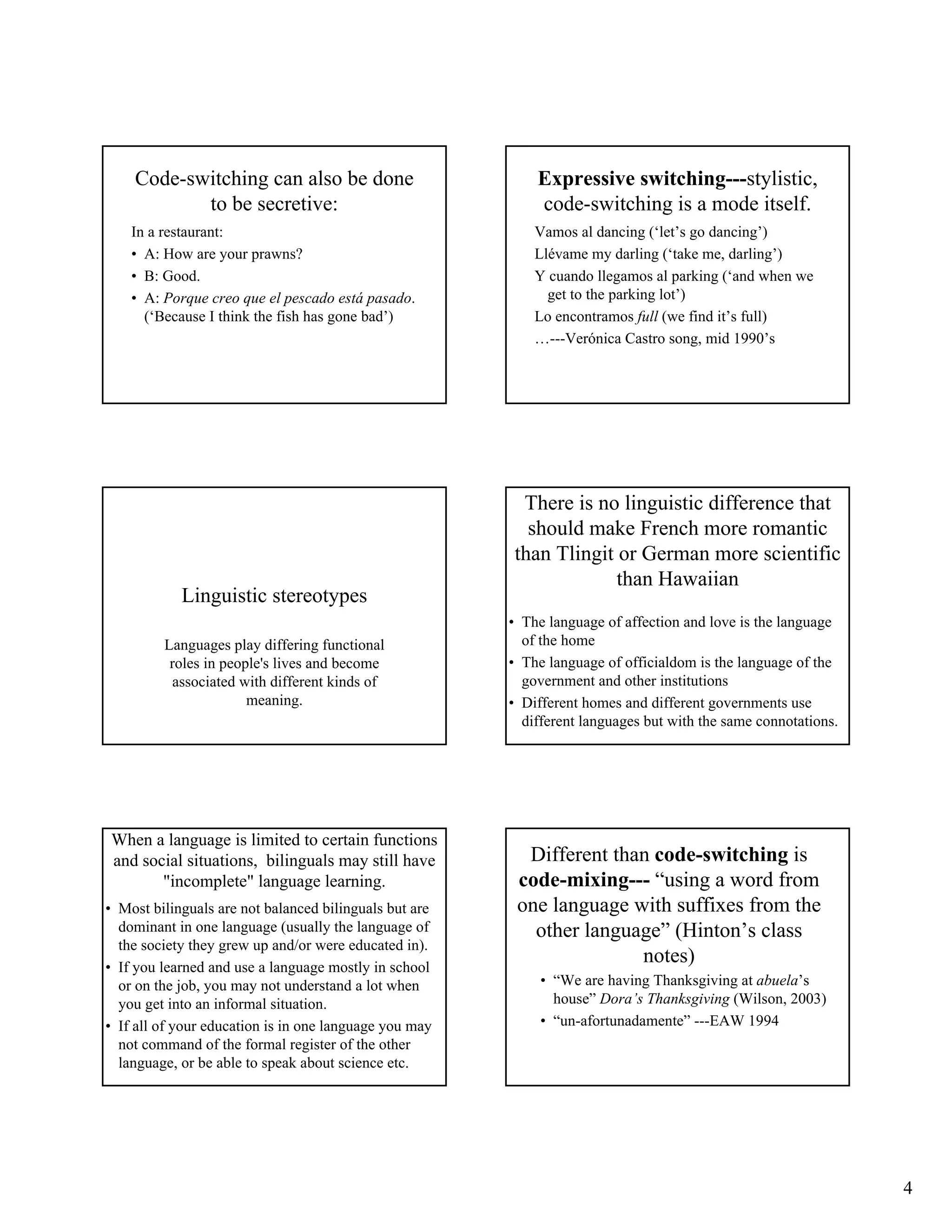
Code-switching can also be done 
to be secretive: 
In a restaurant: 
• A: How are your prawns? 
• B: Good. 
• A: Porque creo que el pescado está pasado. 
(‘Because I think the fish has gone bad’) 
Expressive switching---stylistic, 
code-switching is a mode itself. 
Vamos al dancing (‘let’s go dancing’) 
Llévame my darling (‘take me, darling’) 
Y cuando llegamos al parking (‘and when we 
get to the parking lot’) 
Lo encontramos full (we find it’s full) 
…---Verónica Castro song, mid 1990’s 
Linguistic stereotypes 
Languages play differing functional 
roles in people's lives and become 
associated with different kinds of 
meaning. 
There is no linguistic difference that 
should make French more romantic 
than Tlingit or German more scientific 
than Hawaiian 
• The language of affection and love is the language 
of the home 
• The language of officialdom is the language of the 
government and other institutions 
• Different homes and different governments use 
different languages but with the same connotations. 
When a language is limited to certain functions 
and social situations, bilinguals may still have 
"incomplete" language learning. 
• Most bilinguals are not balanced bilinguals but are 
dominant in one language (usually the language of 
the society they grew up and/or were educated in). 
• If you learned and use a language mostly in school 
or on the job, you may not understand a lot when 
you get into an informal situation. 
• If all of your education is in one language you may 
not command of the formal register of the other 
language, or be able to speak about science etc. 
Different than code-switching is 
code-mixing--- “using a word from 
one language with suffixes from the 
other language” (Hinton’s class 
notes) 
• “We are having Thanksgiving at abuela’s 
house” Dora’s Thanksgiving (Wilson, 2003) 
• “un-afortunadamente” ---EAW 1994
5 
But perhaps this could also 
include mixing phonologies (--- 
Rosemary) 
• “Hola, ¿esto es [ejvis]?” ---EAW from 
Oaxaca hotel (‘Hi, is this Avis?) English 
[ejv´s], Spanish [eBis] or [aBis] ‘three’ 
• [TRi]---overheard at a conference from a 
linguist who recently returned from Mexico 
• ‘Guatemala’ [waR´mala] ---Rosemary in 
class English instead of English 
[gwaR´mala] or Spanish: [(g)watemala]

55 2004-bilingualism

  • 1.
    1 Bilingualism •Diglossia • Borrowing • Code-switching Diglossia A sociolinguistic situation in which two languages ar varieties are spoken in a community with one language having higher status or prestige Borrowing • Language contact results in borrowing even when there isn’t widespread bilingualism: chow mein, spaghetti, pad thai, tacos, crepes, soba noodles (‘noodle noodles’), bratwurst, tabouleh, samosas, couscous, maize, chocolate... • Bilingual people can borrow even more words: – Get me my [®ejb √ws √w] Code Switching People who are bilingual tend to switch back and forth between two languages not only in different social situations but also within the same conversation. Codeswitching is different from borrowing, even though bilinguals may borrow words that monolinguals are not familiar with • Honey, can you get me my [m√w»tSil´]? vs. • I’m going to [»meçiko] Codeswitching examples from My Journey Home • Armando, pero my god • Chip---como se le llama, Armando? (A. answers My Three Sons)---Chip from My Three Sons…y este es Ernie • There’s something I’ve been meaning to tell you, pero I didn’t
  • 2.
    2 • Matrixlanguage---the main language of the utterance • Embedding language---the language being inserted into the utterance People tend to have one of two attitudes towards code-switching: • It is grammatically incorrect, poor usage of the language(s) and a sign of a lack of education and/or linguistic incompetence • It is cool and expressive of biculturalism All bilingual people code-switch to some extent. It is a sign of linguistic resourcefulness. Codeswitching may happen more when a speech community is on the way to language shift, because: • in this situation there is more bilingualism • both languages are coming to share the same social domain There are different syntactic types of codeswitching: • tag switching---Tag words (like “you know”) are switched: “She went back home again ¿verdad?” • intersentential switching---switching between sentences: “I’m going pee-pee. ¡Ven aquí!” ---ENAB 11/22/2003 • intrasentential switching---switching in mid sentence, usually nouns and noun phrases: “Here estoy” Bilingual speakers often believe they switch because they don't know a term; but often switching occurs where speakers know the word in both languages.
  • 3.
    3 One commonpractice is to repeat the same thing in both languages. • “¿Más agua? Do you want some more water?” • E: “Nice caballo.” R: “Yeah, nice horse. Buen caballo.” Researchers have identified different types of codeswitching according to social and semantic contexts including: • Situational switching • Metaphorical switching • Referential switching • Directive switching • Expressive switching Situational Codeswitching In Norway a local dialect is used for greetings, inquiries about one’s family, while Standard Norwegian is used for business transactions Metaphorical switching • “¡Ven acá! ¡Ven acá! Come here, you! • “Yano-san-wa (‘as for Mr. Yano’), he was speaking all in English. • ¿Hiciste tu homework? • Gov. Schwarzennegger has said that his kids know he’s serious about them doing something when he starts counting to three and that if he’s counting in German they really know he means business. Referential switching---talking about a subject that normally is done in the other language When we were dating we really liked to bailar las cumbias. Directive switching---which conversational participant is it directed to? • R to F(in Spanish): ‘How much do you want for this rug? • L to F (in Spanish): ‘Give her a good price.’ • F to L (in Valley Zapotec): ‘What do you think/how much did we pay for it/XXX?’ • L to F (in Valley Zapotec): ‘It cost us ___, why don’t you tell her ___.’ • F to R (in Spanish): ‘500 pesos.’
  • 4.
    4 Code-switching canalso be done to be secretive: In a restaurant: • A: How are your prawns? • B: Good. • A: Porque creo que el pescado está pasado. (‘Because I think the fish has gone bad’) Expressive switching---stylistic, code-switching is a mode itself. Vamos al dancing (‘let’s go dancing’) Llévame my darling (‘take me, darling’) Y cuando llegamos al parking (‘and when we get to the parking lot’) Lo encontramos full (we find it’s full) …---Verónica Castro song, mid 1990’s Linguistic stereotypes Languages play differing functional roles in people's lives and become associated with different kinds of meaning. There is no linguistic difference that should make French more romantic than Tlingit or German more scientific than Hawaiian • The language of affection and love is the language of the home • The language of officialdom is the language of the government and other institutions • Different homes and different governments use different languages but with the same connotations. When a language is limited to certain functions and social situations, bilinguals may still have "incomplete" language learning. • Most bilinguals are not balanced bilinguals but are dominant in one language (usually the language of the society they grew up and/or were educated in). • If you learned and use a language mostly in school or on the job, you may not understand a lot when you get into an informal situation. • If all of your education is in one language you may not command of the formal register of the other language, or be able to speak about science etc. Different than code-switching is code-mixing--- “using a word from one language with suffixes from the other language” (Hinton’s class notes) • “We are having Thanksgiving at abuela’s house” Dora’s Thanksgiving (Wilson, 2003) • “un-afortunadamente” ---EAW 1994
  • 5.
    5 But perhapsthis could also include mixing phonologies (--- Rosemary) • “Hola, ¿esto es [ejvis]?” ---EAW from Oaxaca hotel (‘Hi, is this Avis?) English [ejv´s], Spanish [eBis] or [aBis] ‘three’ • [TRi]---overheard at a conference from a linguist who recently returned from Mexico • ‘Guatemala’ [waR´mala] ---Rosemary in class English instead of English [gwaR´mala] or Spanish: [(g)watemala]