
Presented to Sir Danish
Some of the definitions of bilingualism involve the
term language use: bilinguals are ‘people who need
and use two (or more) languages in their everyday
lives (Grosjean 1992:51)
According to Milroy & Muysken (1995:7), ‘perhaps
the central issue in bilingualism research is code-
switching’. As a matter of fact, in studies on
bilingual speech, there is much evidence that
bilinguals tend to mix their languages during
conversation, often within single utterances .
People may become bilingual either by acquiring
two languages at the same time in childhood or by
acquiring their first language learning a second
language sometime after age.
A ‘code’ is defined as a language or a dialect.
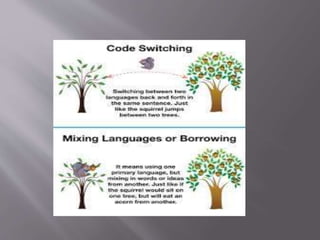
Code switching (CS) is an alternation of words
and phrases between two languages or dialects.
Mixing words or phrases from the two tongues
together during the course of speech or writing.
Language mixing means when a word of language A
or an utterance which contains elements from
languages A and B is mixed into the language
context of language B. The term early mixing states
that we are dealing with language mixing at an early
stage of language acquisition.
Mixing languages is normal process in learning 2
languages
“Code switching”
Using words and word order from one language with
words/ parts of words from another language
Saying one sentence in one language and following
sentence in the other
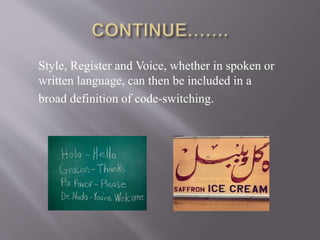
Style, Register and Voice, whether in spoken or
written language, can then be included in a
broad definition of code-switching.
In his study in 1976, Gumpers distinguishes
between the Situational code-switching ,
which concerns the situation the speakers are
exposed
Metaphorical code-switching , which
implicates language choice in order to attain special
communicative effects
While Intersentential code-switching involves
switches from one language to the other between
sentences, Intrasentential switching occurs within
the same sentence, from single-morpheme to
clause level.
Situational code-switching can be
considered as changes in language
choice due to the situation where the
speakers exist.
Conversational code-switching tends to
occur subconsciously as the speakers are
motivated by factors within the
conversation itself when it takes place.
In Asian countries, speakers who are bilingual usually
have English as their second language (L2) and their
first language (L1) is their mother tongue and
dialect.
European bilingual communities, French, German,
Spanish or Italian may use alternatively as the
language of classroom instruction.
It is a widely used in multilingual and multicultural
communities.
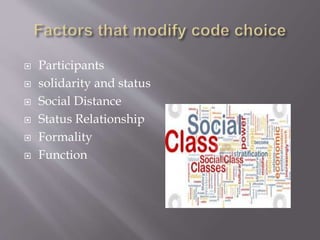
 Participants
 solidarity and status
 Social Distance
 Status Relationship
 Formality
 Function
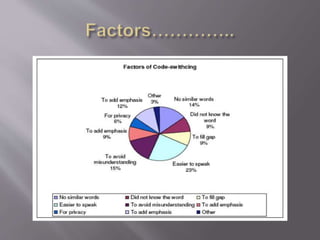
 No similar words in English
 Did not know the English word
 To fill the gap in speaking
 Easier to speak in own language
 To avoid misunderstanding
 To convey intimacy
 So others would not understand (Privacy)
 To add emphasis
 Other reasons
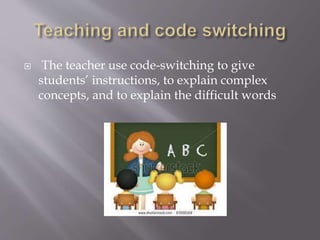
 The teacher use code-switching to give
students’ instructions, to explain complex
concepts, and to explain the difficult words
Expressive Functions The teacher uses code-switching to express the
emotions.
Mata linguistic Functions, paraphrasing others’ words, and some metaphors.
Directive Functions this function is used in a situation where a speaker wants
to direct someone
Poetic Functions s, it means that during the conversation, the speaker inserted
some jokes, stories, some poetic quotations into an English- based
conversation.
Referential Functions The first one is terms that lack readily available in the
other languages.
The second one is terms that lack semantically appropriate words in other
languages.
The final one is that terms with which the speakers are more familiar in L1
than in L2.
Skiba (1997) suggests that code switching is
used in language classrooms and other social
contexts because of an inability of expression
and it provides continuity in speech rather than
interference in the flow of linguistic expression.
In this respect code switching can be seen as a
supporting element in communication of
information and in social interaction. Thus it
enhances communication and is used as a tool
for transference of meaning.

Code switiching

  • 2.
  • 3.
    Some of thedefinitions of bilingualism involve the term language use: bilinguals are ‘people who need and use two (or more) languages in their everyday lives (Grosjean 1992:51)
  • 4.
    According to Milroy& Muysken (1995:7), ‘perhaps the central issue in bilingualism research is code- switching’. As a matter of fact, in studies on bilingual speech, there is much evidence that bilinguals tend to mix their languages during conversation, often within single utterances .
  • 5.
    People may becomebilingual either by acquiring two languages at the same time in childhood or by acquiring their first language learning a second language sometime after age.
  • 6.
    A ‘code’ isdefined as a language or a dialect. Code switching (CS) is an alternation of words and phrases between two languages or dialects. Mixing words or phrases from the two tongues together during the course of speech or writing.
  • 7.
    Language mixing meanswhen a word of language A or an utterance which contains elements from languages A and B is mixed into the language context of language B. The term early mixing states that we are dealing with language mixing at an early stage of language acquisition.
  • 8.
    Mixing languages isnormal process in learning 2 languages “Code switching” Using words and word order from one language with words/ parts of words from another language Saying one sentence in one language and following sentence in the other
  • 9.
    Style, Register andVoice, whether in spoken or written language, can then be included in a broad definition of code-switching.
  • 11.
    In his studyin 1976, Gumpers distinguishes between the Situational code-switching , which concerns the situation the speakers are exposed Metaphorical code-switching , which implicates language choice in order to attain special communicative effects
  • 12.
    While Intersentential code-switchinginvolves switches from one language to the other between sentences, Intrasentential switching occurs within the same sentence, from single-morpheme to clause level.
  • 13.
    Situational code-switching canbe considered as changes in language choice due to the situation where the speakers exist. Conversational code-switching tends to occur subconsciously as the speakers are motivated by factors within the conversation itself when it takes place.
  • 14.
    In Asian countries,speakers who are bilingual usually have English as their second language (L2) and their first language (L1) is their mother tongue and dialect. European bilingual communities, French, German, Spanish or Italian may use alternatively as the language of classroom instruction. It is a widely used in multilingual and multicultural communities.
  • 15.
     Participants  solidarityand status  Social Distance  Status Relationship  Formality  Function
  • 16.
     No similarwords in English  Did not know the English word  To fill the gap in speaking  Easier to speak in own language  To avoid misunderstanding  To convey intimacy  So others would not understand (Privacy)  To add emphasis  Other reasons
  • 18.
     The teacheruse code-switching to give students’ instructions, to explain complex concepts, and to explain the difficult words
  • 19.
    Expressive Functions Theteacher uses code-switching to express the emotions. Mata linguistic Functions, paraphrasing others’ words, and some metaphors. Directive Functions this function is used in a situation where a speaker wants to direct someone Poetic Functions s, it means that during the conversation, the speaker inserted some jokes, stories, some poetic quotations into an English- based conversation. Referential Functions The first one is terms that lack readily available in the other languages. The second one is terms that lack semantically appropriate words in other languages. The final one is that terms with which the speakers are more familiar in L1 than in L2.
  • 20.
    Skiba (1997) suggeststhat code switching is used in language classrooms and other social contexts because of an inability of expression and it provides continuity in speech rather than interference in the flow of linguistic expression. In this respect code switching can be seen as a supporting element in communication of information and in social interaction. Thus it enhances communication and is used as a tool for transference of meaning.