

Pidgin & Creoles
Contact languages
 Introduction
 History/origin
 Characteristics
 Developmental stages
 Comparison
 Conclusion
Outlines:
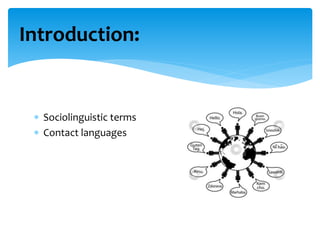
 Sociolinguistic terms
 Contact languages
Introduction:
 Some of the geographical meanings for pidgin are:
In Chinese means business
In Portuguese means ‘job or occupation’
In South American language means ‘people’
In Hebrew word ‘barter’
Definition:
Pidgin is a simple speech-form used as a means
of communication among people who do not share a
common language.
Pidgin:
 Creole is a French word means ‘native to a locality or
country’
Definition:
Creole is a stable natural language that has
developed from a pidgin.
Creole:
History/Origin of pidgin and creole
 Originated from temporary events:
trade
seafaring
tourism
 Traumatic social situation:
wars
slavery
 Baby talk theory
 Independent parallel development theory
 Nautical jargon theory
 Monogenetic/relaxification theory
 Universalist theory
Theories of origin:
Characteristics of pidgin & creole
 A product of multi-lingual
 Unstable grammar
 Socially limited
 Not a mean of group identification
 Short lived
 S-V-O syntax
 No affixation
 Limited vocabulary
characteristics of pidgin:
 Product of expanded pidgin
 Nativization
 Consistency
 Stable grammar
 Expanded vocabulary
 Systematic
 Complex sentence structure
 Long lived (attained as mother tongue)
Characteristics of creole:
Development of pidgin & creole
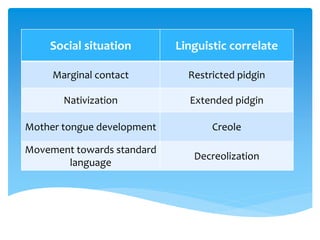
Social situation Linguistic correlate
Marginal contact Restricted pidgin
Nativization Extended pidgin
Mother tongue development Creole
Movement towards standard
language
Decreolization
Comparison between
Pidgin Creole
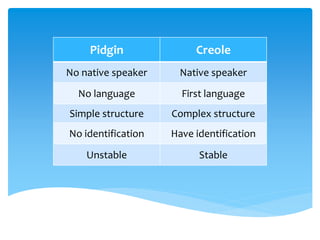
Pidgin Creole
No native speaker Native speaker
No language First language
Simple structure Complex structure
No identification Have identification
Unstable Stable
 Marginal languages.
 Born unconsciously from inter-linguist social
communication.
 Related to each other.
 Have specific characteristics.
 Have geographical and social affection.
 Are systematic & can be investigated or learnt.
Conclusion
Pidgin & creoles

Pidgin & creoles

  • 1.
  • 2.
     Introduction  History/origin Characteristics  Developmental stages  Comparison  Conclusion Outlines:
  • 3.
     Sociolinguistic terms Contact languages Introduction:
  • 4.
     Some ofthe geographical meanings for pidgin are: In Chinese means business In Portuguese means ‘job or occupation’ In South American language means ‘people’ In Hebrew word ‘barter’ Definition: Pidgin is a simple speech-form used as a means of communication among people who do not share a common language. Pidgin:
  • 5.
     Creole isa French word means ‘native to a locality or country’ Definition: Creole is a stable natural language that has developed from a pidgin. Creole:
  • 6.
    History/Origin of pidginand creole  Originated from temporary events: trade seafaring tourism  Traumatic social situation: wars slavery
  • 7.
     Baby talktheory  Independent parallel development theory  Nautical jargon theory  Monogenetic/relaxification theory  Universalist theory Theories of origin:
  • 8.
  • 9.
     A productof multi-lingual  Unstable grammar  Socially limited  Not a mean of group identification  Short lived  S-V-O syntax  No affixation  Limited vocabulary characteristics of pidgin:
  • 10.
     Product ofexpanded pidgin  Nativization  Consistency  Stable grammar  Expanded vocabulary  Systematic  Complex sentence structure  Long lived (attained as mother tongue) Characteristics of creole:
  • 11.
  • 12.
    Social situation Linguisticcorrelate Marginal contact Restricted pidgin Nativization Extended pidgin Mother tongue development Creole Movement towards standard language Decreolization
  • 13.
  • 14.
    Pidgin Creole No nativespeaker Native speaker No language First language Simple structure Complex structure No identification Have identification Unstable Stable
  • 15.
     Marginal languages. Born unconsciously from inter-linguist social communication.  Related to each other.  Have specific characteristics.  Have geographical and social affection.  Are systematic & can be investigated or learnt. Conclusion