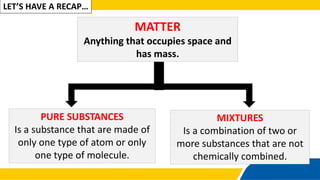
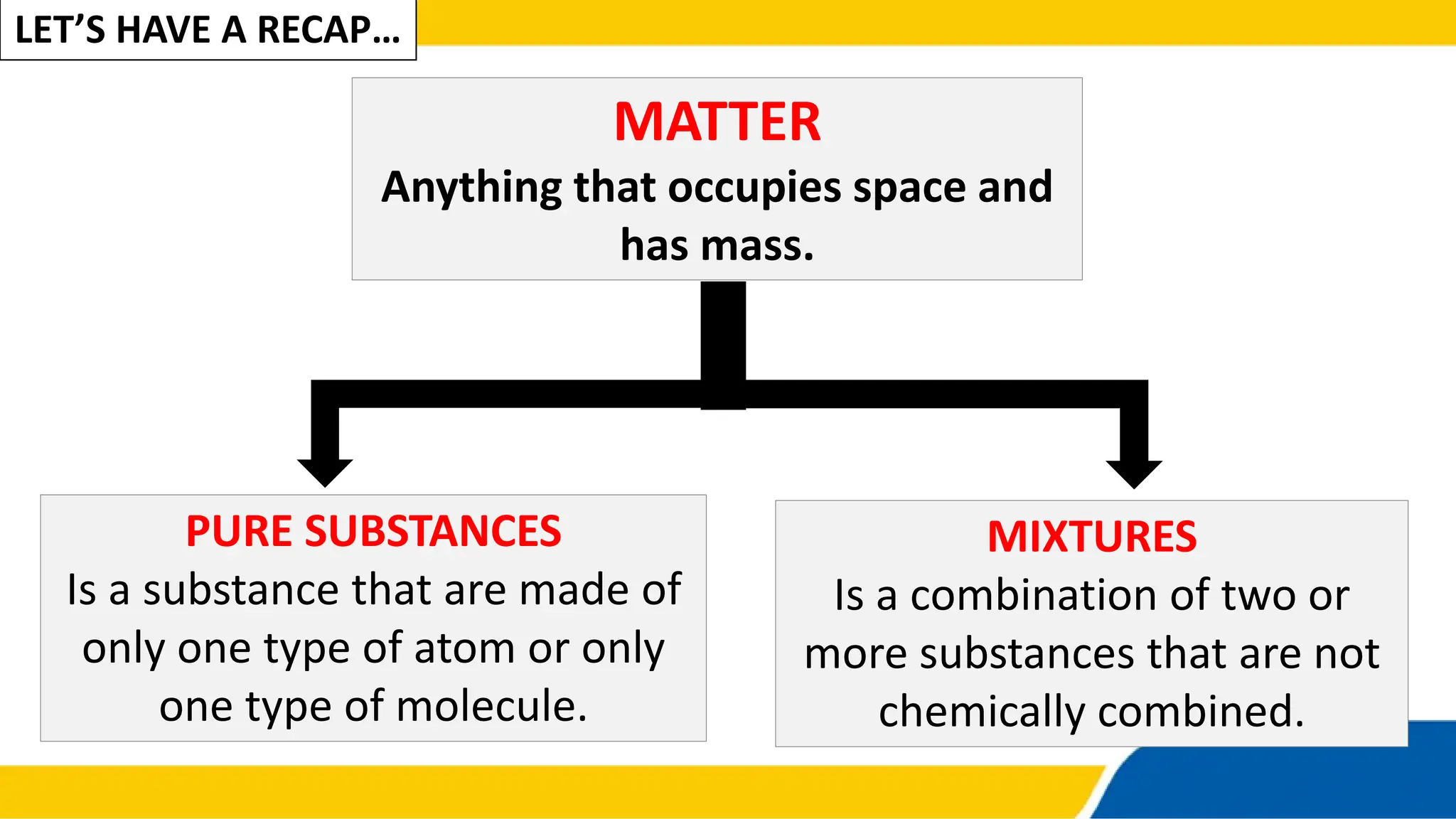

MATTER
Anything that occupies space and
has mass.
MIXTURES
Is a combination of two or
more substances that are not
chemically combined.
PURE SUBSTANCES
Is a substance that are made of
only one type of atom or only
one type of molecule.
LET’S HAVE A RECAP…
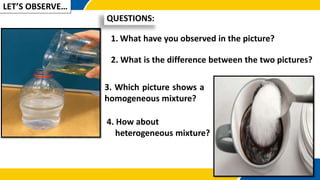
QUESTIONS:
LET’S OBSERVE…
1. What have you observed in the picture?
2. What is the difference between the two pictures?
3. Which picture shows a
homogeneous mixture?
4. How about
heterogeneous mixture?
Romans 12:4-5:
"Just as each of us has one body with many
members, and these members do not all have
the same function, so in Christ we, though
many, form one body, and each member
belongs to all the others."
At the end of the lesson, the students should be able to:
• identify the properties of homogeneous
and heterogeneous mixtures;
• differentiate types of mixtures based
on their particle size; and
• appreciate the importance of mixtures in our daily
lives by writing a reflection.
OBJECTIVES:
MIXTURE
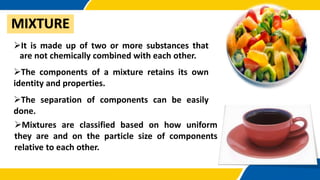
It is made up of two or more substances that
are not chemically combined with each other.
The components of a mixture retains its own
identity and properties.
The separation of components can be easily
done.
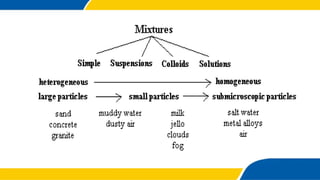
Mixtures are classified based on how uniform
they are and on the particle size of components
relative to each other.
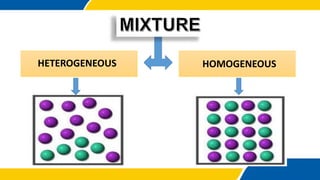
HOMOGENEOUS
HETEROGENEOUS
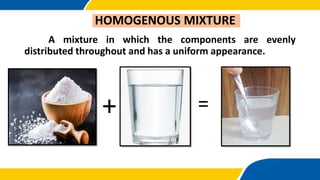
HOMOGENOUS MIXTURE
A mixture in which the components are evenly
distributed throughout and has a uniform appearance.
+ =
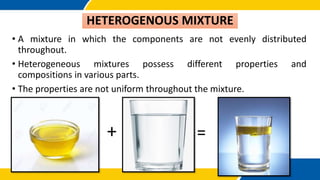
• A mixture in which the components are not evenly distributed
throughout.
• Heterogeneous mixtures possess different properties and
compositions in various parts.
• The properties are not uniform throughout the mixture.
HETEROGENOUS MIXTURE
+ =
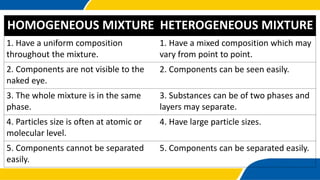
HOMOGENEOUS MIXTURE HETEROGENEOUS MIXTURE
1. Have a uniform composition
throughout the mixture.
1. Have a mixed composition which may
vary from point to point.
2. Components are not visible to the
naked eye.
2. Components can be seen easily.
3. The whole mixture is in the same
phase.
3. Substances can be of two phases and
layers may separate.
4. Particles size is often at atomic or
molecular level.
4. Have large particle sizes.
5. Components cannot be separated
easily.
5. Components can be separated easily.
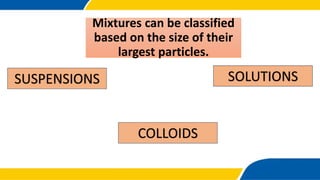
Mixtures can be classified
based on the size of their
largest particles.
SOLUTIONS
SUSPENSIONS
COLLOIDS
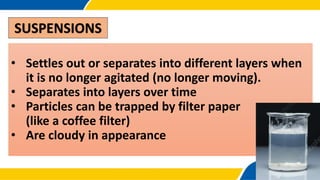
SUSPENSIONS
• Settles out or separates into different layers when
it is no longer agitated (no longer moving).
• Separates into layers over time
• Particles can be trapped by filter paper
(like a coffee filter)
• Are cloudy in appearance
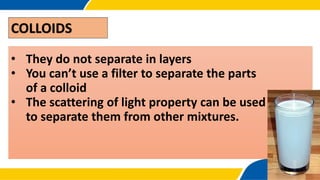
COLLOIDS
• They do not separate in layers
• You can’t use a filter to separate the parts
of a colloid
• The scattering of light property can be used
to separate them from other mixtures.
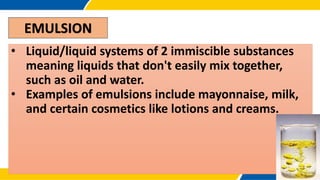
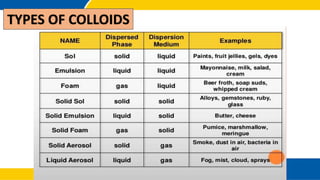
EMULSION
• Liquid/liquid systems of 2 immiscible substances
meaning liquids that don't easily mix together,
such as oil and water.
• Examples of emulsions include mayonnaise, milk,
and certain cosmetics like lotions and creams.
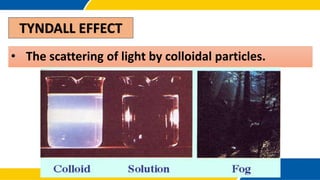
TYNDALL EFFECT
• The scattering of light by colloidal particles.
TYPES OF COLLOIDS
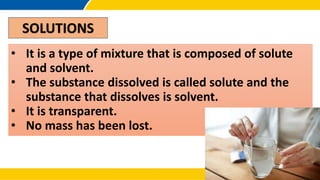
SOLUTIONS
• It is a type of mixture that is composed of solute
and solvent.
• The substance dissolved is called solute and the
substance that dissolves is solvent.
• It is transparent.
• No mass has been lost.
HOMOGENEOUS
MIXTURE
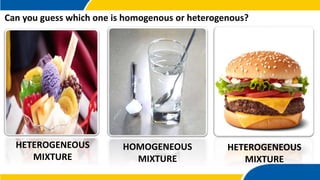
Can you guess which one is homogenous or heterogenous?
HETEROGENEOUS
MIXTURE
HETEROGENEOUS
MIXTURE
HOMOGENEOUS
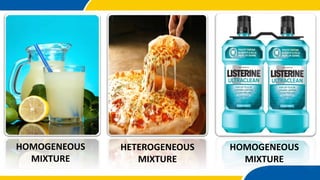
MIXTURE
HETEROGENEOUS
MIXTURE
HOMOGENEOUS
MIXTURE
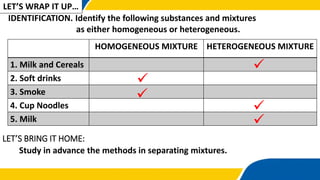
LET’S CHECK YOUR BRAIN…
HOMOGENEOUS MIXTURE HETEROGENEOUS MIXTURE
1. Milk and Cereals
2. Soft drinks
3. Smoke
4. Cup Noodles
5. Milk
IDENTIFICATION. Identify the following substances and mixtures
as either homogeneous or heterogeneous.

LET’S WRAP IT UP…




LET’S BRING IT HOME:
Study in advance the methods in separating mixtures.
LET’S REFLECT…
•Do you think mixtures are important in our daily lives?
•How can you appreciate the importance of mixtures?
•How important is it to you?
•How important is it at home?
LET’S BRING IT HOME:
•Research environmental issues related to pollution or
conservation and propose solutions based on their
knowledge of separating mixtures. As stewards of God’s
creation, how can you protect your own environment from
the threats of the mixture of pollutants?
•Check Schoology for more details.
•Submit on or before April 9, Tuesday.
Romans 12:4-5:
"Just as each of us has one body with many
members, and these members do not all have
the same function, so in Christ we, though
many, form one body, and each member
belongs to all the others."

ALL ABOUT MIXTURES IN GRADE 7 CLASS PPTX

  • 1.
    MATTER Anything that occupiesspace and has mass. MIXTURES Is a combination of two or more substances that are not chemically combined. PURE SUBSTANCES Is a substance that are made of only one type of atom or only one type of molecule. LET’S HAVE A RECAP…
  • 2.
    QUESTIONS: LET’S OBSERVE… 1. Whathave you observed in the picture? 2. What is the difference between the two pictures? 3. Which picture shows a homogeneous mixture? 4. How about heterogeneous mixture?
  • 3.
    Romans 12:4-5: "Just aseach of us has one body with many members, and these members do not all have the same function, so in Christ we, though many, form one body, and each member belongs to all the others."
  • 4.
    At the endof the lesson, the students should be able to: • identify the properties of homogeneous and heterogeneous mixtures; • differentiate types of mixtures based on their particle size; and • appreciate the importance of mixtures in our daily lives by writing a reflection. OBJECTIVES:
  • 5.
    MIXTURE It is madeup of two or more substances that are not chemically combined with each other. The components of a mixture retains its own identity and properties. The separation of components can be easily done. Mixtures are classified based on how uniform they are and on the particle size of components relative to each other.
  • 6.
  • 7.
    HOMOGENOUS MIXTURE A mixturein which the components are evenly distributed throughout and has a uniform appearance. + =
  • 8.
    • A mixturein which the components are not evenly distributed throughout. • Heterogeneous mixtures possess different properties and compositions in various parts. • The properties are not uniform throughout the mixture. HETEROGENOUS MIXTURE + =
  • 9.
    HOMOGENEOUS MIXTURE HETEROGENEOUSMIXTURE 1. Have a uniform composition throughout the mixture. 1. Have a mixed composition which may vary from point to point. 2. Components are not visible to the naked eye. 2. Components can be seen easily. 3. The whole mixture is in the same phase. 3. Substances can be of two phases and layers may separate. 4. Particles size is often at atomic or molecular level. 4. Have large particle sizes. 5. Components cannot be separated easily. 5. Components can be separated easily.
  • 10.
    Mixtures can beclassified based on the size of their largest particles. SOLUTIONS SUSPENSIONS COLLOIDS
  • 12.
    SUSPENSIONS • Settles outor separates into different layers when it is no longer agitated (no longer moving). • Separates into layers over time • Particles can be trapped by filter paper (like a coffee filter) • Are cloudy in appearance
  • 13.
    COLLOIDS • They donot separate in layers • You can’t use a filter to separate the parts of a colloid • The scattering of light property can be used to separate them from other mixtures.
  • 14.
    EMULSION • Liquid/liquid systemsof 2 immiscible substances meaning liquids that don't easily mix together, such as oil and water. • Examples of emulsions include mayonnaise, milk, and certain cosmetics like lotions and creams.
  • 15.
    TYNDALL EFFECT • Thescattering of light by colloidal particles.
  • 16.
  • 17.
    SOLUTIONS • It isa type of mixture that is composed of solute and solvent. • The substance dissolved is called solute and the substance that dissolves is solvent. • It is transparent. • No mass has been lost.
  • 18.
    HOMOGENEOUS MIXTURE Can you guesswhich one is homogenous or heterogenous? HETEROGENEOUS MIXTURE HETEROGENEOUS MIXTURE
  • 19.
  • 20.
  • 21.
    HOMOGENEOUS MIXTURE HETEROGENEOUSMIXTURE 1. Milk and Cereals 2. Soft drinks 3. Smoke 4. Cup Noodles 5. Milk IDENTIFICATION. Identify the following substances and mixtures as either homogeneous or heterogeneous.  LET’S WRAP IT UP…     LET’S BRING IT HOME: Study in advance the methods in separating mixtures.
  • 22.
    LET’S REFLECT… •Do youthink mixtures are important in our daily lives? •How can you appreciate the importance of mixtures? •How important is it to you? •How important is it at home?
  • 23.
    LET’S BRING ITHOME: •Research environmental issues related to pollution or conservation and propose solutions based on their knowledge of separating mixtures. As stewards of God’s creation, how can you protect your own environment from the threats of the mixture of pollutants? •Check Schoology for more details. •Submit on or before April 9, Tuesday.
  • 24.
    Romans 12:4-5: "Just aseach of us has one body with many members, and these members do not all have the same function, so in Christ we, though many, form one body, and each member belongs to all the others."