AAE 5060: Data Acquisition, Tracking &
Post Flight Analysis
Lecture 1: Introduction to Measurement
Systems
Dr. S. Meenatchisundaram
Email: meenasundar@gmail.com
Introduction
• Measurement:
• Process of gathering information from a physical world
and comparing this information with known standard
(References)
• Purpose:
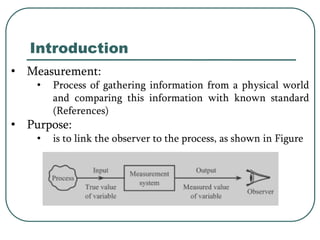
• is to link the observer to the process, as shown in Figure
Introduction
• We can refer to the information variable as a measured
variable.
• The input to the measurement system is the true value
of the variable; the system output is the measured
value of the variable.
• The accuracy of the system can be defined as the
closeness of the measured value to the true value.
• A perfectly accurate system is a theoretical ideal and
the accuracy of a real system is quantified using
measurement system error E,
E = measured value − true value
E = system output − system input
Common Physical Variables
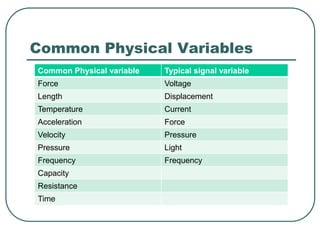
Common Physical variable Typical signal variable
Force Voltage
Length Displacement
Temperature Current
Acceleration Force
Velocity Pressure
Pressure Light
Frequency Frequency
Capacity
Resistance
Time
Common Physical variable Typical signal variable
Classification of Measurement
• Direct Method
• In this method, the value of a quantity is obtained
directly by comparing the unknown with the
standard.
• Direct methods are common for the measurement of
physical quantities such as length, mass and time.
• It involves no mathematical calculations to arrive at
the results, for example, measurement of length by a
graduated scale.
• The method is not very accurate because it depends on
human insensitiveness in making judgment.
Classification of Measurement
• Indirect Method
• In this method several parameters (to which the
quantity to be measured is linked with) are measured
directly and then the value is determined by
mathematical relationship.
• For example, measurement of density by measuring
mass and geometrical dimensions.
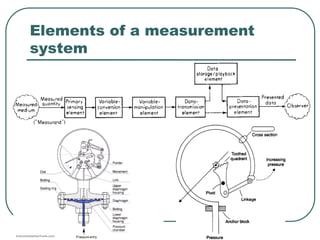
Elements of a measurement
system
Elements of a measurement
system
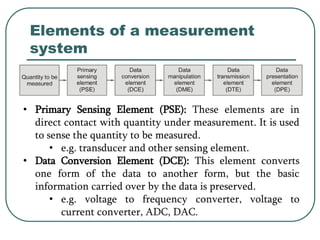
• Primary Sensing Element (PSE): These elements are in
direct contact with quantity under measurement. It is used
to sense the quantity to be measured.
• e.g. transducer and other sensing element.
• Data Conversion Element (DCE): This element converts
one form of the data to another form, but the basic
information carried over by the data is preserved.
• e.g. voltage to frequency converter, voltage to
current converter, ADC, DAC.
Elements of a measurement
system
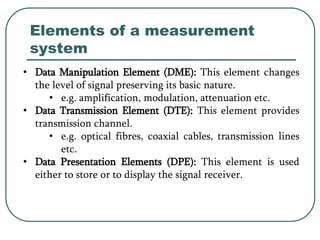
• Data Manipulation Element (DME): This element changes
the level of signal preserving its basic nature.
• e.g. amplification, modulation, attenuation etc.
• Data Transmission Element (DTE): This element provides
transmission channel.
• e.g. optical fibres, coaxial cables, transmission lines
etc.
• Data Presentation Elements (DPE): This element is used
either to store or to display the signal receiver.
References:
• John P. Bentley, “Principles of Measurement Systems”, Fourth
Edition, Pearson Education Limited, 2005.
• Ernest O. Doebelin, “Measurement Systems: Application and
Design”, Fourth Edition, McGraw

Basics of Measurement Systems and Classification

  • 1.
    AAE 5060: DataAcquisition, Tracking & Post Flight Analysis Lecture 1: Introduction to Measurement Systems Dr. S. Meenatchisundaram Email: meenasundar@gmail.com
  • 2.
    Introduction • Measurement: • Processof gathering information from a physical world and comparing this information with known standard (References) • Purpose: • is to link the observer to the process, as shown in Figure
  • 3.
    Introduction • We canrefer to the information variable as a measured variable. • The input to the measurement system is the true value of the variable; the system output is the measured value of the variable. • The accuracy of the system can be defined as the closeness of the measured value to the true value. • A perfectly accurate system is a theoretical ideal and the accuracy of a real system is quantified using measurement system error E, E = measured value − true value E = system output − system input
  • 4.
    Common Physical Variables CommonPhysical variable Typical signal variable Force Voltage Length Displacement Temperature Current Acceleration Force Velocity Pressure Pressure Light Frequency Frequency Capacity Resistance Time Common Physical variable Typical signal variable
  • 5.
    Classification of Measurement •Direct Method • In this method, the value of a quantity is obtained directly by comparing the unknown with the standard. • Direct methods are common for the measurement of physical quantities such as length, mass and time. • It involves no mathematical calculations to arrive at the results, for example, measurement of length by a graduated scale. • The method is not very accurate because it depends on human insensitiveness in making judgment.
  • 6.
    Classification of Measurement •Indirect Method • In this method several parameters (to which the quantity to be measured is linked with) are measured directly and then the value is determined by mathematical relationship. • For example, measurement of density by measuring mass and geometrical dimensions.
  • 7.
    Elements of ameasurement system
  • 8.
    Elements of ameasurement system • Primary Sensing Element (PSE): These elements are in direct contact with quantity under measurement. It is used to sense the quantity to be measured. • e.g. transducer and other sensing element. • Data Conversion Element (DCE): This element converts one form of the data to another form, but the basic information carried over by the data is preserved. • e.g. voltage to frequency converter, voltage to current converter, ADC, DAC.
  • 9.
    Elements of ameasurement system • Data Manipulation Element (DME): This element changes the level of signal preserving its basic nature. • e.g. amplification, modulation, attenuation etc. • Data Transmission Element (DTE): This element provides transmission channel. • e.g. optical fibres, coaxial cables, transmission lines etc. • Data Presentation Elements (DPE): This element is used either to store or to display the signal receiver.
  • 10.
    References: • John P.Bentley, “Principles of Measurement Systems”, Fourth Edition, Pearson Education Limited, 2005. • Ernest O. Doebelin, “Measurement Systems: Application and Design”, Fourth Edition, McGraw