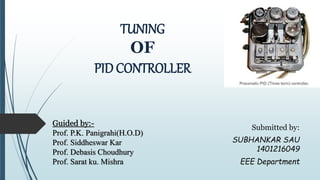
TUNING
OF
PID CONTROLLER
Submitted by:
SUBHANKAR SAU
1401216049
EEE Department
Guided by:-
Prof. P.K. Panigrahi(H.O.D)
Prof. Siddheswar Kar
Prof. Debasis Choudhury
Prof. Sarat ku. Mishra
CONTENTS:-
INTRODUCTION
PID CONTROLLER
TUNNING PROCESS
DIFFERENT TUNING METHODS
ZIEGLER-NICOLAS TUNNING METHOD
CONCLUSION
I N T R O D U C T I O N : -
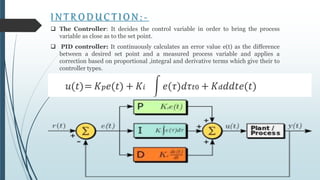
 The Controller: It decides the control variable in order to bring the process
variable as close as to the set point.
 PID controller: It continuously calculates an error value e(t) as the difference
between a desired set point and a measured process variable and applies a
correction based on proportional ,integral and derivative terms which give their to
controller types.
PID Controller:-
 Proportional Term(P): It is a constant directly related to the amount of the error. If you have
large error ,the term gives you a large output, and if you have a small error, it will give you a
small output. In simple term affects the speed to reach your target.
 Integral Term(I): It is constant related to integration(summation) of errors over time. If your
error is increasing, this term gives you a large output. However if the error is decreasing, the I
term give you a small output. Thus it is used to fine tune your results i.e. when you almost reach
your goal, the P term can not serve you any more.
 Derivative Term(D): It is constant related to the rate of change of errors with time. i.e you have
a highly dynamic systems like a multi-coptor, the D-term will give you higher output to catch up
with the changes.
NEED
OF
PID CONTROLLER:-
PARAMETER RISE TIME OVERSHOO
T
SETTLING
TIME
STEADY-
STATE
ERROR
STABILITY
Kp Decrease Increase Small
Change
Decrease Degrade
Ki Decrease Increase Increase Eliminate Degrade
Kd Minor
Change
Decrease Decrease No Effect Improve if
Kd Small
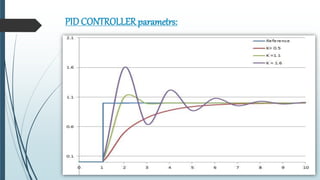
PID CONTROLLER parametrs:
TUNING PROCEDURES OF
PID CONTROLLER:-
1) After nulling all the parameters ,increase the P term so that the output reaches the
target in shortest possible time.
2) If your output starts oscillating ,it means you have too much P. lower your P term
until the oscillation disappears. You will end up slightly higher or lower than
your target.
3) Now increase I term slightly until your errors goes away. Note that usual I values
are very small and they are dependent on the update rate of your PID loop. If you
feel your output is oscillating lower your I term.
4) Now for highly dynamic system we need to adjust the D term also.
5) If your system starts oscillating with high frequency and small transition it
means we have too much D term which is amplifying the noise. If it has too
much noise its better to keep the D parameter to zero.
6) At last watch your limits . If you are changing the previous parameters without
any noticeable change in the output
This Completes the tuning procedure of the PID Controller.
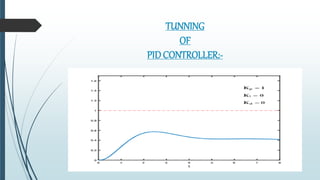
TUNNING
OF
PID CONTROLLER:-
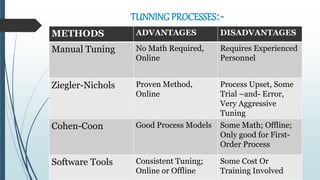
TUNNING PROCESSES:-
METHODS ADVANTAGES DISADVANTAGES
Manual Tuning No Math Required,
Online
Requires Experienced
Personnel
Ziegler-Nichols Proven Method,
Online
Process Upset, Some
Trial –and- Error,
Very Aggressive
Tuning
Cohen-Coon Good Process Models Some Math; Offline;
Only good for First-
Order Process
Software Tools Consistent Tuning;
Online or Offline
Some Cost Or
Training Involved
ZIEGLER-NICHOLUS METHOD
(OpenloopMethod):-
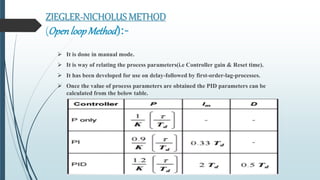
 It is done in manual mode.
 It is way of relating the process parameters(i.e Controller gain & Reset time).
 It has been developed for use on delay-followed by first-order-lag-processes.
 Once the value of process parameters are obtained the PID parameters can be
calculated from the below table.
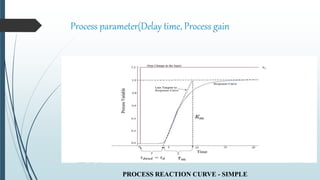
Process parameter(Delay time, Process gain
PROCESS REACTION CURVE - SIMPLE
ZIEGLER-NICHOLUS METHOD
(CloseloopMethod):-continue
 In controller automatic mode(operating condition), PV approximate to set point, change the
%PB of controller to maximum, Integral time maximum and Derivative time minimum,
then decrease %PB and take load step(change set-point or process loads) for monitor PV
responding until PV occur slight oscillation. Record %PB of Oscillate condition(Ultimate
controller gain ,Kcu) and Band width( ultimate period ,Pu).
ZIEGLER-NICHOLUS METHOD
(closeloopMethod):-continue
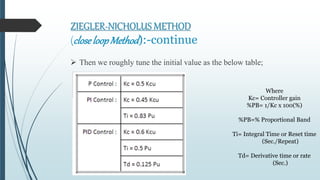
 Then we roughly tune the initial value as the below table;
Where
Kc= Controller gain
%PB= 1/Kc x 100(%)
%PB=% Proportional Band
Ti= Integral Time or Reset time
(Sec./Repeat)
Td= Derivative time or rate
(Sec.)
CONCLUSION:-
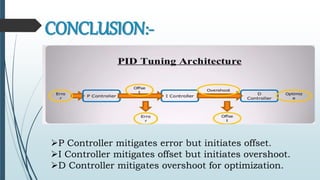
P Controller mitigates error but initiates offset.
I Controller mitigates offset but initiates overshoot.
D Controller mitigates overshoot for optimization.
Tuning of pid controller

Tuning of pid controller

  • 1.
    TUNING OF PID CONTROLLER Submitted by: SUBHANKARSAU 1401216049 EEE Department Guided by:- Prof. P.K. Panigrahi(H.O.D) Prof. Siddheswar Kar Prof. Debasis Choudhury Prof. Sarat ku. Mishra
  • 2.
    CONTENTS:- INTRODUCTION PID CONTROLLER TUNNING PROCESS DIFFERENTTUNING METHODS ZIEGLER-NICOLAS TUNNING METHOD CONCLUSION
  • 3.
    I N TR O D U C T I O N : -  The Controller: It decides the control variable in order to bring the process variable as close as to the set point.  PID controller: It continuously calculates an error value e(t) as the difference between a desired set point and a measured process variable and applies a correction based on proportional ,integral and derivative terms which give their to controller types.
  • 4.
    PID Controller:-  ProportionalTerm(P): It is a constant directly related to the amount of the error. If you have large error ,the term gives you a large output, and if you have a small error, it will give you a small output. In simple term affects the speed to reach your target.  Integral Term(I): It is constant related to integration(summation) of errors over time. If your error is increasing, this term gives you a large output. However if the error is decreasing, the I term give you a small output. Thus it is used to fine tune your results i.e. when you almost reach your goal, the P term can not serve you any more.  Derivative Term(D): It is constant related to the rate of change of errors with time. i.e you have a highly dynamic systems like a multi-coptor, the D-term will give you higher output to catch up with the changes.
  • 5.
    NEED OF PID CONTROLLER:- PARAMETER RISETIME OVERSHOO T SETTLING TIME STEADY- STATE ERROR STABILITY Kp Decrease Increase Small Change Decrease Degrade Ki Decrease Increase Increase Eliminate Degrade Kd Minor Change Decrease Decrease No Effect Improve if Kd Small
  • 6.
  • 7.
    TUNING PROCEDURES OF PIDCONTROLLER:- 1) After nulling all the parameters ,increase the P term so that the output reaches the target in shortest possible time. 2) If your output starts oscillating ,it means you have too much P. lower your P term until the oscillation disappears. You will end up slightly higher or lower than your target. 3) Now increase I term slightly until your errors goes away. Note that usual I values are very small and they are dependent on the update rate of your PID loop. If you feel your output is oscillating lower your I term. 4) Now for highly dynamic system we need to adjust the D term also. 5) If your system starts oscillating with high frequency and small transition it means we have too much D term which is amplifying the noise. If it has too much noise its better to keep the D parameter to zero. 6) At last watch your limits . If you are changing the previous parameters without any noticeable change in the output This Completes the tuning procedure of the PID Controller.
  • 8.
  • 9.
    TUNNING PROCESSES:- METHODS ADVANTAGESDISADVANTAGES Manual Tuning No Math Required, Online Requires Experienced Personnel Ziegler-Nichols Proven Method, Online Process Upset, Some Trial –and- Error, Very Aggressive Tuning Cohen-Coon Good Process Models Some Math; Offline; Only good for First- Order Process Software Tools Consistent Tuning; Online or Offline Some Cost Or Training Involved
  • 10.
    ZIEGLER-NICHOLUS METHOD (OpenloopMethod):-  Itis done in manual mode.  It is way of relating the process parameters(i.e Controller gain & Reset time).  It has been developed for use on delay-followed by first-order-lag-processes.  Once the value of process parameters are obtained the PID parameters can be calculated from the below table.
  • 11.
    Process parameter(Delay time,Process gain PROCESS REACTION CURVE - SIMPLE
  • 12.
    ZIEGLER-NICHOLUS METHOD (CloseloopMethod):-continue  Incontroller automatic mode(operating condition), PV approximate to set point, change the %PB of controller to maximum, Integral time maximum and Derivative time minimum, then decrease %PB and take load step(change set-point or process loads) for monitor PV responding until PV occur slight oscillation. Record %PB of Oscillate condition(Ultimate controller gain ,Kcu) and Band width( ultimate period ,Pu).
  • 13.
    ZIEGLER-NICHOLUS METHOD (closeloopMethod):-continue  Thenwe roughly tune the initial value as the below table; Where Kc= Controller gain %PB= 1/Kc x 100(%) %PB=% Proportional Band Ti= Integral Time or Reset time (Sec./Repeat) Td= Derivative time or rate (Sec.)
  • 14.
    CONCLUSION:- P Controller mitigateserror but initiates offset. I Controller mitigates offset but initiates overshoot. D Controller mitigates overshoot for optimization.