ICE401: PROCESS INSTRUMENTATION
AND CONTROL
Class 6: Basics of Mathematical
Modeling
Dr. S. Meenatchisundaram
Email: meenasundar@gmail.com
Process Instrumentation and Control (ICE 401)
Dr. S.Meenatchisundaram, MIT, Manipal, Jan – May 2015
The Rationale For Mathematical Modeling:
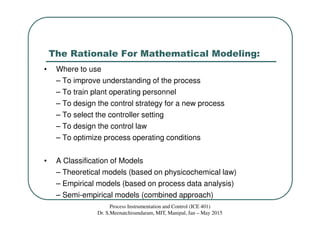
• Where to use
– To improve understanding of the process
– To train plant operating personnel
– To design the control strategy for a new process
– To select the controller setting
– To design the control law
– To optimize process operating conditions
• A Classification of Models
– Theoretical models (based on physicochemical law)
– Empirical models (based on process data analysis)
– Semi-empirical models (combined approach)
Process Instrumentation and Control (ICE 401)
Dr. S.Meenatchisundaram, MIT, Manipal, Jan – May 2015
Model Classification:
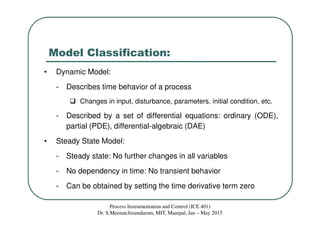
• Dynamic Model:
- Describes time behavior of a process
Changes in input, disturbance, parameters, initial condition, etc.
- Described by a set of differential equations: ordinary (ODE),
partial (PDE), differential-algebraic (DAE)
• Steady State Model:
- Steady state: No further changes in all variables
- No dependency in time: No transient behavior
- Can be obtained by setting the time derivative term zero
Process Instrumentation and Control (ICE 401)
Dr. S.Meenatchisundaram, MIT, Manipal, Jan – May 2015
Modeling Principles:
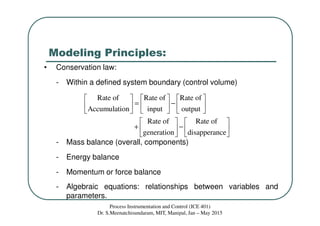
• Conservation law:
- Within a defined system boundary (control volume)
- Mass balance (overall, components)
- Energy balance
- Momentum or force balance
- Algebraic equations: relationships between variables and
parameters.
Process Instrumentation and Control (ICE 401)
Dr. S.Meenatchisundaram, MIT, Manipal, Jan – May 2015
Rate of Rate of Rate of
Accumulation input output
Rate of Rate of
generation disapperance
     
= −     
     
   
+ −   
   
Model Approaches:
Process Instrumentation and Control (ICE 401)
Dr. S.Meenatchisundaram, MIT, Manipal, Jan – May 2015
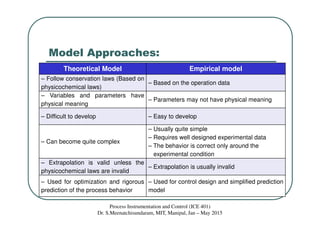
Theoretical Model Empirical model
– Follow conservation laws (Based on
physicochemical laws)
– Based on the operation data
– Variables and parameters have
physical meaning
– Parameters may not have physical meaning
– Difficult to develop – Easy to develop
– Can become quite complex
– Usually quite simple
– Requires well designed experimental data
– The behavior is correct only around the
experimental condition
– Extrapolation is valid unless the
physicochemical laws are invalid
– Extrapolation is usually invalid
– Used for optimization and rigorous
prediction of the process behavior
– Used for control design and simplified prediction
model
Degrees of Freedom:
The number of process variables over which the operator or designer
may exert control. Specifically, control degrees of freedom include:
1. The number of process variables that may be manipulated once
design specifications are set.
2. The number of said manipulated variables used in control loops.
3. The number of single-input, single-output control loops.
4. The number of regulated variables contained in control loops.
The following procedure identifies potential variables for
manipulation.
Process Instrumentation and Control (ICE 401)
Dr. S.Meenatchisundaram, MIT, Manipal, Jan – May 2015
Degrees of Freedom:
The method we will discuss is the Kwauk method, developed by
Kwauk and refined by Smith. The general equation follows:
Degrees of freedom = unknowns - equations
Unknowns are associated with mass or energy streams and include
pressure, temperature, or composition. If a unit had Ni inlet streams,
No outlets, and C components, then for design degrees of freedom,
C+2 unknowns can be associated with each stream. This means that
the designer would be manipulating the temperature, pressure, and
stream composition.
This sums to an equation of
Total Unknowns = Ni*(C+2) + No*(C+2)
Process Instrumentation and Control (ICE 401)
Dr. S.Meenatchisundaram, MIT, Manipal, Jan – May 2015
Degrees of Freedom:
• If the process involves an energy stream there is one unknown
associated with it, which is added to this value.
• Equations may be of several different types, including mass or
energy balances and equations of state such as the Ideal Gas
Law.
• After Degrees of Freedom are determined, the operator assigns
controls. Carrying out a DOF analysis allows planning and
understanding of the chemical process and is useful in systems
design.
Process Instrumentation and Control (ICE 401)
Dr. S.Meenatchisundaram, MIT, Manipal, Jan – May 2015
Degrees of Freedom:
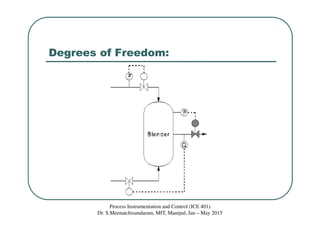
Example 1: Blender:
• This example investigates
degrees of freedom in a simple
vapor mixing unit.
• Two gaseous streams enter a
vessel and exit as a single well-
mixed stream (Figure).
• We will apply the above
equation to determine degrees
of freedom.
Process Instrumentation and Control (ICE 401)
Dr. S.Meenatchisundaram, MIT, Manipal, Jan – May 2015
Degrees of Freedom:
• Here, there are 3 streams, each with C+2 unknowns for a total of
3C+6 Unknowns.
• We have C mass balances and 1 energy balance for a total of
2C+1 equations. We also know composition, pressure, and
temperature for the incoming streams. This adds 2C+2 to the
equation. Putting everything together gives:
• Degrees of freedom = 3C+6 - (2C+1 + 2C+2)
• Hence, the system has 3 degrees of freedom. Therefore, we can
fix outlet composition, pressure, and flow rate. Figure shows an
example control scheme:
Process Instrumentation and Control (ICE 401)
Dr. S.Meenatchisundaram, MIT, Manipal, Jan – May 2015
Degrees of Freedom:
Process Instrumentation and Control (ICE 401)
Dr. S.Meenatchisundaram, MIT, Manipal, Jan – May 2015
Degrees of Freedom:
• Solution depending on DOF:
− If NF = 0, the system is exactly determined. Unique solution
exists.
− If NF > 0, the system is underdetermined. Infinitely many
solutions exist.
− If NF < 0, the system is overdetermined. No solutions exist.
Process Instrumentation and Control (ICE 401)
Dr. S.Meenatchisundaram, MIT, Manipal, Jan – May 2015

Class 6 basics of mathematical modeling

  • 1.
    ICE401: PROCESS INSTRUMENTATION ANDCONTROL Class 6: Basics of Mathematical Modeling Dr. S. Meenatchisundaram Email: meenasundar@gmail.com Process Instrumentation and Control (ICE 401) Dr. S.Meenatchisundaram, MIT, Manipal, Jan – May 2015
  • 2.
    The Rationale ForMathematical Modeling: • Where to use – To improve understanding of the process – To train plant operating personnel – To design the control strategy for a new process – To select the controller setting – To design the control law – To optimize process operating conditions • A Classification of Models – Theoretical models (based on physicochemical law) – Empirical models (based on process data analysis) – Semi-empirical models (combined approach) Process Instrumentation and Control (ICE 401) Dr. S.Meenatchisundaram, MIT, Manipal, Jan – May 2015
  • 3.
    Model Classification: • DynamicModel: - Describes time behavior of a process Changes in input, disturbance, parameters, initial condition, etc. - Described by a set of differential equations: ordinary (ODE), partial (PDE), differential-algebraic (DAE) • Steady State Model: - Steady state: No further changes in all variables - No dependency in time: No transient behavior - Can be obtained by setting the time derivative term zero Process Instrumentation and Control (ICE 401) Dr. S.Meenatchisundaram, MIT, Manipal, Jan – May 2015
  • 4.
    Modeling Principles: • Conservationlaw: - Within a defined system boundary (control volume) - Mass balance (overall, components) - Energy balance - Momentum or force balance - Algebraic equations: relationships between variables and parameters. Process Instrumentation and Control (ICE 401) Dr. S.Meenatchisundaram, MIT, Manipal, Jan – May 2015 Rate of Rate of Rate of Accumulation input output Rate of Rate of generation disapperance       = −                + −       
  • 5.
    Model Approaches: Process Instrumentationand Control (ICE 401) Dr. S.Meenatchisundaram, MIT, Manipal, Jan – May 2015 Theoretical Model Empirical model – Follow conservation laws (Based on physicochemical laws) – Based on the operation data – Variables and parameters have physical meaning – Parameters may not have physical meaning – Difficult to develop – Easy to develop – Can become quite complex – Usually quite simple – Requires well designed experimental data – The behavior is correct only around the experimental condition – Extrapolation is valid unless the physicochemical laws are invalid – Extrapolation is usually invalid – Used for optimization and rigorous prediction of the process behavior – Used for control design and simplified prediction model
  • 6.
    Degrees of Freedom: Thenumber of process variables over which the operator or designer may exert control. Specifically, control degrees of freedom include: 1. The number of process variables that may be manipulated once design specifications are set. 2. The number of said manipulated variables used in control loops. 3. The number of single-input, single-output control loops. 4. The number of regulated variables contained in control loops. The following procedure identifies potential variables for manipulation. Process Instrumentation and Control (ICE 401) Dr. S.Meenatchisundaram, MIT, Manipal, Jan – May 2015
  • 7.
    Degrees of Freedom: Themethod we will discuss is the Kwauk method, developed by Kwauk and refined by Smith. The general equation follows: Degrees of freedom = unknowns - equations Unknowns are associated with mass or energy streams and include pressure, temperature, or composition. If a unit had Ni inlet streams, No outlets, and C components, then for design degrees of freedom, C+2 unknowns can be associated with each stream. This means that the designer would be manipulating the temperature, pressure, and stream composition. This sums to an equation of Total Unknowns = Ni*(C+2) + No*(C+2) Process Instrumentation and Control (ICE 401) Dr. S.Meenatchisundaram, MIT, Manipal, Jan – May 2015
  • 8.
    Degrees of Freedom: •If the process involves an energy stream there is one unknown associated with it, which is added to this value. • Equations may be of several different types, including mass or energy balances and equations of state such as the Ideal Gas Law. • After Degrees of Freedom are determined, the operator assigns controls. Carrying out a DOF analysis allows planning and understanding of the chemical process and is useful in systems design. Process Instrumentation and Control (ICE 401) Dr. S.Meenatchisundaram, MIT, Manipal, Jan – May 2015
  • 9.
    Degrees of Freedom: Example1: Blender: • This example investigates degrees of freedom in a simple vapor mixing unit. • Two gaseous streams enter a vessel and exit as a single well- mixed stream (Figure). • We will apply the above equation to determine degrees of freedom. Process Instrumentation and Control (ICE 401) Dr. S.Meenatchisundaram, MIT, Manipal, Jan – May 2015
  • 10.
    Degrees of Freedom: •Here, there are 3 streams, each with C+2 unknowns for a total of 3C+6 Unknowns. • We have C mass balances and 1 energy balance for a total of 2C+1 equations. We also know composition, pressure, and temperature for the incoming streams. This adds 2C+2 to the equation. Putting everything together gives: • Degrees of freedom = 3C+6 - (2C+1 + 2C+2) • Hence, the system has 3 degrees of freedom. Therefore, we can fix outlet composition, pressure, and flow rate. Figure shows an example control scheme: Process Instrumentation and Control (ICE 401) Dr. S.Meenatchisundaram, MIT, Manipal, Jan – May 2015
  • 11.
    Degrees of Freedom: ProcessInstrumentation and Control (ICE 401) Dr. S.Meenatchisundaram, MIT, Manipal, Jan – May 2015
  • 12.
    Degrees of Freedom: •Solution depending on DOF: − If NF = 0, the system is exactly determined. Unique solution exists. − If NF > 0, the system is underdetermined. Infinitely many solutions exist. − If NF < 0, the system is overdetermined. No solutions exist. Process Instrumentation and Control (ICE 401) Dr. S.Meenatchisundaram, MIT, Manipal, Jan – May 2015