ICE401: PROCESS INSTRUMENTATION
AND CONTROL
Class 8: Mathematical Modeling of
Interacting and Non-Interacting Level
Systems
Dr. S. Meenatchisundaram
Email: meenasundar@gmail.com
Process Instrumentation and Control (ICE 401)
Dr. S.Meenatchisundaram, MIT, Manipal, Aug – Nov 2015
Liquid-Level Systems with Interaction:
Process Instrumentation and Control (ICE 401)
Dr. S.Meenatchisundaram, MIT, Manipal, Aug – Nov 2015
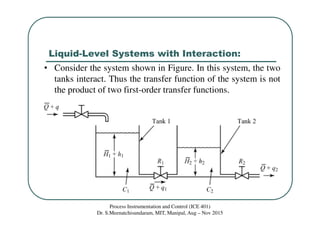
• Consider the system shown in Figure. In this system, the two
tanks interact. Thus the transfer function of the system is not
the product of two first-order transfer functions.
Liquid-Level Systems with Interaction:
Process Instrumentation and Control (ICE 401)
Dr. S.Meenatchisundaram, MIT, Manipal, Aug – Nov 2015
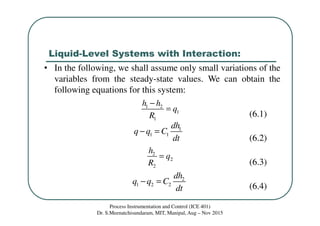
• In the following, we shall assume only small variations of the
variables from the steady-state values. We can obtain the
following equations for this system:
(6.1)
(6.2)
(6.3)
(6.4)
1 2
1
1
h h
q
R
−
=
1
1 1
dh
q q C
dt
− =
2
2
2
h
q
R
=
2
1 2 2
dh
q q C
dt
− =
Liquid-Level Systems with Interaction:
Process Instrumentation and Control (ICE 401)
Dr. S.Meenatchisundaram, MIT, Manipal, Aug – Nov 2015
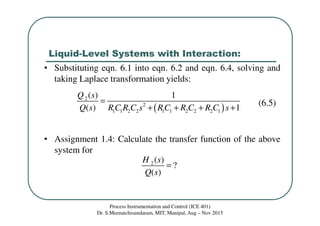
• Substituting eqn. 6.1 into eqn. 6.2 and eqn. 6.4, solving and
taking Laplace transformation yields:
(6.5)
• Assignment 1.4: Calculate the transfer function of the above
system for
( )
2
2
1 1 2 2 1 1 2 2 2 1
( ) 1
( ) 1
Q s
Q s RC R C s RC R C R C s
=
+ + + +
2( )
?
( )
H s
Q s
=
Liquid-Level Systems without Interaction:
Process Instrumentation and Control (ICE 401)
Dr. S.Meenatchisundaram, MIT, Manipal, Aug – Nov 2015
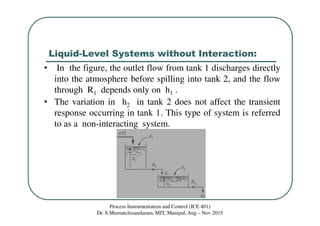
• In the figure, the outlet flow from tank 1 discharges directly
into the atmosphere before spilling into tank 2, and the flow
through R1 depends only on h1 .
• The variation in h2 in tank 2 does not affect the transient
response occurring in tank 1. This type of system is referred
to as a non-interacting system.
Liquid-Level Systems without Interaction:
Process Instrumentation and Control (ICE 401)
Dr. S.Meenatchisundaram, MIT, Manipal, Aug – Nov 2015
• In the following, we shall assume only small variations of the
variables from the steady-state values. We can obtain the
following equations for this system:
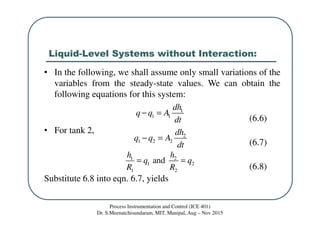
(6.6)
• For tank 2,
(6.7)
(6.8)
Substitute 6.8 into eqn. 6.7, yields
1
1 1
dh
q q A
dt
− =
1 2
1 2
1 2
and
h h
q q
R R
= =
2
1 2 2
dh
q q A
dt
− =
Liquid-Level Systems without Interaction:
Process Instrumentation and Control (ICE 401)
Dr. S.Meenatchisundaram, MIT, Manipal, Aug – Nov 2015
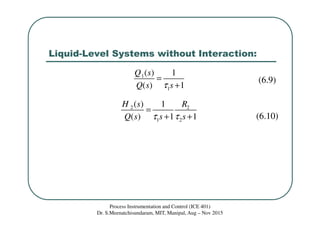
(6.9)
(6.10)
1
1
( ) 1
( ) 1
Q s
Q s sτ
=
+
2 2
1 2
( ) 1
( ) 1 1
H s R
Q s s sτ τ
=
+ +
Assignments:
Process Instrumentation and Control (ICE 401)
Dr. S.Meenatchisundaram, MIT, Manipal, Aug – Nov 2015
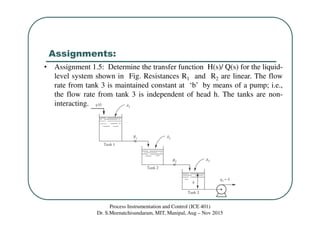
• Assignment 1.5: Determine the transfer function H(s)/ Q(s) for the liquid-
level system shown in Fig. Resistances R1 and R2 are linear. The flow
rate from tank 3 is maintained constant at ‘b’ by means of a pump; i.e.,
the flow rate from tank 3 is independent of head h. The tanks are non-
interacting.
References:
• Modern Control Engineering, 5th Edition, by Katsuhiko Ogata
• Measurement and Control Basics, 3rd Edition, by Thomas A.
Hughes.
• Process Control: Concepts Dynamics And Applications by Shio
Kumar Singh
Process Instrumentation and Control (ICE 401)
Dr. S.Meenatchisundaram, MIT, Manipal, Aug – Nov 2015

Class 8 mathematical modeling of interacting and non-interacting level systems

  • 1.
    ICE401: PROCESS INSTRUMENTATION ANDCONTROL Class 8: Mathematical Modeling of Interacting and Non-Interacting Level Systems Dr. S. Meenatchisundaram Email: meenasundar@gmail.com Process Instrumentation and Control (ICE 401) Dr. S.Meenatchisundaram, MIT, Manipal, Aug – Nov 2015
  • 2.
    Liquid-Level Systems withInteraction: Process Instrumentation and Control (ICE 401) Dr. S.Meenatchisundaram, MIT, Manipal, Aug – Nov 2015 • Consider the system shown in Figure. In this system, the two tanks interact. Thus the transfer function of the system is not the product of two first-order transfer functions.
  • 3.
    Liquid-Level Systems withInteraction: Process Instrumentation and Control (ICE 401) Dr. S.Meenatchisundaram, MIT, Manipal, Aug – Nov 2015 • In the following, we shall assume only small variations of the variables from the steady-state values. We can obtain the following equations for this system: (6.1) (6.2) (6.3) (6.4) 1 2 1 1 h h q R − = 1 1 1 dh q q C dt − = 2 2 2 h q R = 2 1 2 2 dh q q C dt − =
  • 4.
    Liquid-Level Systems withInteraction: Process Instrumentation and Control (ICE 401) Dr. S.Meenatchisundaram, MIT, Manipal, Aug – Nov 2015 • Substituting eqn. 6.1 into eqn. 6.2 and eqn. 6.4, solving and taking Laplace transformation yields: (6.5) • Assignment 1.4: Calculate the transfer function of the above system for ( ) 2 2 1 1 2 2 1 1 2 2 2 1 ( ) 1 ( ) 1 Q s Q s RC R C s RC R C R C s = + + + + 2( ) ? ( ) H s Q s =
  • 5.
    Liquid-Level Systems withoutInteraction: Process Instrumentation and Control (ICE 401) Dr. S.Meenatchisundaram, MIT, Manipal, Aug – Nov 2015 • In the figure, the outlet flow from tank 1 discharges directly into the atmosphere before spilling into tank 2, and the flow through R1 depends only on h1 . • The variation in h2 in tank 2 does not affect the transient response occurring in tank 1. This type of system is referred to as a non-interacting system.
  • 6.
    Liquid-Level Systems withoutInteraction: Process Instrumentation and Control (ICE 401) Dr. S.Meenatchisundaram, MIT, Manipal, Aug – Nov 2015 • In the following, we shall assume only small variations of the variables from the steady-state values. We can obtain the following equations for this system: (6.6) • For tank 2, (6.7) (6.8) Substitute 6.8 into eqn. 6.7, yields 1 1 1 dh q q A dt − = 1 2 1 2 1 2 and h h q q R R = = 2 1 2 2 dh q q A dt − =
  • 7.
    Liquid-Level Systems withoutInteraction: Process Instrumentation and Control (ICE 401) Dr. S.Meenatchisundaram, MIT, Manipal, Aug – Nov 2015 (6.9) (6.10) 1 1 ( ) 1 ( ) 1 Q s Q s sτ = + 2 2 1 2 ( ) 1 ( ) 1 1 H s R Q s s sτ τ = + +
  • 8.
    Assignments: Process Instrumentation andControl (ICE 401) Dr. S.Meenatchisundaram, MIT, Manipal, Aug – Nov 2015 • Assignment 1.5: Determine the transfer function H(s)/ Q(s) for the liquid- level system shown in Fig. Resistances R1 and R2 are linear. The flow rate from tank 3 is maintained constant at ‘b’ by means of a pump; i.e., the flow rate from tank 3 is independent of head h. The tanks are non- interacting.
  • 9.
    References: • Modern ControlEngineering, 5th Edition, by Katsuhiko Ogata • Measurement and Control Basics, 3rd Edition, by Thomas A. Hughes. • Process Control: Concepts Dynamics And Applications by Shio Kumar Singh Process Instrumentation and Control (ICE 401) Dr. S.Meenatchisundaram, MIT, Manipal, Aug – Nov 2015