ICE401: PROCESS INSTRUMENTATION
AND CONTROL
Class 29
PI, PD and PID Pneumatic Controllers
Dr. S. Meenatchisundaram
Email: meenasundar@gmail.com
Process Instrumentation and Control (ICE 401)
Dr. S.Meenatchisundaram, MIT, Manipal, Aug – Nov 2015
PI Controllers:
Process Instrumentation and Control (ICE 401)
Dr. S.Meenatchisundaram, MIT, Manipal, Aug – Nov 2015
PI Controllers:
Process Instrumentation and Control (ICE 401)
Dr. S.Meenatchisundaram, MIT, Manipal, Aug – Nov 2015
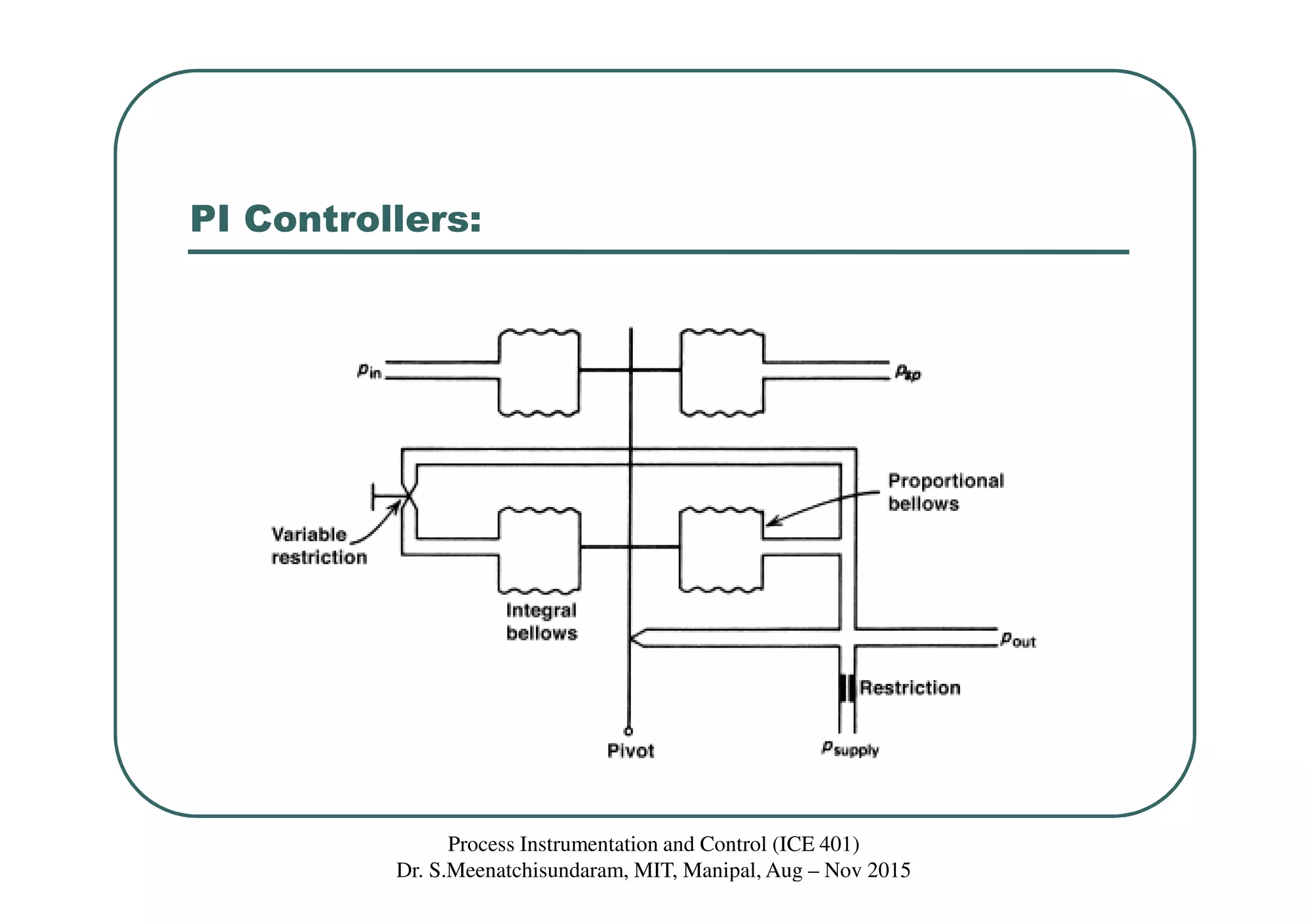
• In this case, an extra bellows with a variable restriction is added to
the proportional system.
• Suppose the input pressure shows a sudden increase. This drives
the flapper toward the nozzle, increasing output pressure until
the proportional bellows balances the input as in the previous case.
• The integral bellows is still at the original output pressure, because
the restriction prevents pressure changes from being transmitted
immediately.
• As the increased pressure on the output bleeds through the
restriction, the integral bellows slowly moves the flapper closer to
the nozzle, thereby causing a steady increase in output pressure.
• The variable restriction allows for variation of the leakage rate, and
hence the integration time.
PD Controllers:
Process Instrumentation and Control (ICE 401)
Dr. S.Meenatchisundaram, MIT, Manipal, Aug – Nov 2015
PD Controllers:
Process Instrumentation and Control (ICE 401)
Dr. S.Meenatchisundaram, MIT, Manipal, Aug – Nov 2015
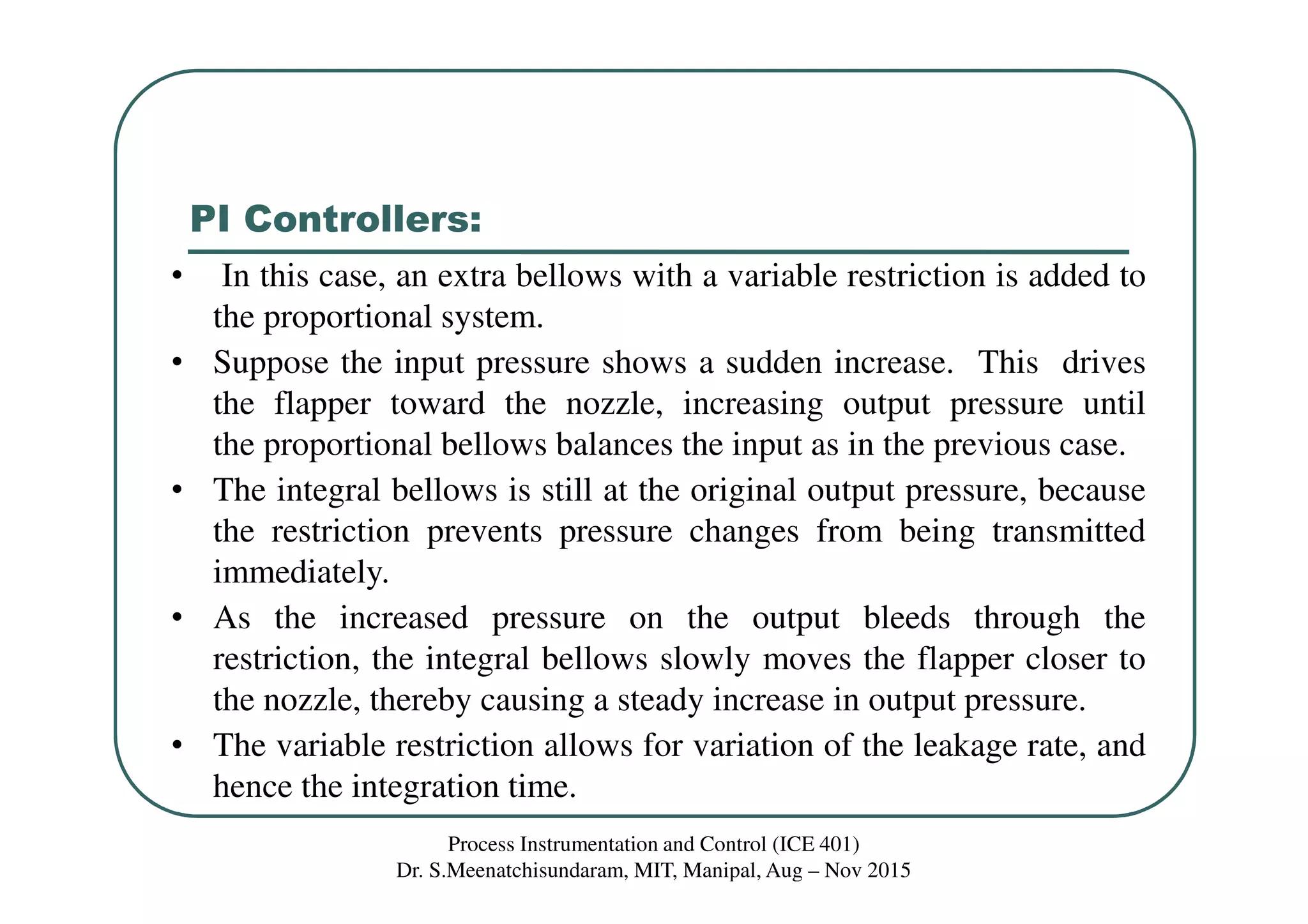
• A variable restriction is placed on the line leading to the balance
bellows.
• Thus, as the input pressure increases, the flapper is moved toward
the nozzle with no impedance, because the restrictions prevent an
immediate response of the balance bellows.
• Thus, the output pressure rises very fast and then, as the increased
pressure leaks into the balance bellows, decreases as the balance
bellows moves the flapper back away from the nozzle.
• Adjustment of the variable restriction allows for changing the
derivative time constraint.
PID Controllers:
Process Instrumentation and Control (ICE 401)
Dr. S.Meenatchisundaram, MIT, Manipal, Aug – Nov 2015
PD Controllers:
Process Instrumentation and Control (ICE 401)
Dr. S.Meenatchisundaram, MIT, Manipal, Aug – Nov 2015
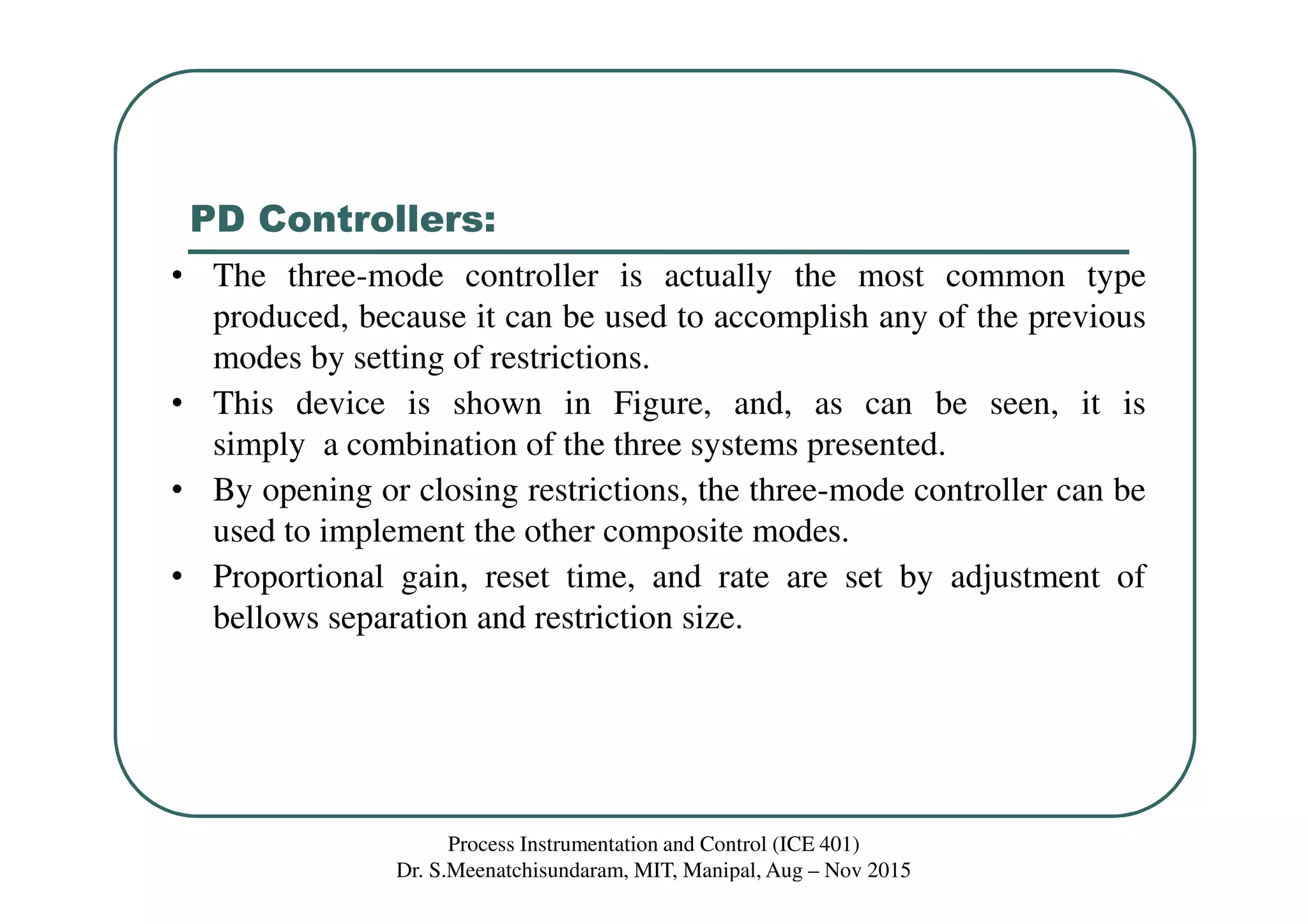
• The three-mode controller is actually the most common type
produced, because it can be used to accomplish any of the previous
modes by setting of restrictions.
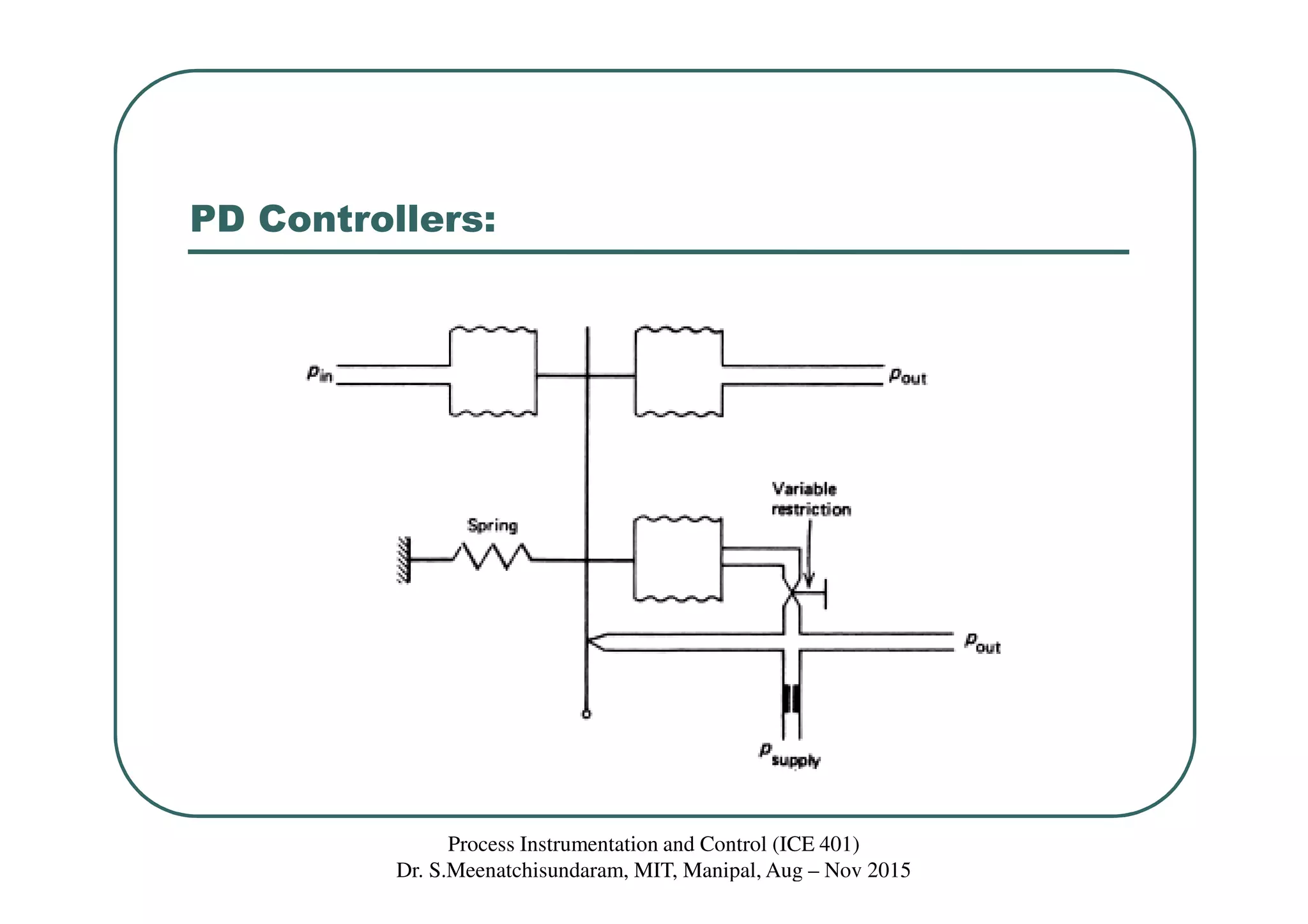
• This device is shown in Figure, and, as can be seen, it is
simply a combination of the three systems presented.
• By opening or closing restrictions, the three-mode controller can be
used to implement the other composite modes.
• Proportional gain, reset time, and rate are set by adjustment of
bellows separation and restriction size.
References:
• Process Control Instrumentation Technology, by Curtis D.
Johnson, Eighth Edition, Pearson Education Limited.
Process Instrumentation and Control (ICE 401)
Dr. S.Meenatchisundaram, MIT, Manipal, Aug – Nov 2015

Class 29 pi, pd and pid pneumatic controllers

  • 1.
    ICE401: PROCESS INSTRUMENTATION ANDCONTROL Class 29 PI, PD and PID Pneumatic Controllers Dr. S. Meenatchisundaram Email: meenasundar@gmail.com Process Instrumentation and Control (ICE 401) Dr. S.Meenatchisundaram, MIT, Manipal, Aug – Nov 2015
  • 2.
    PI Controllers: Process Instrumentationand Control (ICE 401) Dr. S.Meenatchisundaram, MIT, Manipal, Aug – Nov 2015
  • 3.
    PI Controllers: Process Instrumentationand Control (ICE 401) Dr. S.Meenatchisundaram, MIT, Manipal, Aug – Nov 2015 • In this case, an extra bellows with a variable restriction is added to the proportional system. • Suppose the input pressure shows a sudden increase. This drives the flapper toward the nozzle, increasing output pressure until the proportional bellows balances the input as in the previous case. • The integral bellows is still at the original output pressure, because the restriction prevents pressure changes from being transmitted immediately. • As the increased pressure on the output bleeds through the restriction, the integral bellows slowly moves the flapper closer to the nozzle, thereby causing a steady increase in output pressure. • The variable restriction allows for variation of the leakage rate, and hence the integration time.
  • 4.
    PD Controllers: Process Instrumentationand Control (ICE 401) Dr. S.Meenatchisundaram, MIT, Manipal, Aug – Nov 2015
  • 5.
    PD Controllers: Process Instrumentationand Control (ICE 401) Dr. S.Meenatchisundaram, MIT, Manipal, Aug – Nov 2015 • A variable restriction is placed on the line leading to the balance bellows. • Thus, as the input pressure increases, the flapper is moved toward the nozzle with no impedance, because the restrictions prevent an immediate response of the balance bellows. • Thus, the output pressure rises very fast and then, as the increased pressure leaks into the balance bellows, decreases as the balance bellows moves the flapper back away from the nozzle. • Adjustment of the variable restriction allows for changing the derivative time constraint.
  • 6.
    PID Controllers: Process Instrumentationand Control (ICE 401) Dr. S.Meenatchisundaram, MIT, Manipal, Aug – Nov 2015
  • 7.
    PD Controllers: Process Instrumentationand Control (ICE 401) Dr. S.Meenatchisundaram, MIT, Manipal, Aug – Nov 2015 • The three-mode controller is actually the most common type produced, because it can be used to accomplish any of the previous modes by setting of restrictions. • This device is shown in Figure, and, as can be seen, it is simply a combination of the three systems presented. • By opening or closing restrictions, the three-mode controller can be used to implement the other composite modes. • Proportional gain, reset time, and rate are set by adjustment of bellows separation and restriction size.
  • 8.
    References: • Process ControlInstrumentation Technology, by Curtis D. Johnson, Eighth Edition, Pearson Education Limited. Process Instrumentation and Control (ICE 401) Dr. S.Meenatchisundaram, MIT, Manipal, Aug – Nov 2015