ICE401: PROCESS INSTRUMENTATION
AND CONTROL
Class 28
Pneumatic Controllers
Dr. S. Meenatchisundaram
Email: meenasundar@gmail.com
Process Instrumentation and Control (ICE 401)
Dr. S.Meenatchisundaram, MIT, Manipal, Aug – Nov 2015
Nozzle / Flapper System:
Process Instrumentation and Control (ICE 401)
Dr. S.Meenatchisundaram, MIT, Manipal, Aug – Nov 2015
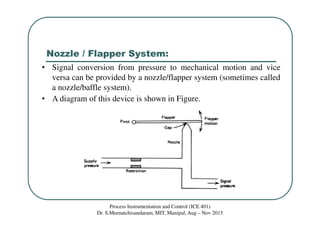
• Signal conversion from pressure to mechanical motion and vice
versa can be provided by a nozzle/flapper system (sometimes called
a nozzle/baffle system).
• A diagram of this device is shown in Figure.
Nozzle / Flapper System:
Process Instrumentation and Control (ICE 401)
Dr. S.Meenatchisundaram, MIT, Manipal, Aug – Nov 2015
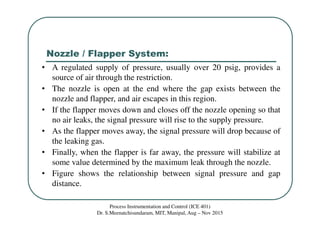
• A regulated supply of pressure, usually over 20 psig, provides a
source of air through the restriction.
• The nozzle is open at the end where the gap exists between the
nozzle and flapper, and air escapes in this region.
• If the flapper moves down and closes off the nozzle opening so that
no air leaks, the signal pressure will rise to the supply pressure.
• As the flapper moves away, the signal pressure will drop because of
the leaking gas.
• Finally, when the flapper is far away, the pressure will stabilize at
some value determined by the maximum leak through the nozzle.
• Figure shows the relationship between signal pressure and gap
distance.
Nozzle / Flapper System:
Process Instrumentation and Control (ICE 401)
Dr. S.Meenatchisundaram, MIT, Manipal, Aug – Nov 2015
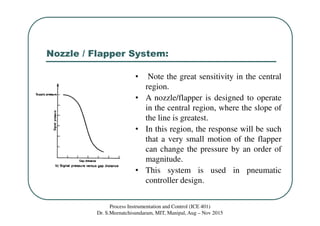
• Note the great sensitivity in the central
region.
• A nozzle/flapper is designed to operate
in the central region, where the slope of
the line is greatest.
• In this region, the response will be such
that a very small motion of the flapper
can change the pressure by an order of
magnitude.
• This system is used in pneumatic
controller design.
Current-to-Pressure Converters:
Process Instrumentation and Control (ICE 401)
Dr. S.Meenatchisundaram, MIT, Manipal, Aug – Nov 2015
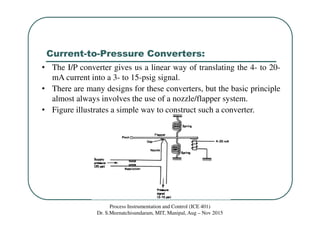
• The I/P converter gives us a linear way of translating the 4- to 20-
mA current into a 3- to 15-psig signal.
• There are many designs for these converters, but the basic principle
almost always involves the use of a nozzle/flapper system.
• Figure illustrates a simple way to construct such a converter.
Pneumatic Controllers:
Process Instrumentation and Control (ICE 401)
Dr. S.Meenatchisundaram, MIT, Manipal, Aug – Nov 2015
• The outward appearance of a pneumatic controller is typically the
same as that for the electronic controller.
• The same readout of setpoint, error, and controller output appears,
and adjustments of gain, rate, and reset are available.
• The working signal is most typically the 3- to 15-psi standard
pneumatic process-control signal, usually derived from a regulated
air supply of 20 to 30 psi.
• As usual, we use the English system unit of pressure because its use
is so widespread in the process-control industry.
• Eventual conversion to the SI unit of N/m2 or Pa will require some
alteration in scale (of measurement) to a range of 20 to 100 kPa.
Pneumatic Proportional Controllers:
Process Instrumentation and Control (ICE 401)
Dr. S.Meenatchisundaram, MIT, Manipal, Aug – Nov 2015
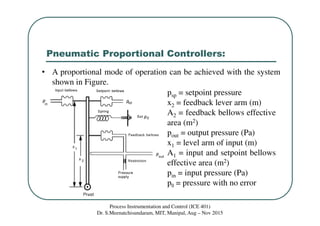
• A proportional mode of operation can be achieved with the system
shown in Figure.
psp = setpoint pressure
x2 = feedback lever arm (m)
A2 = feedback bellows effective
area (m2)
pout = output pressure (Pa)
x1 = level arm of input (m)
A1 = input and setpoint bellows
effective area (m2)
pin = input pressure (Pa)
p0 = pressure with no error
Pneumatic Proportional Controllers:
Process Instrumentation and Control (ICE 401)
Dr. S.Meenatchisundaram, MIT, Manipal, Aug – Nov 2015
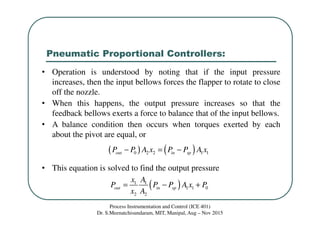
• Operation is understood by noting that if the input pressure
increases, then the input bellows forces the flapper to rotate to close
off the nozzle.
• When this happens, the output pressure increases so that the
feedback bellows exerts a force to balance that of the input bellows.
• A balance condition then occurs when torques exerted by each
about the pivot are equal, or
• This equation is solved to find the output pressure
( ) ( )0 2 2 1 1out in spP P A x P P A x− = −
( )1 1
1 1 0
2 2
out in sp
x A
P P P A x P
x A
= − +
Pneumatic Proportional Controllers:
Process Instrumentation and Control (ICE 401)
Dr. S.Meenatchisundaram, MIT, Manipal, Aug – Nov 2015
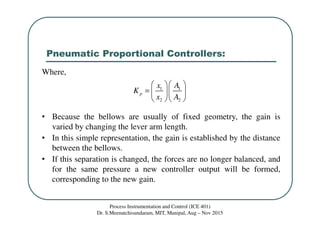
Where,
• Because the bellows are usually of fixed geometry, the gain is
varied by changing the lever arm length.
• In this simple representation, the gain is established by the distance
between the bellows.
• If this separation is changed, the forces are no longer balanced, and
for the same pressure a new controller output will be formed,
corresponding to the new gain.
1 1
2 2
p
x A
K
x A
  
=   
  
Pneumatic Proportional Controllers:
Process Instrumentation and Control (ICE 401)
Dr. S.Meenatchisundaram, MIT, Manipal, Aug – Nov 2015
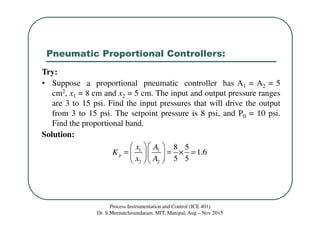
Try:
• Suppose a proportional pneumatic controller has A1 = A2 = 5
cm2, x1 = 8 cm and x2 = 5 cm. The input and output pressure ranges
are 3 to 15 psi. Find the input pressures that will drive the output
from 3 to 15 psi. The setpoint pressure is 8 psi, and P0 = 10 psi.
Find the proportional band.
Solution:
1 1
2 2
8 5
1.6
5 5
p
x A
K
x A
  
= = × =  
  
References:
• Process Control Instrumentation Technology, by Curtis D.
Johnson, Eighth Edition, Pearson Education Limited.
Process Instrumentation and Control (ICE 401)
Dr. S.Meenatchisundaram, MIT, Manipal, Aug – Nov 2015

Class 28 pneumatic controllers

  • 1.
    ICE401: PROCESS INSTRUMENTATION ANDCONTROL Class 28 Pneumatic Controllers Dr. S. Meenatchisundaram Email: meenasundar@gmail.com Process Instrumentation and Control (ICE 401) Dr. S.Meenatchisundaram, MIT, Manipal, Aug – Nov 2015
  • 2.
    Nozzle / FlapperSystem: Process Instrumentation and Control (ICE 401) Dr. S.Meenatchisundaram, MIT, Manipal, Aug – Nov 2015 • Signal conversion from pressure to mechanical motion and vice versa can be provided by a nozzle/flapper system (sometimes called a nozzle/baffle system). • A diagram of this device is shown in Figure.
  • 3.
    Nozzle / FlapperSystem: Process Instrumentation and Control (ICE 401) Dr. S.Meenatchisundaram, MIT, Manipal, Aug – Nov 2015 • A regulated supply of pressure, usually over 20 psig, provides a source of air through the restriction. • The nozzle is open at the end where the gap exists between the nozzle and flapper, and air escapes in this region. • If the flapper moves down and closes off the nozzle opening so that no air leaks, the signal pressure will rise to the supply pressure. • As the flapper moves away, the signal pressure will drop because of the leaking gas. • Finally, when the flapper is far away, the pressure will stabilize at some value determined by the maximum leak through the nozzle. • Figure shows the relationship between signal pressure and gap distance.
  • 4.
    Nozzle / FlapperSystem: Process Instrumentation and Control (ICE 401) Dr. S.Meenatchisundaram, MIT, Manipal, Aug – Nov 2015 • Note the great sensitivity in the central region. • A nozzle/flapper is designed to operate in the central region, where the slope of the line is greatest. • In this region, the response will be such that a very small motion of the flapper can change the pressure by an order of magnitude. • This system is used in pneumatic controller design.
  • 5.
    Current-to-Pressure Converters: Process Instrumentationand Control (ICE 401) Dr. S.Meenatchisundaram, MIT, Manipal, Aug – Nov 2015 • The I/P converter gives us a linear way of translating the 4- to 20- mA current into a 3- to 15-psig signal. • There are many designs for these converters, but the basic principle almost always involves the use of a nozzle/flapper system. • Figure illustrates a simple way to construct such a converter.
  • 6.
    Pneumatic Controllers: Process Instrumentationand Control (ICE 401) Dr. S.Meenatchisundaram, MIT, Manipal, Aug – Nov 2015 • The outward appearance of a pneumatic controller is typically the same as that for the electronic controller. • The same readout of setpoint, error, and controller output appears, and adjustments of gain, rate, and reset are available. • The working signal is most typically the 3- to 15-psi standard pneumatic process-control signal, usually derived from a regulated air supply of 20 to 30 psi. • As usual, we use the English system unit of pressure because its use is so widespread in the process-control industry. • Eventual conversion to the SI unit of N/m2 or Pa will require some alteration in scale (of measurement) to a range of 20 to 100 kPa.
  • 7.
    Pneumatic Proportional Controllers: ProcessInstrumentation and Control (ICE 401) Dr. S.Meenatchisundaram, MIT, Manipal, Aug – Nov 2015 • A proportional mode of operation can be achieved with the system shown in Figure. psp = setpoint pressure x2 = feedback lever arm (m) A2 = feedback bellows effective area (m2) pout = output pressure (Pa) x1 = level arm of input (m) A1 = input and setpoint bellows effective area (m2) pin = input pressure (Pa) p0 = pressure with no error
  • 8.
    Pneumatic Proportional Controllers: ProcessInstrumentation and Control (ICE 401) Dr. S.Meenatchisundaram, MIT, Manipal, Aug – Nov 2015 • Operation is understood by noting that if the input pressure increases, then the input bellows forces the flapper to rotate to close off the nozzle. • When this happens, the output pressure increases so that the feedback bellows exerts a force to balance that of the input bellows. • A balance condition then occurs when torques exerted by each about the pivot are equal, or • This equation is solved to find the output pressure ( ) ( )0 2 2 1 1out in spP P A x P P A x− = − ( )1 1 1 1 0 2 2 out in sp x A P P P A x P x A = − +
  • 9.
    Pneumatic Proportional Controllers: ProcessInstrumentation and Control (ICE 401) Dr. S.Meenatchisundaram, MIT, Manipal, Aug – Nov 2015 Where, • Because the bellows are usually of fixed geometry, the gain is varied by changing the lever arm length. • In this simple representation, the gain is established by the distance between the bellows. • If this separation is changed, the forces are no longer balanced, and for the same pressure a new controller output will be formed, corresponding to the new gain. 1 1 2 2 p x A K x A    =      
  • 10.
    Pneumatic Proportional Controllers: ProcessInstrumentation and Control (ICE 401) Dr. S.Meenatchisundaram, MIT, Manipal, Aug – Nov 2015 Try: • Suppose a proportional pneumatic controller has A1 = A2 = 5 cm2, x1 = 8 cm and x2 = 5 cm. The input and output pressure ranges are 3 to 15 psi. Find the input pressures that will drive the output from 3 to 15 psi. The setpoint pressure is 8 psi, and P0 = 10 psi. Find the proportional band. Solution: 1 1 2 2 8 5 1.6 5 5 p x A K x A    = = × =     
  • 11.
    References: • Process ControlInstrumentation Technology, by Curtis D. Johnson, Eighth Edition, Pearson Education Limited. Process Instrumentation and Control (ICE 401) Dr. S.Meenatchisundaram, MIT, Manipal, Aug – Nov 2015