ICE401: PROCESS INSTRUMENTATION
AND CONTROL
Class 27: Valve Shapes, selection guide
Dr. S. Meenatchisundaram
Email: meenasundar@gmail.com
Control System Components (ICE 3015)
Dr. S.Meenatchisundaram, MIT, Manipal, Aug – Nov 2017
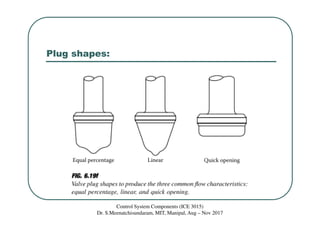
Plug shapes:
Control System Components (ICE 3015)
Dr. S.Meenatchisundaram, MIT, Manipal, Aug – Nov 2017
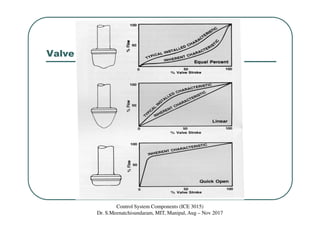
Valve Types:
Control System Components (ICE 3015)
Dr. S.Meenatchisundaram, MIT, Manipal, Aug – Nov 2017
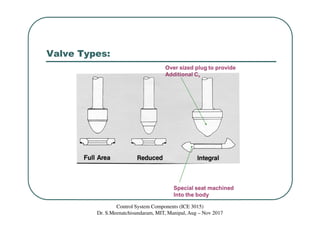
Valve Types:
Control System Components (ICE 3015)
Dr. S.Meenatchisundaram, MIT, Manipal, Aug – Nov 2017
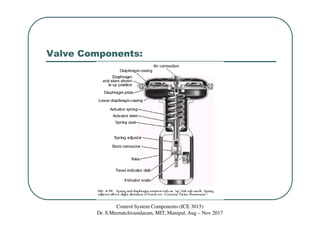
Valve Components:
Control System Components (ICE 3015)
Dr. S.Meenatchisundaram, MIT, Manipal, Aug – Nov 2017
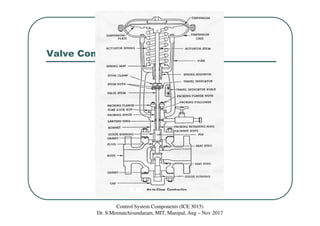
Valve Components:
Control System Components (ICE 3015)
Dr. S.Meenatchisundaram, MIT, Manipal, Aug – Nov 2017
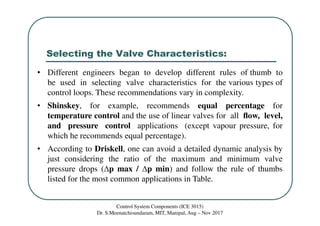
Selecting the Valve Characteristics:
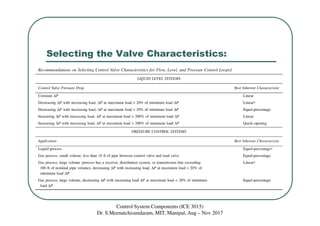
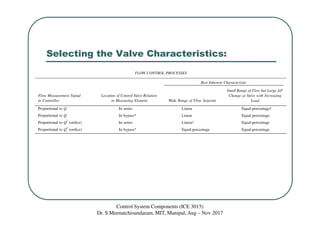
• Different engineers began to develop different rules of thumb to
be used in selecting valve characteristics for the various types of
control loops. These recommendations vary in complexity.
• Shinskey, for example, recommends equal percentage for
temperature control and the use of linear valves for all flow, level,
and pressure control applications (except vapour pressure, for
which he recommends equal percentage).
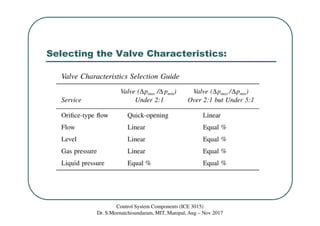
• According to Driskell, one can avoid a detailed dynamic analysis by
just considering the ratio of the maximum and minimum valve
pressure drops (∆p max / ∆p min) and follow the rule of thumbs
listed for the most common applications in Table.
Control System Components (ICE 3015)
Dr. S.Meenatchisundaram, MIT, Manipal, Aug – Nov 2017
Selecting the Valve Characteristics:
Control System Components (ICE 3015)
Dr. S.Meenatchisundaram, MIT, Manipal, Aug – Nov 2017
Selecting the Valve Characteristics:
Control System Components (ICE 3015)
Dr. S.Meenatchisundaram, MIT, Manipal, Aug – Nov 2017
Selecting the Valve Characteristics:
Control System Components (ICE 3015)
Dr. S.Meenatchisundaram, MIT, Manipal, Aug – Nov 2017
Rangeability:
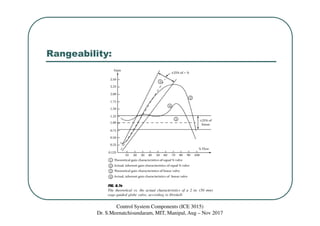
• The conventional definition of rangeability is the ratio between
maximum and minimum “controllable” flow through the valve.
• Minimum controllable flow (Fmin) is defined as the flow below
which the valve tends to close completely.
• In other words, this widely held definition of Fmin refers not to
the leakage flow (which occurs when the valve is closed), but to the
minimum flow that is controllable in the sense that it can be changed
up or down as the valve stroke is changed.
• Using this definition, manufacturers usually claim a 50:1 rangeability
for equal-percentage valves, 33:1 for linear valves, and about
20:1 for quick-opening valves.
Control System Components (ICE 3015)
Dr. S.Meenatchisundaram, MIT, Manipal, Aug – Nov 2017
Rangeability:
• These claims suggest that the flow through these valves can be
controlled down to 2, 3, and 5% of the flow corresponding to their
rated Cv (Kv).
• The acceptable flow range within which the valve can safely be
used for closed-loop control must be based on a relationship
between the theoretical and the actual valve gain.
• The valve rangeability should therefore be defined as the flow range
over which the theoretical (inherent) valve gain and the actual
installed valve gain will stay within preset limits.
• Therefore, the rangeability of the valve can be defined as the ratio of
the minimum and maximum Cv s (Kv s) bordering the region within
which the actual valve gain is within ± 25% of the theoretical valve
gain. Control System Components (ICE 3015)
Dr. S.Meenatchisundaram, MIT, Manipal, Aug – Nov 2017
Rangeability:
Control System Components (ICE 3015)
Dr. S.Meenatchisundaram, MIT, Manipal, Aug – Nov 2017
References:
• Process Dynamics and Control - Dale E. Seborg, 3rd Edition, John
Wiley Publishers.
• Instrument Engineers' Handbook: Volume Two: Process Control
And Optimization (Fourth Edition) - Bela G. Liptak, CRC Press,
2005.
Control System Components (ICE 3015)
Dr. S.Meenatchisundaram, MIT, Manipal, Aug – Nov 2017

Lecture 27 valve shapes, selection guide

  • 1.
    ICE401: PROCESS INSTRUMENTATION ANDCONTROL Class 27: Valve Shapes, selection guide Dr. S. Meenatchisundaram Email: meenasundar@gmail.com Control System Components (ICE 3015) Dr. S.Meenatchisundaram, MIT, Manipal, Aug – Nov 2017
  • 2.
    Plug shapes: Control SystemComponents (ICE 3015) Dr. S.Meenatchisundaram, MIT, Manipal, Aug – Nov 2017
  • 3.
    Valve Types: Control SystemComponents (ICE 3015) Dr. S.Meenatchisundaram, MIT, Manipal, Aug – Nov 2017
  • 4.
    Valve Types: Control SystemComponents (ICE 3015) Dr. S.Meenatchisundaram, MIT, Manipal, Aug – Nov 2017
  • 5.
    Valve Components: Control SystemComponents (ICE 3015) Dr. S.Meenatchisundaram, MIT, Manipal, Aug – Nov 2017
  • 6.
    Valve Components: Control SystemComponents (ICE 3015) Dr. S.Meenatchisundaram, MIT, Manipal, Aug – Nov 2017
  • 7.
    Selecting the ValveCharacteristics: • Different engineers began to develop different rules of thumb to be used in selecting valve characteristics for the various types of control loops. These recommendations vary in complexity. • Shinskey, for example, recommends equal percentage for temperature control and the use of linear valves for all flow, level, and pressure control applications (except vapour pressure, for which he recommends equal percentage). • According to Driskell, one can avoid a detailed dynamic analysis by just considering the ratio of the maximum and minimum valve pressure drops (∆p max / ∆p min) and follow the rule of thumbs listed for the most common applications in Table. Control System Components (ICE 3015) Dr. S.Meenatchisundaram, MIT, Manipal, Aug – Nov 2017
  • 8.
    Selecting the ValveCharacteristics: Control System Components (ICE 3015) Dr. S.Meenatchisundaram, MIT, Manipal, Aug – Nov 2017
  • 9.
    Selecting the ValveCharacteristics: Control System Components (ICE 3015) Dr. S.Meenatchisundaram, MIT, Manipal, Aug – Nov 2017
  • 10.
    Selecting the ValveCharacteristics: Control System Components (ICE 3015) Dr. S.Meenatchisundaram, MIT, Manipal, Aug – Nov 2017
  • 11.
    Rangeability: • The conventionaldefinition of rangeability is the ratio between maximum and minimum “controllable” flow through the valve. • Minimum controllable flow (Fmin) is defined as the flow below which the valve tends to close completely. • In other words, this widely held definition of Fmin refers not to the leakage flow (which occurs when the valve is closed), but to the minimum flow that is controllable in the sense that it can be changed up or down as the valve stroke is changed. • Using this definition, manufacturers usually claim a 50:1 rangeability for equal-percentage valves, 33:1 for linear valves, and about 20:1 for quick-opening valves. Control System Components (ICE 3015) Dr. S.Meenatchisundaram, MIT, Manipal, Aug – Nov 2017
  • 12.
    Rangeability: • These claimssuggest that the flow through these valves can be controlled down to 2, 3, and 5% of the flow corresponding to their rated Cv (Kv). • The acceptable flow range within which the valve can safely be used for closed-loop control must be based on a relationship between the theoretical and the actual valve gain. • The valve rangeability should therefore be defined as the flow range over which the theoretical (inherent) valve gain and the actual installed valve gain will stay within preset limits. • Therefore, the rangeability of the valve can be defined as the ratio of the minimum and maximum Cv s (Kv s) bordering the region within which the actual valve gain is within ± 25% of the theoretical valve gain. Control System Components (ICE 3015) Dr. S.Meenatchisundaram, MIT, Manipal, Aug – Nov 2017
  • 13.
    Rangeability: Control System Components(ICE 3015) Dr. S.Meenatchisundaram, MIT, Manipal, Aug – Nov 2017
  • 14.
    References: • Process Dynamicsand Control - Dale E. Seborg, 3rd Edition, John Wiley Publishers. • Instrument Engineers' Handbook: Volume Two: Process Control And Optimization (Fourth Edition) - Bela G. Liptak, CRC Press, 2005. Control System Components (ICE 3015) Dr. S.Meenatchisundaram, MIT, Manipal, Aug – Nov 2017