various Fishing gears for
promoting Sustainable
Fishing in various Aquatic
Resources potential areas
By
B. Bhaskar
Fisheries
For promoting sustainable exploitation of Capture Fisheries Resources in various aquatic
resources
• To achieve sustainable fishing in trawlers, the optimum mesh size is primarily
determined by the Length at First Maturity (LFM) of your target species. The goal
is to allow at least 50% of the individuals (juveniles) to escape so they can
reproduce before being caught
• The optimum mesh size for sustainable fishing in a trawler is not a single,
universal number, but rather a range that depends on the target species' size at
maturity, desired catch size, and regional regulations. Research and guidelines
consistently show that larger meshes (often >40–50 mm) are more sustainable
than smaller, traditional ones (e.g., <20 mm) as they allow juveniles and non-
target species to escape.
Recommended Mesh Sizes for Sustainability
• Recommended Mesh Sizes for Sustainability
• Fish Trawl Net: Generally recommended to have a minimum mesh size of 40
mm or greater at the codend.
• Shrimp Trawl Net: Minimum mesh size is often recommended at 35–38 mm
or more to reduce juvenile bycatch.
• Species-Specific Examples (India):
• Sardine: 33 mm
• Mackerel: 50 mm
• Croaker: 40 mm
• Pomfret: 126 mm
• Shrimp: 38 mm
• Specific Studies:
• Thryssa dussumieri (Gujarat coast): 49–56.6 mm (square/diamond).
• Johnius dussumieri (Gujarat coast): 65 mm.
• Marbled Flounder (Korea): 57.5–90 mm
• Mixed Demersal Species (e.g., Cod, Haddock, Whiting)
• Cod/Haddock: Standard regulations often mandate a 120–135 mm diamond
mesh. Research suggests that increasing to 155 mm can offer better
protection for younger stocks without complex gear modifications.
• Whiting: Studies recommend 32–34 mm monofilament gillnets or larger for
sustainability.
Critical Factors Influencing Selectivity Mesh Shape
• Critical Factors Influencing
Selectivity Mesh Shape: Square mesh
(T45) and turned diamond mesh (T90)
stay open during towing, whereas
traditional diamond mesh (T0) can
close under tension, trapping juveniles.
• Selection Factor (SF): This is a constant
used to calculate mesh size: Optimum
Mesh Size}=(LFM/SF)
• Example: For if a fish matures at 122
mm and the gear's SF is 1.9, the
optimum mesh is 64.2 mm.
• Bycatch Reduction: Larger meshes
significantly reduce the bycatch of
non-target species and undersized
individuals.
• For instance, increasing mesh from
60 mm to 90 mm can reduce
undersized crab catches from 64%
to 24%
• Square Mesh Panels: Switching from diamond mesh to square mesh in the
codend is highly effective for sustainability because square meshes remain open
under tension, allowing immature fish to escape, unlike diamond meshes which
can stretch and close.Selectivity Factors: The mesh size should be matched to the
length of first maturity ((L∞_{m})) of the target species.Regulation Compliance:
Minimum Mesh Size (MMS) regulations are crucial for protecting juveniles and
reducing bycatch.
• Using larger, properly designed mesh sizes (e.g., 50 mm+) in the codend is the
most effective technical measure for promoting sustainable, eco-friendly trawling
• The optimum mesh size for sustainable fishing in a purse seine is not a single, universal number, but
rather a target that depends on the species, the maturity of the fish, and regional regulations.
However, studies indicate that for small pelagic species (sardines, anchovies, mackerel), the
optimum mesh size for sustainable fishing often falls in the range of 16 mm to 25.7 mm or larger,
which is higher than the commonly practiced 8–12 mm in some regions.
• Key Findings for Sustainable Purse Seine Mesh Sizes:
• Small Pelagics (Anchovy/Sardine): A 16 mm mesh size is often identified as effective for targeting
adult anchovies and white sardines, specifically reducing the catch of juveniles.
• Mediterranean Studies: Research suggests a minimum legal mesh size of 25.7 mm to 28.1 mm for
Sardinella aurita in certain regions, as smaller mesh sizes (e.g., 8.5–16 mm) lead to overexploitation.
• Tuna Purse Seines: A, 40 mm mesh is considered a minimum for certain fisheries, with suggestions
to increase it to up to 20.3 cm (8 inches) for specific large pelagic species to maximize yield per
recruit.
• Bunt vs. Main Body: The "bunt" (the final, reinforced section of the net) is crucial for sustainability.
Using a larger mesh size (e.g., 45 mm instead of 18 mm) in the bunt can significantly enhance the
release of immature, undersized fish
• Reasons for Selecting Larger Mesh Sizes:
• Reducing Bycatch: Larger mesh sizes allow juvenile fish to escape, ensuring they
reach maturity and can reproduce.
• Improved Efficiency: Larger meshes decrease the total weight of the net, improve
the sinking speed, and reduce drag, which can increase the efficiency of the
fishing operation.
• Preventing Overfishing: Moving away from 8–10 mm meshes to 16–25 mm+
helps in protecting the stock and prevents the catch of "trash fish" or immature
species, which is crucial for long-term sustainability
• Important Considerations:
Mesh size requirements vary significantly by region and target species. It is crucial
to consult local fisheries regulations to ensure compliance with the specific legal
minimum mesh size in your area
• World's best" as top fish landing centers (like those in Japan, Norway, Iceland, US
, China) excel in efficient, hygienic handling, advanced tech ( auctions,
tracking), cold chain, waste management & integrated services (fuel, repair),
with key components including deep water berths, specialized unloading, ice
plants, processing units, smart auctions, quality control labs, and seamless
logistics for rapid distribution, aiming for minimal spoilage & maximum value.
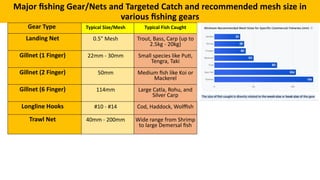
Major fishing Gear/Nets and Targeted Catch and recommended mesh size in
various fishing gears
Gear Type Typical Size/Mesh Typical Fish Caught
Landing Net 0.5" Mesh Trout, Bass, Carp (up to
2.5kg - 20kg)
Gillnet (1 Finger) 22mm - 30mm Small species like Puti,
Tengra, Taki
Gillnet (2 Finger) 50mm Medium fish like Koi or
Mackerel
Gillnet (6 Finger) 114mm Large Catla, Rohu, and
Silver Carp
Longline Hooks #10 - #14 Cod, Haddock, Wolffish
Trawl Net 40mm - 200mm Wide range from Shrimp
to large Demersal fish
Worlds Innovative initiatives in Fishing harbours
• Best green fishing harbors, integrating sustainable design,
smart tech (IoT), clean energy (electric vessels, solar),
waste treatment, and green building (living walls, green
roofs) to reduce impact, featuring components like water
monitoring, advanced processing, and community spaces,
aiming for climate resilience with holistic models:
• Examples & Initiatives:
• James Town Fishing Harbour (Ghana): Modern,
integrated facility with waste treatment, cold storage, fish
market, workshops, incorporating modern standards.
• Wagner's Pinkenba Wharf (Brisbane): Innovative use
of FRP composites and cement-free concrete for a
durable, non-corrosive structure, setting sustainability
benchmarks.
• Best Practices & Goals:
• Integrated Approach: Combining ecological principles
with economic viability and social benefits
• Climate Resilience: Designing for future climate impacts
• Stakeholder Involvement: Engaging fishers,
communities, and private sector for inclusive green
transitions
• Key Green Infrastructure Components
• Energy Efficiency & Renewables: Solar panels on
buildings, electric vessel charging, energy-efficient
lighting.
• Sustainable Construction: Using green materials
(e.g., Earth Friendly Concrete in Brisbane's wharf),
recycled content, green roofs/walls for biodiversity.
• Water Management: Rainwater harvesting,
bioretention (rain gardens), advanced sewage
treatment, oil spill booms, water quality monitoring.
• Waste Management: Segregation, recycling,
biogas plants, converting waste into energy.
• Smart Technology (IoT): Sensors for water quality,
resource optimization, smart fish handling, digital
tracking.
• Ecosystem Support: Developing green belts,
restoring natural habitats, managing coastal
ecosystems.
Mahashivratri often occurs during the Sun’s
transit in Pisces, which is symbolized by fish
Lord Shiva is known as Gangadhara,(or the one who carries the water of the Ganges on his head) When the river Goddess Ganga
descended from heaven, her force was so great that it threatened to drown the earth. Shiva stood beneath, catching her in his
tangled hair to break her fall, turning her torrent into manageable streams.
• 2. Submerged Shivalingas: At places like Sahasralinga in Karnataka, thousands of lingams are carved on rocks in a river, symbolizing
the divinity within nature’s water.
• 3. According to the Tiruvilaiyadal Puranam, Shiva once took the form of a fisherman to marry Parvati, who had taken birth as a
fisherwoman (Matsya Kanya) due to a curse. To unite with her, Shiva, with Nandi’s help (who took the form of a giant whale),
proved his prowess to the head of the fishing community.
• 4. near Visakhapatnam, Andhra Pradesh,a local legend says that Shiva appeared in the form of a fish to protect other fish from
serpents.The place is called Matsyagundam, and the deity is known as Matsya Lingeswara
• .Shiva interacts in various forms to guide the world, or even lord Vishnu worships Shiva, as seen in the Ekampareshwarar temple,
Kanchipuram, where Shiva is depicted as a crane catching a fish (Vishnu) to symbolize a cosmic lesson.
• Shiva is worshipped as the element of water at the Thiruvanaikaval temple (Jambukeswarar Temple) in Tamil Nadu.
• flowing water represents the continuous flow of knowledge and spiritual consciousness.
• According to the Tiruvilaiyadal Puranam, Shiva once took the form of a fisherman.
• Matsya Kundam (Matsyagundam): near Visakhapatnam, Andhra Pradesh, a local legend says that Shiva appeared in the form of a
fish to protect other fish from serpents. The place is called Matsyagundam, and the deity is known as Matsya Lingeswara Swami.