ICE401: PROCESS INSTRUMENTATION
AND CONTROL
Class 23, 24 & 25: Valve Types, Valve
Positioners, Cavitation & Flashing
Dr. S. Meenatchisundaram
Email: meenasundar@gmail.com
Control System Components (ICE 3015)
Dr. S.Meenatchisundaram, MIT, Manipal, Aug – Nov 2018
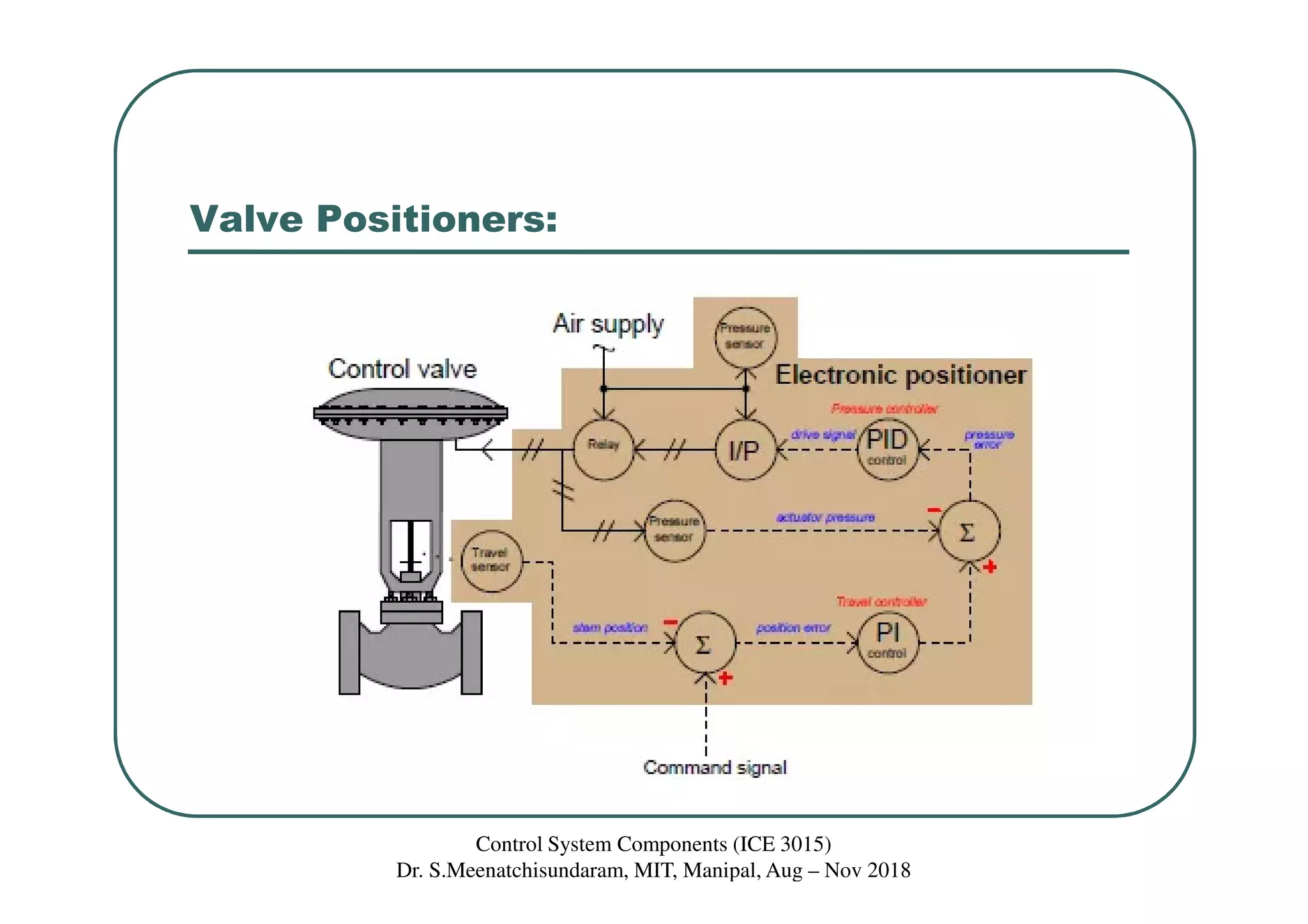
Valve Positioners:
Control System Components (ICE 3015)
Dr. S.Meenatchisundaram, MIT, Manipal, Aug – Nov 2018
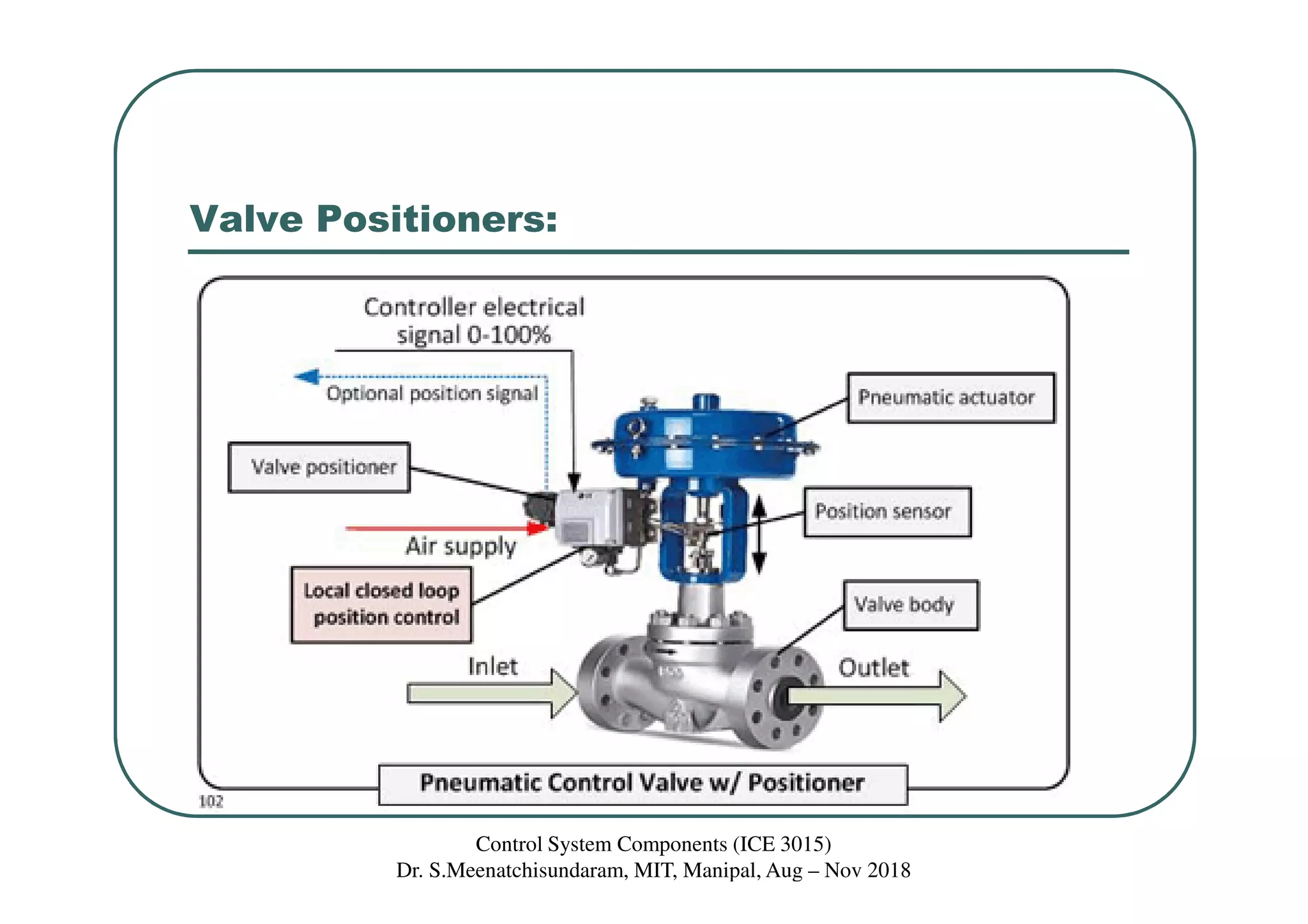
Valve Positioners:
Control System Components (ICE 3015)
Dr. S.Meenatchisundaram, MIT, Manipal, Aug – Nov 2018
Valves:
Linear Type
Rotary Type
Control System Components (ICE 3015)
Dr. S.Meenatchisundaram, MIT, Manipal, Aug – Nov 2018
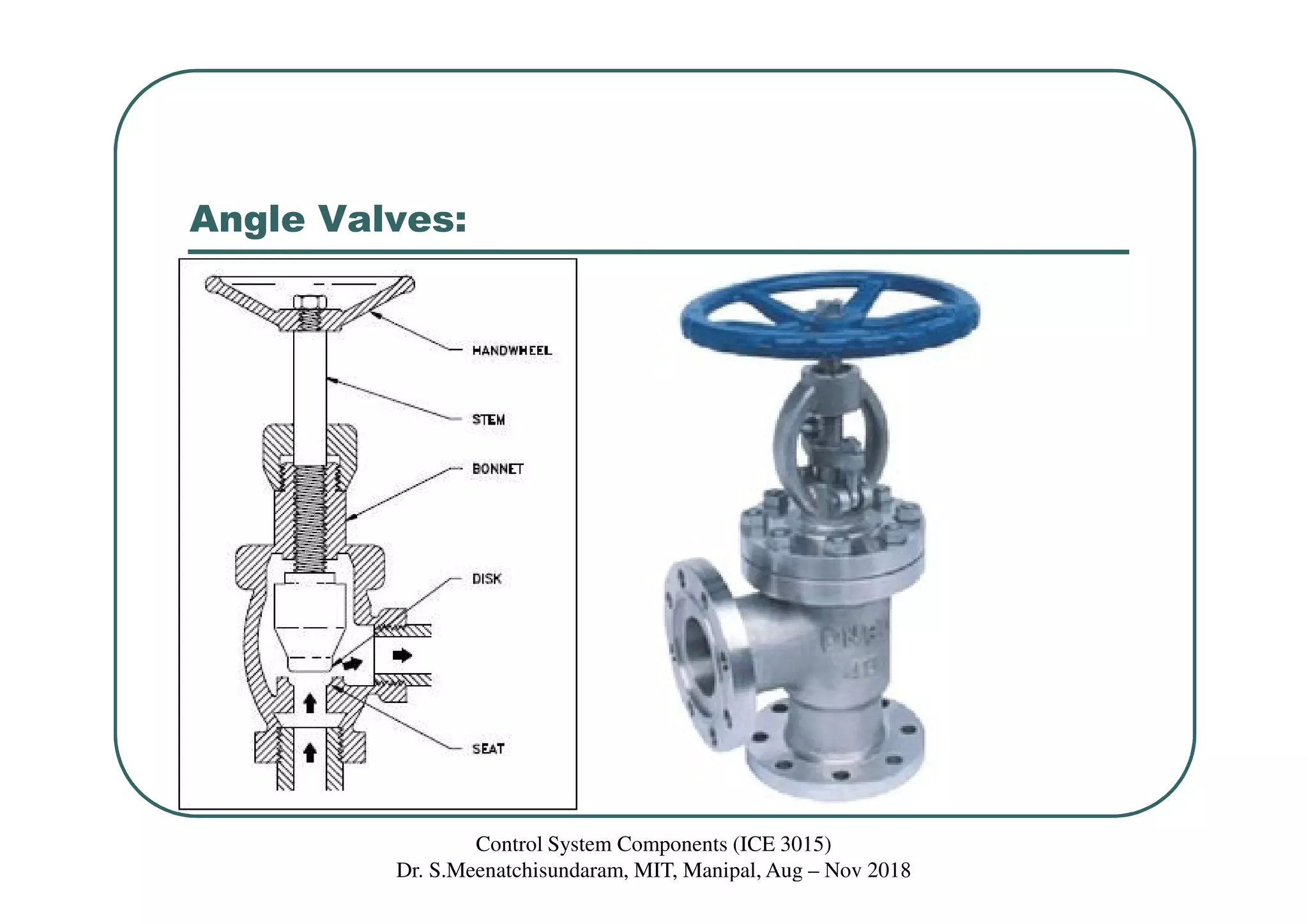
Angle Valves:
Control System Components (ICE 3015)
Dr. S.Meenatchisundaram, MIT, Manipal, Aug – Nov 2018
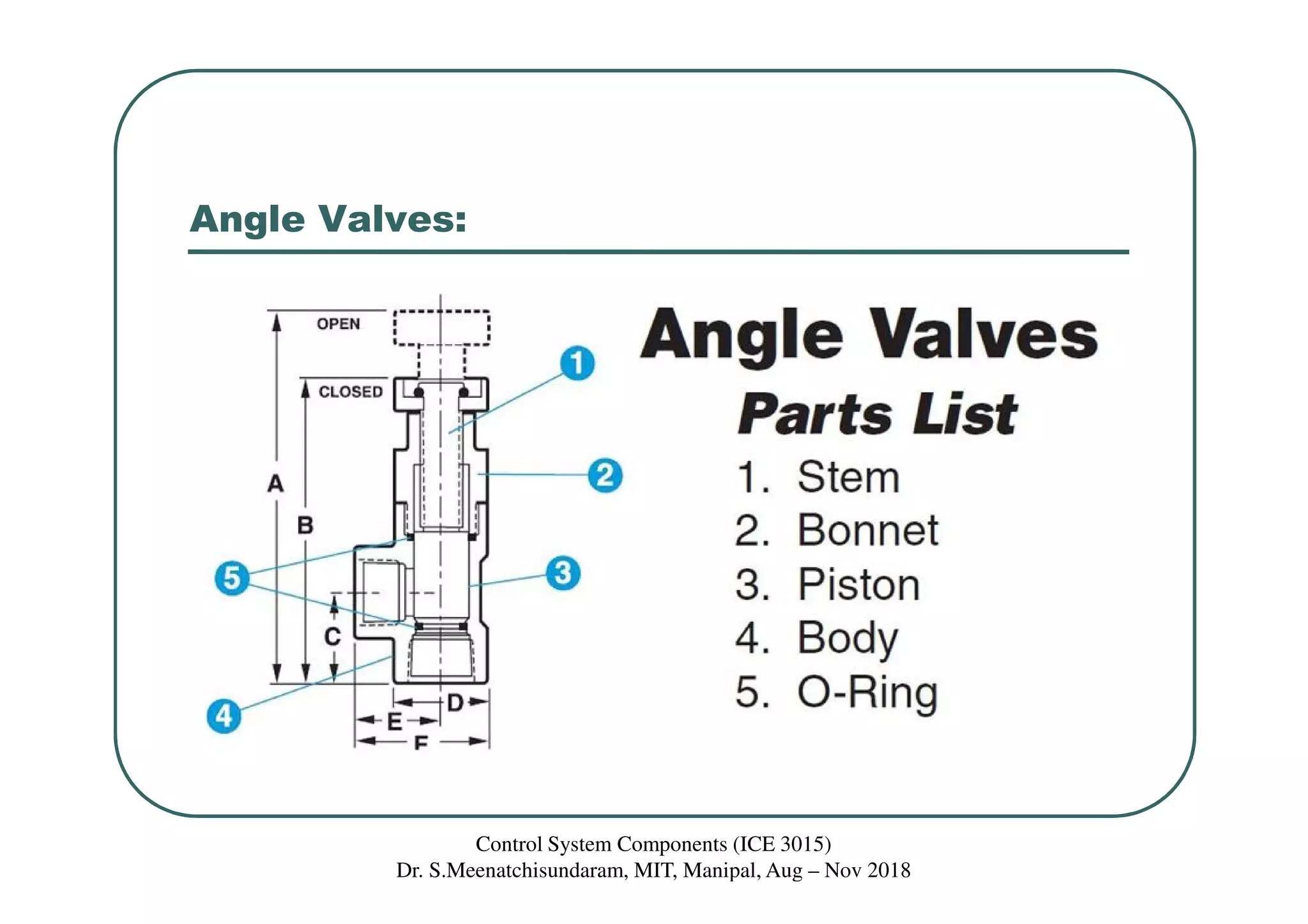
Angle Valves:
Control System Components (ICE 3015)
Dr. S.Meenatchisundaram, MIT, Manipal, Aug – Nov 2018
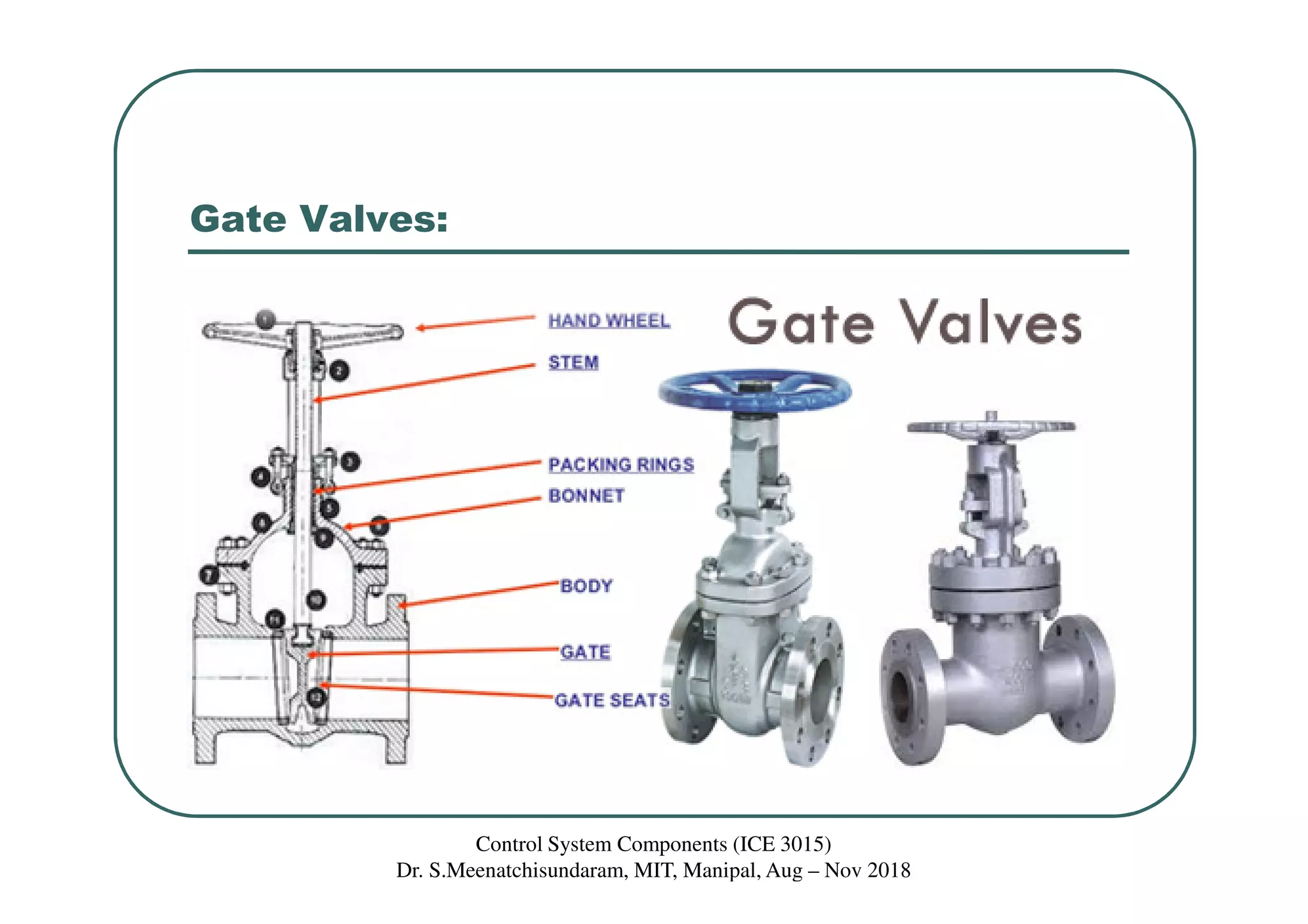
Gate Valves:
Control System Components (ICE 3015)
Dr. S.Meenatchisundaram, MIT, Manipal, Aug – Nov 2018
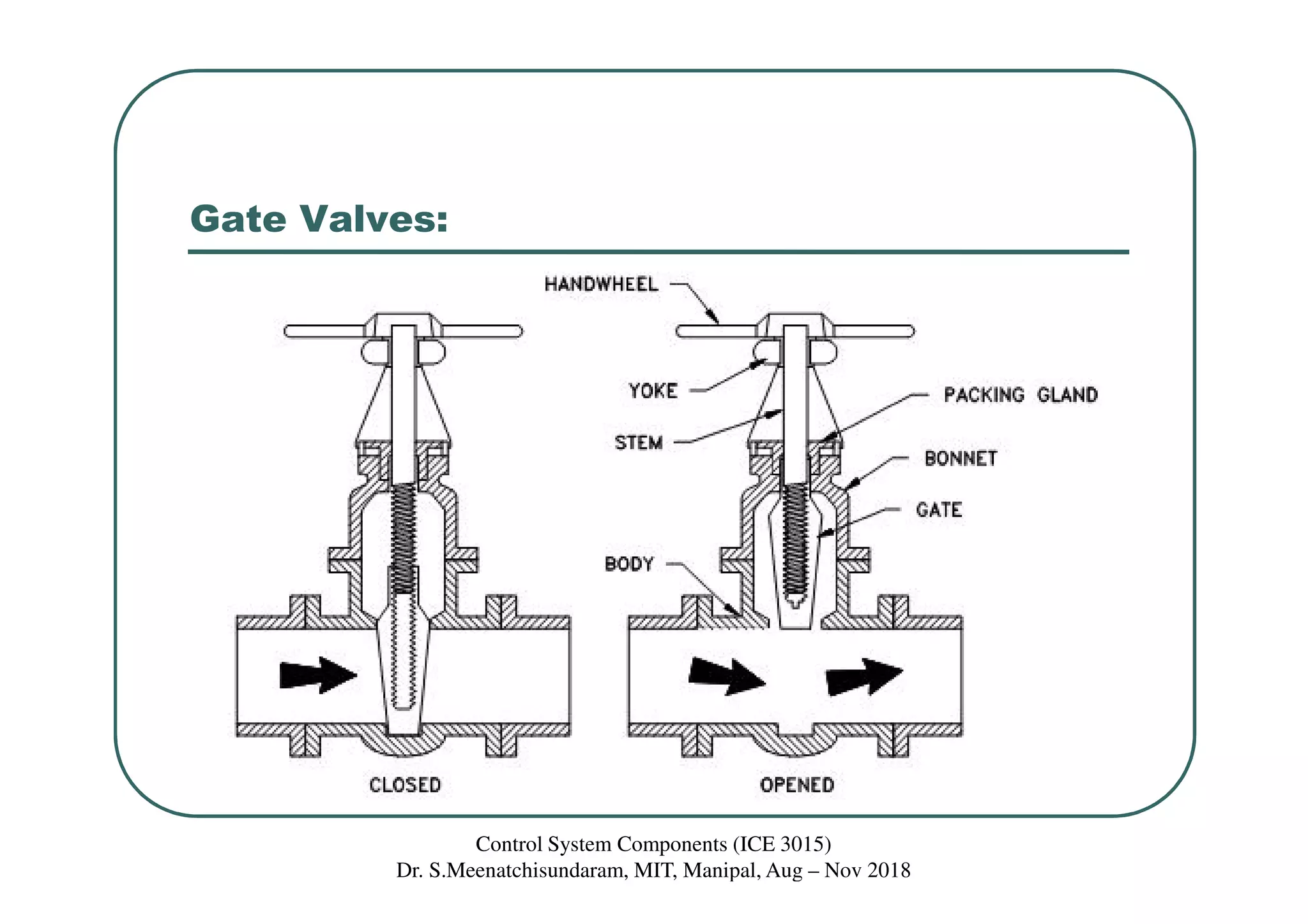
Gate Valves:
Control System Components (ICE 3015)
Dr. S.Meenatchisundaram, MIT, Manipal, Aug – Nov 2018
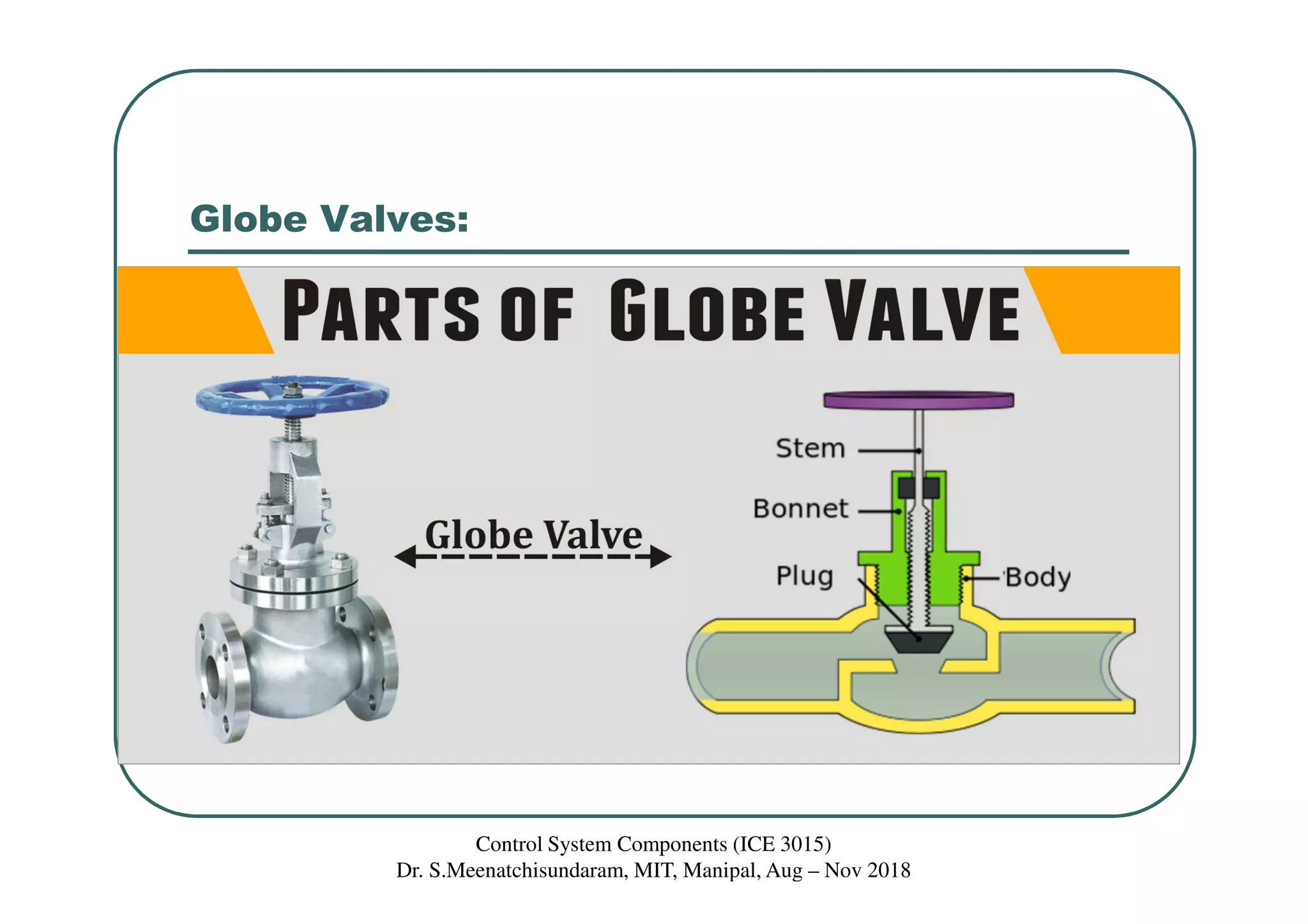
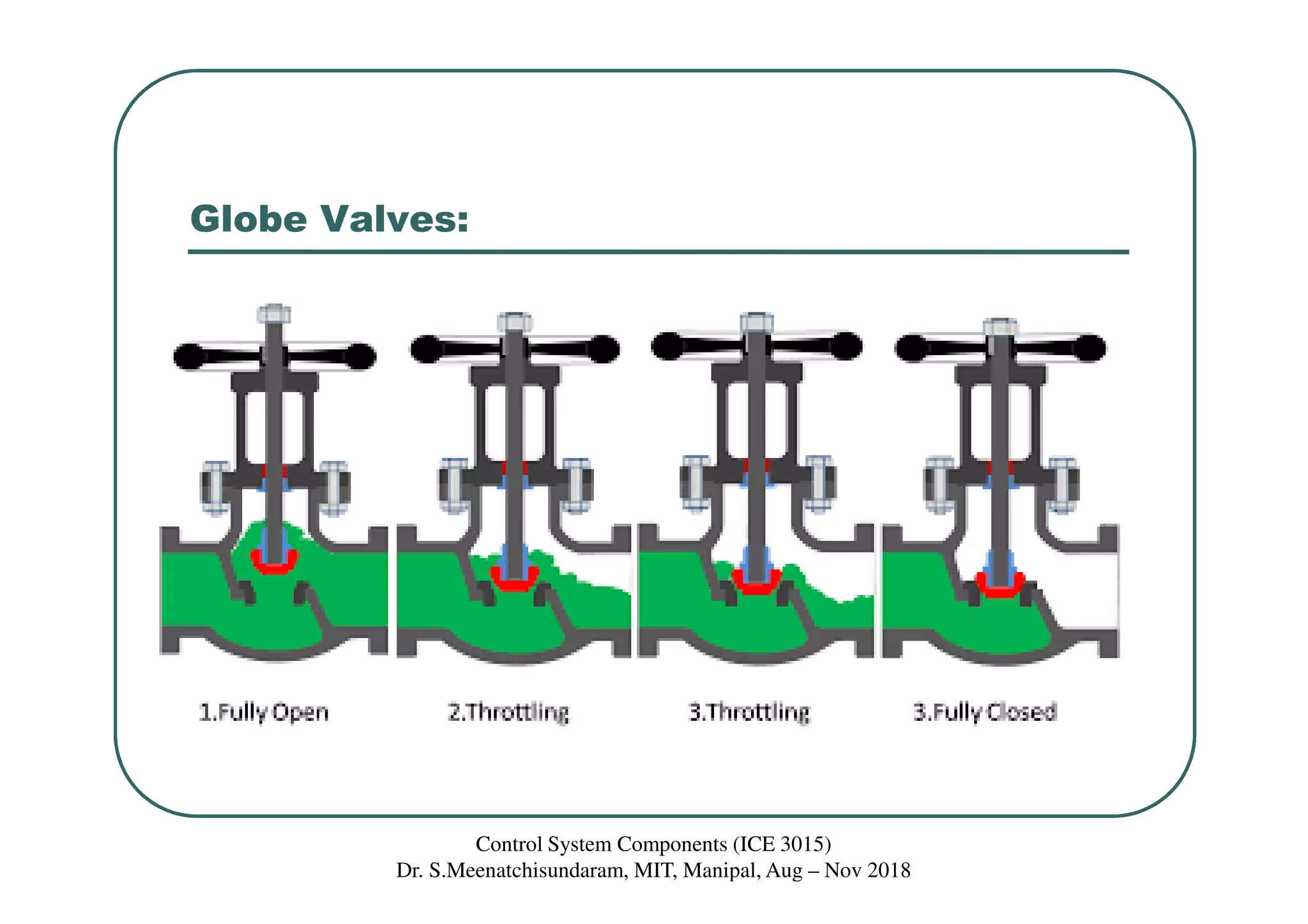
Globe Valves:
Control System Components (ICE 3015)
Dr. S.Meenatchisundaram, MIT, Manipal, Aug – Nov 2018
Globe Valves:
Control System Components (ICE 3015)
Dr. S.Meenatchisundaram, MIT, Manipal, Aug – Nov 2018
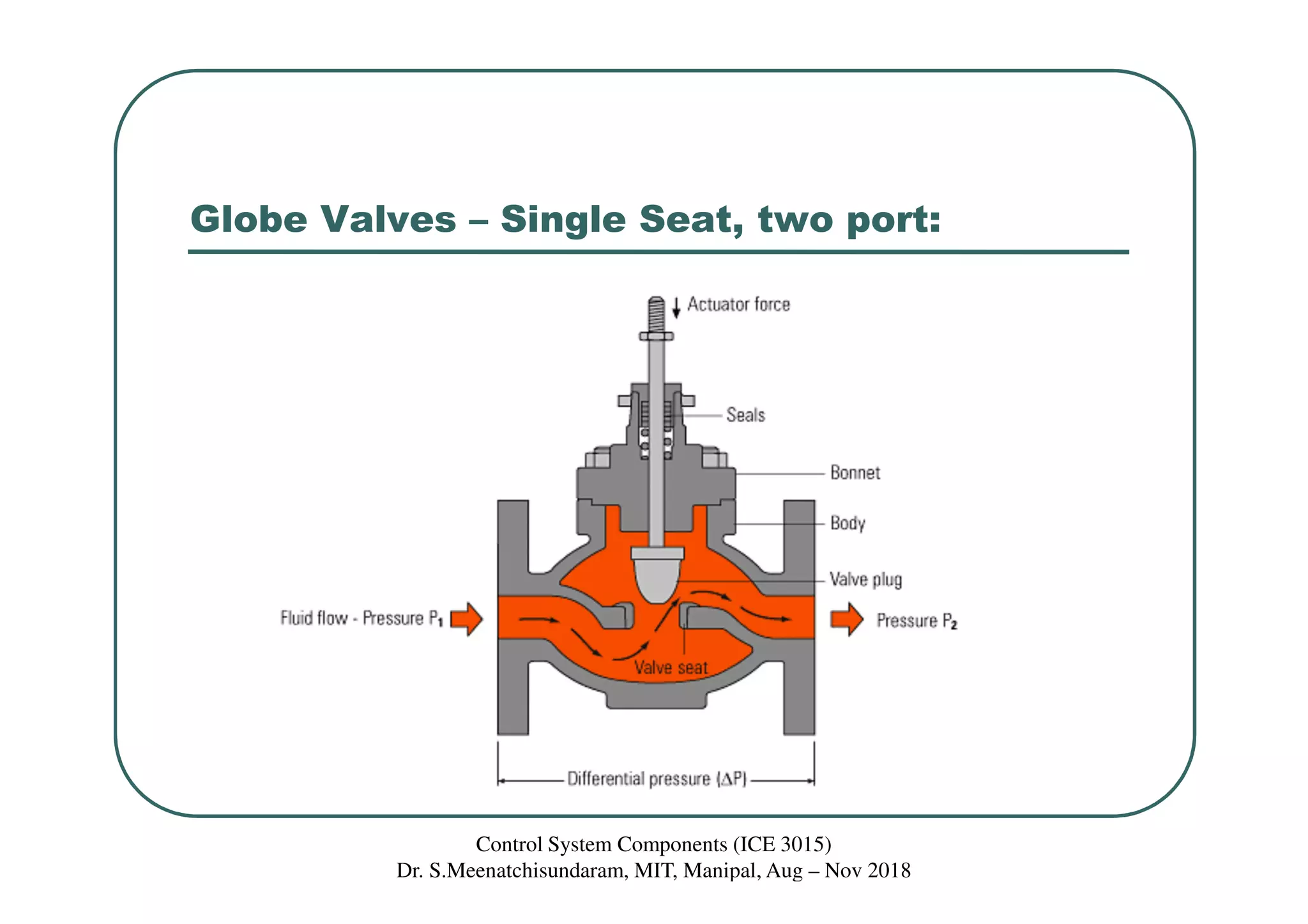
Globe Valves – Single Seat, two port:
Control System Components (ICE 3015)
Dr. S.Meenatchisundaram, MIT, Manipal, Aug – Nov 2018
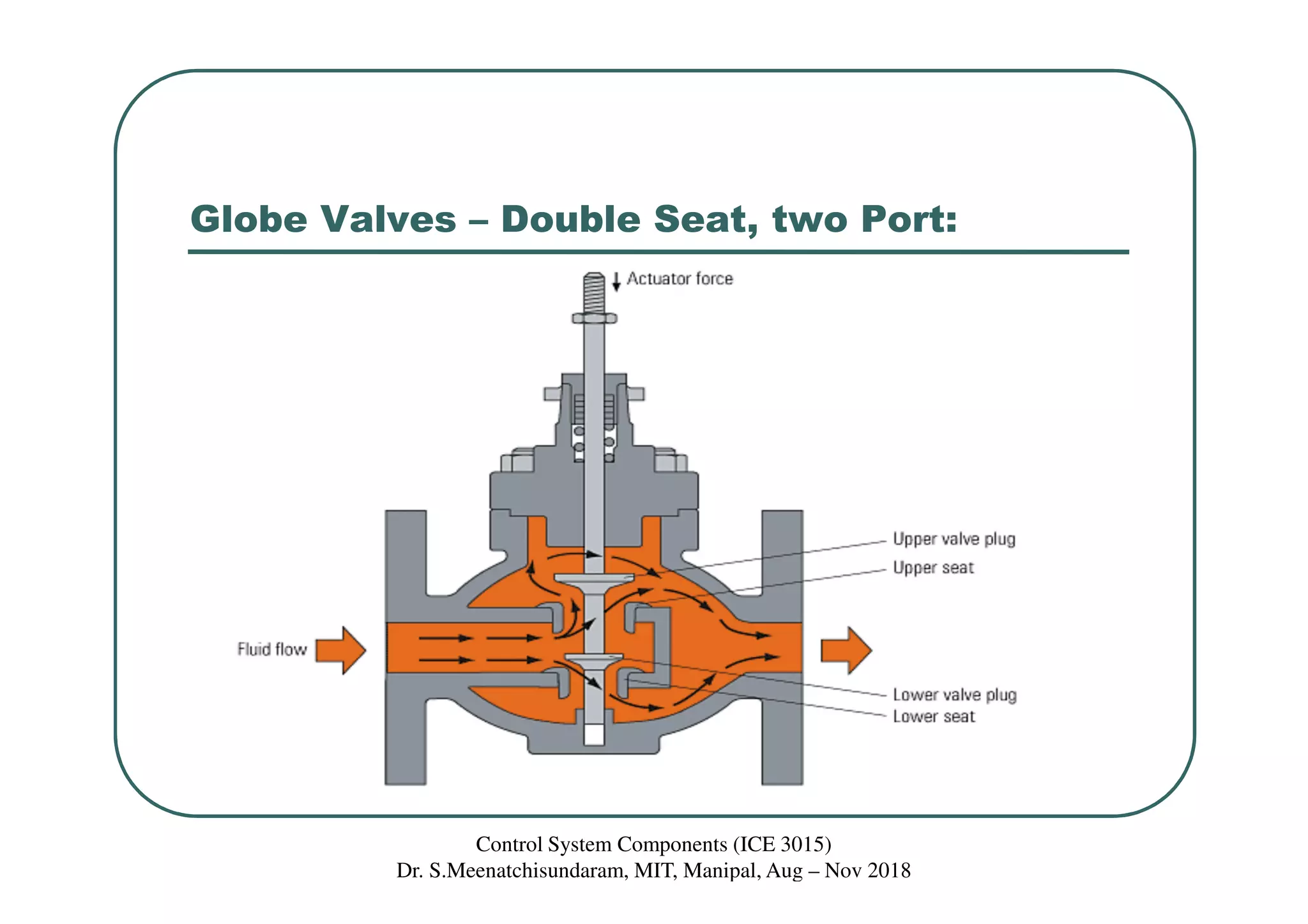
Globe Valves – Double Seat, two Port:
Control System Components (ICE 3015)
Dr. S.Meenatchisundaram, MIT, Manipal, Aug – Nov 2018
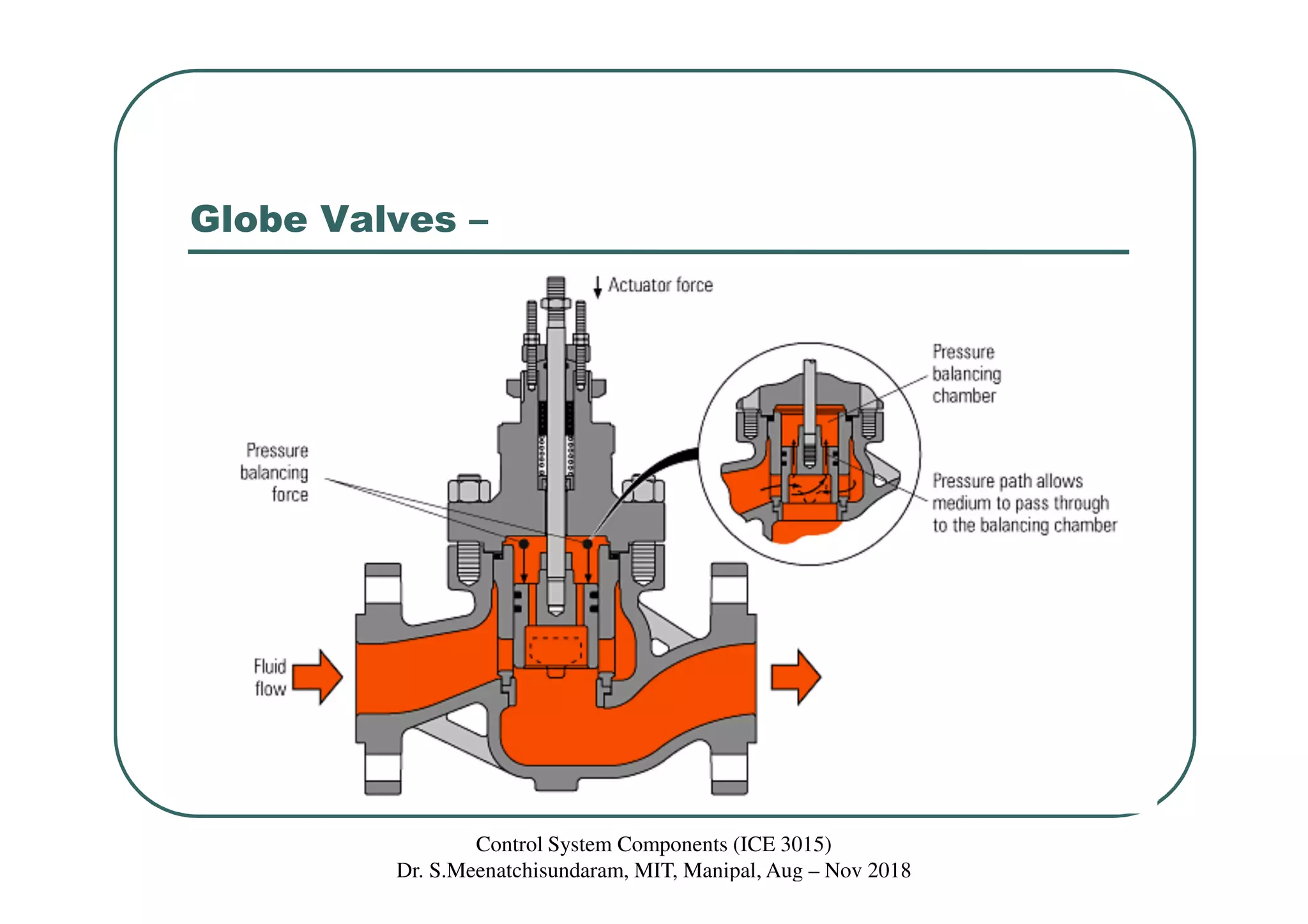
Globe Valves –
Control System Components (ICE 3015)
Dr. S.Meenatchisundaram, MIT, Manipal, Aug – Nov 2018
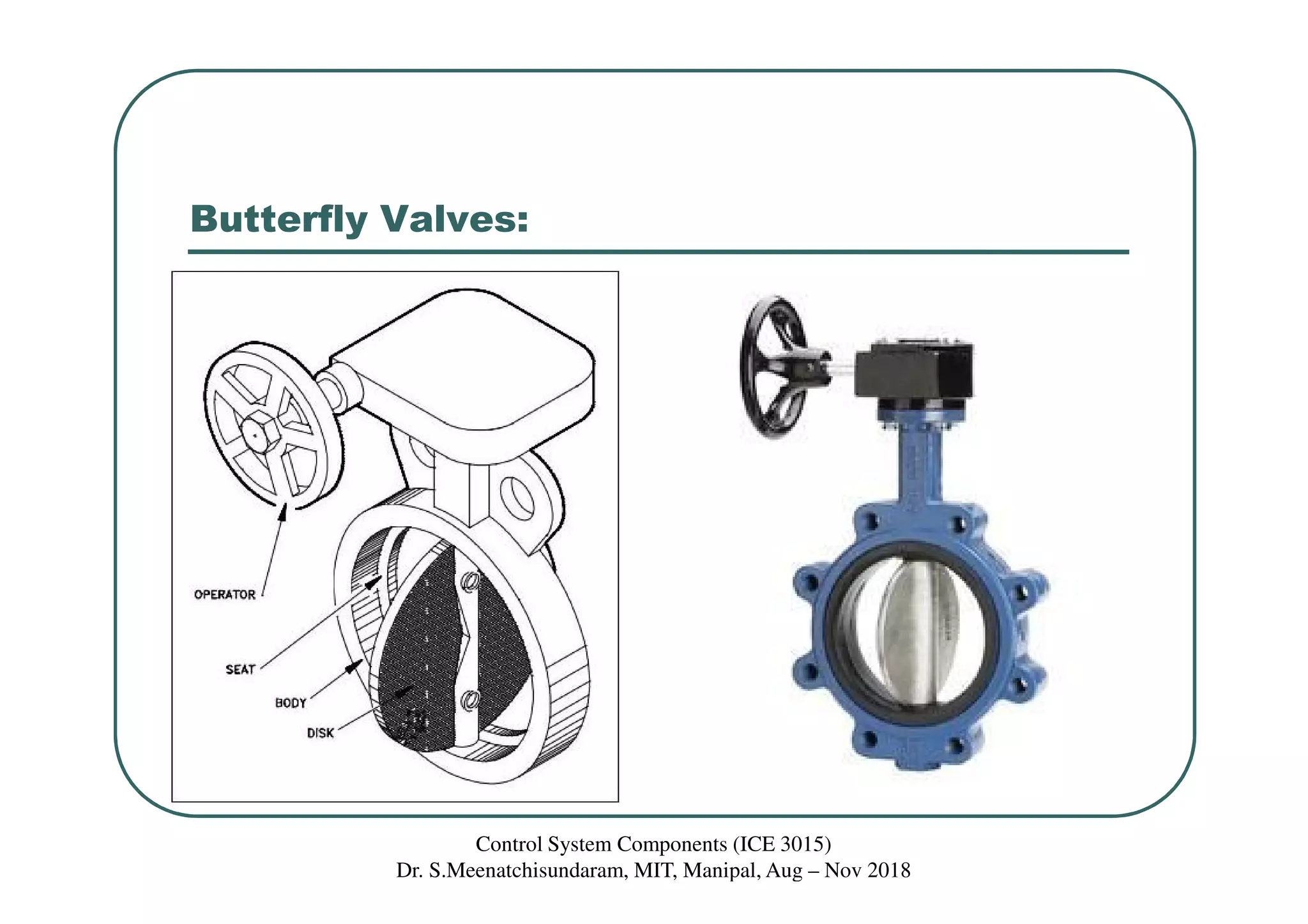
Butterfly Valves:
Control System Components (ICE 3015)
Dr. S.Meenatchisundaram, MIT, Manipal, Aug – Nov 2018
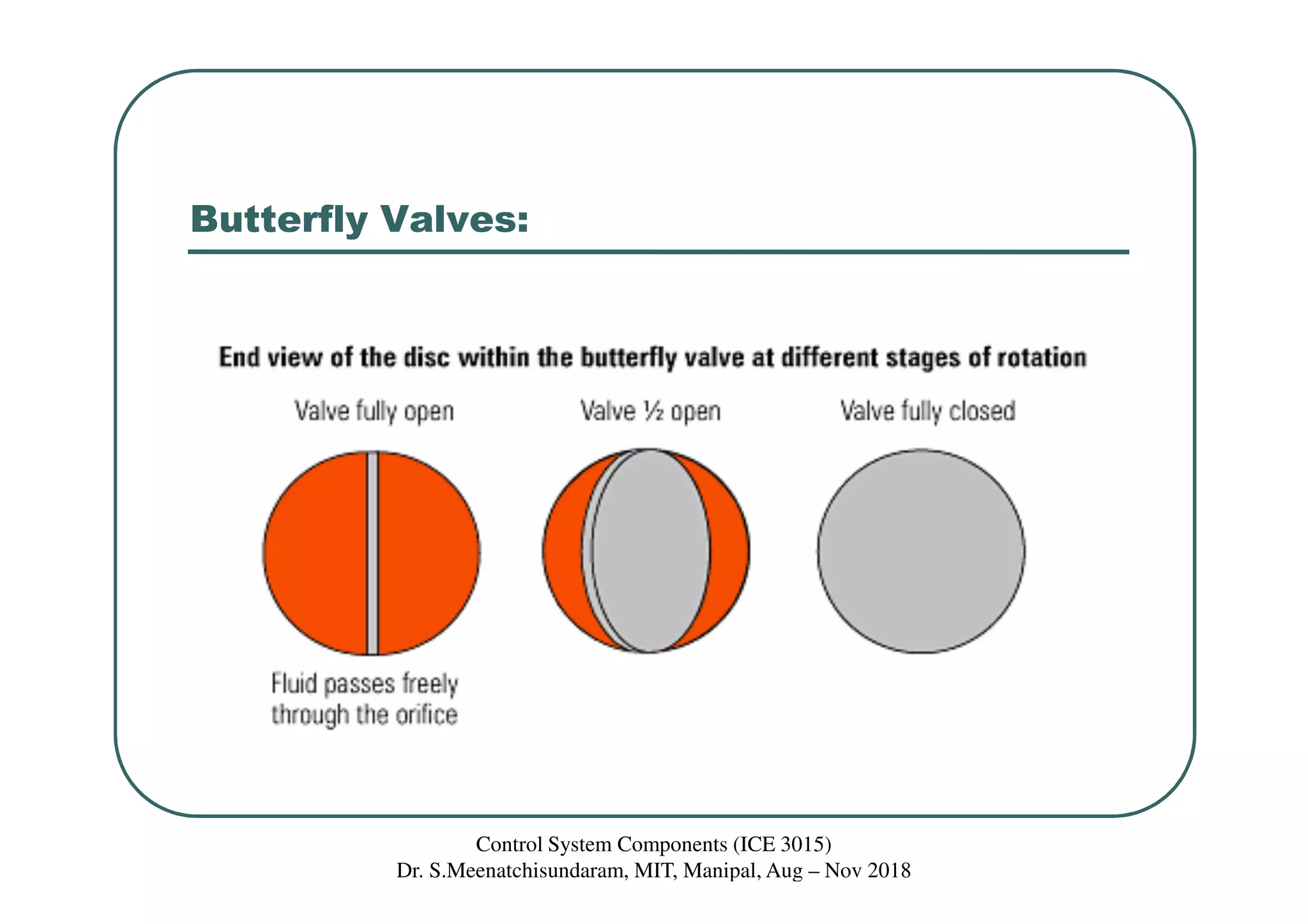
Butterfly Valves:
Control System Components (ICE 3015)
Dr. S.Meenatchisundaram, MIT, Manipal, Aug – Nov 2018
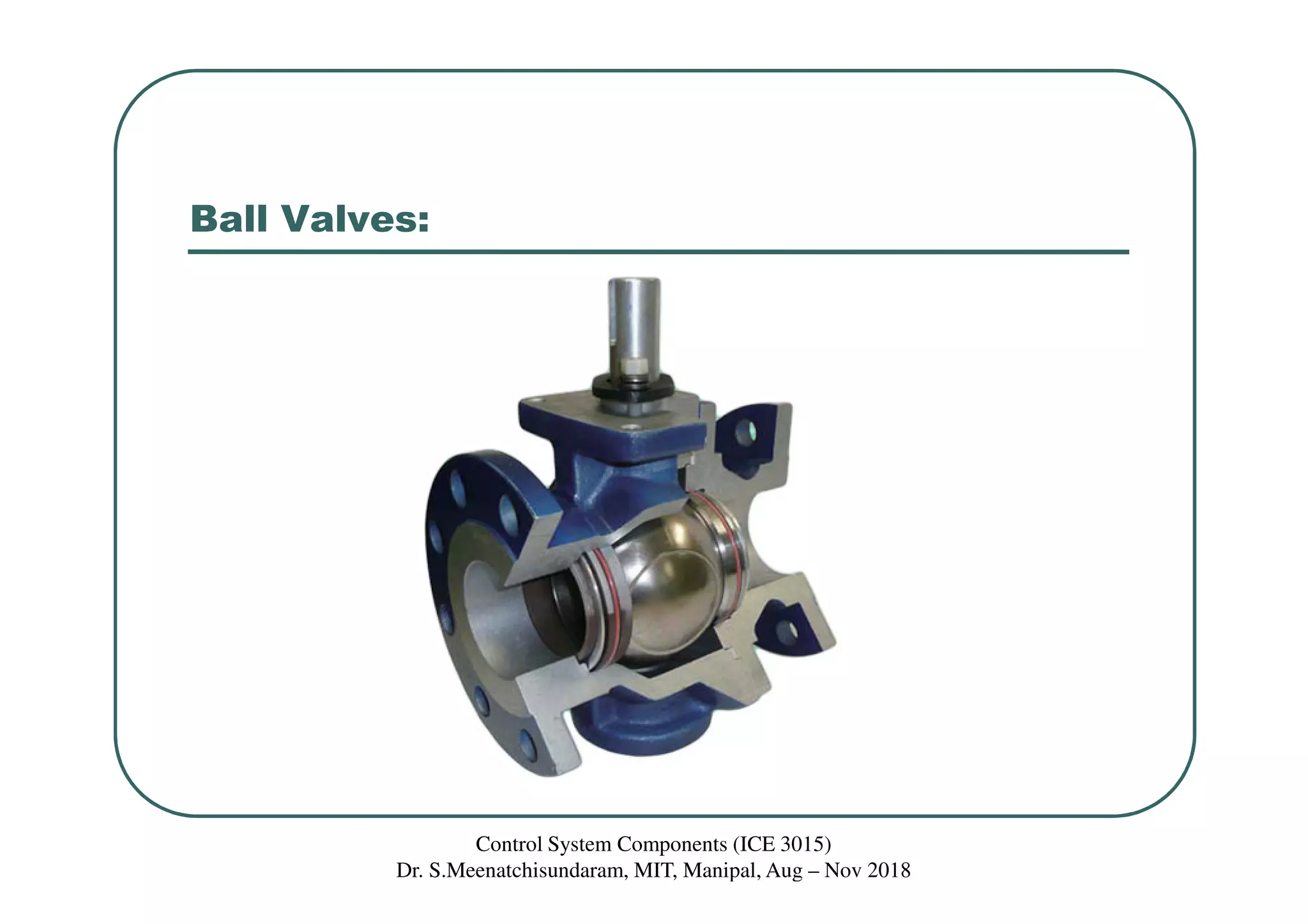
Ball Valves:
Control System Components (ICE 3015)
Dr. S.Meenatchisundaram, MIT, Manipal, Aug – Nov 2018
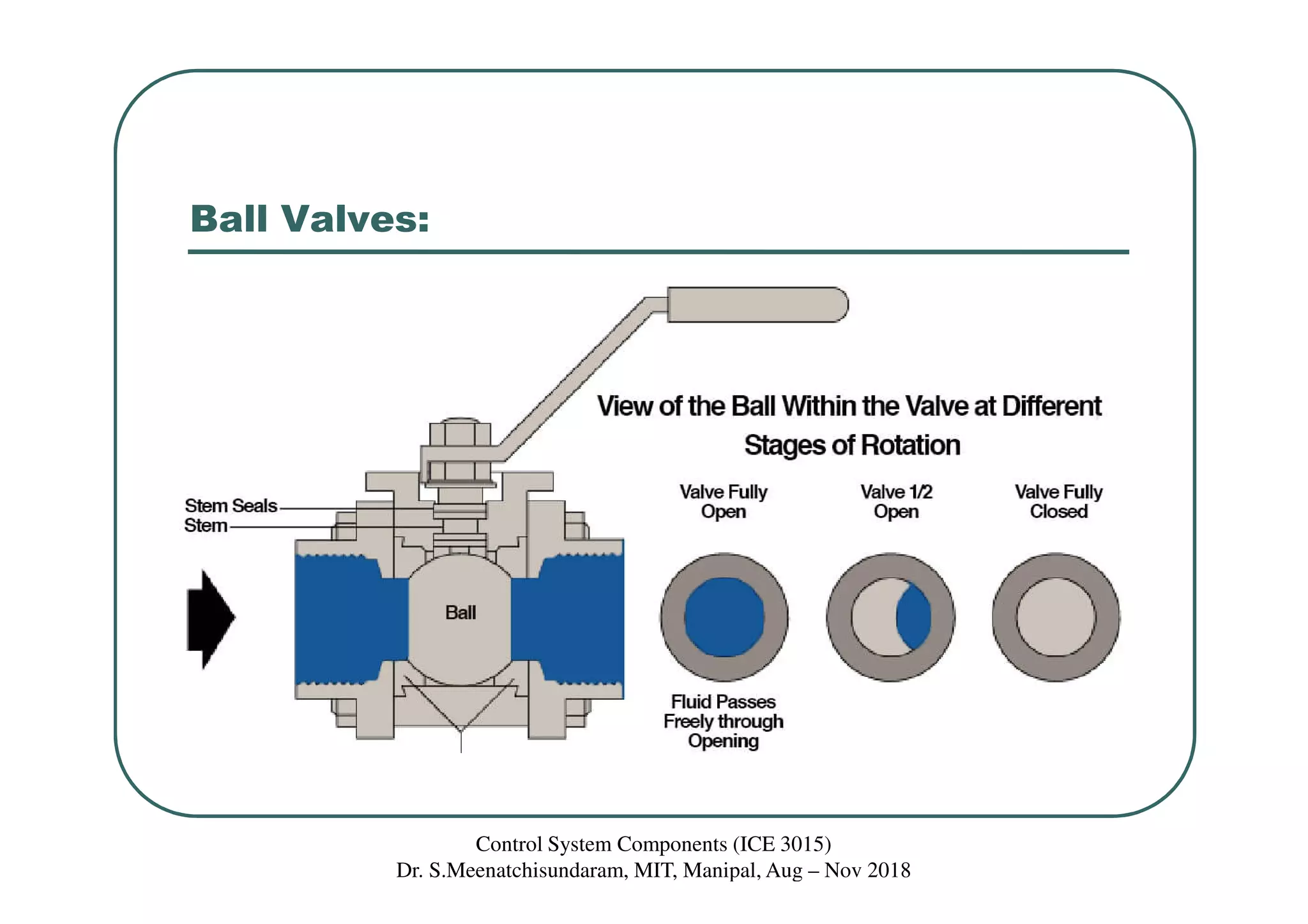
Ball Valves:
Control System Components (ICE 3015)
Dr. S.Meenatchisundaram, MIT, Manipal, Aug – Nov 2018
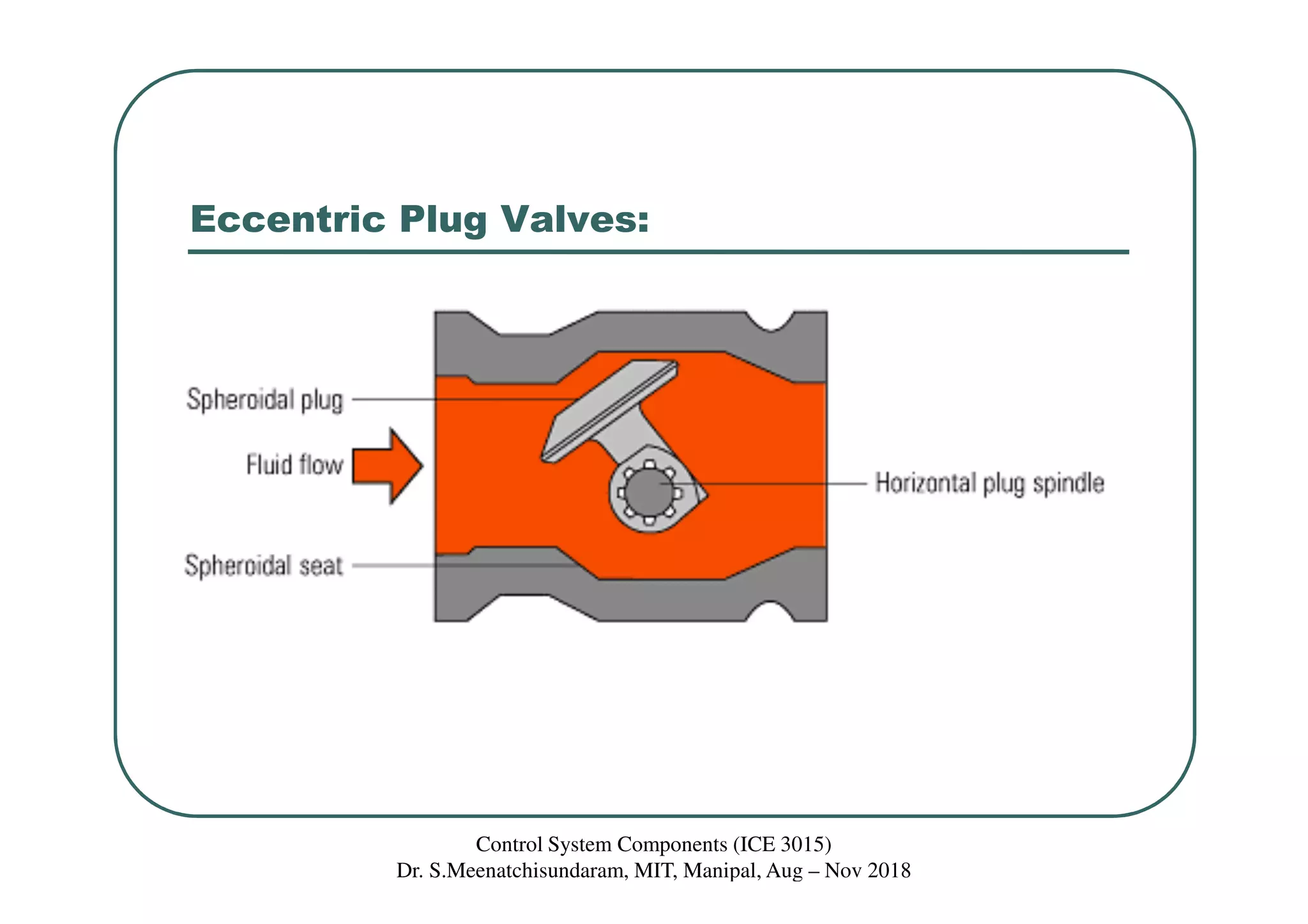
Eccentric Plug Valves:
Control System Components (ICE 3015)
Dr. S.Meenatchisundaram, MIT, Manipal, Aug – Nov 2018
Three port valves:
There are three basic types of three-port valve:
• Piston valve type.
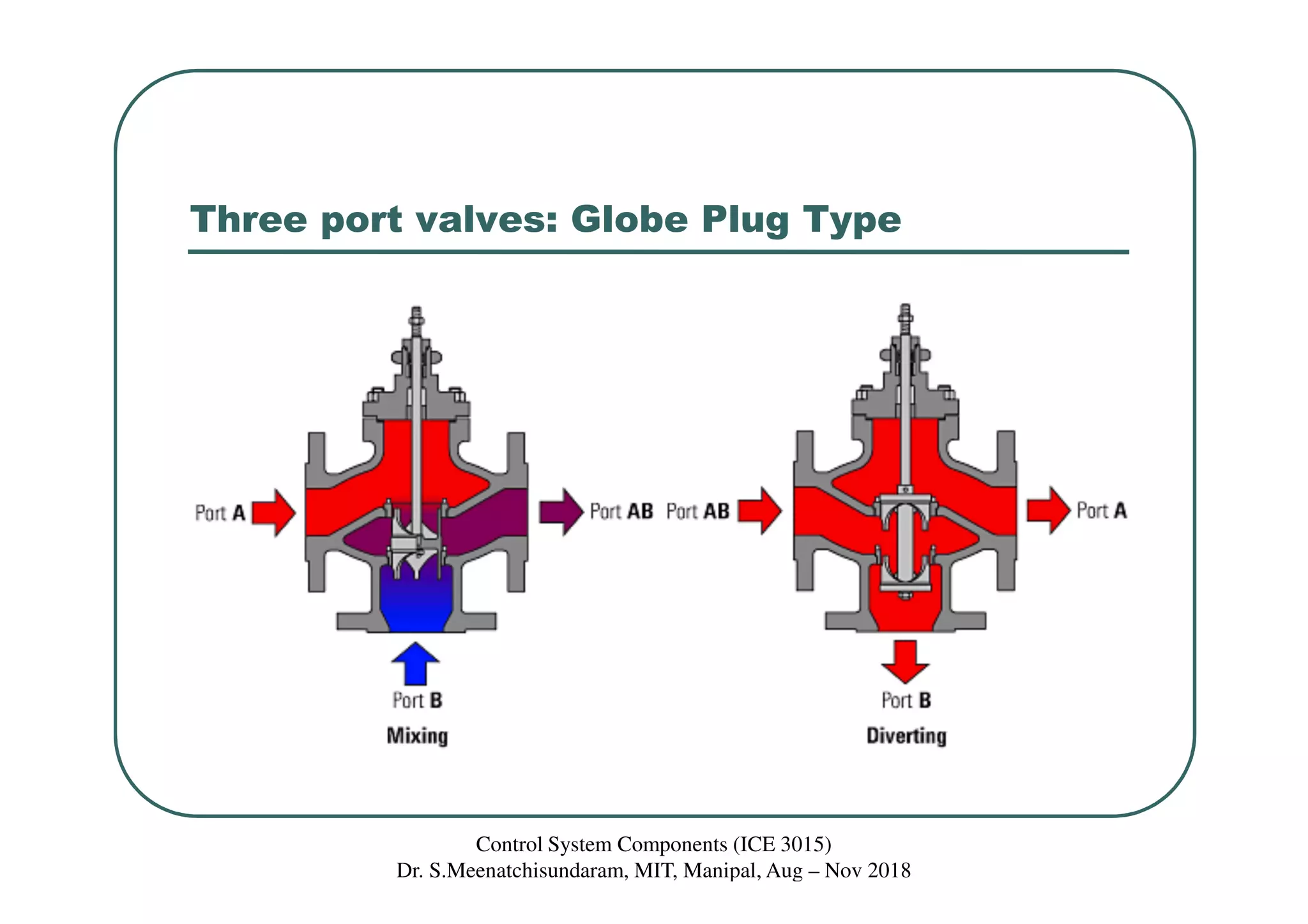
• Globe plug type.
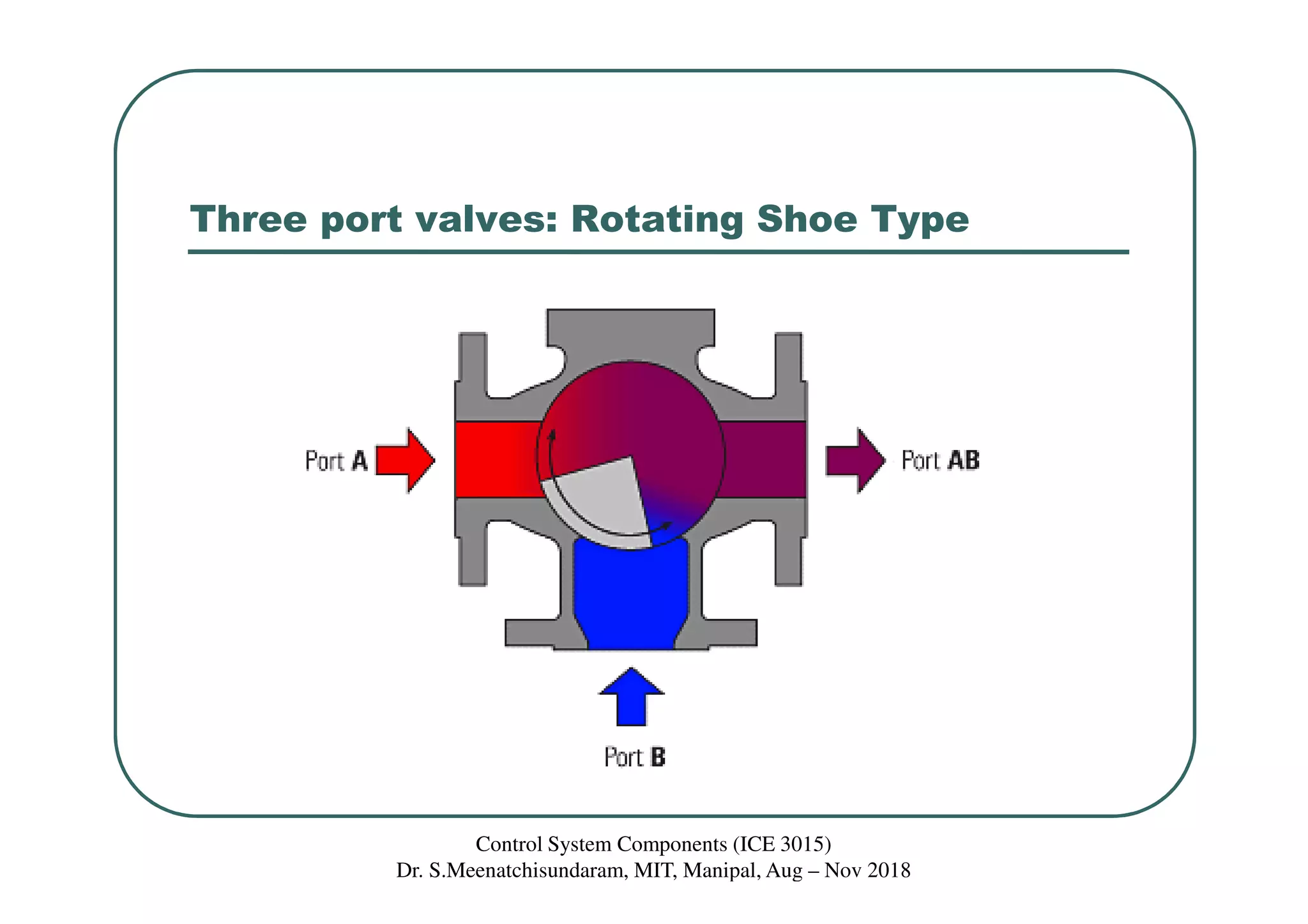
• Rotating shoe type.
Control System Components (ICE 3015)
Dr. S.Meenatchisundaram, MIT, Manipal, Aug – Nov 2018
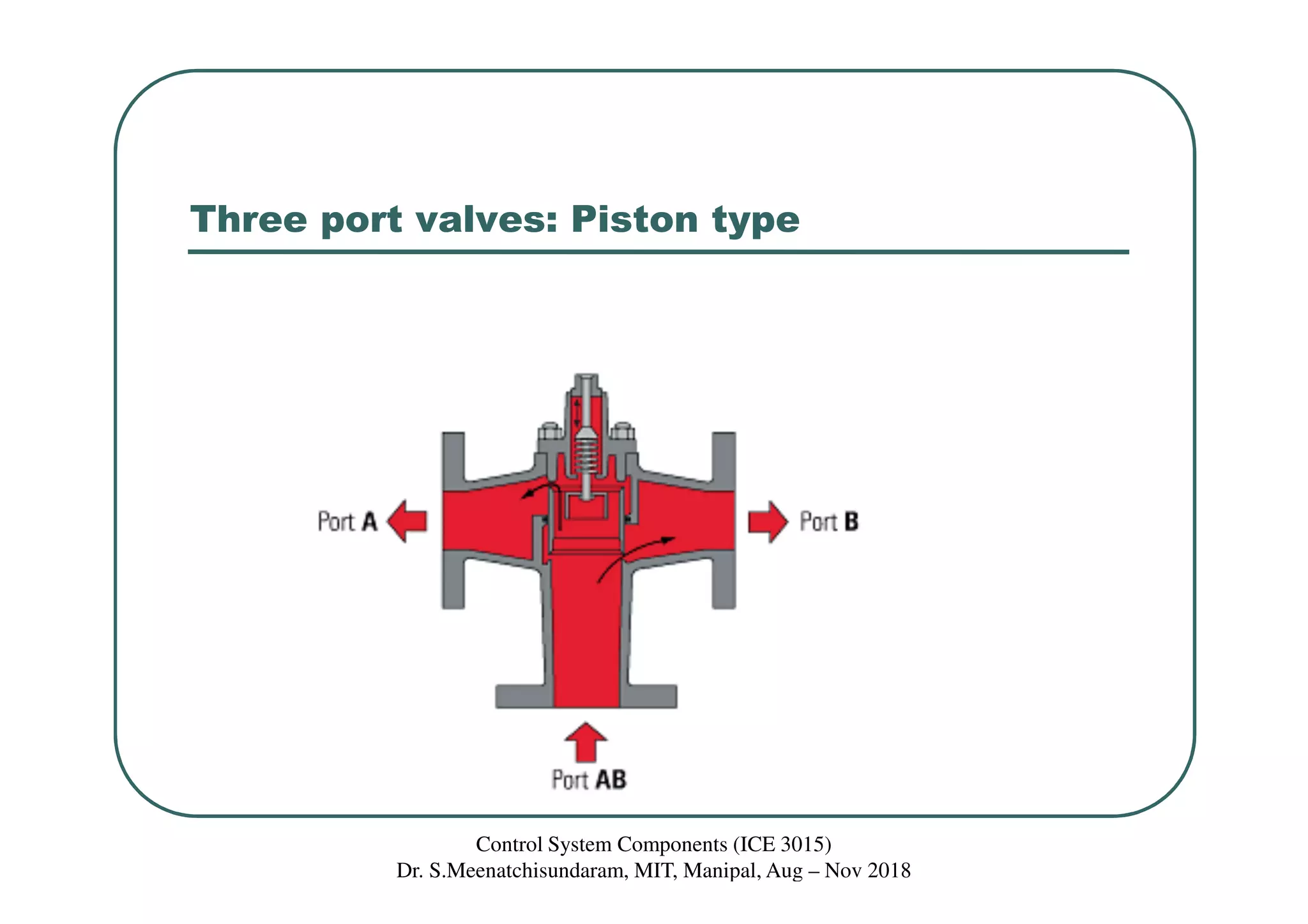
Three port valves: Piston type
Control System Components (ICE 3015)
Dr. S.Meenatchisundaram, MIT, Manipal, Aug – Nov 2018
Three port valves: Globe Plug Type
Control System Components (ICE 3015)
Dr. S.Meenatchisundaram, MIT, Manipal, Aug – Nov 2018
Three port valves: Rotating Shoe Type
Control System Components (ICE 3015)
Dr. S.Meenatchisundaram, MIT, Manipal, Aug – Nov 2018
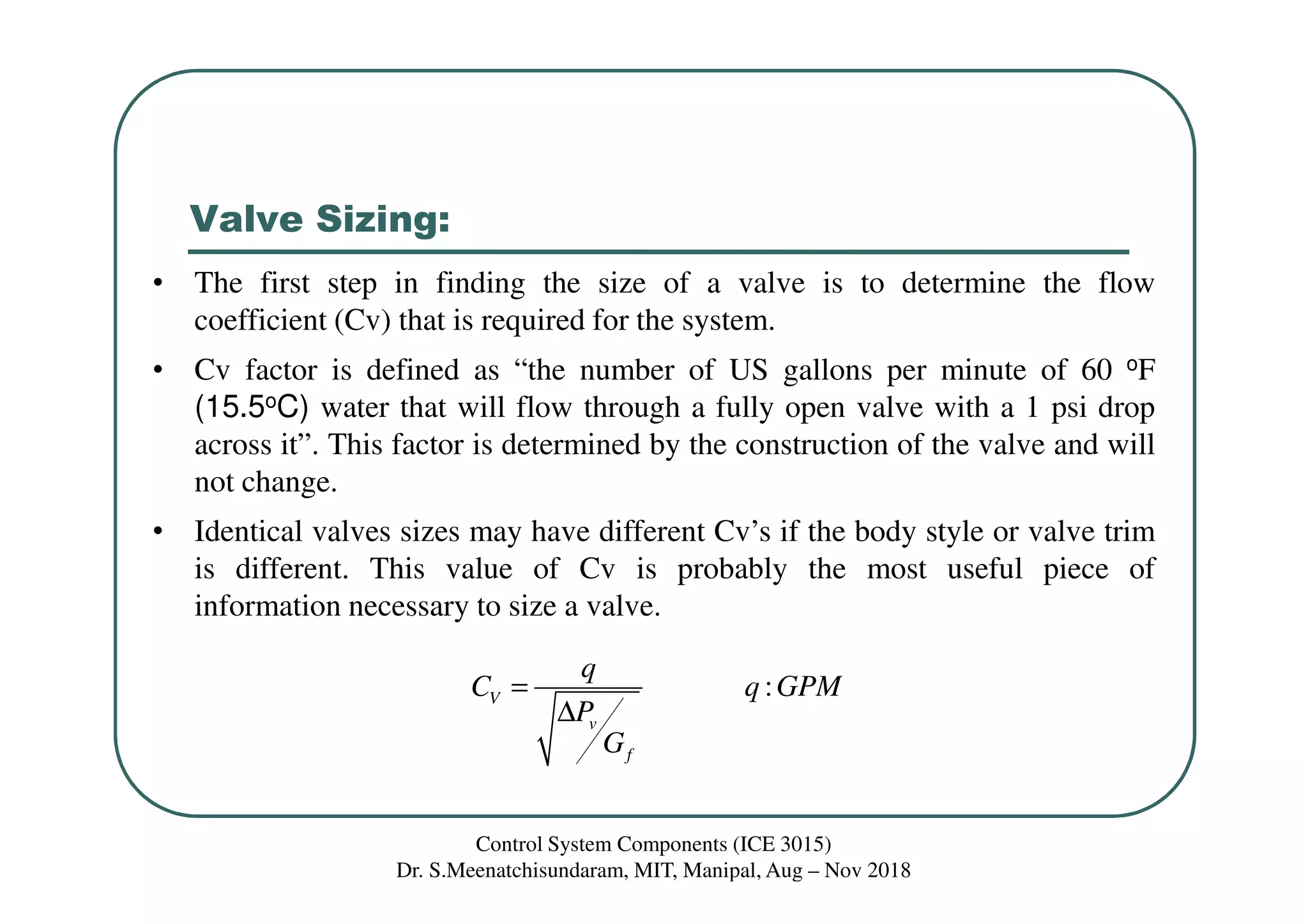
Valve Sizing:
:V
v
f
q
C q GPM
P
G
=
∆
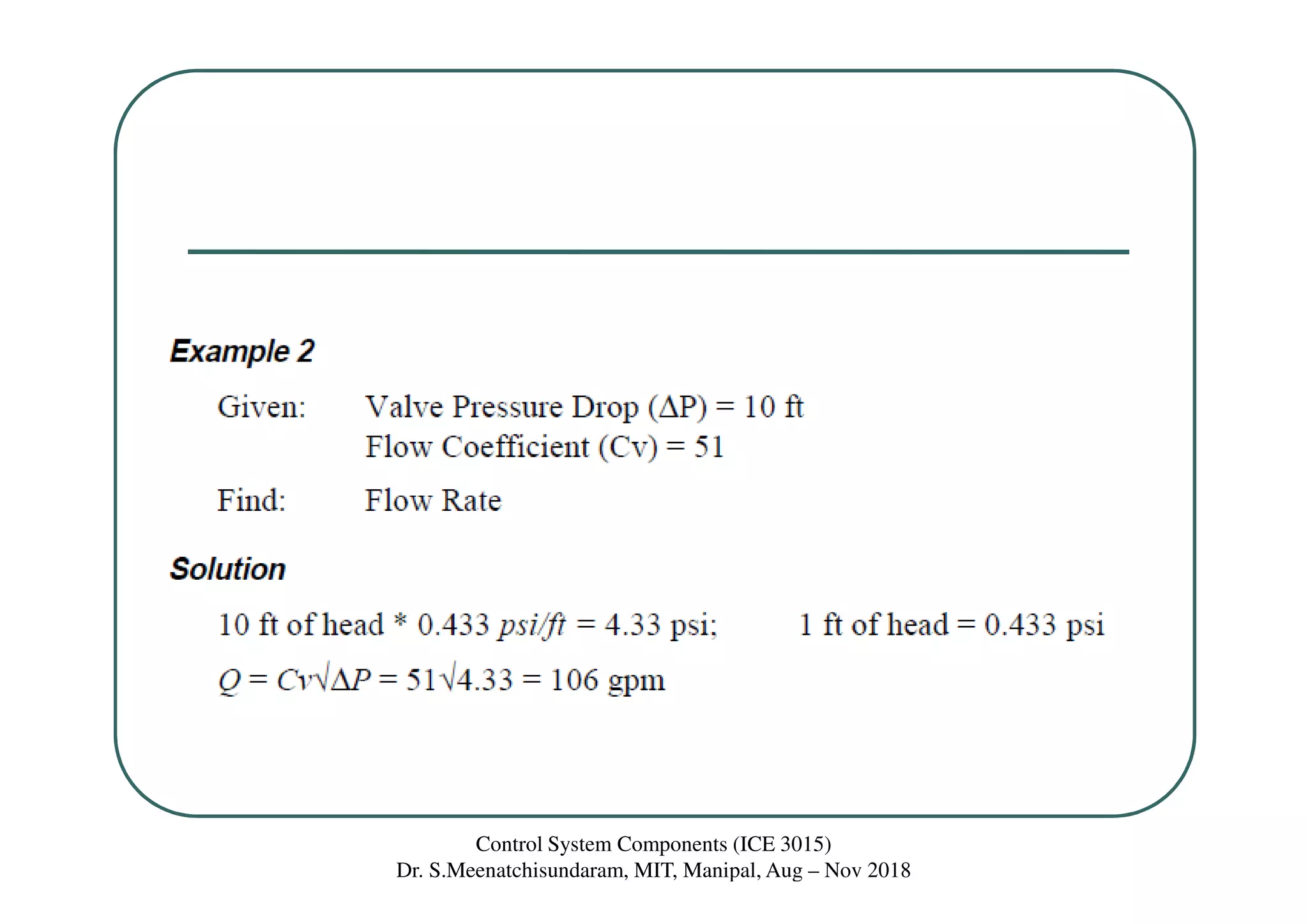
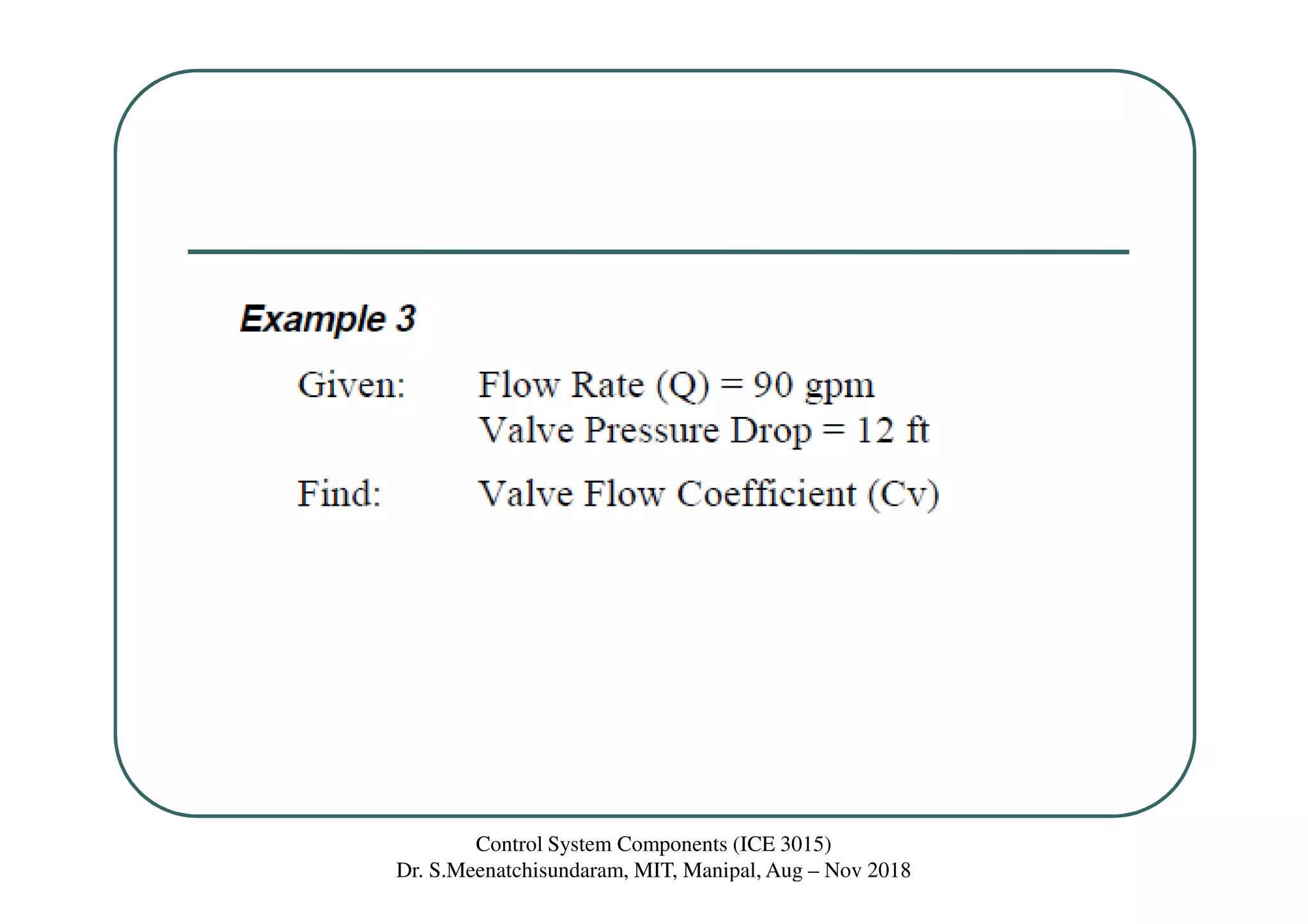
• The first step in finding the size of a valve is to determine the flow
coefficient (Cv) that is required for the system.
• Cv factor is defined as “the number of US gallons per minute of 60 oF
(15.5oC) water that will flow through a fully open valve with a 1 psi drop
across it”. This factor is determined by the construction of the valve and will
not change.
• Identical valves sizes may have different Cv’s if the body style or valve trim
is different. This value of Cv is probably the most useful piece of
information necessary to size a valve.
Control System Components (ICE 3015)
Dr. S.Meenatchisundaram, MIT, Manipal, Aug – Nov 2018
Control System Components (ICE 3015)
Dr. S.Meenatchisundaram, MIT, Manipal, Aug – Nov 2018
Control System Components (ICE 3015)
Dr. S.Meenatchisundaram, MIT, Manipal, Aug – Nov 2018
Control System Components (ICE 3015)
Dr. S.Meenatchisundaram, MIT, Manipal, Aug – Nov 2018
Flashing and Erosion:
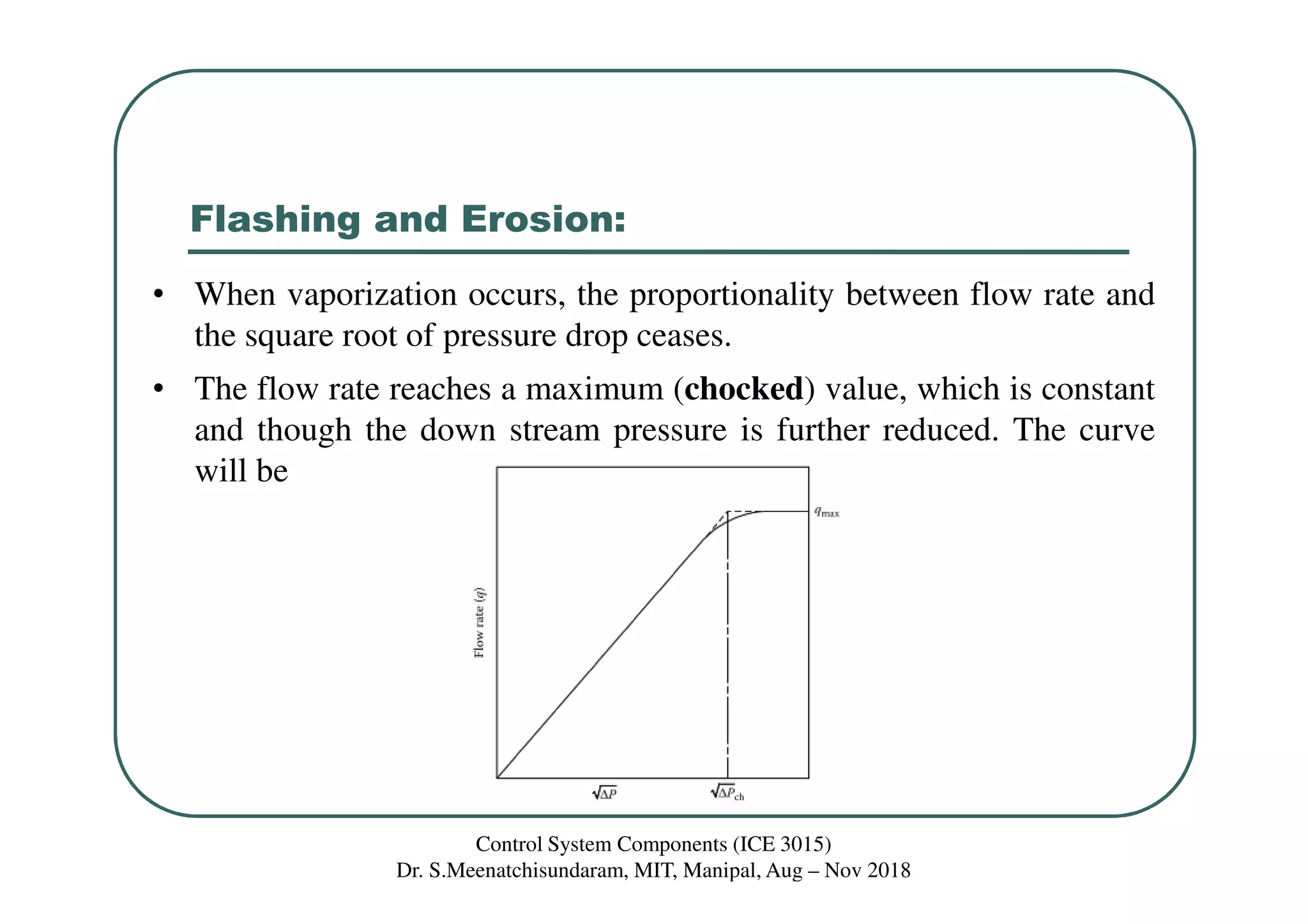
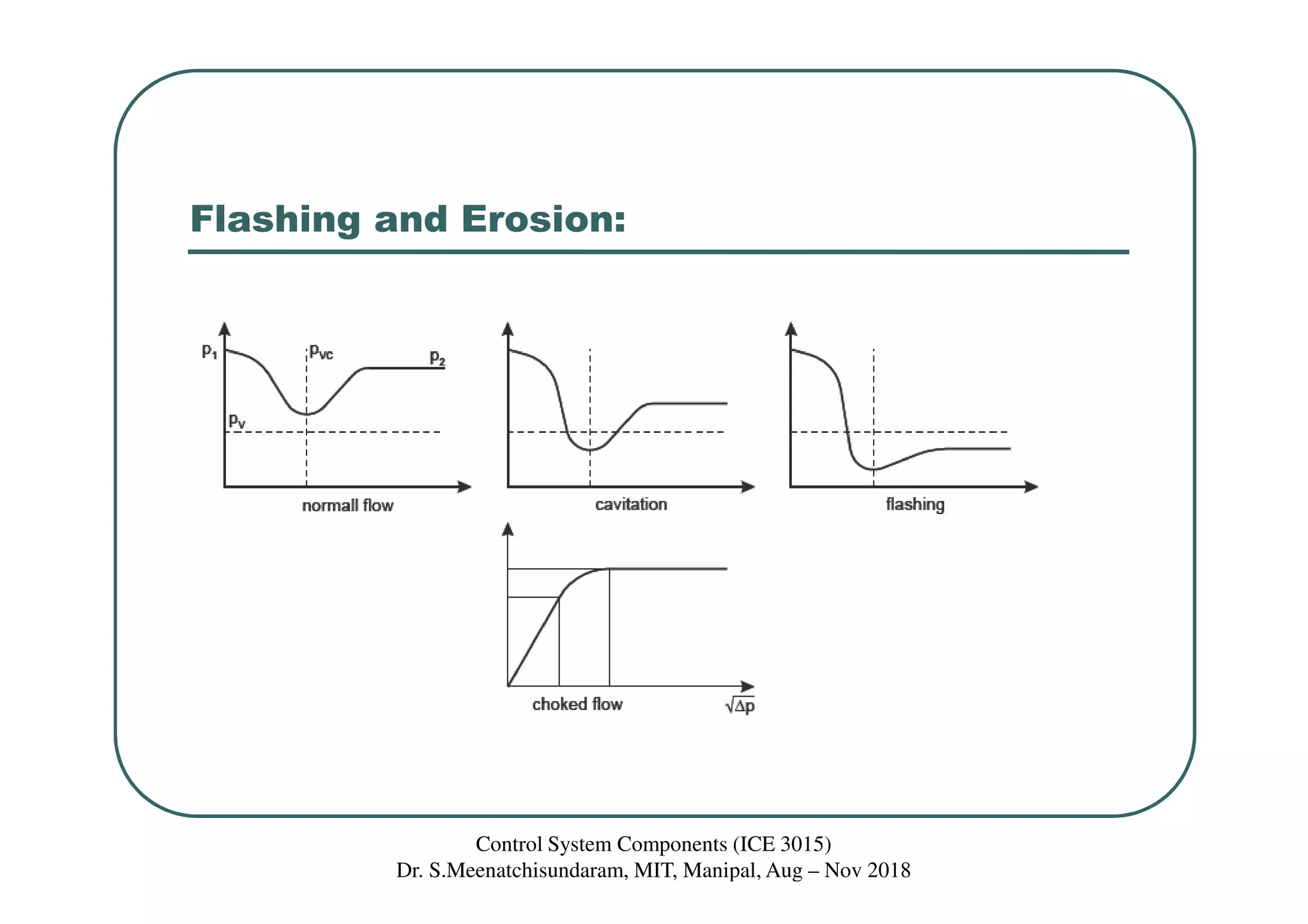
• When vaporization occurs, the proportionality between flow rate and
the square root of pressure drop ceases.
• The flow rate reaches a maximum (chocked) value, which is constant
and though the down stream pressure is further reduced. The curve
will be
Control System Components (ICE 3015)
Dr. S.Meenatchisundaram, MIT, Manipal, Aug – Nov 2018
Flashing and Erosion:
• This condition is referred as “chocked flow’. If large amount of
dissolved gases come out of solutions as the pressure drop in the flow,
these released gases will also restrict the flow.
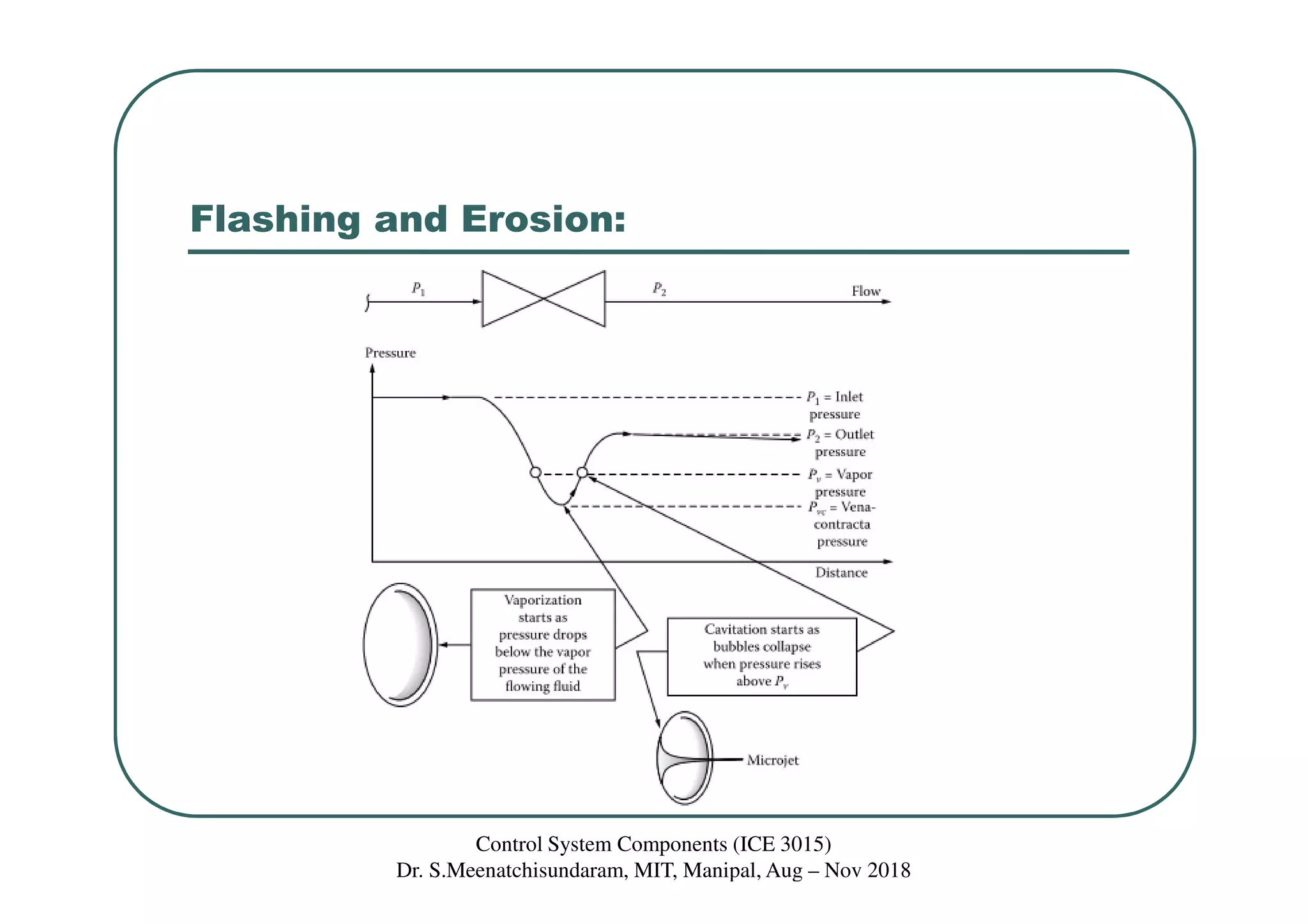
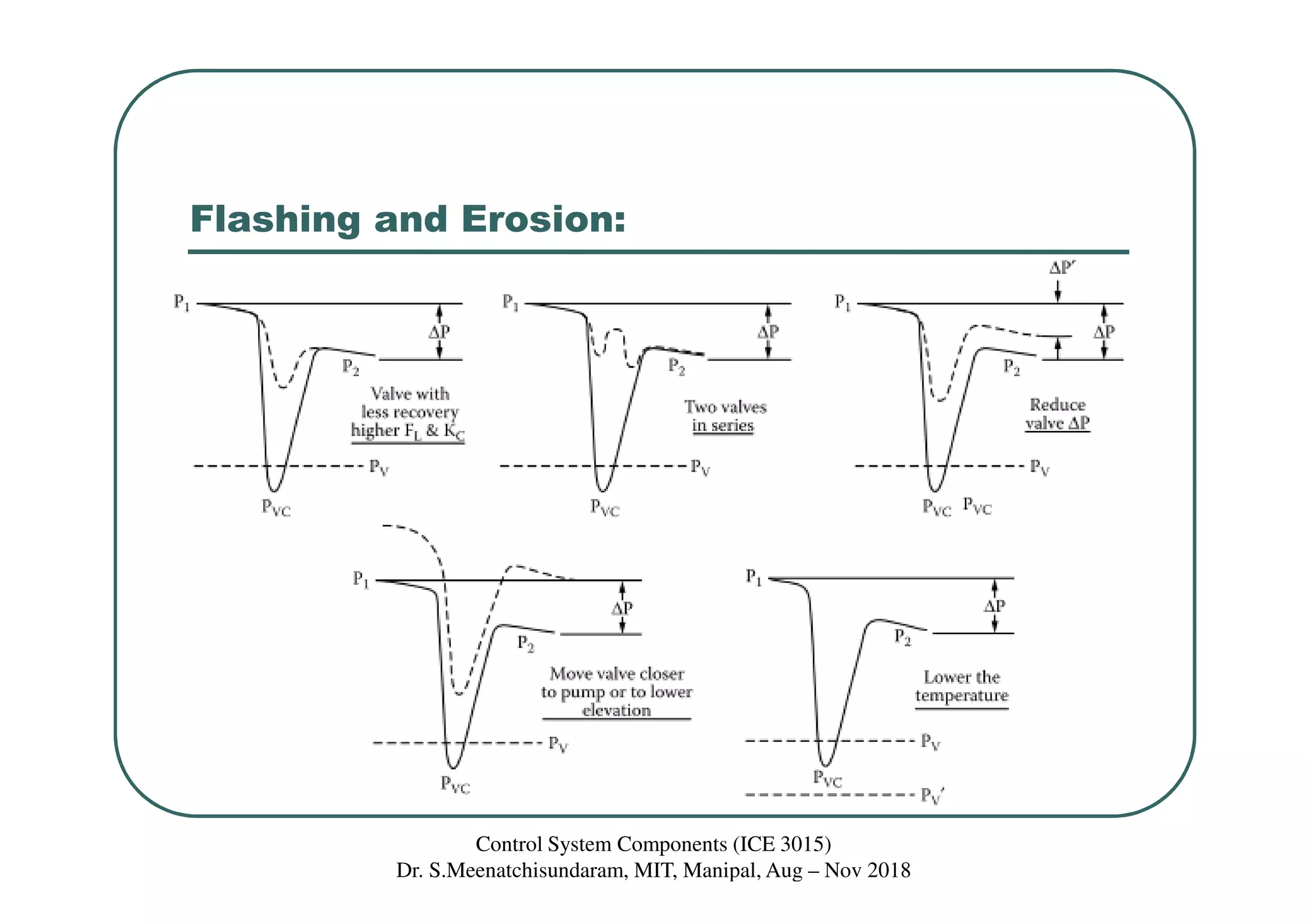
• Vaporization can cause cavitation or flashing. Cavitation occurs
when static pressure anywhere in the valve drops to or below the
vapour pressure of the process liquid.
• Vaporization begins around microscopic gaseous nuclei. The
cavitation process includes the vapour cavity formation and
sudden condensation (collapse) of the vapour bubble driven by
pressure changes.
• The basic process of cavitation is related to the conservation of
energy and Bernoulli’s theorem, which describes the pressure profile
of a liquid flowing through a restriction or orifice.
Control System Components (ICE 3015)
Dr. S.Meenatchisundaram, MIT, Manipal, Aug – Nov 2018
Flashing and Erosion:
Control System Components (ICE 3015)
Dr. S.Meenatchisundaram, MIT, Manipal, Aug – Nov 2018
Flashing and Erosion:
Control System Components (ICE 3015)
Dr. S.Meenatchisundaram, MIT, Manipal, Aug – Nov 2018
Flashing and Erosion:
Control System Components (ICE 3015)
Dr. S.Meenatchisundaram, MIT, Manipal, Aug – Nov 2018
Flashing and Erosion:
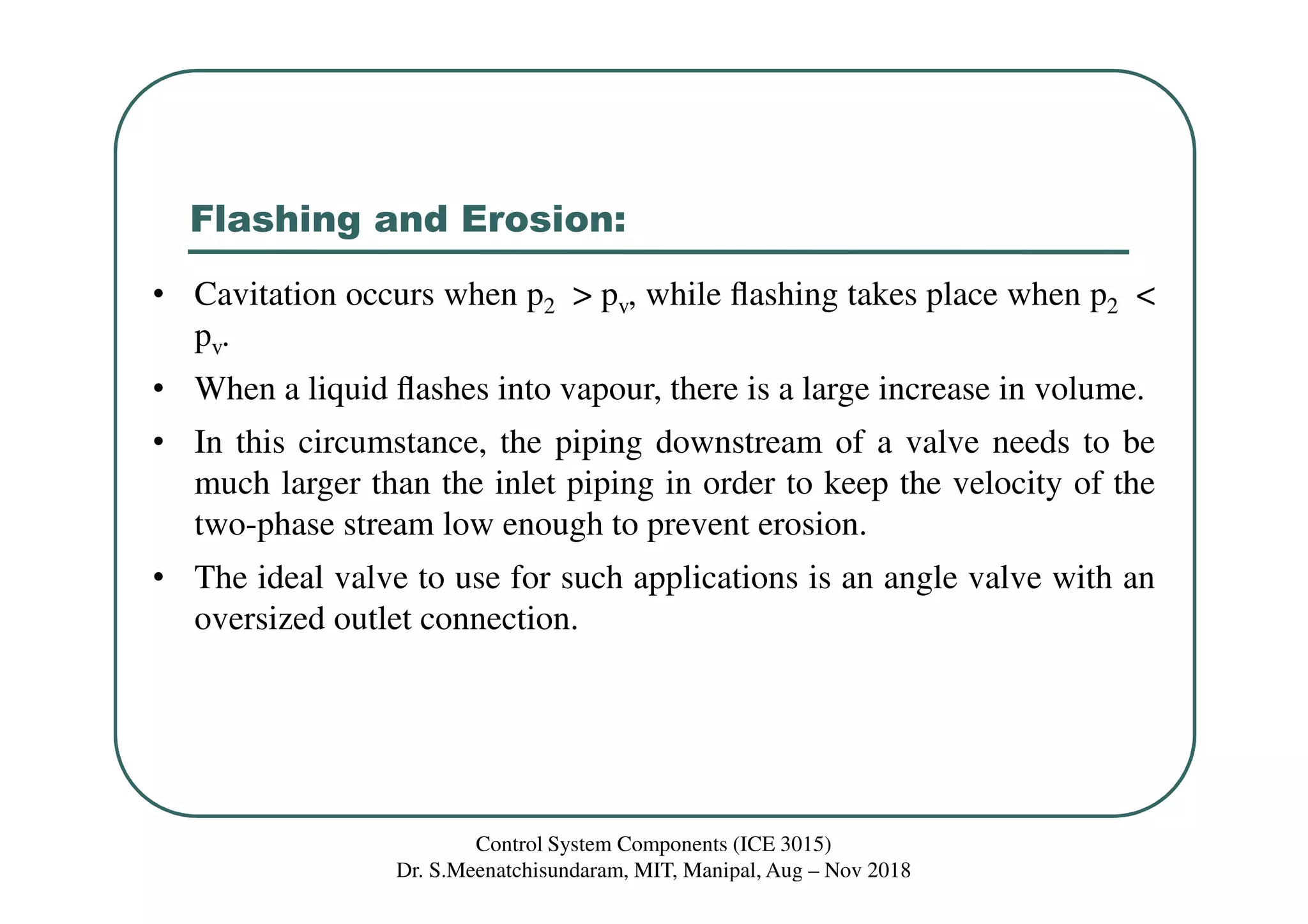
• Cavitation occurs when p2 > pv, while flashing takes place when p2 <
pv.
• When a liquid flashes into vapour, there is a large increase in volume.
• In this circumstance, the piping downstream of a valve needs to be
much larger than the inlet piping in order to keep the velocity of the
two-phase stream low enough to prevent erosion.
• The ideal valve to use for such applications is an angle valve with an
oversized outlet connection.
Control System Components (ICE 3015)
Dr. S.Meenatchisundaram, MIT, Manipal, Aug – Nov 2018
Flashing and Erosion:
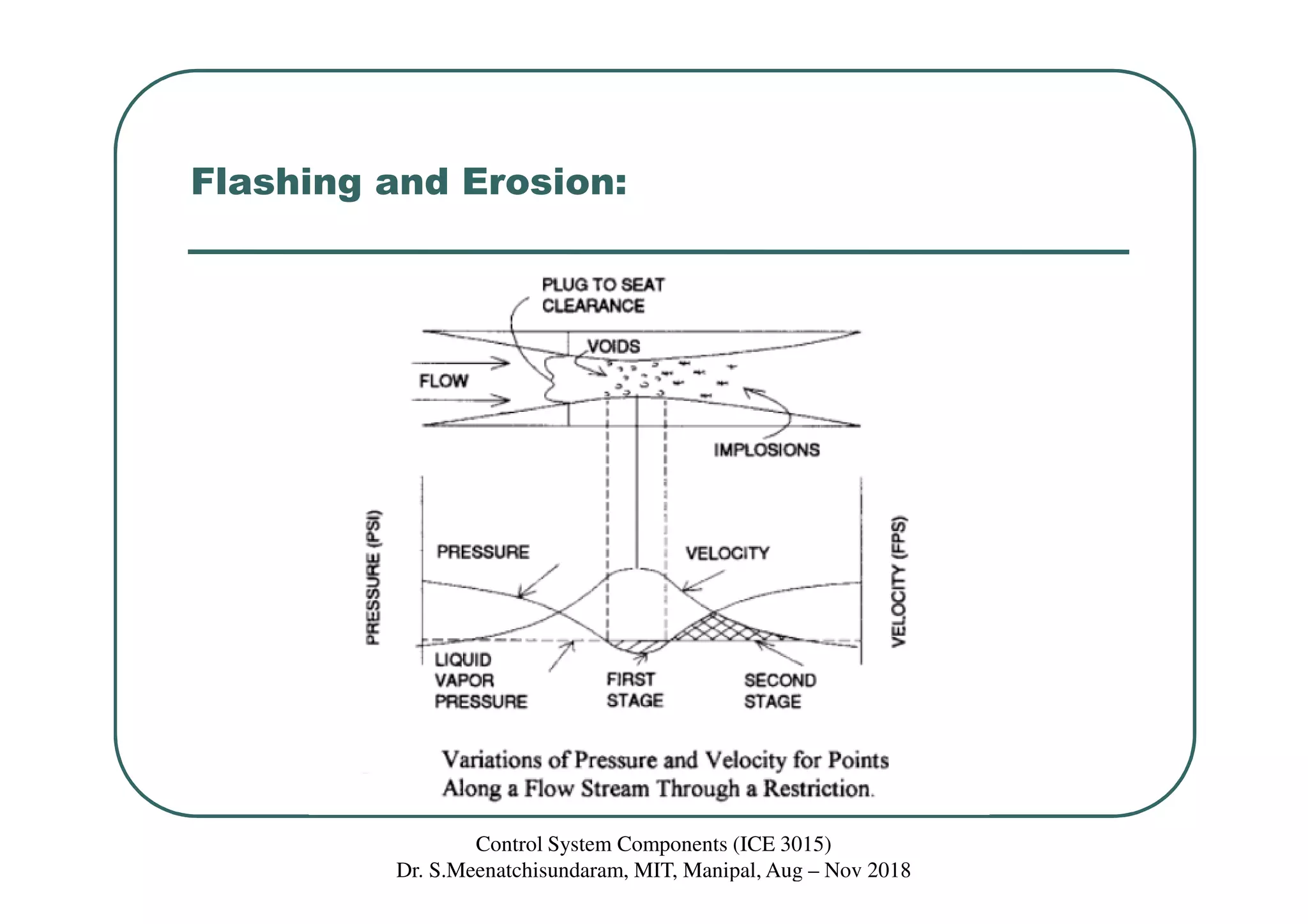
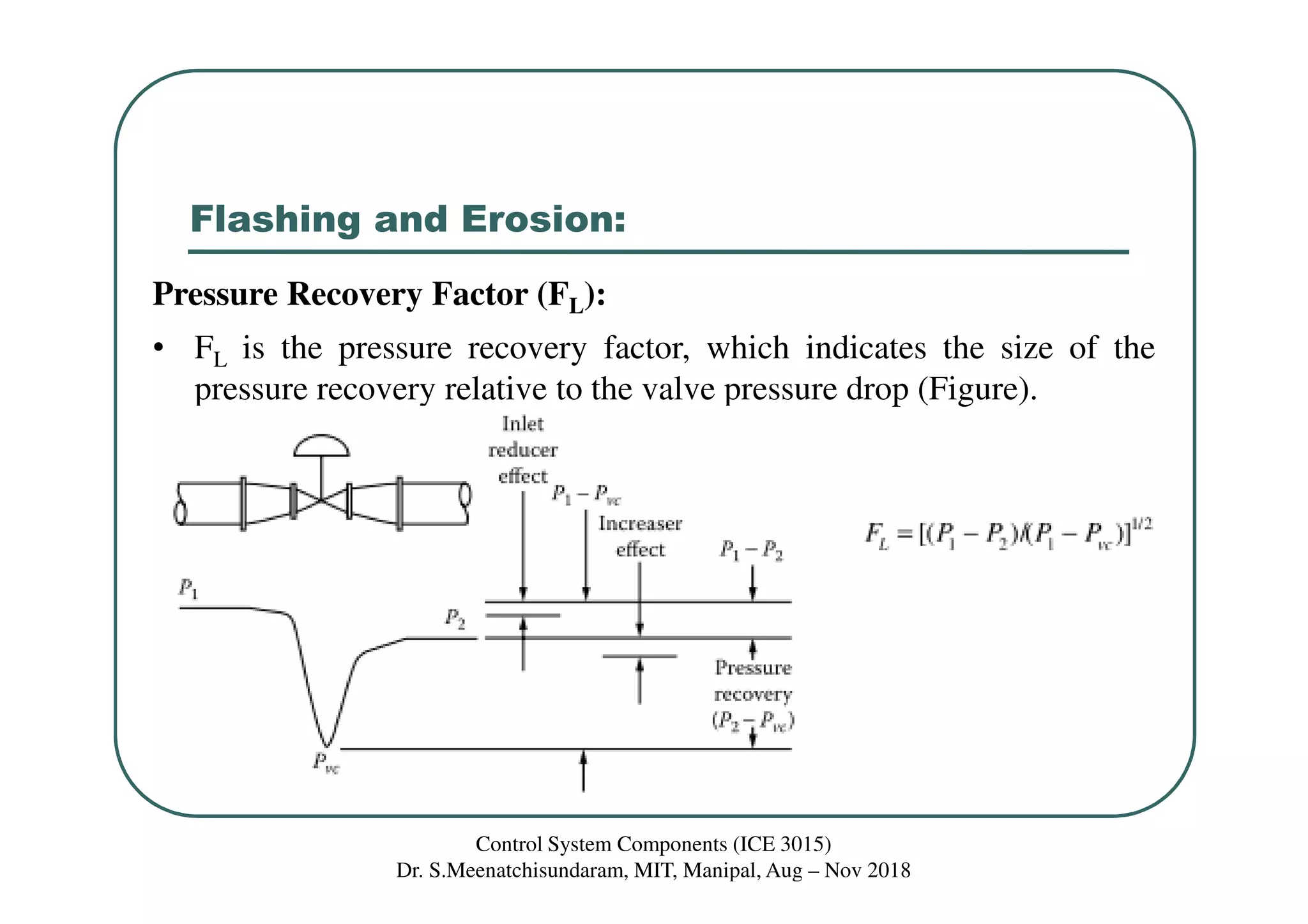
• In order to accelerate the fluid through the restriction, some of
the pressure head is converted into velocity head.
• This transfer of static energy is needed to maintain the same mass
flow through the reduced passage. The fluid accelerates to its
maximum velocity, which corresponds to the point of minimum
pressure (vena contracta).
• The fluid velocity gradually slows down as it expands back to the
full pipe area. The static pressure also recovers somewhat, but part of
it is lost due to turbulence and friction.
• If the static pressure at any point drops below the liquid vapour
pressure (Pv) corresponding to the process temperature, then vapour
bubbles will form.
Control System Components (ICE 3015)
Dr. S.Meenatchisundaram, MIT, Manipal, Aug – Nov 2018
Flashing and Erosion:
• If enough energy is imparted to the growing vapour bubble to
overcome surface tension effects, the bubble will reach a critical
diameter and expand rapidly.
• As the static pressure recovers to a point greater than the vapour
pressure, the vapour will condense, causing the bubbles to
collapse violently back into their liquid phase.
• The growth and collapse of the bubbles produce high-energy
shock waves in the fluid. The collapse stage of the process (the bubble
implosion) produces the more severe shock waves.
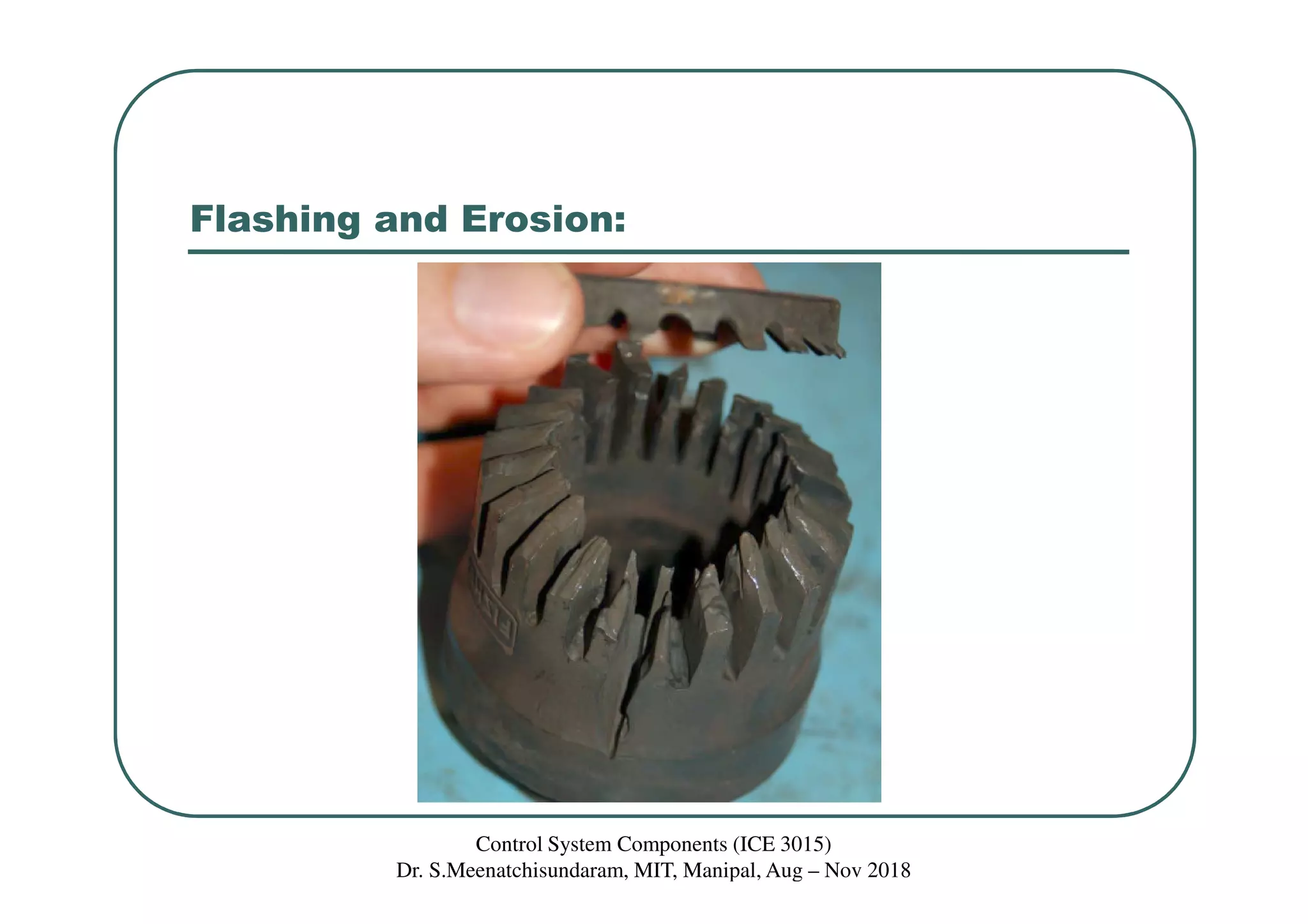
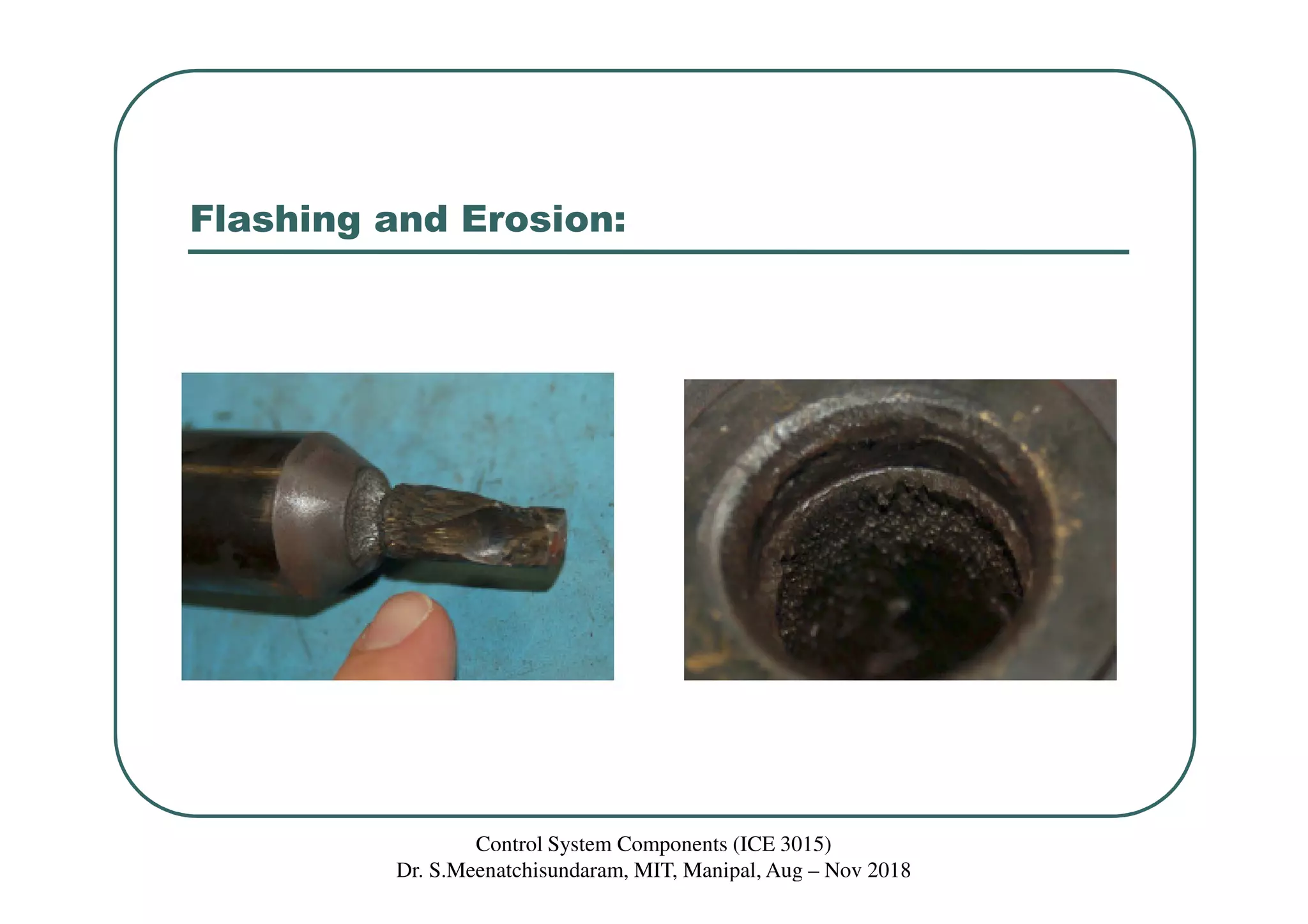
• Shock waves and liquid microjets radiate for short distances from
imploding cavities and erode nearby surfaces.
Control System Components (ICE 3015)
Dr. S.Meenatchisundaram, MIT, Manipal, Aug – Nov 2018
Flashing and Erosion:
Control System Components (ICE 3015)
Dr. S.Meenatchisundaram, MIT, Manipal, Aug – Nov 2018
Flashing and Erosion:
Control System Components (ICE 3015)
Dr. S.Meenatchisundaram, MIT, Manipal, Aug – Nov 2018
Flashing and Erosion:
Control System Components (ICE 3015)
Dr. S.Meenatchisundaram, MIT, Manipal, Aug – Nov 2018
Flashing and Erosion:
Control System Components (ICE 3015)
Dr. S.Meenatchisundaram, MIT, Manipal, Aug – Nov 2018
Flashing and Erosion:
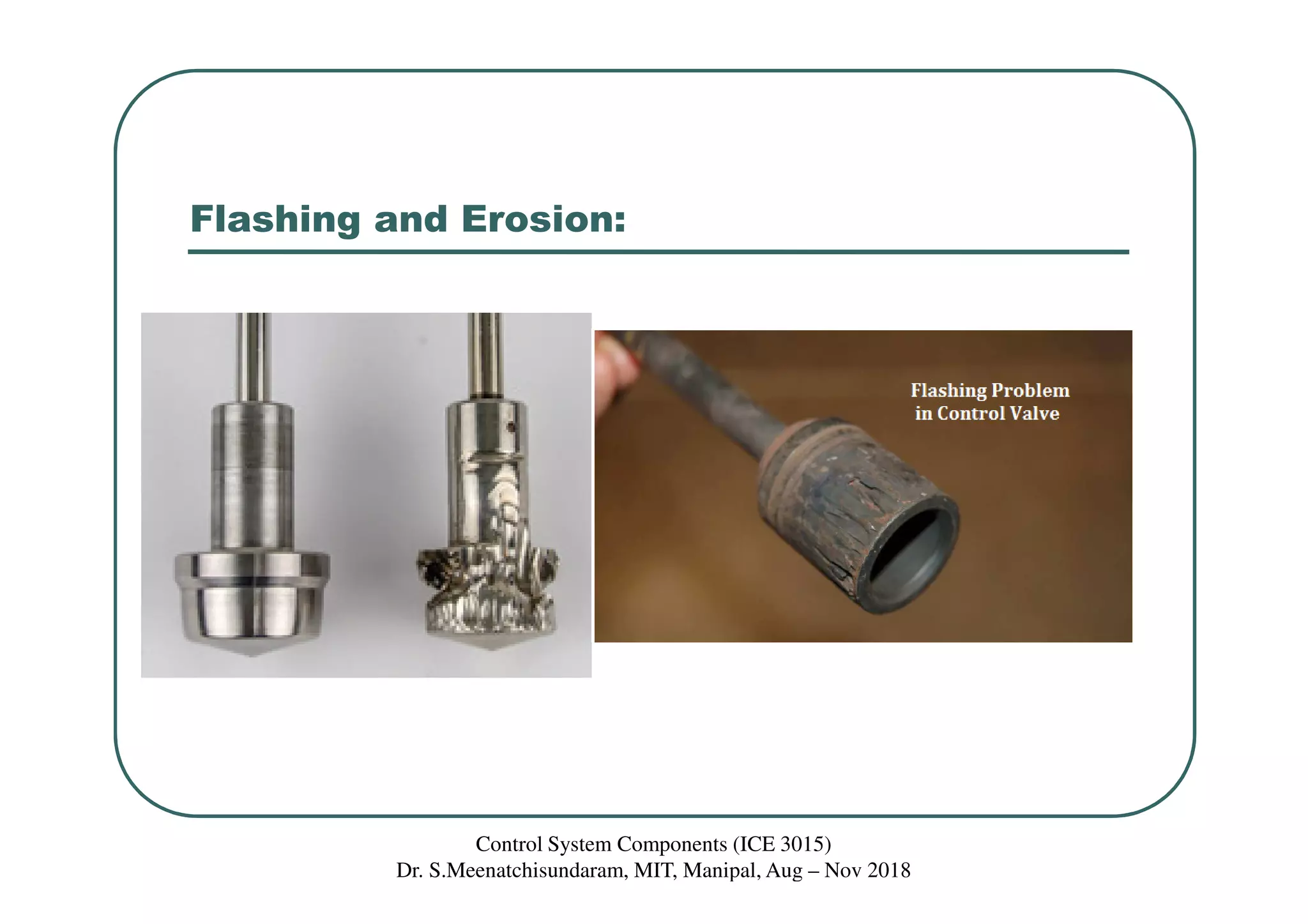
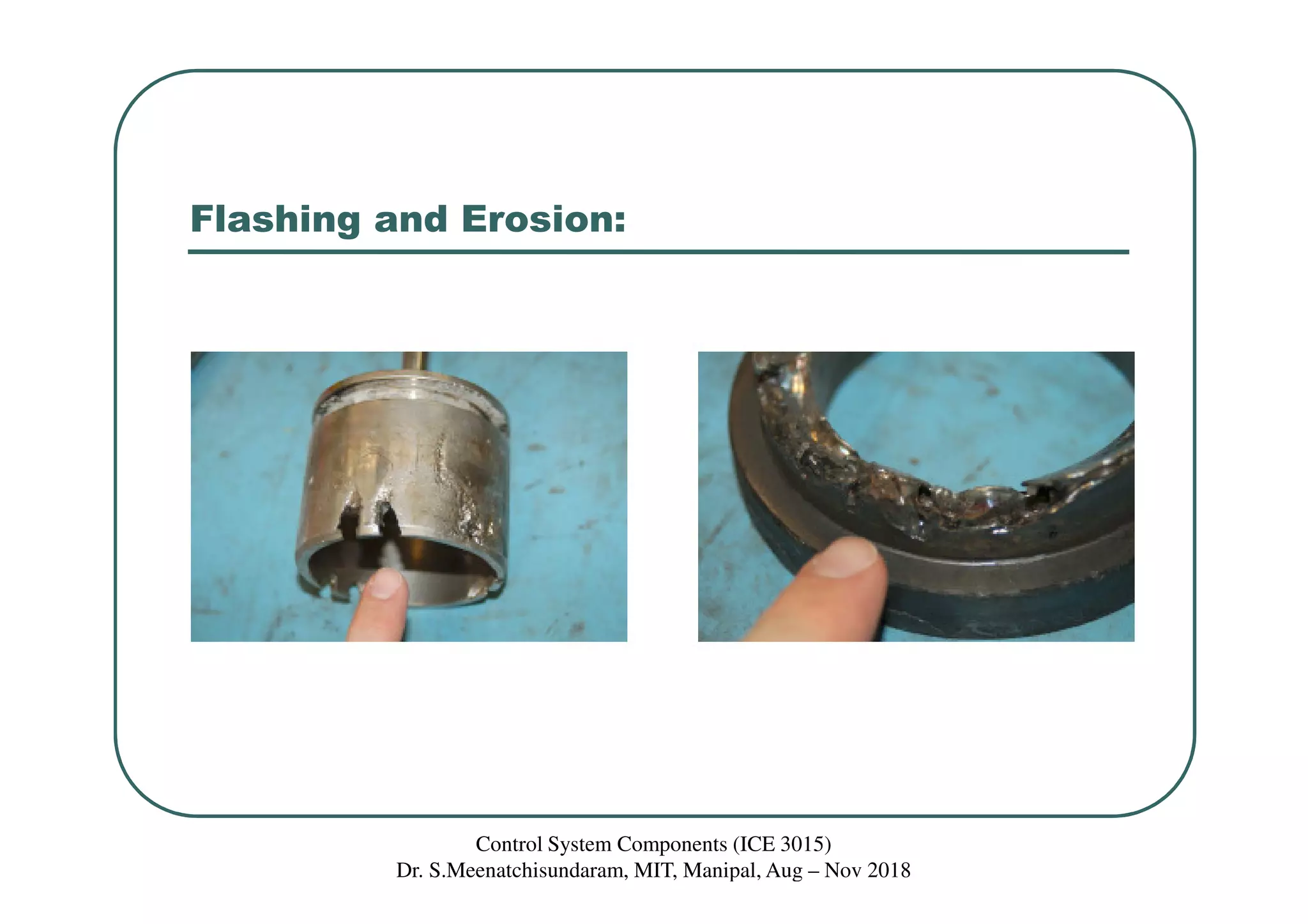
• Cavitation can cause erosion, noise, and vibration in piping
systems and therefore must be avoided.
• Extensive cavitation also causes choked flow conditions in the
valve.
Predicting and Mitigating Cavitation:
• Sizing a valve in liquid service for choked flow allows one to
determine its maximum flow capacity, but this is of limited value,
because most liquid-service valves should not be operated under
choked conditions.
• Special trim designs with multiple stages or multiple flow paths are
typically used to prevent severe cavitation and are better able to
operate at or near choked conditions without damage.
Control System Components (ICE 3015)
Dr. S.Meenatchisundaram, MIT, Manipal, Aug – Nov 2018
Flashing and Erosion:
Pressure Recovery Factor (FL):
• FL is the pressure recovery factor, which indicates the size of the
pressure recovery relative to the valve pressure drop (Figure).
Control System Components (ICE 3015)
Dr. S.Meenatchisundaram, MIT, Manipal, Aug – Nov 2018
Flashing and Erosion:
Control System Components (ICE 3015)
Dr. S.Meenatchisundaram, MIT, Manipal, Aug – Nov 2018

Lecture 23, 24,25 valve types, valve positioners, cavitation &amp; flashing

  • 1.
    ICE401: PROCESS INSTRUMENTATION ANDCONTROL Class 23, 24 & 25: Valve Types, Valve Positioners, Cavitation & Flashing Dr. S. Meenatchisundaram Email: meenasundar@gmail.com Control System Components (ICE 3015) Dr. S.Meenatchisundaram, MIT, Manipal, Aug – Nov 2018
  • 2.
    Valve Positioners: Control SystemComponents (ICE 3015) Dr. S.Meenatchisundaram, MIT, Manipal, Aug – Nov 2018
  • 3.
    Valve Positioners: Control SystemComponents (ICE 3015) Dr. S.Meenatchisundaram, MIT, Manipal, Aug – Nov 2018
  • 4.
    Valves: Linear Type Rotary Type ControlSystem Components (ICE 3015) Dr. S.Meenatchisundaram, MIT, Manipal, Aug – Nov 2018
  • 5.
    Angle Valves: Control SystemComponents (ICE 3015) Dr. S.Meenatchisundaram, MIT, Manipal, Aug – Nov 2018
  • 6.
    Angle Valves: Control SystemComponents (ICE 3015) Dr. S.Meenatchisundaram, MIT, Manipal, Aug – Nov 2018
  • 7.
    Gate Valves: Control SystemComponents (ICE 3015) Dr. S.Meenatchisundaram, MIT, Manipal, Aug – Nov 2018
  • 8.
    Gate Valves: Control SystemComponents (ICE 3015) Dr. S.Meenatchisundaram, MIT, Manipal, Aug – Nov 2018
  • 9.
    Globe Valves: Control SystemComponents (ICE 3015) Dr. S.Meenatchisundaram, MIT, Manipal, Aug – Nov 2018
  • 10.
    Globe Valves: Control SystemComponents (ICE 3015) Dr. S.Meenatchisundaram, MIT, Manipal, Aug – Nov 2018
  • 11.
    Globe Valves –Single Seat, two port: Control System Components (ICE 3015) Dr. S.Meenatchisundaram, MIT, Manipal, Aug – Nov 2018
  • 12.
    Globe Valves –Double Seat, two Port: Control System Components (ICE 3015) Dr. S.Meenatchisundaram, MIT, Manipal, Aug – Nov 2018
  • 13.
    Globe Valves – ControlSystem Components (ICE 3015) Dr. S.Meenatchisundaram, MIT, Manipal, Aug – Nov 2018
  • 14.
    Butterfly Valves: Control SystemComponents (ICE 3015) Dr. S.Meenatchisundaram, MIT, Manipal, Aug – Nov 2018
  • 15.
    Butterfly Valves: Control SystemComponents (ICE 3015) Dr. S.Meenatchisundaram, MIT, Manipal, Aug – Nov 2018
  • 16.
    Ball Valves: Control SystemComponents (ICE 3015) Dr. S.Meenatchisundaram, MIT, Manipal, Aug – Nov 2018
  • 17.
    Ball Valves: Control SystemComponents (ICE 3015) Dr. S.Meenatchisundaram, MIT, Manipal, Aug – Nov 2018
  • 18.
    Eccentric Plug Valves: ControlSystem Components (ICE 3015) Dr. S.Meenatchisundaram, MIT, Manipal, Aug – Nov 2018
  • 19.
    Three port valves: Thereare three basic types of three-port valve: • Piston valve type. • Globe plug type. • Rotating shoe type. Control System Components (ICE 3015) Dr. S.Meenatchisundaram, MIT, Manipal, Aug – Nov 2018
  • 20.
    Three port valves:Piston type Control System Components (ICE 3015) Dr. S.Meenatchisundaram, MIT, Manipal, Aug – Nov 2018
  • 21.
    Three port valves:Globe Plug Type Control System Components (ICE 3015) Dr. S.Meenatchisundaram, MIT, Manipal, Aug – Nov 2018
  • 22.
    Three port valves:Rotating Shoe Type Control System Components (ICE 3015) Dr. S.Meenatchisundaram, MIT, Manipal, Aug – Nov 2018
  • 23.
    Valve Sizing: :V v f q C qGPM P G = ∆ • The first step in finding the size of a valve is to determine the flow coefficient (Cv) that is required for the system. • Cv factor is defined as “the number of US gallons per minute of 60 oF (15.5oC) water that will flow through a fully open valve with a 1 psi drop across it”. This factor is determined by the construction of the valve and will not change. • Identical valves sizes may have different Cv’s if the body style or valve trim is different. This value of Cv is probably the most useful piece of information necessary to size a valve. Control System Components (ICE 3015) Dr. S.Meenatchisundaram, MIT, Manipal, Aug – Nov 2018
  • 24.
    Control System Components(ICE 3015) Dr. S.Meenatchisundaram, MIT, Manipal, Aug – Nov 2018
  • 25.
    Control System Components(ICE 3015) Dr. S.Meenatchisundaram, MIT, Manipal, Aug – Nov 2018
  • 26.
    Control System Components(ICE 3015) Dr. S.Meenatchisundaram, MIT, Manipal, Aug – Nov 2018
  • 27.
    Flashing and Erosion: •When vaporization occurs, the proportionality between flow rate and the square root of pressure drop ceases. • The flow rate reaches a maximum (chocked) value, which is constant and though the down stream pressure is further reduced. The curve will be Control System Components (ICE 3015) Dr. S.Meenatchisundaram, MIT, Manipal, Aug – Nov 2018
  • 28.
    Flashing and Erosion: •This condition is referred as “chocked flow’. If large amount of dissolved gases come out of solutions as the pressure drop in the flow, these released gases will also restrict the flow. • Vaporization can cause cavitation or flashing. Cavitation occurs when static pressure anywhere in the valve drops to or below the vapour pressure of the process liquid. • Vaporization begins around microscopic gaseous nuclei. The cavitation process includes the vapour cavity formation and sudden condensation (collapse) of the vapour bubble driven by pressure changes. • The basic process of cavitation is related to the conservation of energy and Bernoulli’s theorem, which describes the pressure profile of a liquid flowing through a restriction or orifice. Control System Components (ICE 3015) Dr. S.Meenatchisundaram, MIT, Manipal, Aug – Nov 2018
  • 29.
    Flashing and Erosion: ControlSystem Components (ICE 3015) Dr. S.Meenatchisundaram, MIT, Manipal, Aug – Nov 2018
  • 30.
    Flashing and Erosion: ControlSystem Components (ICE 3015) Dr. S.Meenatchisundaram, MIT, Manipal, Aug – Nov 2018
  • 31.
    Flashing and Erosion: ControlSystem Components (ICE 3015) Dr. S.Meenatchisundaram, MIT, Manipal, Aug – Nov 2018
  • 32.
    Flashing and Erosion: •Cavitation occurs when p2 > pv, while flashing takes place when p2 < pv. • When a liquid flashes into vapour, there is a large increase in volume. • In this circumstance, the piping downstream of a valve needs to be much larger than the inlet piping in order to keep the velocity of the two-phase stream low enough to prevent erosion. • The ideal valve to use for such applications is an angle valve with an oversized outlet connection. Control System Components (ICE 3015) Dr. S.Meenatchisundaram, MIT, Manipal, Aug – Nov 2018
  • 33.
    Flashing and Erosion: •In order to accelerate the fluid through the restriction, some of the pressure head is converted into velocity head. • This transfer of static energy is needed to maintain the same mass flow through the reduced passage. The fluid accelerates to its maximum velocity, which corresponds to the point of minimum pressure (vena contracta). • The fluid velocity gradually slows down as it expands back to the full pipe area. The static pressure also recovers somewhat, but part of it is lost due to turbulence and friction. • If the static pressure at any point drops below the liquid vapour pressure (Pv) corresponding to the process temperature, then vapour bubbles will form. Control System Components (ICE 3015) Dr. S.Meenatchisundaram, MIT, Manipal, Aug – Nov 2018
  • 34.
    Flashing and Erosion: •If enough energy is imparted to the growing vapour bubble to overcome surface tension effects, the bubble will reach a critical diameter and expand rapidly. • As the static pressure recovers to a point greater than the vapour pressure, the vapour will condense, causing the bubbles to collapse violently back into their liquid phase. • The growth and collapse of the bubbles produce high-energy shock waves in the fluid. The collapse stage of the process (the bubble implosion) produces the more severe shock waves. • Shock waves and liquid microjets radiate for short distances from imploding cavities and erode nearby surfaces. Control System Components (ICE 3015) Dr. S.Meenatchisundaram, MIT, Manipal, Aug – Nov 2018
  • 35.
    Flashing and Erosion: ControlSystem Components (ICE 3015) Dr. S.Meenatchisundaram, MIT, Manipal, Aug – Nov 2018
  • 36.
    Flashing and Erosion: ControlSystem Components (ICE 3015) Dr. S.Meenatchisundaram, MIT, Manipal, Aug – Nov 2018
  • 37.
    Flashing and Erosion: ControlSystem Components (ICE 3015) Dr. S.Meenatchisundaram, MIT, Manipal, Aug – Nov 2018
  • 38.
    Flashing and Erosion: ControlSystem Components (ICE 3015) Dr. S.Meenatchisundaram, MIT, Manipal, Aug – Nov 2018
  • 39.
    Flashing and Erosion: •Cavitation can cause erosion, noise, and vibration in piping systems and therefore must be avoided. • Extensive cavitation also causes choked flow conditions in the valve. Predicting and Mitigating Cavitation: • Sizing a valve in liquid service for choked flow allows one to determine its maximum flow capacity, but this is of limited value, because most liquid-service valves should not be operated under choked conditions. • Special trim designs with multiple stages or multiple flow paths are typically used to prevent severe cavitation and are better able to operate at or near choked conditions without damage. Control System Components (ICE 3015) Dr. S.Meenatchisundaram, MIT, Manipal, Aug – Nov 2018
  • 40.
    Flashing and Erosion: PressureRecovery Factor (FL): • FL is the pressure recovery factor, which indicates the size of the pressure recovery relative to the valve pressure drop (Figure). Control System Components (ICE 3015) Dr. S.Meenatchisundaram, MIT, Manipal, Aug – Nov 2018
  • 41.
    Flashing and Erosion: ControlSystem Components (ICE 3015) Dr. S.Meenatchisundaram, MIT, Manipal, Aug – Nov 2018