ICE401: PROCESS INSTRUMENTATION
AND CONTROL
Class 23
Electronic Controllers – Error Detector, Two
Position Controller
Dr. S. Meenatchisundaram
Email: meenasundar@gmail.com
Process Instrumentation and Control (ICE 401)
Dr. S.Meenatchisundaram, MIT, Manipal, Aug – Nov 2015
Error Detector:
Process Instrumentation and Control (ICE 401)
Dr. S.Meenatchisundaram, MIT, Manipal, Aug – Nov 2015
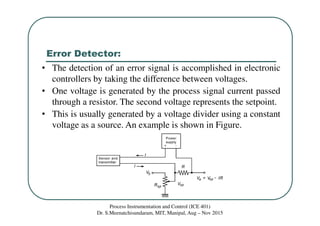
• The detection of an error signal is accomplished in electronic
controllers by taking the difference between voltages.
• One voltage is generated by the process signal current passed
through a resistor. The second voltage represents the setpoint.
• This is usually generated by a voltage divider using a constant
voltage as a source. An example is shown in Figure.
Error Detector:
Process Instrumentation and Control (ICE 401)
Dr. S.Meenatchisundaram, MIT, Manipal, Aug – Nov 2015
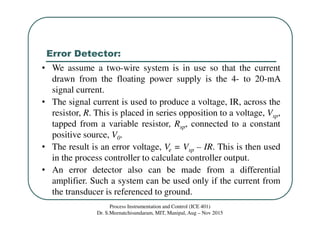
• We assume a two-wire system is in use so that the current
drawn from the floating power supply is the 4- to 20-mA
signal current.
• The signal current is used to produce a voltage, IR, across the
resistor, R. This is placed in series opposition to a voltage, Vsp,
tapped from a variable resistor, Rsp, connected to a constant
positive source, V0.
• The result is an error voltage, Ve = Vsp – IR. This is then used
in the process controller to calculate controller output.
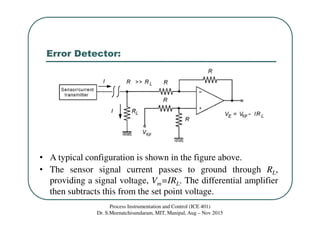
• An error detector also can be made from a differential
amplifier. Such a system can be used only if the current from
the transducer is referenced to ground.
Error Detector:
Process Instrumentation and Control (ICE 401)
Dr. S.Meenatchisundaram, MIT, Manipal, Aug – Nov 2015
• A typical configuration is shown in the figure above.
• The sensor signal current passes to ground through RL,
providing a signal voltage, Vm=IRL. The differential amplifier
then subtracts this from the set point voltage.
Single Mode:
Process Instrumentation and Control (ICE 401)
Dr. S.Meenatchisundaram, MIT, Manipal, Aug – Nov 2015
Two-Position:
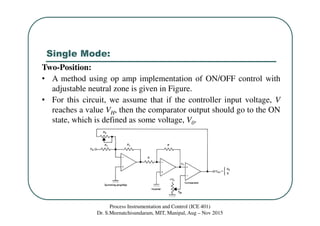
• A method using op amp implementation of ON/OFF control with
adjustable neutral zone is given in Figure.
• For this circuit, we assume that if the controller input voltage, V
reaches a value VH, then the comparator output should go to the ON
state, which is defined as some voltage, V0.
Single Mode:
Process Instrumentation and Control (ICE 401)
Dr. S.Meenatchisundaram, MIT, Manipal, Aug – Nov 2015
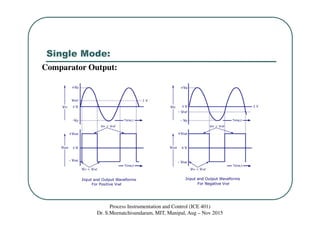
Comparator Output:
Single Mode:
Process Instrumentation and Control (ICE 401)
Dr. S.Meenatchisundaram, MIT, Manipal, Aug – Nov 2015
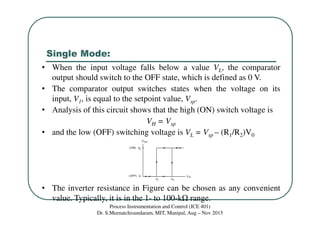
• When the input voltage falls below a value VL, the comparator
output should switch to the OFF state, which is defined as 0 V.
• The comparator output switches states when the voltage on its
input, V1, is equal to the setpoint value, Vsp.
• Analysis of this circuit shows that the high (ON) switch voltage is
VH = Vsp
• and the low (OFF) switching voltage is VL = Vsp – (R1/R2)V0
• The inverter resistance in Figure can be chosen as any convenient
value. Typically, it is in the 1- to 100-k range.
References:
• Process Control Instrumentation Technology, by Curtis D.
Johnson, Eighth Edition, Pearson Education Limited.
Process Instrumentation and Control (ICE 401)
Dr. S.Meenatchisundaram, MIT, Manipal, Aug – Nov 2015

Class 23 electronic controllers

  • 1.
    ICE401: PROCESS INSTRUMENTATION ANDCONTROL Class 23 Electronic Controllers – Error Detector, Two Position Controller Dr. S. Meenatchisundaram Email: meenasundar@gmail.com Process Instrumentation and Control (ICE 401) Dr. S.Meenatchisundaram, MIT, Manipal, Aug – Nov 2015
  • 2.
    Error Detector: Process Instrumentationand Control (ICE 401) Dr. S.Meenatchisundaram, MIT, Manipal, Aug – Nov 2015 • The detection of an error signal is accomplished in electronic controllers by taking the difference between voltages. • One voltage is generated by the process signal current passed through a resistor. The second voltage represents the setpoint. • This is usually generated by a voltage divider using a constant voltage as a source. An example is shown in Figure.
  • 3.
    Error Detector: Process Instrumentationand Control (ICE 401) Dr. S.Meenatchisundaram, MIT, Manipal, Aug – Nov 2015 • We assume a two-wire system is in use so that the current drawn from the floating power supply is the 4- to 20-mA signal current. • The signal current is used to produce a voltage, IR, across the resistor, R. This is placed in series opposition to a voltage, Vsp, tapped from a variable resistor, Rsp, connected to a constant positive source, V0. • The result is an error voltage, Ve = Vsp – IR. This is then used in the process controller to calculate controller output. • An error detector also can be made from a differential amplifier. Such a system can be used only if the current from the transducer is referenced to ground.
  • 4.
    Error Detector: Process Instrumentationand Control (ICE 401) Dr. S.Meenatchisundaram, MIT, Manipal, Aug – Nov 2015 • A typical configuration is shown in the figure above. • The sensor signal current passes to ground through RL, providing a signal voltage, Vm=IRL. The differential amplifier then subtracts this from the set point voltage.
  • 5.
    Single Mode: Process Instrumentationand Control (ICE 401) Dr. S.Meenatchisundaram, MIT, Manipal, Aug – Nov 2015 Two-Position: • A method using op amp implementation of ON/OFF control with adjustable neutral zone is given in Figure. • For this circuit, we assume that if the controller input voltage, V reaches a value VH, then the comparator output should go to the ON state, which is defined as some voltage, V0.
  • 6.
    Single Mode: Process Instrumentationand Control (ICE 401) Dr. S.Meenatchisundaram, MIT, Manipal, Aug – Nov 2015 Comparator Output:
  • 7.
    Single Mode: Process Instrumentationand Control (ICE 401) Dr. S.Meenatchisundaram, MIT, Manipal, Aug – Nov 2015 • When the input voltage falls below a value VL, the comparator output should switch to the OFF state, which is defined as 0 V. • The comparator output switches states when the voltage on its input, V1, is equal to the setpoint value, Vsp. • Analysis of this circuit shows that the high (ON) switch voltage is VH = Vsp • and the low (OFF) switching voltage is VL = Vsp – (R1/R2)V0 • The inverter resistance in Figure can be chosen as any convenient value. Typically, it is in the 1- to 100-k range.
  • 8.
    References: • Process ControlInstrumentation Technology, by Curtis D. Johnson, Eighth Edition, Pearson Education Limited. Process Instrumentation and Control (ICE 401) Dr. S.Meenatchisundaram, MIT, Manipal, Aug – Nov 2015