

A OB ND IGN S
A
OB N D I GN
S
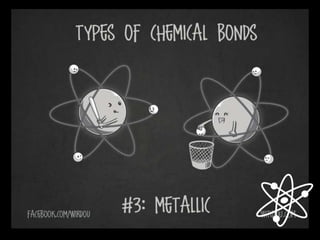
METALLI
C
BOND
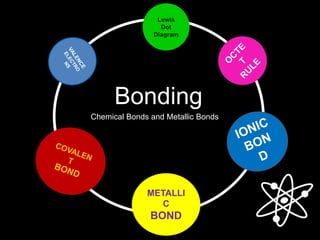
Bonding
Lewis
Dot
Diagram
Chemical Bonds and Metallic Bonds
• The force that holds atoms or ions together as a
unit.
**During a chemical reaction, it is the valence
electrons that actively take part in the charge.
• The electrons in the lower energy levels
usually remain unchanged
Chemical Bonding
• Results of a chemical bonding can form an
ion, molecules and compounds depending
to what type of bonding took place.
Chemical Bonding
Has two types
Ionic Bonding
Covalent Bonding
Chemical Bonding
Valence
electrons
Lewis Dot
Diagram
Octet
Rule
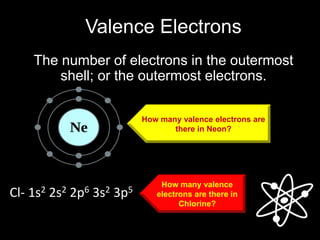
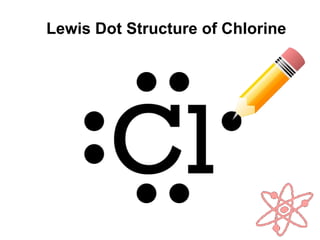
How many valence
electrons are there in
Chlorine?
Valence Electrons
The number of electrons in the outermost
shell; or the outermost electrons.
How many valence electrons are
there in Neon?
Cl- 1s2 2s2 2p6 3s2 3p5
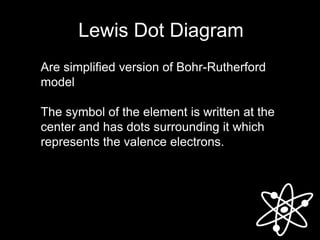
Lewis Dot Diagram
Are simplified version of Bohr-Rutherford
model
The symbol of the element is written at the
center and has dots surrounding it which
represents the valence electrons.
Gilbert Newton Lewis
1990
An American chemist,
who developed Lewis
Dot Diagram
He contributed to the
development of the new
model of atomic
structure
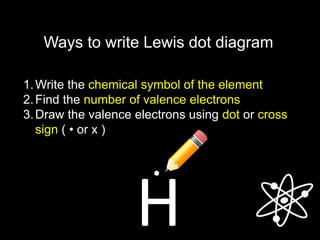
Ways to write Lewis dot diagram
1.Write the chemical symbol of the element
2.Find the number of valence electrons
3.Draw the valence electrons using dot or cross
sign ( • or x )
H
•
Lewis Dot Structure of Chlorine
Octet Rule
Atoms tend to combine in such way that they each
have eight (8) electrons in their valence shells,
giving them the same electronic configuration as a
noble gas.
Molecules or ions tend to be stable when the
outermost electron shells contain eight electrons.
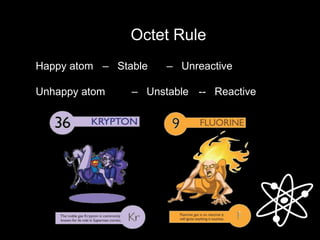
Octet Rule
Happy atom – Stable – Unreactive
Unhappy atom – Unstable -- Reactive
An ionic bond is fomed between
a metal and a nonmetal
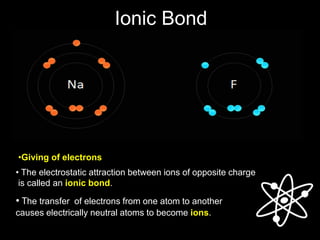
Ionic Bond
• The transfer of electrons from one atom to another
causes electrically neutral atoms to become ions.
• The electrostatic attraction between ions of opposite charge
is called an ionic bond.
•Giving of electrons
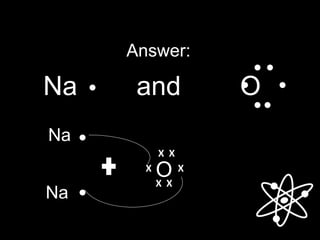
Sample problem:
Draw “dot/cross” diagrams to
represent the electron transfer in
the formation of sodium oxide
and Magnesium oxide
Answer:
Na and O
Na
Na
O
X X
X X
X X
Answer:
The Lewis structure for Na and O are:
[Na]+
[Na]+
O
X X
X X
X X[ ]
2-
Sodium Oxide (Na2O)
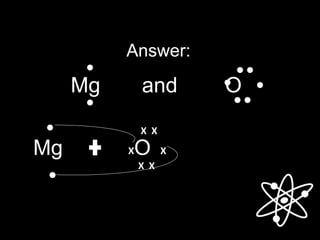
Answer:
Mg and O
Mg O
X X
X X
X X
Answer:
[Mg] O
X X
X X
X X
The Lewis structure for Mg and O are:
[ ]2+ 2-
Magnesium Oxide (MgO)
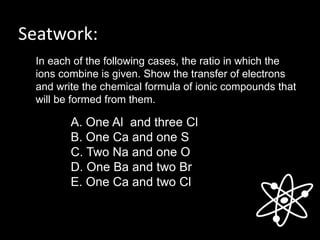
Seatwork:
In each of the following cases, the ratio in which the
ions combine is given. Show the transfer of electrons
and write the chemical formula of ionic compounds that
will be formed from them.
A. One Al and three Cl
B. One Ca and one S
C. Two Na and one O
D. One Ba and two Br
E. One Ca and two Cl
A covalent bond is formed between
two non metals
Covalent Bonds
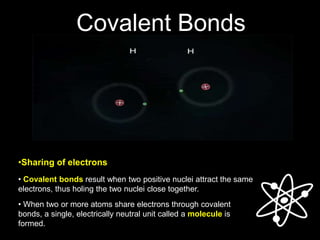
• Covalent bonds result when two positive nuclei attract the same
electrons, thus holing the two nuclei close together.
• When two or more atoms share electrons through covalent
bonds, a single, electrically neutral unit called a molecule is
formed.
•Sharing of electrons
Sample problem:
Show how the NH3 was formed
after a covalent bonding. Draw
the Lewis Structure of NH3.
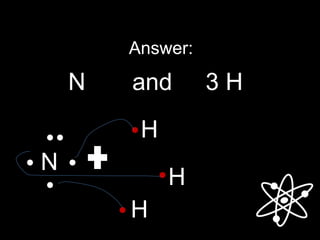
Answer:
N and 3 H
N
H
H
H
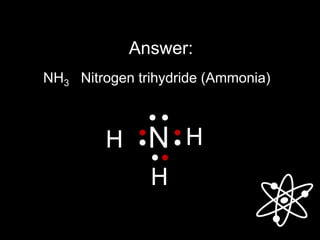
Answer:
N HH
H
NH3 Nitrogen trihydride (Ammonia)
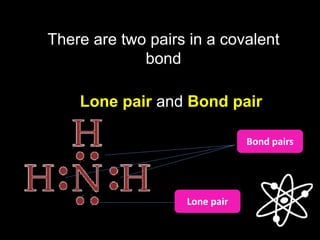
There are two pairs in a covalent
bond
Lone pair and Bond pair
Bond pairs
Lone pair
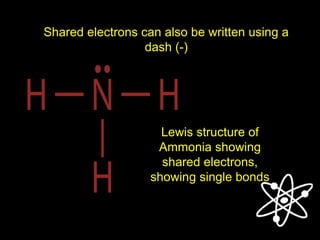
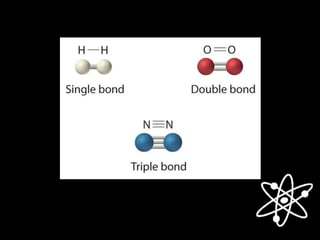
Lewis structure of
Ammonia showing
shared electrons,
showing single bonds
Shared electrons can also be written using a
dash (-)
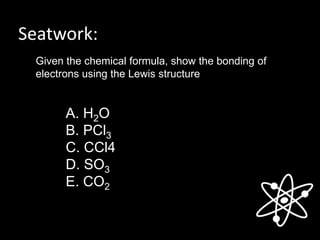
Seatwork:
Given the chemical formula, show the bonding of
electrons using the Lewis structure
A. H2O
B. PCl3
C. CCl4
D. SO3
E. CO2
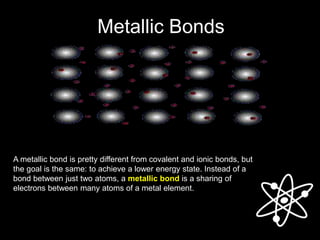
Metallic Bonds
A metallic bond is pretty different from covalent and ionic bonds, but
the goal is the same: to achieve a lower energy state. Instead of a
bond between just two atoms, a metallic bond is a sharing of
electrons between many atoms of a metal element.
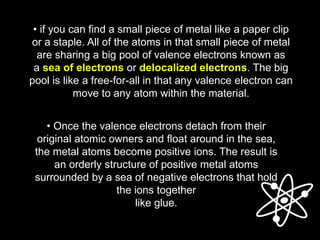
• if you can find a small piece of metal like a paper clip
or a staple. All of the atoms in that small piece of metal
are sharing a big pool of valence electrons known as
a sea of electrons or delocalized electrons. The big
pool is like a free-for-all in that any valence electron can
move to any atom within the material.
• Once the valence electrons detach from their
original atomic owners and float around in the sea,
the metal atoms become positive ions. The result is
an orderly structure of positive metal atoms
surrounded by a sea of negative electrons that hold
the ions together
like glue.
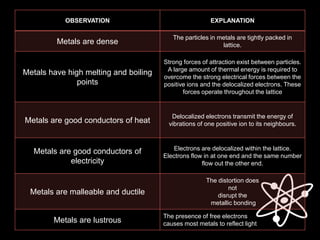
OBSERVATION EXPLANATION
Metals are dense
The particles in metals are tightly packed in
lattice.
Metals have high melting and boiling
points
Strong forces of attraction exist between particles.
A large amount of thermal energy is required to
overcome the strong electrical forces between the
positive ions and the delocalized electrons. These
forces operate throughout the lattice
Metals are good conductors of heat
Delocalized electrons transmit the energy of
vibrations of one positive ion to its neighbours.
Metals are good conductors of
electricity
Electrons are delocalized within the lattice.
Electrons flow in at one end and the same number
flow out the other end.
Metals are malleable and ductile
The distortion does
not
disrupt the
metallic bonding
Metals are lustrous
The presence of free electrons
causes most metals to reflect light
Thank you for Listening!
Prepared by: Hannah Joy Lontayao

Chemical bonding

  • 2.
    A OB NDIGN S
  • 3.
    A OB N DI GN S
  • 4.
  • 5.
    • The forcethat holds atoms or ions together as a unit. **During a chemical reaction, it is the valence electrons that actively take part in the charge. • The electrons in the lower energy levels usually remain unchanged Chemical Bonding
  • 6.
    • Results ofa chemical bonding can form an ion, molecules and compounds depending to what type of bonding took place. Chemical Bonding
  • 7.
    Has two types IonicBonding Covalent Bonding Chemical Bonding
  • 8.
  • 9.
    How many valence electronsare there in Chlorine? Valence Electrons The number of electrons in the outermost shell; or the outermost electrons. How many valence electrons are there in Neon? Cl- 1s2 2s2 2p6 3s2 3p5
  • 10.
    Lewis Dot Diagram Aresimplified version of Bohr-Rutherford model The symbol of the element is written at the center and has dots surrounding it which represents the valence electrons.
  • 11.
    Gilbert Newton Lewis 1990 AnAmerican chemist, who developed Lewis Dot Diagram He contributed to the development of the new model of atomic structure
  • 12.
    Ways to writeLewis dot diagram 1.Write the chemical symbol of the element 2.Find the number of valence electrons 3.Draw the valence electrons using dot or cross sign ( • or x ) H •
  • 13.
  • 14.
    Octet Rule Atoms tendto combine in such way that they each have eight (8) electrons in their valence shells, giving them the same electronic configuration as a noble gas. Molecules or ions tend to be stable when the outermost electron shells contain eight electrons.
  • 15.
    Octet Rule Happy atom– Stable – Unreactive Unhappy atom – Unstable -- Reactive
  • 17.
    An ionic bondis fomed between a metal and a nonmetal
  • 18.
    Ionic Bond • Thetransfer of electrons from one atom to another causes electrically neutral atoms to become ions. • The electrostatic attraction between ions of opposite charge is called an ionic bond. •Giving of electrons
  • 19.
    Sample problem: Draw “dot/cross”diagrams to represent the electron transfer in the formation of sodium oxide and Magnesium oxide
  • 20.
  • 21.
    Answer: The Lewis structurefor Na and O are: [Na]+ [Na]+ O X X X X X X[ ] 2- Sodium Oxide (Na2O)
  • 22.
    Answer: Mg and O MgO X X X X X X
  • 23.
    Answer: [Mg] O X X XX X X The Lewis structure for Mg and O are: [ ]2+ 2- Magnesium Oxide (MgO)
  • 24.
    Seatwork: In each ofthe following cases, the ratio in which the ions combine is given. Show the transfer of electrons and write the chemical formula of ionic compounds that will be formed from them. A. One Al and three Cl B. One Ca and one S C. Two Na and one O D. One Ba and two Br E. One Ca and two Cl
  • 26.
    A covalent bondis formed between two non metals
  • 27.
    Covalent Bonds • Covalentbonds result when two positive nuclei attract the same electrons, thus holing the two nuclei close together. • When two or more atoms share electrons through covalent bonds, a single, electrically neutral unit called a molecule is formed. •Sharing of electrons
  • 28.
    Sample problem: Show howthe NH3 was formed after a covalent bonding. Draw the Lewis Structure of NH3.
  • 29.
    Answer: N and 3H N H H H
  • 30.
    Answer: N HH H NH3 Nitrogentrihydride (Ammonia)
  • 31.
    There are twopairs in a covalent bond Lone pair and Bond pair Bond pairs Lone pair
  • 32.
    Lewis structure of Ammoniashowing shared electrons, showing single bonds Shared electrons can also be written using a dash (-)
  • 34.
    Seatwork: Given the chemicalformula, show the bonding of electrons using the Lewis structure A. H2O B. PCl3 C. CCl4 D. SO3 E. CO2
  • 36.
    Metallic Bonds A metallicbond is pretty different from covalent and ionic bonds, but the goal is the same: to achieve a lower energy state. Instead of a bond between just two atoms, a metallic bond is a sharing of electrons between many atoms of a metal element.
  • 37.
    • if youcan find a small piece of metal like a paper clip or a staple. All of the atoms in that small piece of metal are sharing a big pool of valence electrons known as a sea of electrons or delocalized electrons. The big pool is like a free-for-all in that any valence electron can move to any atom within the material. • Once the valence electrons detach from their original atomic owners and float around in the sea, the metal atoms become positive ions. The result is an orderly structure of positive metal atoms surrounded by a sea of negative electrons that hold the ions together like glue.
  • 38.
    OBSERVATION EXPLANATION Metals aredense The particles in metals are tightly packed in lattice. Metals have high melting and boiling points Strong forces of attraction exist between particles. A large amount of thermal energy is required to overcome the strong electrical forces between the positive ions and the delocalized electrons. These forces operate throughout the lattice Metals are good conductors of heat Delocalized electrons transmit the energy of vibrations of one positive ion to its neighbours. Metals are good conductors of electricity Electrons are delocalized within the lattice. Electrons flow in at one end and the same number flow out the other end. Metals are malleable and ductile The distortion does not disrupt the metallic bonding Metals are lustrous The presence of free electrons causes most metals to reflect light
  • 39.
    Thank you forListening! Prepared by: Hannah Joy Lontayao

Editor's Notes

  • #6 valence electrons of an atom that form chemical bonds.