Concepts of Chemical
Bonding
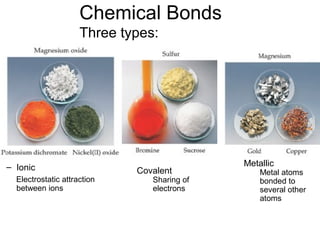
Chemical Bonds
Three types:
– Ionic
Electrostatic attraction
between ions
Covalent
Sharing of
electrons
Metallic
Metal atoms
bonded to
several other
atoms
Ionic Bonding
When a metal and a nonmetal get
together
Energetics of Ionic Bonding
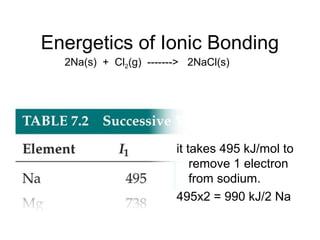
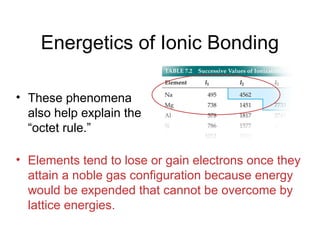
it takes 495 kJ/mol to
remove 1 electron
from sodium.
495x2 = 990 kJ/2 Na
2Na(s) + Cl2(g) -------> 2NaCl(s)
Energetics of Ionic Bonding
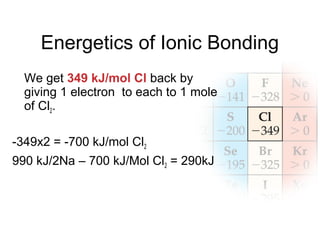
We get 349 kJ/mol Cl back by
giving 1 electron to each to 1 mole
of Cl2.
-349x2 = -700 kJ/mol Cl2
990 kJ/2Na – 700 kJ/Mol Cl2 = 290kJ
Energetics of Ionic Bonding
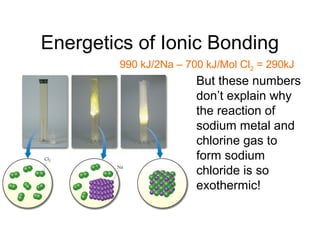
• But these numbers
don’t explain why
the reaction of
sodium metal and
chlorine gas to
form sodium
chloride is so
exothermic!
990 kJ/2Na – 700 kJ/Mol Cl2 = 290kJ
Energetics of Ionic Bonding
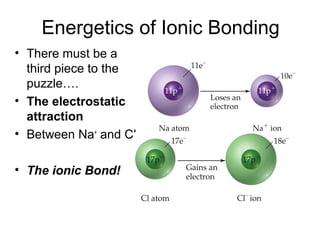
• There must be a
third piece to the
puzzle….
• The electrostatic
attraction
• Between Na+
and Cl-
.
• The ionic Bond!
Lattice Energy
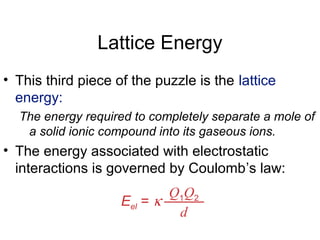
• This third piece of the puzzle is the lattice
energy:
The energy required to completely separate a mole of
a solid ionic compound into its gaseous ions.
• The energy associated with electrostatic
interactions is governed by Coulomb’s law:
Eel = κ
Q1Q2
d
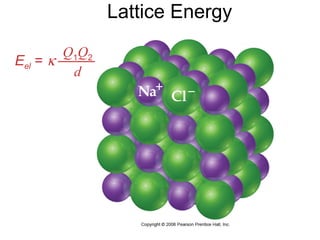
Lattice Energy
Eel = κ
Q1Q2
d
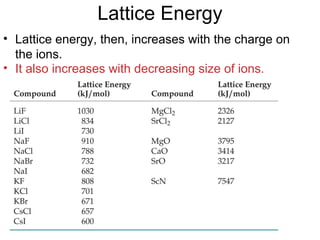
Lattice Energy
• Lattice energy, then, increases with the charge on
the ions.
• It also increases with decreasing size of ions.
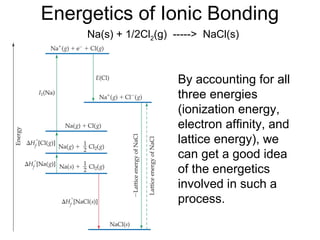
Energetics of Ionic Bonding
By accounting for all
three energies
(ionization energy,
electron affinity, and
lattice energy), we
can get a good idea
of the energetics
involved in such a
process.
Na(s) + 1/2Cl2(g) -----> NaCl(s)
Energetics of Ionic Bonding
• These phenomena
also help explain the
“octet rule.”
• Elements tend to lose or gain electrons once they
attain a noble gas configuration because energy
would be expended that cannot be overcome by
lattice energies.
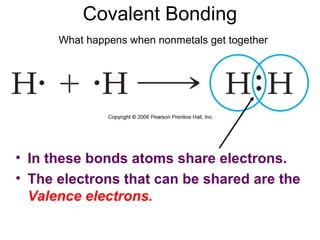
Covalent Bonding
• In these bonds atoms share electrons.
• The electrons that can be shared are the
Valence electrons.
What happens when nonmetals get together
Covalent Bonding
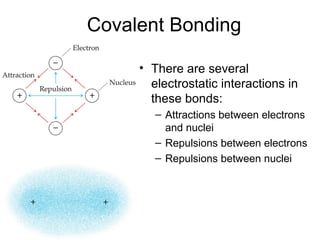
• There are several
electrostatic interactions in
these bonds:
– Attractions between electrons
and nuclei
– Repulsions between electrons
– Repulsions between nuclei
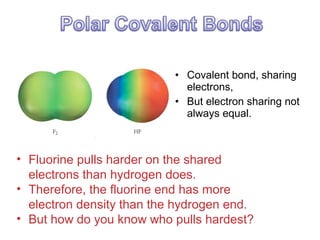
• Covalent bond, sharing
electrons,
• But electron sharing not
always equal.
• Fluorine pulls harder on the shared
electrons than hydrogen does.
• Therefore, the fluorine end has more
electron density than the hydrogen end.
• But how do you know who pulls hardest?
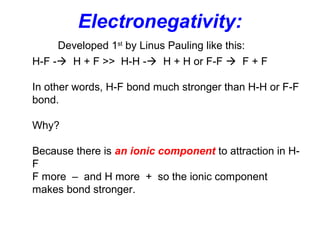
Electronegativity:
Developed 1st
by Linus Pauling like this:
H-F - H + F >> H-H - H + H or F-F  F + F
In other words, H-F bond much stronger than H-H or F-F
bond.
Why?
Because there is an ionic component to attraction in H-
F
F more – and H more + so the ionic component
makes bond stronger.
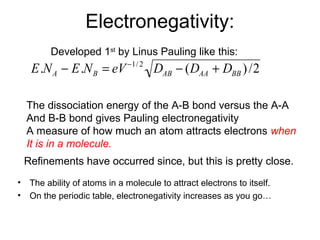
Electronegativity:
• The ability of atoms in a molecule to attract electrons to itself.
• On the periodic table, electronegativity increases as you go…
E.NA − E.NB = eV−1/ 2
DAB − (DAA + DBB )/2
The dissociation energy of the A-B bond versus the A-A
And B-B bond gives Pauling electronegativity
A measure of how much an atom attracts electrons when
It is in a molecule.
Developed 1st
by Linus Pauling like this:
Refinements have occurred since, but this is pretty close.
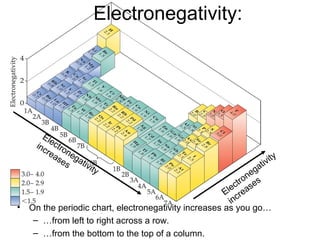
Electronegativity:
• On the periodic chart, electronegativity increases as you go…
– …from left to right across a row.
– …from the bottom to the top of a column.
Electronegativity
increases
Electronegativity
increases
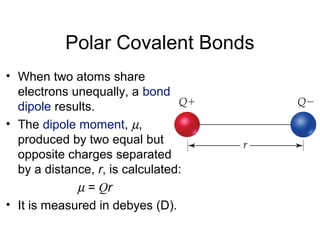
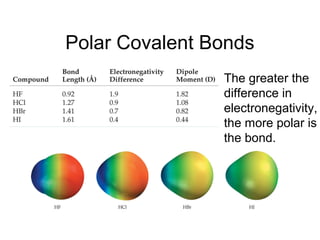
Polar Covalent Bonds
• When two atoms share
electrons unequally, a bond
dipole results.
• The dipole moment, µ,
produced by two equal but
opposite charges separated
by a distance, r, is calculated:
µ = Qr
• It is measured in debyes (D).
Polar Covalent Bonds
The greater the
difference in
electronegativity,
the more polar is
the bond.
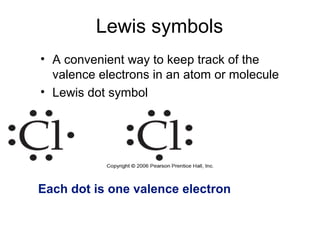
Lewis symbols
• A convenient way to keep track of the
valence electrons in an atom or molecule
• Lewis dot symbol
Each dot is one valence electron
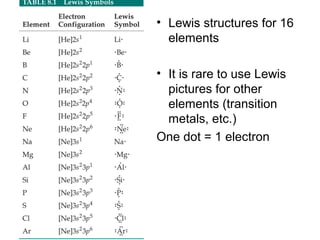
• Lewis structures for 16
elements
• It is rare to use Lewis
pictures for other
elements (transition
metals, etc.)
One dot = 1 electron
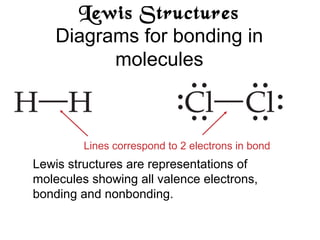
Lewis Structures
Diagrams for bonding in
molecules
Lewis structures are representations of
molecules showing all valence electrons,
bonding and nonbonding.
Lines correspond to 2 electrons in bond
Covalent Bonding
• A bond where electrons from each atom are
shared
• Each covalent bond has 2 electrons that are
shared.
• Only the Valence electrons are involved in
these covalent bonds.
• Why? Why don’t electrons in n-1 levels get
shared?
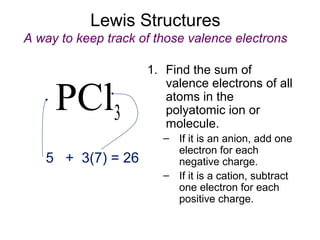
1. Find the sum of
valence electrons of all
atoms in the
polyatomic ion or
molecule.
– If it is an anion, add one
electron for each
negative charge.
– If it is a cation, subtract
one electron for each
positive charge.
PCl3
5 + 3(7) = 26
Lewis Structures
A way to keep track of those valence electrons
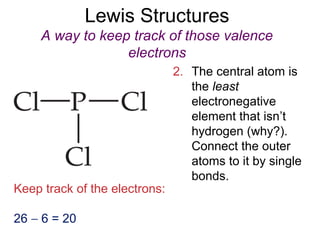
Lewis Structures
A way to keep track of those valence
electrons
2. The central atom is
the least
electronegative
element that isn’t
hydrogen (why?).
Connect the outer
atoms to it by single
bonds.
Keep track of the electrons:
26 − 6 = 20
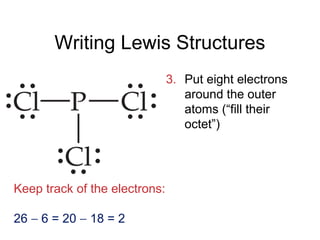
Writing Lewis Structures
3. Put eight electrons
around the outer
atoms (“fill their
octet”)
Keep track of the electrons:
26 − 6 = 20 − 18 = 2
Writing Lewis Structures
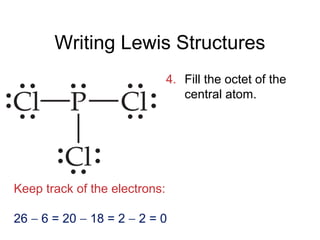
4. Fill the octet of the
central atom.
Keep track of the electrons:
26 − 6 = 20 − 18 = 2 − 2 = 0
Writing Lewis Structures
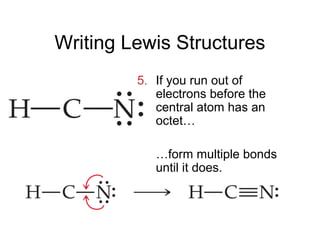
5. If you run out of
electrons before the
central atom has an
octet…
…form multiple bonds
until it does.
Writing Lewis Structures
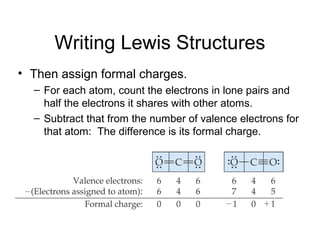
• Then assign formal charges.
– For each atom, count the electrons in lone pairs and
half the electrons it shares with other atoms.
– Subtract that from the number of valence electrons for
that atom: The difference is its formal charge.
Writing Lewis Structures
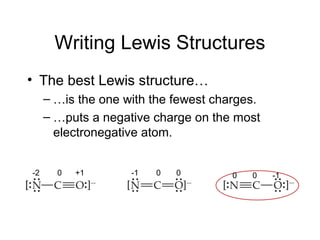
• The best Lewis structure…
– …is the one with the fewest charges.
– …puts a negative charge on the most
electronegative atom.
-2 0 +1 -1 0 0 0 0 -1
Resonance
Draw the Lewis
structure for
ozone, O3.
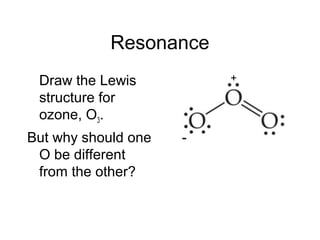
Resonance
Draw the Lewis
structure for
ozone, O3.
But why should one
O be different
from the other?
-
+
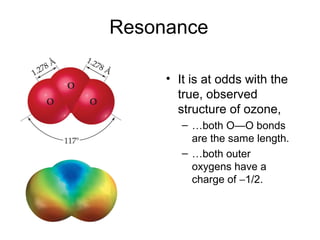
Resonance
• It is at odds with the
true, observed
structure of ozone,
– …both O—O bonds
are the same length.
– …both outer
oxygens have a
charge of −1/2.
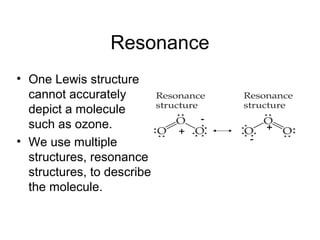
Resonance
• One Lewis structure
cannot accurately
depict a molecule
such as ozone.
• We use multiple
structures, resonance
structures, to describe
the molecule.
+
-
-
+
Resonance
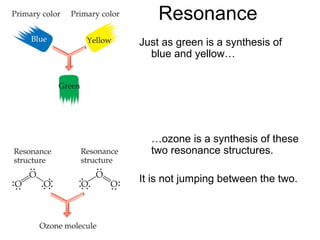
Just as green is a synthesis of
blue and yellow…
…ozone is a synthesis of these
two resonance structures.
It is not jumping between the two.
Resonance
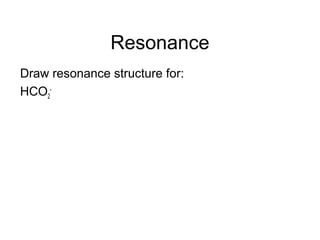
Draw resonance structure for:
HCO2
-
Resonance
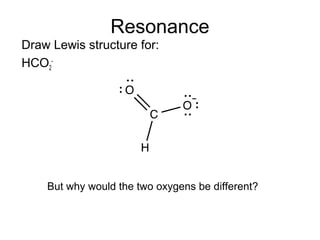
Draw Lewis structure for:
HCO2
-
But why would the two oxygens be different?
Resonance
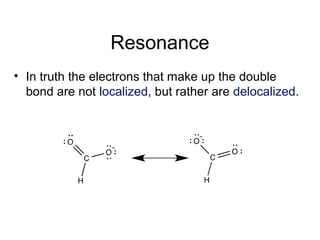
• In truth the electrons that make up the double
bond are not localized, but rather are delocalized.
Resonance
• Draw the Lewis structure of NO3
-
Resonance
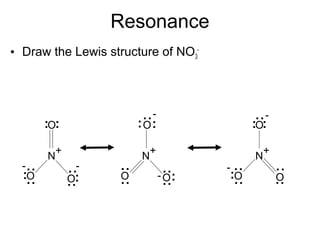
• Draw the Lewis structure of NO3
-
N
O
OO
..
....
..
..
..
..-
+
N
O
OO
..
....
..
..
..
..
-
+
N
O
OO
..
....
..
..
..
..
-
+
....- -
..
-
More than one central atom
• Many atoms have more
than 1 central atom
• You just deal with each
separately
• Example:
• Lewis structure for
acetate:
• CH3CO2
-
More than one central atom
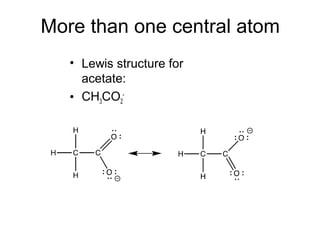
• Lewis structure for
acetate:
• CH3CO2
-
More than 1 central atom
• The organic compound
benzene, C6H6 is a
hexagon of carbon
atoms with 6 H/s Draw
the Lewis structure for
benzene.
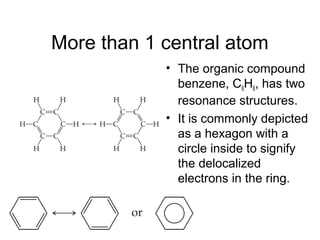
More than 1 central atom
• The organic compound
benzene, C6H6, has two
resonance structures.
• It is commonly depicted
as a hexagon with a
circle inside to signify
the delocalized
electrons in the ring.
Exceptions to the Octet Rule
• There are three types of ions or
molecules that do not follow the octet
rule:
– Ions or molecules with an odd number of
electrons.
– Ions or molecules with less than an octet.
– Ions or molecules with more than eight
valence electrons (an expanded octet).
Odd Number of Electrons
Though relatively rare and usually quite
unstable and reactive, there are ions
and molecules with an odd number of
electrons.
Odd Number of Electrons
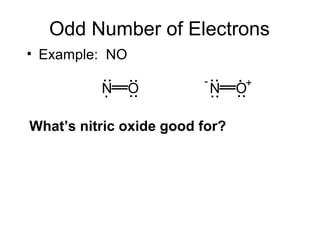
• Example: NO
N O
..
..
..
.
What’s nitric oxide good for?
N O..
.. .- +
..
Fewer Than Eight Electrons
Draw the Lewis structure for BF3
Fewer Than Eight Electrons
Draw the Lewis structure for BF3:
Fewer Than Eight Electrons
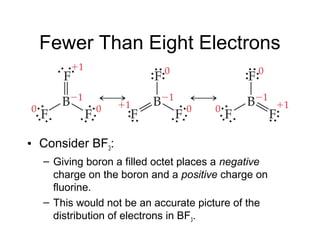
• Consider BF3:
– Giving boron a filled octet places a negative
charge on the boron and a positive charge on
fluorine.
– This would not be an accurate picture of the
distribution of electrons in BF3.
Fewer Than Eight Electrons
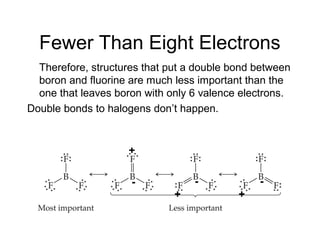
Therefore, structures that put a double bond between
boron and fluorine are much less important than the
one that leaves boron with only 6 valence electrons.
Double bonds to halogens don’t happen.
+
- - -
+ +
Fewer Than Eight Electrons
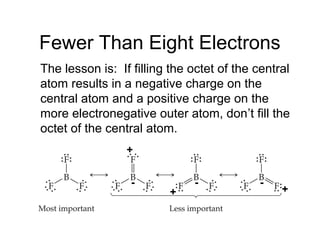
The lesson is: If filling the octet of the central
atom results in a negative charge on the
central atom and a positive charge on the
more electronegative outer atom, don’t fill the
octet of the central atom.
+
+ +
- - -
More Than Eight Electrons
Draw the Lewis structure for PCl5
More Than Eight Electrons
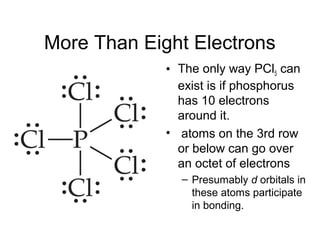
• The only way PCl5 can
exist is if phosphorus
has 10 electrons
around it.
• atoms on the 3rd row
or below can go over
an octet of electrons
– Presumably d orbitals in
these atoms participate
in bonding.
More Than Eight Electrons
• Draw the Lewis structure for phosphate
• PO4
-3
More Than Eight Electrons
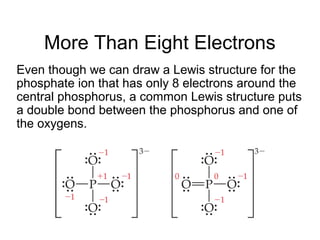
Even though we can draw a Lewis structure for the
phosphate ion that has only 8 electrons around the
central phosphorus, a common Lewis structure puts
a double bond between the phosphorus and one of
the oxygens.
More Than Eight Electrons
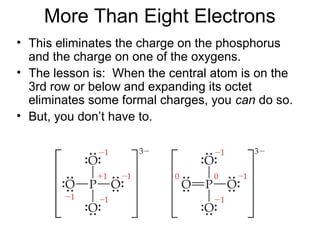
• This eliminates the charge on the phosphorus
and the charge on one of the oxygens.
• The lesson is: When the central atom is on the
3rd row or below and expanding its octet
eliminates some formal charges, you can do so.
• But, you don’t have to.
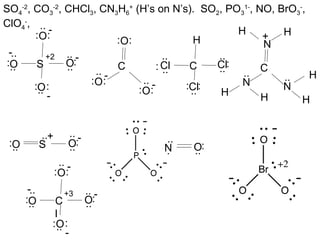
More Practice
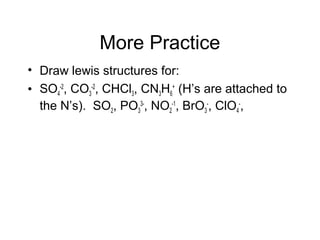
• Draw lewis structures for:
• SO4
-2
, CO3
-2
, CHCl3, CN3H6
+
(H’s are attached to
the N’s). SO2, PO3
3-
, NO2
-1
, BrO3
-
, ClO4
-
,
..
SO4
-2
, CO3
-2
, CHCl3, CN3H6
+
(H’s on N’s). SO2, PO3
1-
, NO, BrO3
-
,
ClO4
-
,
S
O
O
O
O
..
....
.. ..
..
::
: :
: :
- -
-
-
+2
C
O: :
O
..
: :
-O
..
: :
-
C Cl
..
:
..Cl:
..Cl:
..
:
H
C
N
H H
N H
H
..N..
HH
+
S OO ....
..
::
-..+
N O..
..
:.
C
l
O
O
O
O
..
....
.. ..
..
::
: :
: :
- -
-
-
+3
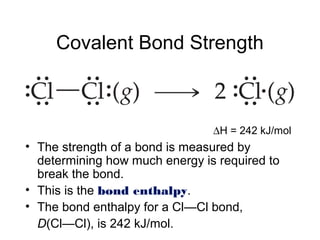
Covalent Bond Strength
• The strength of a bond is measured by
determining how much energy is required to
break the bond.
• This is the bond enthalpy.
• The bond enthalpy for a Cl—Cl bond,
D(Cl—Cl), is 242 kJ/mol.
∆H = 242 kJ/mol
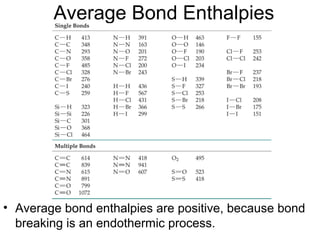
Average Bond Enthalpies
• Average bond enthalpies are positive, because bond
breaking is an endothermic process.
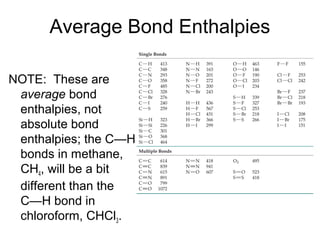
Average Bond Enthalpies
NOTE: These are
average bond
enthalpies, not
absolute bond
enthalpies; the C—H
bonds in methane,
CH4, will be a bit
different than the
C—H bond in
chloroform, CHCl3.
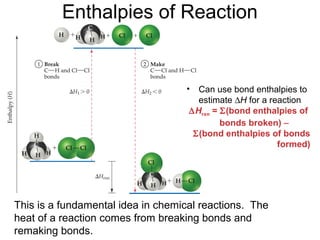
Enthalpies of Reaction
• Can use bond enthalpies to
estimate ∆H for a reaction
∆Hrxn = Σ(bond enthalpies of
bonds broken) −
Σ(bond enthalpies of bonds
formed)
This is a fundamental idea in chemical reactions. The
heat of a reaction comes from breaking bonds and
remaking bonds.
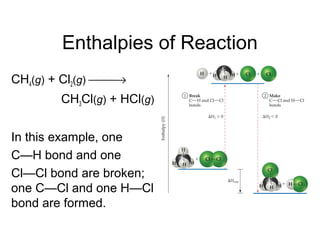
Enthalpies of Reaction
CH4(g) + Cl2(g) →
CH3Cl(g) + HCl(g)
In this example, one
C—H bond and one
Cl—Cl bond are broken;
one C—Cl and one H—Cl
bond are formed.
Enthalpies of Reaction
So,
∆Hrxn = [D(C—H) + D(Cl—Cl) − [D(C—Cl) + D(H—Cl)
= [(413 kJ) + (242 kJ)] − [(328 kJ) + (431 kJ)]
= (655 kJ) − (759 kJ)
= −104 kJ
CH4(g) + Cl2(g) → CH3Cl(g) + HCl(g)
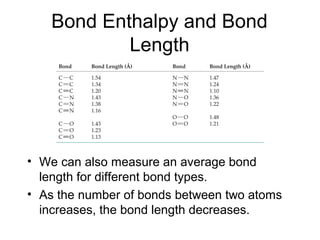
Bond Enthalpy and Bond
Length
• We can also measure an average bond
length for different bond types.
• As the number of bonds between two atoms
increases, the bond length decreases.
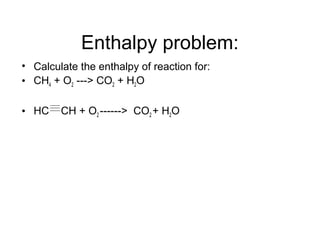
Enthalpy problem:
• Calculate the enthalpy of reaction for:
• CH4 + O2 ---> CO2 + H2O
• HC CH + O2 ------> CO2 + H2O
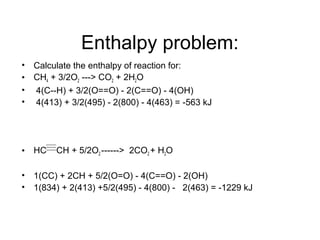
Enthalpy problem:
• Calculate the enthalpy of reaction for:
• CH4 + 3/2O2 ---> CO2 + 2H2O
• 4(C--H) + 3/2(O==O) - 2(C==O) - 4(OH)
• 4(413) + 3/2(495) - 2(800) - 4(463) = -563 kJ
• HC CH + 5/2O2 ------> 2CO2 + H2O
• 1(CC) + 2CH + 5/2(O=O) - 4(C==O) - 2(OH)
• 1(834) + 2(413) +5/2(495) - 4(800) - 2(463) = -1229 kJ
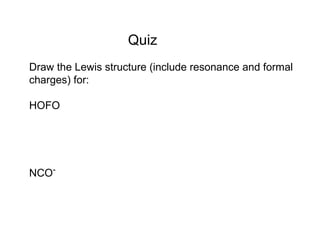
Quiz
Draw the Lewis structure (include resonance and formal
charges) for:
HOFO
NCO-

Chap1

  • 1.
  • 2.
    Chemical Bonds Three types: –Ionic Electrostatic attraction between ions Covalent Sharing of electrons Metallic Metal atoms bonded to several other atoms
  • 3.
    Ionic Bonding When ametal and a nonmetal get together
  • 4.
    Energetics of IonicBonding it takes 495 kJ/mol to remove 1 electron from sodium. 495x2 = 990 kJ/2 Na 2Na(s) + Cl2(g) -------> 2NaCl(s)
  • 5.
    Energetics of IonicBonding We get 349 kJ/mol Cl back by giving 1 electron to each to 1 mole of Cl2. -349x2 = -700 kJ/mol Cl2 990 kJ/2Na – 700 kJ/Mol Cl2 = 290kJ
  • 6.
    Energetics of IonicBonding • But these numbers don’t explain why the reaction of sodium metal and chlorine gas to form sodium chloride is so exothermic! 990 kJ/2Na – 700 kJ/Mol Cl2 = 290kJ
  • 7.
    Energetics of IonicBonding • There must be a third piece to the puzzle…. • The electrostatic attraction • Between Na+ and Cl- . • The ionic Bond!
  • 8.
    Lattice Energy • Thisthird piece of the puzzle is the lattice energy: The energy required to completely separate a mole of a solid ionic compound into its gaseous ions. • The energy associated with electrostatic interactions is governed by Coulomb’s law: Eel = κ Q1Q2 d
  • 9.
  • 10.
    Lattice Energy • Latticeenergy, then, increases with the charge on the ions. • It also increases with decreasing size of ions.
  • 11.
    Energetics of IonicBonding By accounting for all three energies (ionization energy, electron affinity, and lattice energy), we can get a good idea of the energetics involved in such a process. Na(s) + 1/2Cl2(g) -----> NaCl(s)
  • 12.
    Energetics of IonicBonding • These phenomena also help explain the “octet rule.” • Elements tend to lose or gain electrons once they attain a noble gas configuration because energy would be expended that cannot be overcome by lattice energies.
  • 13.
    Covalent Bonding • Inthese bonds atoms share electrons. • The electrons that can be shared are the Valence electrons. What happens when nonmetals get together
  • 14.
    Covalent Bonding • Thereare several electrostatic interactions in these bonds: – Attractions between electrons and nuclei – Repulsions between electrons – Repulsions between nuclei
  • 15.
    • Covalent bond,sharing electrons, • But electron sharing not always equal. • Fluorine pulls harder on the shared electrons than hydrogen does. • Therefore, the fluorine end has more electron density than the hydrogen end. • But how do you know who pulls hardest?
  • 16.
    Electronegativity: Developed 1st by LinusPauling like this: H-F - H + F >> H-H - H + H or F-F  F + F In other words, H-F bond much stronger than H-H or F-F bond. Why? Because there is an ionic component to attraction in H- F F more – and H more + so the ionic component makes bond stronger.
  • 17.
    Electronegativity: • The abilityof atoms in a molecule to attract electrons to itself. • On the periodic table, electronegativity increases as you go… E.NA − E.NB = eV−1/ 2 DAB − (DAA + DBB )/2 The dissociation energy of the A-B bond versus the A-A And B-B bond gives Pauling electronegativity A measure of how much an atom attracts electrons when It is in a molecule. Developed 1st by Linus Pauling like this: Refinements have occurred since, but this is pretty close.
  • 18.
    Electronegativity: • On theperiodic chart, electronegativity increases as you go… – …from left to right across a row. – …from the bottom to the top of a column. Electronegativity increases Electronegativity increases
  • 19.
    Polar Covalent Bonds •When two atoms share electrons unequally, a bond dipole results. • The dipole moment, µ, produced by two equal but opposite charges separated by a distance, r, is calculated: µ = Qr • It is measured in debyes (D).
  • 20.
    Polar Covalent Bonds Thegreater the difference in electronegativity, the more polar is the bond.
  • 21.
    Lewis symbols • Aconvenient way to keep track of the valence electrons in an atom or molecule • Lewis dot symbol Each dot is one valence electron
  • 22.
    • Lewis structuresfor 16 elements • It is rare to use Lewis pictures for other elements (transition metals, etc.) One dot = 1 electron
  • 23.
    Lewis Structures Diagrams forbonding in molecules Lewis structures are representations of molecules showing all valence electrons, bonding and nonbonding. Lines correspond to 2 electrons in bond
  • 24.
    Covalent Bonding • Abond where electrons from each atom are shared • Each covalent bond has 2 electrons that are shared. • Only the Valence electrons are involved in these covalent bonds. • Why? Why don’t electrons in n-1 levels get shared?
  • 25.
    1. Find thesum of valence electrons of all atoms in the polyatomic ion or molecule. – If it is an anion, add one electron for each negative charge. – If it is a cation, subtract one electron for each positive charge. PCl3 5 + 3(7) = 26 Lewis Structures A way to keep track of those valence electrons
  • 26.
    Lewis Structures A wayto keep track of those valence electrons 2. The central atom is the least electronegative element that isn’t hydrogen (why?). Connect the outer atoms to it by single bonds. Keep track of the electrons: 26 − 6 = 20
  • 27.
    Writing Lewis Structures 3.Put eight electrons around the outer atoms (“fill their octet”) Keep track of the electrons: 26 − 6 = 20 − 18 = 2
  • 28.
    Writing Lewis Structures 4.Fill the octet of the central atom. Keep track of the electrons: 26 − 6 = 20 − 18 = 2 − 2 = 0
  • 29.
    Writing Lewis Structures 5.If you run out of electrons before the central atom has an octet… …form multiple bonds until it does.
  • 30.
    Writing Lewis Structures •Then assign formal charges. – For each atom, count the electrons in lone pairs and half the electrons it shares with other atoms. – Subtract that from the number of valence electrons for that atom: The difference is its formal charge.
  • 31.
    Writing Lewis Structures •The best Lewis structure… – …is the one with the fewest charges. – …puts a negative charge on the most electronegative atom. -2 0 +1 -1 0 0 0 0 -1
  • 32.
  • 33.
    Resonance Draw the Lewis structurefor ozone, O3. But why should one O be different from the other? - +
  • 34.
    Resonance • It isat odds with the true, observed structure of ozone, – …both O—O bonds are the same length. – …both outer oxygens have a charge of −1/2.
  • 35.
    Resonance • One Lewisstructure cannot accurately depict a molecule such as ozone. • We use multiple structures, resonance structures, to describe the molecule. + - - +
  • 36.
    Resonance Just as greenis a synthesis of blue and yellow… …ozone is a synthesis of these two resonance structures. It is not jumping between the two.
  • 37.
  • 38.
    Resonance Draw Lewis structurefor: HCO2 - But why would the two oxygens be different?
  • 39.
    Resonance • In truththe electrons that make up the double bond are not localized, but rather are delocalized.
  • 40.
    Resonance • Draw theLewis structure of NO3 -
  • 41.
    Resonance • Draw theLewis structure of NO3 - N O OO .. .... .. .. .. ..- + N O OO .. .... .. .. .. .. - + N O OO .. .... .. .. .. .. - + ....- - .. -
  • 42.
    More than onecentral atom • Many atoms have more than 1 central atom • You just deal with each separately • Example: • Lewis structure for acetate: • CH3CO2 -
  • 43.
    More than onecentral atom • Lewis structure for acetate: • CH3CO2 -
  • 44.
    More than 1central atom • The organic compound benzene, C6H6 is a hexagon of carbon atoms with 6 H/s Draw the Lewis structure for benzene.
  • 45.
    More than 1central atom • The organic compound benzene, C6H6, has two resonance structures. • It is commonly depicted as a hexagon with a circle inside to signify the delocalized electrons in the ring.
  • 46.
    Exceptions to theOctet Rule • There are three types of ions or molecules that do not follow the octet rule: – Ions or molecules with an odd number of electrons. – Ions or molecules with less than an octet. – Ions or molecules with more than eight valence electrons (an expanded octet).
  • 47.
    Odd Number ofElectrons Though relatively rare and usually quite unstable and reactive, there are ions and molecules with an odd number of electrons.
  • 48.
    Odd Number ofElectrons • Example: NO N O .. .. .. . What’s nitric oxide good for? N O.. .. .- + ..
  • 49.
    Fewer Than EightElectrons Draw the Lewis structure for BF3
  • 50.
    Fewer Than EightElectrons Draw the Lewis structure for BF3:
  • 51.
    Fewer Than EightElectrons • Consider BF3: – Giving boron a filled octet places a negative charge on the boron and a positive charge on fluorine. – This would not be an accurate picture of the distribution of electrons in BF3.
  • 52.
    Fewer Than EightElectrons Therefore, structures that put a double bond between boron and fluorine are much less important than the one that leaves boron with only 6 valence electrons. Double bonds to halogens don’t happen. + - - - + +
  • 53.
    Fewer Than EightElectrons The lesson is: If filling the octet of the central atom results in a negative charge on the central atom and a positive charge on the more electronegative outer atom, don’t fill the octet of the central atom. + + + - - -
  • 54.
    More Than EightElectrons Draw the Lewis structure for PCl5
  • 55.
    More Than EightElectrons • The only way PCl5 can exist is if phosphorus has 10 electrons around it. • atoms on the 3rd row or below can go over an octet of electrons – Presumably d orbitals in these atoms participate in bonding.
  • 56.
    More Than EightElectrons • Draw the Lewis structure for phosphate • PO4 -3
  • 57.
    More Than EightElectrons Even though we can draw a Lewis structure for the phosphate ion that has only 8 electrons around the central phosphorus, a common Lewis structure puts a double bond between the phosphorus and one of the oxygens.
  • 58.
    More Than EightElectrons • This eliminates the charge on the phosphorus and the charge on one of the oxygens. • The lesson is: When the central atom is on the 3rd row or below and expanding its octet eliminates some formal charges, you can do so. • But, you don’t have to.
  • 59.
    More Practice • Drawlewis structures for: • SO4 -2 , CO3 -2 , CHCl3, CN3H6 + (H’s are attached to the N’s). SO2, PO3 3- , NO2 -1 , BrO3 - , ClO4 - ,
  • 60.
    .. SO4 -2 , CO3 -2 , CHCl3,CN3H6 + (H’s on N’s). SO2, PO3 1- , NO, BrO3 - , ClO4 - , S O O O O .. .... .. .. .. :: : : : : - - - - +2 C O: : O .. : : -O .. : : - C Cl .. : ..Cl: ..Cl: .. : H C N H H N H H ..N.. HH + S OO .... .. :: -..+ N O.. .. :. C l O O O O .. .... .. .. .. :: : : : : - - - - +3
  • 61.
    Covalent Bond Strength •The strength of a bond is measured by determining how much energy is required to break the bond. • This is the bond enthalpy. • The bond enthalpy for a Cl—Cl bond, D(Cl—Cl), is 242 kJ/mol. ∆H = 242 kJ/mol
  • 62.
    Average Bond Enthalpies •Average bond enthalpies are positive, because bond breaking is an endothermic process.
  • 63.
    Average Bond Enthalpies NOTE:These are average bond enthalpies, not absolute bond enthalpies; the C—H bonds in methane, CH4, will be a bit different than the C—H bond in chloroform, CHCl3.
  • 64.
    Enthalpies of Reaction •Can use bond enthalpies to estimate ∆H for a reaction ∆Hrxn = Σ(bond enthalpies of bonds broken) − Σ(bond enthalpies of bonds formed) This is a fundamental idea in chemical reactions. The heat of a reaction comes from breaking bonds and remaking bonds.
  • 65.
    Enthalpies of Reaction CH4(g)+ Cl2(g) → CH3Cl(g) + HCl(g) In this example, one C—H bond and one Cl—Cl bond are broken; one C—Cl and one H—Cl bond are formed.
  • 66.
    Enthalpies of Reaction So, ∆Hrxn= [D(C—H) + D(Cl—Cl) − [D(C—Cl) + D(H—Cl) = [(413 kJ) + (242 kJ)] − [(328 kJ) + (431 kJ)] = (655 kJ) − (759 kJ) = −104 kJ CH4(g) + Cl2(g) → CH3Cl(g) + HCl(g)
  • 67.
    Bond Enthalpy andBond Length • We can also measure an average bond length for different bond types. • As the number of bonds between two atoms increases, the bond length decreases.
  • 68.
    Enthalpy problem: • Calculatethe enthalpy of reaction for: • CH4 + O2 ---> CO2 + H2O • HC CH + O2 ------> CO2 + H2O
  • 69.
    Enthalpy problem: • Calculatethe enthalpy of reaction for: • CH4 + 3/2O2 ---> CO2 + 2H2O • 4(C--H) + 3/2(O==O) - 2(C==O) - 4(OH) • 4(413) + 3/2(495) - 2(800) - 4(463) = -563 kJ • HC CH + 5/2O2 ------> 2CO2 + H2O • 1(CC) + 2CH + 5/2(O=O) - 4(C==O) - 2(OH) • 1(834) + 2(413) +5/2(495) - 4(800) - 2(463) = -1229 kJ
  • 70.
    Quiz Draw the Lewisstructure (include resonance and formal charges) for: HOFO NCO-