Lewis Structures of Molecules
Lewis Structure Assumptions Only valance electrons are involved in bonding. Atoms react to form molecules, so to achieve stable noble gas electron configurations. Atoms in molecules want eight valance electrons (octet rule) except for hydrogen which wants two electrons (duet rule). In covalent compounds atoms share electrons to form bonds in order to achieve stable noble gas electron configurations.  In ionic compounds electrons are transferred from one atom to another to achieve stable noble gas electron configurations.
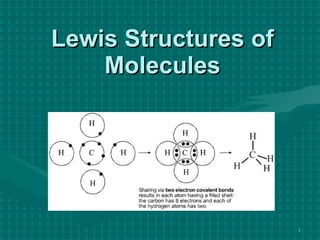
Covalent Bonds Lewis Structures are only for covalently bonded molecules. Covalent bonds mean that electrons are shared between atoms. Single bond = 2 electrons to each atom Double bond = 4 electrons to each atom Triple Bond = 6 electrons to each atom Quadruple Bond = 8 electrons to each atom
Rules for Drawing Lewis Structures Step 1:  Count the total number of valance electrons. Step 2:  Identify the central atom (the first atom written unless that atom is hydrogen).  Place all terminal atoms around that atom.  Hydrogen atoms NEVER have more than one bond. Step 3:  Complete the octet for all atoms in the Lewis structure with lone pairs of electrons (except hydrogen). Step 4:  Check your structure by counting the number of valance  electrons used (they will match step 1 if the structure is  correct).  If your valance electrons don’t match you will need to tweak your structure as follows.
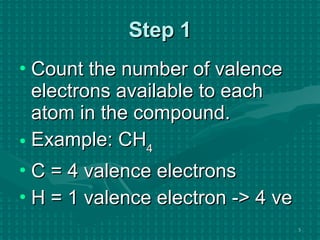
Step 1 Count the number of valence electrons available to each atom in the compound. Example: CH 4 C = 4 valence electrons H = 1 valence electron -> 4 ve
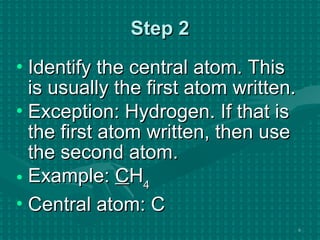
Step 2 Identify the central atom. This is usually the first atom written. Exception: Hydrogen. If that is the first atom written, then use the second atom. Example:  C H 4 Central atom: C
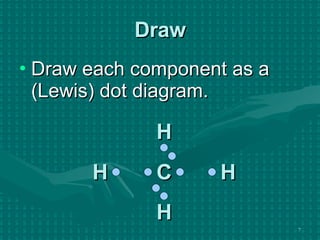
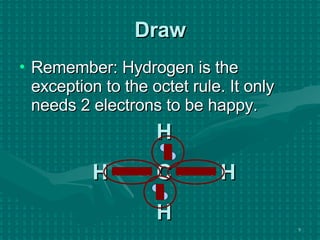
Draw Draw each component as a (Lewis) dot diagram. H H H H C
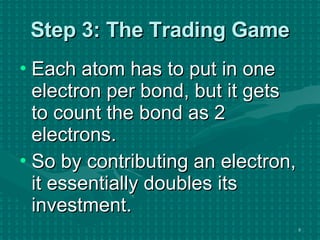
Step 3: The Trading Game Each atom has to put in one electron per bond, but it gets to count the bond as 2 electrons. So by contributing an electron, it essentially doubles its investment.
Draw Remember: Hydrogen is the exception to the octet rule. It only needs 2 electrons to be happy. H H H H C
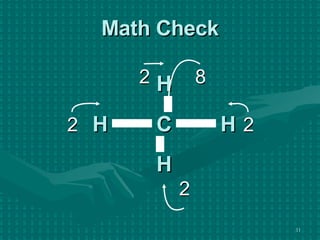
Step 4: Check Math Make sure that each atom in your new lewis dot structure “feels” like it has eight electrons around it. Remember: One bond “feels” like two electrons to EACH element it borders.
Math Check H H H H C 2 2 2 2 8
Check Math If there are atoms whose octet rules are not satisfied, you may need to increase the number of bonds between atoms.
Tweaking Lewis Structures Too Many Electrons Initially:   Redraw the  Lewis structure from step 2 adding a double bond.  If you still have too many electrons add another multiple bond and repeat. Always add double bonds before triple bonds. Every double bonds effectively remove two electrons from the structure while triple bonds effectively remove 4 electrons.
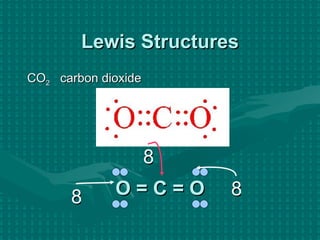
Lewis Structures CO 2   carbon dioxide O = C = O 8 8 8
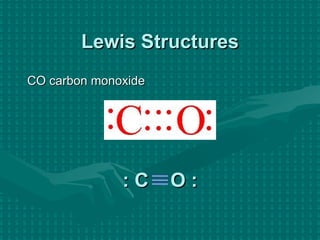
Lewis Structures CO carbon monoxide : C  O :
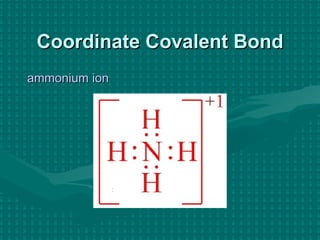
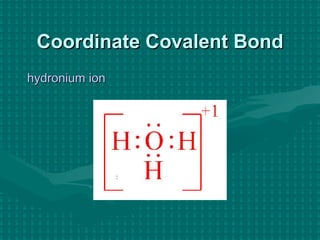
Rules for Molecules with an Overall Charge When figuring out the number of electrons available, make sure to add or subtract as indicated by the charge. Create the Lewis structure the same as always. Put square brackets [ ] around the structure. Write the charge in a superscript. Called a “Coordinate Covalent Bond”
Lewis Structures – Charged Species A species that has a   -  charge has a shortage of bonds over the normal number If a species has received electrons from elsewhere, it does not have to share as many electrons  Therefore less bonds have to be made
Lewis Structures – Charged Species A species that has a   +  charge has an excess of bonds over the normal number. if a species has given up some electrons, it has to involve more of the electrons it has kept Therefore more bonds have to be made
Lewis Structures – Charged Species The size of the  -  or  +  charge tells you the shortage or excess of bonds +2 = 2 extra bonds; -3 = 3 bond shortage)
Coordinate Covalent Bond ammonium ion
Coordinate Covalent Bond hydronium ion
“ Exceptions” to the Octet Two Few Electrons:   If you only have four or six valance electrons initially you can’t possibly fill the octet rule (usually BeH 2  or BH 3 ).  Just place hydrogens around central  atoms and call it done.
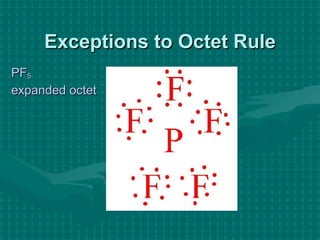
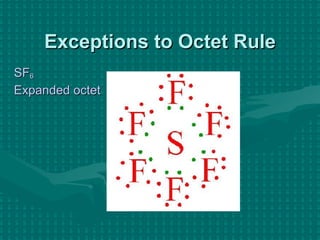
Exceptions to the Octet Rule (That are not H) There are two other exceptions to the Octet Rule (that are not Hydrogen) PF 5 SF 6 Exceptions usually involve F
“ Exceptions” to the Octet Odd number of electrons:  One atom will have to have less than eight electrons.  Draw the Lewis structure as if it had one more valance electrons than it actually does. Then subtract one electron from the least electronegative element (often the central atom).
“ Exceptions” to the Octect Exceeding the Octet Rule:  When you must break the octet rule draw the structure as you would in steps 1-4  and the place the extra electrons around the central atom.  Even when breaking the octet rule no atom will ever have more than 12 electrons.
Exceptions to Octet Rule PF 5 expanded octet
Exceptions to Octet Rule SF 6 Expanded octet
Diatomic Molecules In nature, the following elements are always found in a paired molecule. They are never found solo. H 2 O 2 F 2 Br 2 I 2 N 2 Cl 2 I   Br ing  Cl ay  F or  O ur  N ew  H ouse Quiz on these 7 next class period. Memorize them.

Lewis Structures

  • 1.
  • 2.
    Lewis Structure AssumptionsOnly valance electrons are involved in bonding. Atoms react to form molecules, so to achieve stable noble gas electron configurations. Atoms in molecules want eight valance electrons (octet rule) except for hydrogen which wants two electrons (duet rule). In covalent compounds atoms share electrons to form bonds in order to achieve stable noble gas electron configurations. In ionic compounds electrons are transferred from one atom to another to achieve stable noble gas electron configurations.
  • 3.
    Covalent Bonds LewisStructures are only for covalently bonded molecules. Covalent bonds mean that electrons are shared between atoms. Single bond = 2 electrons to each atom Double bond = 4 electrons to each atom Triple Bond = 6 electrons to each atom Quadruple Bond = 8 electrons to each atom
  • 4.
    Rules for DrawingLewis Structures Step 1: Count the total number of valance electrons. Step 2: Identify the central atom (the first atom written unless that atom is hydrogen). Place all terminal atoms around that atom. Hydrogen atoms NEVER have more than one bond. Step 3: Complete the octet for all atoms in the Lewis structure with lone pairs of electrons (except hydrogen). Step 4: Check your structure by counting the number of valance electrons used (they will match step 1 if the structure is correct). If your valance electrons don’t match you will need to tweak your structure as follows.
  • 5.
    Step 1 Countthe number of valence electrons available to each atom in the compound. Example: CH 4 C = 4 valence electrons H = 1 valence electron -> 4 ve
  • 6.
    Step 2 Identifythe central atom. This is usually the first atom written. Exception: Hydrogen. If that is the first atom written, then use the second atom. Example: C H 4 Central atom: C
  • 7.
    Draw Draw eachcomponent as a (Lewis) dot diagram. H H H H C
  • 8.
    Step 3: TheTrading Game Each atom has to put in one electron per bond, but it gets to count the bond as 2 electrons. So by contributing an electron, it essentially doubles its investment.
  • 9.
    Draw Remember: Hydrogenis the exception to the octet rule. It only needs 2 electrons to be happy. H H H H C
  • 10.
    Step 4: CheckMath Make sure that each atom in your new lewis dot structure “feels” like it has eight electrons around it. Remember: One bond “feels” like two electrons to EACH element it borders.
  • 11.
    Math Check HH H H C 2 2 2 2 8
  • 12.
    Check Math Ifthere are atoms whose octet rules are not satisfied, you may need to increase the number of bonds between atoms.
  • 13.
    Tweaking Lewis StructuresToo Many Electrons Initially: Redraw the Lewis structure from step 2 adding a double bond. If you still have too many electrons add another multiple bond and repeat. Always add double bonds before triple bonds. Every double bonds effectively remove two electrons from the structure while triple bonds effectively remove 4 electrons.
  • 14.
    Lewis Structures CO2 carbon dioxide O = C = O 8 8 8
  • 15.
    Lewis Structures COcarbon monoxide : C O :
  • 16.
    Rules for Moleculeswith an Overall Charge When figuring out the number of electrons available, make sure to add or subtract as indicated by the charge. Create the Lewis structure the same as always. Put square brackets [ ] around the structure. Write the charge in a superscript. Called a “Coordinate Covalent Bond”
  • 17.
    Lewis Structures –Charged Species A species that has a - charge has a shortage of bonds over the normal number If a species has received electrons from elsewhere, it does not have to share as many electrons Therefore less bonds have to be made
  • 18.
    Lewis Structures –Charged Species A species that has a + charge has an excess of bonds over the normal number. if a species has given up some electrons, it has to involve more of the electrons it has kept Therefore more bonds have to be made
  • 19.
    Lewis Structures –Charged Species The size of the - or + charge tells you the shortage or excess of bonds +2 = 2 extra bonds; -3 = 3 bond shortage)
  • 20.
  • 21.
  • 22.
    “ Exceptions” tothe Octet Two Few Electrons: If you only have four or six valance electrons initially you can’t possibly fill the octet rule (usually BeH 2 or BH 3 ). Just place hydrogens around central atoms and call it done.
  • 23.
    Exceptions to theOctet Rule (That are not H) There are two other exceptions to the Octet Rule (that are not Hydrogen) PF 5 SF 6 Exceptions usually involve F
  • 24.
    “ Exceptions” tothe Octet Odd number of electrons: One atom will have to have less than eight electrons. Draw the Lewis structure as if it had one more valance electrons than it actually does. Then subtract one electron from the least electronegative element (often the central atom).
  • 25.
    “ Exceptions” tothe Octect Exceeding the Octet Rule: When you must break the octet rule draw the structure as you would in steps 1-4 and the place the extra electrons around the central atom. Even when breaking the octet rule no atom will ever have more than 12 electrons.
  • 26.
    Exceptions to OctetRule PF 5 expanded octet
  • 27.
    Exceptions to OctetRule SF 6 Expanded octet
  • 28.
    Diatomic Molecules Innature, the following elements are always found in a paired molecule. They are never found solo. H 2 O 2 F 2 Br 2 I 2 N 2 Cl 2 I Br ing Cl ay F or O ur N ew H ouse Quiz on these 7 next class period. Memorize them.