Chemical bonding
and Lewis structure
A force that holds
atoms together to
create a single unit.
Chemical bond
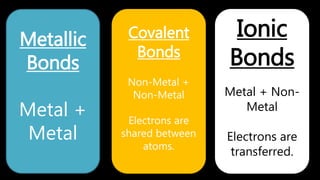
Metallic
Bonds
Metal +
Metal
Covalent
Bonds
Non-Metal +
Non-Metal
Electrons are
shared between
atoms.
Ionic
Bonds
Metal + Non-
Metal
Electrons are
transferred.
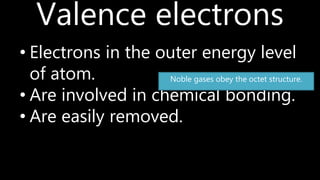
Valence electrons
• Electrons in the outer energy level
of atom.
• Are involved in chemical bonding.
• Are easily removed.
Noble gases obey the octet structure.
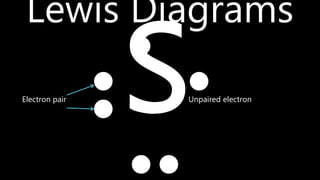
Lewis Diagrams
Electron pair Unpaired electron
When two non-metallic
atoms bond together by
sharing one or more pairs
of electrons.
Covalent bond
•Forms molecules.
•Molecule is held together by a
shared electron pair.
•Individual atoms in the
molecule has octet structure.
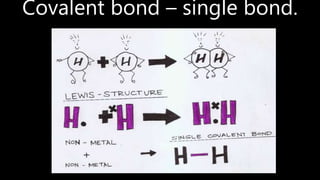
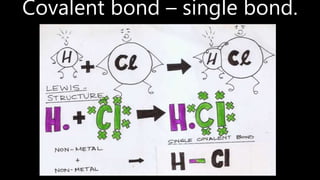
Covalent bond – single bond.
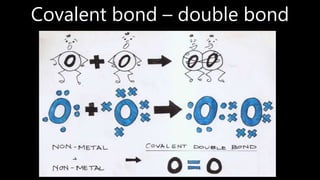
Covalent bond – double bond
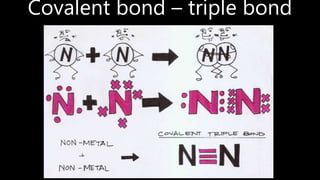
Covalent bond – triple bond
Relative molecular mass is
the sum of the relative
atomic mass of the atoms
in the molecule.
Results from the transfer
of one or more electrons
from metal atoms to non-
metal atoms.
Ionic bond
Metals give off electrons to form cations in order to
obtain a noble gas electron structure.
Li  Li+ + e-
[He]2s1 [He]
[Ar]4s2 [Ar]
Ca Ca2++2e-
Non-metals gain electrons to form anions in order to
obtain a noble gas electron structure.
N + 3e-  [ N ]3-
[He]2s2p3
S + 2e-  [ S ]2-
[Ne]3s23p4
[He]2s22p6 = [Ne]
[Ne]3s23p6 = [Ar]
• The metal atom gives away its electrons to the
non-metal.
• The positive and negative ions attract each
other due to electrostatic forces. (opposite
charges attract)
• The electrostatic attraction is the ionic bond.
• Crystal lattices form, and are built up of
alternating positive and negative ions.
Ca  Ca2+ + 2e-
2x: F + e-  [ F ]-
Ca2+ + 2[ F ]-  Ca2+2[ F ]-  CaF2
Positive ion:
Negative ion:
Crystal lattice
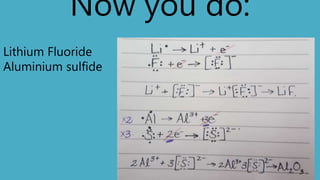
Now you do:
Lithium Fluoride Li+ and F-
Aluminium sulfide Al3+ and S2-
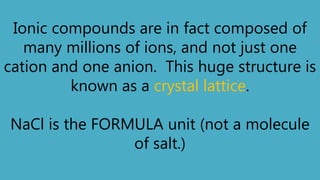
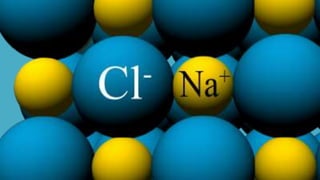
Ionic compounds are in fact composed of
many millions of ions, and not just one
cation and one anion. This huge structure is
known as a crystal lattice.
NaCl is the FORMULA unit (not a molecule
of salt.)
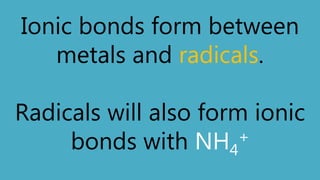
Ionic bonds form between
metals and radicals.
Radicals will also form ionic
bonds with NH4
+
The sum of the relative
atomic masses of the
atom in the chemical
formula.
Relative formula mass
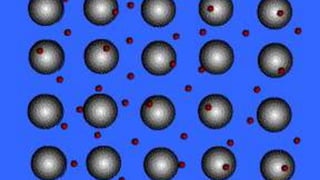
Electrostatic attraction
between the positive
atomic residue and the
sea of delocalised
electrons. Metallic bonds
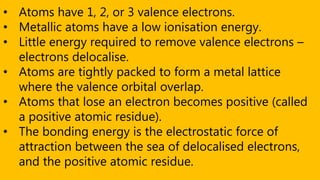
• Atoms have 1, 2, or 3 valence electrons.
• Metallic atoms have a low ionisation energy.
• Little energy required to remove valence electrons –
electrons delocalise.
• Atoms are tightly packed to form a metal lattice
where the valence orbital overlap.
• Atoms that lose an electron becomes positive (called
a positive atomic residue).
• The bonding energy is the electrostatic force of
attraction between the sea of delocalised electrons,
and the positive atomic residue.
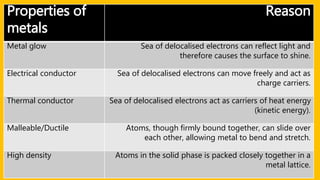
Properties of
metals
Reason
Metal glow Sea of delocalised electrons can reflect light and
therefore causes the surface to shine.
Electrical conductor Sea of delocalised electrons can move freely and act as
charge carriers.
Thermal conductor Sea of delocalised electrons act as carriers of heat energy
(kinetic energy).
Malleable/Ductile Atoms, though firmly bound together, can slide over
each other, allowing metal to bend and stretch.
High density Atoms in the solid phase is packed closely together in a
metal lattice.
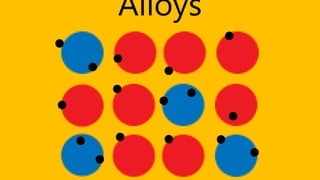
Alloys
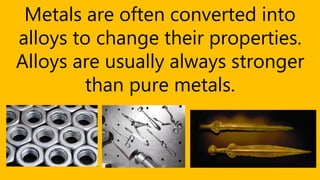
Metals are often converted into
alloys to change their properties.
Alloys are usually always stronger
than pure metals.
Text: Olivier, A: Physical Science textbook and workbook, Grade 10 ; Reivilo Uitgewers.
Slide 8 – 11: Lily Kotzè
Slide 18: Lily Kotzè
Slide 20: http://dtc-wsuv.org/isci/module/img/7_14_NaCl.png
Slide 24: http://i.imgur.com/oIoEZhH.gif
Slide 27: http://i0.wp.com/upload.wikimedia.org/wikipedia/commons/thumb/3/36/Alloy_Substitutional.svg/150px-
Alloy_Substitutional.svg.png?w=625
Slide 28: Steel: https://encrypted-
tbn2.gstatic.com/images?q=tbn:ANd9GcRb7xMBVsBuBLTvAOfjtLXoghcMRgMkIH5puPfnzKRRKmwUNtHk
Stainless steel: http://curiousscience.com/images/stock/img780.jpg Bronze:
https://upload.wikimedia.org/wikipedia/commons/c/ca/Apa_Schwerter.jpg

Chemical bonding and the lewis structure

  • 1.
  • 2.
    A force thatholds atoms together to create a single unit. Chemical bond
  • 3.
    Metallic Bonds Metal + Metal Covalent Bonds Non-Metal + Non-Metal Electronsare shared between atoms. Ionic Bonds Metal + Non- Metal Electrons are transferred.
  • 4.
    Valence electrons • Electronsin the outer energy level of atom. • Are involved in chemical bonding. • Are easily removed. Noble gases obey the octet structure.
  • 5.
  • 6.
    When two non-metallic atomsbond together by sharing one or more pairs of electrons. Covalent bond
  • 7.
    •Forms molecules. •Molecule isheld together by a shared electron pair. •Individual atoms in the molecule has octet structure.
  • 8.
    Covalent bond –single bond.
  • 9.
    Covalent bond –single bond.
  • 10.
    Covalent bond –double bond
  • 11.
    Covalent bond –triple bond
  • 12.
    Relative molecular massis the sum of the relative atomic mass of the atoms in the molecule.
  • 13.
    Results from thetransfer of one or more electrons from metal atoms to non- metal atoms. Ionic bond
  • 14.
    Metals give offelectrons to form cations in order to obtain a noble gas electron structure. Li  Li+ + e- [He]2s1 [He] [Ar]4s2 [Ar] Ca Ca2++2e-
  • 15.
    Non-metals gain electronsto form anions in order to obtain a noble gas electron structure. N + 3e-  [ N ]3- [He]2s2p3 S + 2e-  [ S ]2- [Ne]3s23p4 [He]2s22p6 = [Ne] [Ne]3s23p6 = [Ar]
  • 16.
    • The metalatom gives away its electrons to the non-metal. • The positive and negative ions attract each other due to electrostatic forces. (opposite charges attract) • The electrostatic attraction is the ionic bond. • Crystal lattices form, and are built up of alternating positive and negative ions.
  • 17.
    Ca  Ca2++ 2e- 2x: F + e-  [ F ]- Ca2+ + 2[ F ]-  Ca2+2[ F ]-  CaF2 Positive ion: Negative ion: Crystal lattice
  • 18.
    Now you do: LithiumFluoride Li+ and F- Aluminium sulfide Al3+ and S2-
  • 19.
    Ionic compounds arein fact composed of many millions of ions, and not just one cation and one anion. This huge structure is known as a crystal lattice. NaCl is the FORMULA unit (not a molecule of salt.)
  • 21.
    Ionic bonds formbetween metals and radicals. Radicals will also form ionic bonds with NH4 +
  • 22.
    The sum ofthe relative atomic masses of the atom in the chemical formula. Relative formula mass
  • 23.
    Electrostatic attraction between thepositive atomic residue and the sea of delocalised electrons. Metallic bonds
  • 25.
    • Atoms have1, 2, or 3 valence electrons. • Metallic atoms have a low ionisation energy. • Little energy required to remove valence electrons – electrons delocalise. • Atoms are tightly packed to form a metal lattice where the valence orbital overlap. • Atoms that lose an electron becomes positive (called a positive atomic residue). • The bonding energy is the electrostatic force of attraction between the sea of delocalised electrons, and the positive atomic residue.
  • 26.
    Properties of metals Reason Metal glowSea of delocalised electrons can reflect light and therefore causes the surface to shine. Electrical conductor Sea of delocalised electrons can move freely and act as charge carriers. Thermal conductor Sea of delocalised electrons act as carriers of heat energy (kinetic energy). Malleable/Ductile Atoms, though firmly bound together, can slide over each other, allowing metal to bend and stretch. High density Atoms in the solid phase is packed closely together in a metal lattice.
  • 27.
  • 28.
    Metals are oftenconverted into alloys to change their properties. Alloys are usually always stronger than pure metals.
  • 29.
    Text: Olivier, A:Physical Science textbook and workbook, Grade 10 ; Reivilo Uitgewers. Slide 8 – 11: Lily Kotzè Slide 18: Lily Kotzè Slide 20: http://dtc-wsuv.org/isci/module/img/7_14_NaCl.png Slide 24: http://i.imgur.com/oIoEZhH.gif Slide 27: http://i0.wp.com/upload.wikimedia.org/wikipedia/commons/thumb/3/36/Alloy_Substitutional.svg/150px- Alloy_Substitutional.svg.png?w=625 Slide 28: Steel: https://encrypted- tbn2.gstatic.com/images?q=tbn:ANd9GcRb7xMBVsBuBLTvAOfjtLXoghcMRgMkIH5puPfnzKRRKmwUNtHk Stainless steel: http://curiousscience.com/images/stock/img780.jpg Bronze: https://upload.wikimedia.org/wikipedia/commons/c/ca/Apa_Schwerter.jpg