


SEATWORK # 2
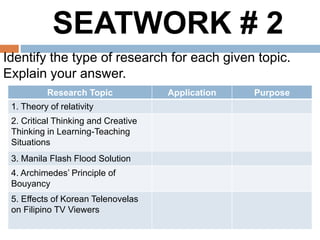
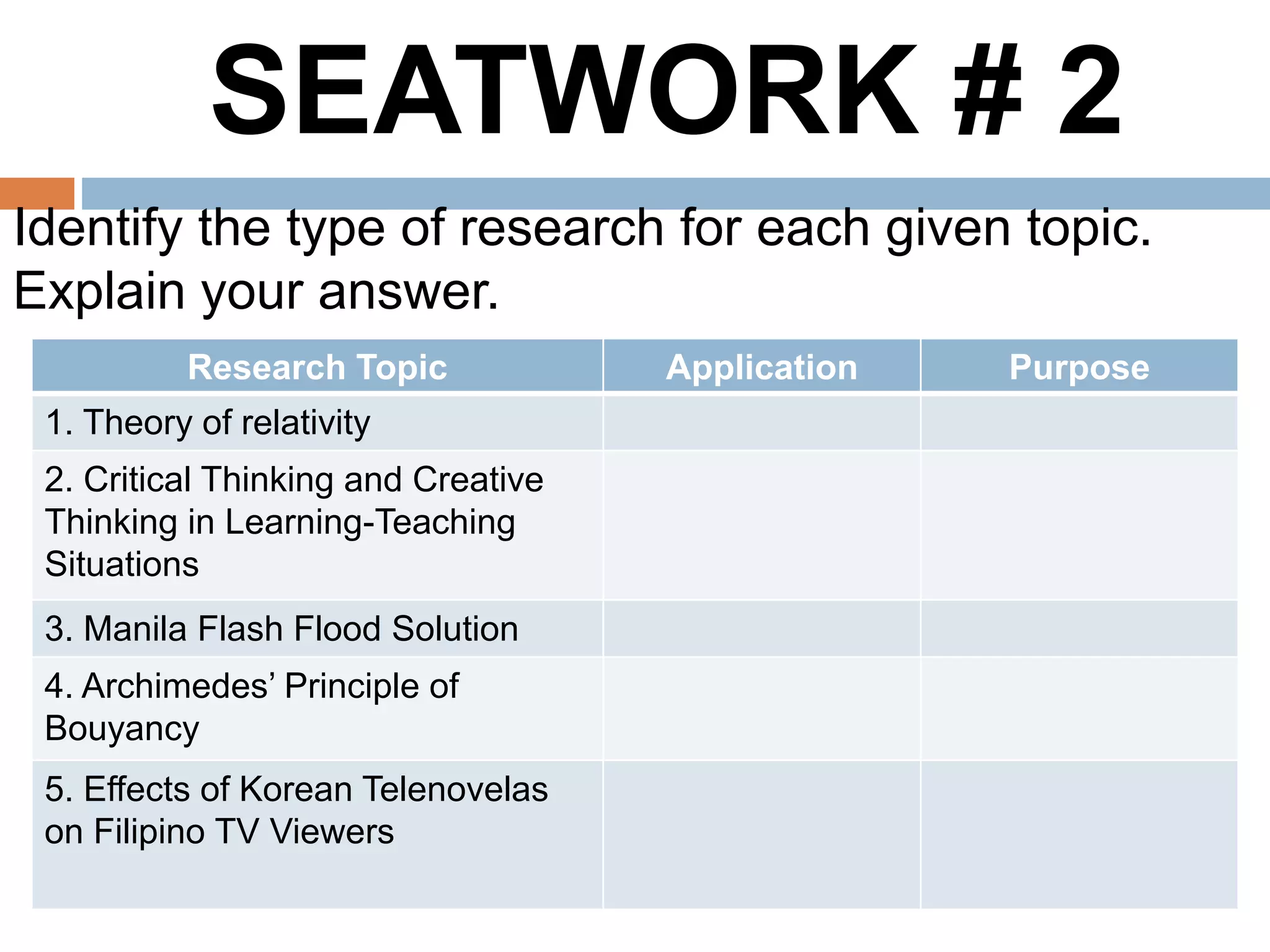
Identify the type of research for each given topic.
Explain your answer.
Research Topic Application Purpose
1. Theory of relativity
2. Critical Thinking and Creative
Thinking in Learning-Teaching
Situations
3. Manila Flash Flood Solution
4. Archimedes’ Principle of
Bouyancy
5. Effects of Korean Telenovelas
on Filipino TV Viewers
QUALITATIVE RESEAR
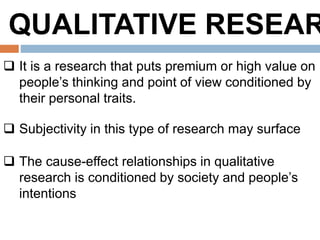
 It is a research that puts premium or high value on
people’s thinking and point of view conditioned by
their personal traits.
 Subjectivity in this type of research may surface
 The cause-effect relationships in qualitative
research is conditioned by society and people’s
intentions
QUALITATIVE RESEAR
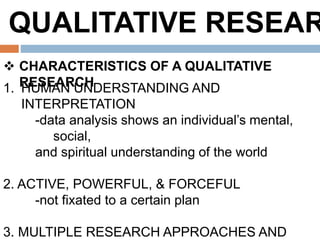
 CHARACTERISTICS OF A QUALITATIVE
RESEARCH1. HUMAN UNDERSTANDING AND
INTERPRETATION
-data analysis shows an individual’s mental,
social,
and spiritual understanding of the world
2. ACTIVE, POWERFUL, & FORCEFUL
-not fixated to a certain plan
3. MULTIPLE RESEARCH APPROACHES AND
QUALITATIVE RESEAR
 CHARACTERISTICS OF A QUALITATIVE
RESEARCH5. CONTEXTUALIZATION
-understand the situation of an individual’s life
that affects his/her way of living
6. DIVERSIFIED DATA IN REAL-LIFE SITUATIONS
7. ABOUNDS WITH WORDS AND VISUALS
-data gathering through interviews or library
reading
-presenting world views through visual
QUALITATIVE RESEAR
 CHARACTERISTICS OF A QUALITATIVE
RESEARCH
8. INTERNAL ANALYSIS
-your focus is the people’s perception or views
about your topic, not the effects of their physical
existence on your study
QUALITATIVE RESEAR
 TYPES OF QUALITATIVE RESEARCH
1. CASE STUDY
-involves a long-time study of a person, group,
organization, or situation to find answer to why
such thing occur to the subject.
2. ETHNOGRAPHY
-understanding the organizational set-up, internal
operation, and lifestyle of a particular group
QUALITATIVE RESEAR
 TYPES OF QUALITATIVE RESEARCH
3. PHENOMENOLOGY
-study of how people find their experience
meaningful
4. NARRATIVE
-studies a single person or several individuals,
gathers data through the collection of stories or
anecdotes, reports the person’s experiences, and
discuss the meaning of those experiences
QUALITATIVE RESEAR
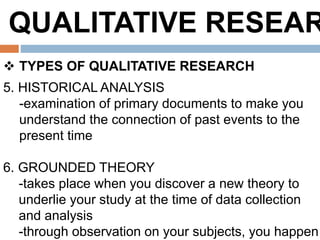
 TYPES OF QUALITATIVE RESEARCH
5. HISTORICAL ANALYSIS
-examination of primary documents to make you
understand the connection of past events to the
present time
6. GROUNDED THEORY
-takes place when you discover a new theory to
underlie your study at the time of data collection
and analysis
-through observation on your subjects, you happen
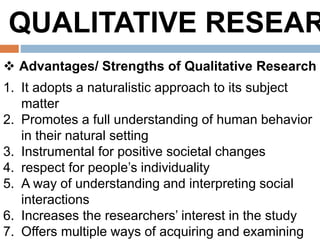
QUALITATIVE RESEAR
 Advantages/ Strengths of Qualitative Research
1. It adopts a naturalistic approach to its subject
matter
2. Promotes a full understanding of human behavior
in their natural setting
3. Instrumental for positive societal changes
4. respect for people’s individuality
5. A way of understanding and interpreting social
interactions
6. Increases the researchers’ interest in the study
7. Offers multiple ways of acquiring and examining
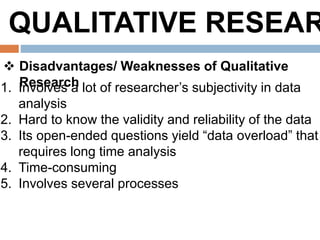
QUALITATIVE RESEAR
 Disadvantages/ Weaknesses of Qualitative
Research1. Involves a lot of researcher’s subjectivity in data
analysis
2. Hard to know the validity and reliability of the data
3. Its open-ended questions yield “data overload” that
requires long time analysis
4. Time-consuming
5. Involves several processes
SEATWORK # 3
Name the type of qualitative research best
suited for the following topics.
1. The Mangyan’s Burial Practices
2. Relative of Typhoon Victims
3. Philippines’ Political Party System: Then and Now
4. Alien Abduction
5. Jose Rizal: A Biographical Sketch by Teofilo H.
Montemayor
6. Being there: A Study of Student Perceptions of
Instructor Presence in Online Classes
HOMEWORK # 3
Read “ The Ethics of Higher Studies” by Etienne
Gilson and answer the following questions.
1. How did Mr. Gilson define scholarship?
2. What are the characteristics of being a scholar?
Can you identify these in the text?
3. What does the essay mean by “Moral honesty”?
4. What does “intellectual honesty” mean?
5. What is “objectivity”?
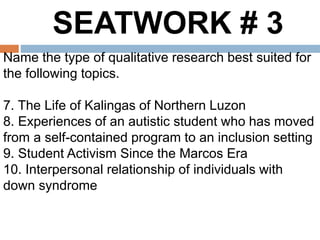
SEATWORK # 3
Name the type of qualitative research best suited for
the following topics.
7. The Life of Kalingas of Northern Luzon
8. Experiences of an autistic student who has moved
from a self-contained program to an inclusion setting
9. Student Activism Since the Marcos Era
10. Interpersonal relationship of individuals with
down syndrome

Qualitative research

  • 1.
    SEATWORK # 2 Identifythe type of research for each given topic. Explain your answer. Research Topic Application Purpose 1. Theory of relativity 2. Critical Thinking and Creative Thinking in Learning-Teaching Situations 3. Manila Flash Flood Solution 4. Archimedes’ Principle of Bouyancy 5. Effects of Korean Telenovelas on Filipino TV Viewers
  • 3.
    QUALITATIVE RESEAR  Itis a research that puts premium or high value on people’s thinking and point of view conditioned by their personal traits.  Subjectivity in this type of research may surface  The cause-effect relationships in qualitative research is conditioned by society and people’s intentions
  • 4.
    QUALITATIVE RESEAR  CHARACTERISTICSOF A QUALITATIVE RESEARCH1. HUMAN UNDERSTANDING AND INTERPRETATION -data analysis shows an individual’s mental, social, and spiritual understanding of the world 2. ACTIVE, POWERFUL, & FORCEFUL -not fixated to a certain plan 3. MULTIPLE RESEARCH APPROACHES AND
  • 5.
    QUALITATIVE RESEAR  CHARACTERISTICSOF A QUALITATIVE RESEARCH5. CONTEXTUALIZATION -understand the situation of an individual’s life that affects his/her way of living 6. DIVERSIFIED DATA IN REAL-LIFE SITUATIONS 7. ABOUNDS WITH WORDS AND VISUALS -data gathering through interviews or library reading -presenting world views through visual
  • 6.
    QUALITATIVE RESEAR  CHARACTERISTICSOF A QUALITATIVE RESEARCH 8. INTERNAL ANALYSIS -your focus is the people’s perception or views about your topic, not the effects of their physical existence on your study
  • 7.
    QUALITATIVE RESEAR  TYPESOF QUALITATIVE RESEARCH 1. CASE STUDY -involves a long-time study of a person, group, organization, or situation to find answer to why such thing occur to the subject. 2. ETHNOGRAPHY -understanding the organizational set-up, internal operation, and lifestyle of a particular group
  • 8.
    QUALITATIVE RESEAR  TYPESOF QUALITATIVE RESEARCH 3. PHENOMENOLOGY -study of how people find their experience meaningful 4. NARRATIVE -studies a single person or several individuals, gathers data through the collection of stories or anecdotes, reports the person’s experiences, and discuss the meaning of those experiences
  • 9.
    QUALITATIVE RESEAR  TYPESOF QUALITATIVE RESEARCH 5. HISTORICAL ANALYSIS -examination of primary documents to make you understand the connection of past events to the present time 6. GROUNDED THEORY -takes place when you discover a new theory to underlie your study at the time of data collection and analysis -through observation on your subjects, you happen
  • 10.
    QUALITATIVE RESEAR  Advantages/Strengths of Qualitative Research 1. It adopts a naturalistic approach to its subject matter 2. Promotes a full understanding of human behavior in their natural setting 3. Instrumental for positive societal changes 4. respect for people’s individuality 5. A way of understanding and interpreting social interactions 6. Increases the researchers’ interest in the study 7. Offers multiple ways of acquiring and examining
  • 11.
    QUALITATIVE RESEAR  Disadvantages/Weaknesses of Qualitative Research1. Involves a lot of researcher’s subjectivity in data analysis 2. Hard to know the validity and reliability of the data 3. Its open-ended questions yield “data overload” that requires long time analysis 4. Time-consuming 5. Involves several processes
  • 12.
    SEATWORK # 3 Namethe type of qualitative research best suited for the following topics. 1. The Mangyan’s Burial Practices 2. Relative of Typhoon Victims 3. Philippines’ Political Party System: Then and Now 4. Alien Abduction 5. Jose Rizal: A Biographical Sketch by Teofilo H. Montemayor 6. Being there: A Study of Student Perceptions of Instructor Presence in Online Classes
  • 13.
    HOMEWORK # 3 Read“ The Ethics of Higher Studies” by Etienne Gilson and answer the following questions. 1. How did Mr. Gilson define scholarship? 2. What are the characteristics of being a scholar? Can you identify these in the text? 3. What does the essay mean by “Moral honesty”? 4. What does “intellectual honesty” mean? 5. What is “objectivity”?
  • 14.
    SEATWORK # 3 Namethe type of qualitative research best suited for the following topics. 7. The Life of Kalingas of Northern Luzon 8. Experiences of an autistic student who has moved from a self-contained program to an inclusion setting 9. Student Activism Since the Marcos Era 10. Interpersonal relationship of individuals with down syndrome

Editor's Notes

  • #4 Transcripts of interviews, focus group discussion, field observation notes, relevant written documents,
  • #11 6. Includes the researchers experiences or background knowledge in interpreting verbal and visual data
  • #12 5.